Author Archives: Iain

Looking for a Sign (for Wanda Zyborska)

A while ago I came across an advertisement for a book called Looking for a Sign: Contemporary Art, Magic and Language (2024), published in Ireland by Durty Books. In a fit of curiosity, and because I’ve a long-time interest in old songs and recent theories that relate to what, broadly speaking, might be called ‘magical understandings’, I bought a copy. Perhaps, before I go on, I need to say a little more about why I would do that. In 2018 I presented an illustrated talk to art students at the University of Dundee called Un-disciplining practices: some paradoxes and possibilities. Part of the introduction goes as follows.

“Increasingly, the assumptions that underwrite disciplinarity are being questioned. Isabelle Stengers is a Belgian professor of philosophy. She trained as a chemist and has won international acclaim for her work in the philosophy of science. Starhawk is an American writer, teacher, activist and leading exponent of feminist neopaganism and ecofeminism – or, as she might say, a witch. From the perspective of academic disciplinarity, these two women are separated by an unbridgeable divide. Yet in Capitalist Sorcery: Breaking the Spell, Stengers and her co-author Philippe Pignarre present Starhawk as somebody reclaiming an art of participation that deals directly with pragmatic concerns about effects and consequences”.

Put bluntly, Stengers and Pignarre’s book insists that we take witches seriously. I suppose I had hoped that Looking for a Sign might take up and extend the thinking that underpins that argument. And, if one understands that the point that Pignarre and Stengers want to make by references people like Starhawk and the practices they have developed is that they are ways of communicating with what Stengers describes as the ‘unknowns’ of modernity – with all that it fails to adequately address – then perhaps to a very small extent it does.

Andrew Gojfey is the translator of Capitalist Sorcery: Breaking the Spell. What follows is in part a free paraphrase of points made in his introduction to that book: On the Witch’s Broomstick. To help explain its orientation he asks whether it’s possible to take seriously somebody who claims to have been attacked by a sorcerer? The answer, he insists with the book’s authors, should be “yes”. But  on the condition that we understand that the modern approach that frames such questions, namely that of psychoanalysis, is predicated on an unjustifiable pretension. Namely, that as a discipline it has scientific authority to make universally valid pronouncements about ‘the unconscious’. Stengers points out, however, that psychoanalysis fails to acknowledge what it does when it claims to explain its curative effects through quasi-scientific notions like ‘transference’. Stengers argument is that therapeutic practitioners in non-modern cultures are ‘technicians of the cure’ who adopt culturally specific approaches that are effective in their own context and, significantly, don’t make “scientific” claims regarding universal authority as does psychoanalysis.

Gojfey goes on to point out that one consequence of Stengers’ argument regarding the therapeutic practices of  non-modern therapeutic ‘technicians of the cure’ is that it requires us to set aside any notion of their hierarchical subordination to science. A point that returns him to witches again, persons whose technique cannot be explained by science and so is, from a modern point of view, simply another artefact. However, if we refuse to ‘privilege episteme over techne, not only is artefactuality not necessarily a criticism, but the idea that there is something to be learned from the neo-pagans becomes a more credible claim – because a central element of what would otherwise allow what they do to be explained (away) is removed’ (p. xix).

Pignarre and Stengers, drawing on Guattari, consider  the techniques of non-violent protest and ritual used by contemporary witches as an effective form of ‘existential catalysis’. Stengers notes that: ‘to take the efficacy of a technique seriously imposes the need to understand it as being addressed to something more powerful than the technician’ and that for witches such as Starhawk this is the immanent Goddess who, in turn, becomes the ground for  cultivating ‘a sensibility and disposition to think and act’ otherwise (p.xx). For Pignarre and Stengers, then,  the artifices of witchcraft are a means to cultivate an active thinking that is not framed by the presuppositions of modernity and, as such, returns us to  the need to insist that alternatives to it are possible. Or, as Starhawk puts it: “Systems don’t change easily. Systems try to maintain themselves, and seek equilibrium. To change a system, you need to shake it up, disrupt the equilibrium. That often requires conflict. …To me, conflict is a deeply spiritual place. It’s the high-energy place where power meets power, where change and transformation can occur.”

It may be that the artists whose thinking and work make up Looking for a Sign: Contemporary Art, Magic and Language would be in agreement with this, although there s no evidence that any of them are aware of the arguments in Capitalist Sorcery: Breaking the Spell. All I can say is that I am more taken by the work of Crone Cast, a feminist art collective that explores the conditions of the pandemic, climate change, and societal and ecosystem collapse, and that reimagines the crone as noticed, seen, and heard so as to engage with ageing, power, identity, eccentricity and merging with the more-than-human as a process of becoming, in symbiosis with the precariousness of our times.

Images provided by Wanda Zyborska

Remembering that ‘culture is not an industry’.

Yesterday I drove up to this open studio event at studioMADE in Dinbych, North Wales, to meet up with the sculptor Lois Williams. I’ve been in contact with her – I’m writing about her work – for a while now and very much wanted to see what she’s currently making. I hope to post that writing here at some point soon – hopefully next month – so want to use this post to reflect on the context in which she was showing work.

I have been reading Prof. Justin O’Connor’s book Culture is not an Industry: Reclaiming art and culture for the common good (Manchester University Press, 2024) and my trip to Dinbych grounded what I’ve been reading in a very real example of why his argument is both important and urgent. Lois introduced me to the artists Angela Davies and Mark Eaglen, who originally established studioMADE on the first floor of the Carriageworks as a hybrid studio/gallery space back in 2015. Then, in the spring of 2022, they took on the tenancy of the main, downstairs, gallery space. Like so many artist/curators outside big towns and cities (and, of course, like some within those major urban spaces), they function at the margins of what is seen as significant by the funding arm of the culture industry yet serve as an active cultural interface between the community in which they live and work and a wide and diverse range of cultural activity. And, as they point out on their website, much of the work that they do is “self-funded and voluntary”. Which could been seen as meaning that it’s done using time and energy that goes against the grain of commitment to their creative work. However, as I gathered from talking to Angela and Mark, while there’s an element of truth in that, it’s not by any means the whole story.

As O’Connor reminds us: ‘culture is how we remember the past and imagine the future. It is part of how we become free individuals in a democratic society’ (p.228). It It is clear from our conversation that they are both alert to questions about both the metaphors made available by the past and present concerns about ecology and science relating to the future. While running studioMADE clearly takes a good deal of time and energy and generates all the inevitable worries about funding that dog all such enterprises, it also has real benefits for them.

I would summarise those benefits by putting down what might seem obvious but that, none the less, I feel needs restating. Places like studioMADE are ultimately sites of active conversation as much as of making, of the exchange of ideas, of the questioning, and sometimes validation, of the kind of knowing and gut intuition that, for an artist largely working alone, just doesn’t happen often enough. In short, they provide a particular kind of complex interface that animates and sustains a wide and diverse range of intellectual, emotional, and physical cultural life. They are also places where personal and “local” preoccupations can intersect with wider public concerns. (I am thinking here of Angela’s current preoccupation with bees). Places where elements of the personal and public, the local and international, can freely rub up against each other in unexpected and often creative ways. Such places are, in short, a point of animated convergence and intersection between multiple psychic and social ecologies – places that, in turn, have the possibility to inform and animate activity in the communities of which they are a part.

As O’Connor points out, the ‘funded aspect of the cultural infrastructure intersects in complex ways with the “overlooked” zone of small independent not-for-profit projects and spaces, volunteers and unpaid artists’ that, at a local level, sustain what he calls ‘culture’s soft infrastructure’, the ‘shared knowledge, traditions’, and ‘patterns of sociability’ (p. 183) vital to human social ecologies.

That managing such places has some real benefit for the artists who do that work shouldn’t blind us to the difficult practical issues involved. As O’Connor again reminds us, a ‘functioning cultural infrastructure requires money, skills, time and effort’, yet the orientation of economic power in the now-dominant world of culture as an industry is ‘to the highly extractive, and mostly non-locally owned, minority commercial sector for its exemplar and sign of success’ (pp.183-185). Anyone who doubts that claim should read Sarah Thornton’s 33 Artists in 3 Acts (Granta, 2014). Thornton’s interviews make all too clear that today’s examples of global artistic success, operate ‘on the basis of the ‘forces of the market in a capitalist society’ and know only too well that, today, ‘handling one’s market – making decisions about how much art to make and where to show it’ – is central to being a successful contemporary artist in a global art market (p.333).

I’m not going to start on a critique of the realpolitik of the art world and its deep, and officially unacknowledged, complicity not only with global capital but with the cultural of possessive individualism that underpins its extractive philosophy. It’s enough to remind ourselves that we need to rethink how we support spaces like the Carriageworks. Spaces that need to be seen, for reasons I’ve tried to indicated, not only as significant (if sadly often under-appreciated) community and educational resources but as focusing resistance to the cultural status quo that continues to add to our socio-environmental problems.

Some ways by which we might start to build that support come to mind. The first would be for their organisers to build alliances that help give a collective profile to such spaces, perhaps a federation of independent arts spaces. While there are always problems associated with building such alliances, they also provide a way to share knowledge and experience and some degree of lobbying power. I wonder whether it would be worth looking to an organisation like the Joseph Rowntree Foundation for support to build such a federation? Then there is the possibility of making common cause with other cultural initiatives that actively break with the culture industry mould in interesting and productive ways. An obvious choice in a Welsh context might be Utopias Bach (although, as someone involved in that collaborative, I have to admit a bias). Another, not unrelated initiative, this time in Ireland, would be the model of eco-education for people who, broadly speaking, work in the arts being delivered by Cathy Fitzgerald.

Finally, we might all help build such support by letting go of our mistaken belief in our possession of a monolithic, rather than relational, identity. As the feminist philosopher Geraldine Finn rightly insists, we are ‘always both more and less than the categories that name and divide us’ (Why Althusser killed His Wife: Essays on Discourse and Violence, 1996, p. 171), categories that include “artist”. A view shared, in another context, by the poet and immunologist Miroslav Holub who, when pondering our preoccupation with categories like “artist” and “scientist”, reminds us that, in actuality: ’95 per cent of our time we are really secretaries, telephonists, passers-by, carpenters, plumbers, privileged and underprivileged citizens, waiting patrons, applicants, household maids, clerks, commuters, offenders, listeners, drivers, runners, patients, losers, subjects and shadows?’ (The Dimensions of the Present Moment and other essays, Faber & Faber, 1990). The details of the list will, of course, vary for each of us but, if we’re honest, I think Holub’s point still holds. It was this insight, supported by those of the psychologist James Hillman in relation to the relational nature of the self, that underpins my chapter ‘Ensemble Practices’ for The Routledge Companion to Art in the Public Realm, edited by Cameron Cartiere and Leon (2021). As I argue there, we now need to detach our understanding of art from the culture industry’s model of competitive production and consumption and see it, instead, in terms of more inclusive and wide-ranging: ‘creative activity in which art acts to animate ensembles of heterogeneous skills and concerns, facilitating in turn processes of “mutual accompaniment” necessary to enact a geopolitics of the terrestrial. Ensembles that retain the psychic benefits of an engendering creativity but at a distance from the assumptions, expectations, and protocols central to a hyper-professionalised art world. Considering increasingly heterogeneous creative practices as compound ensembles is, I suggest, a step towards reversing the situation in which art serves to perpetuate the culture of possessive individualism, and with it the Great Derangement’ (p. 269).

Importantly, of course, that’s a step that each of us is able to make for ourselves.

Convergence / Creative Lab. (Part 2)

In between sessions together, we’ve worked individually.
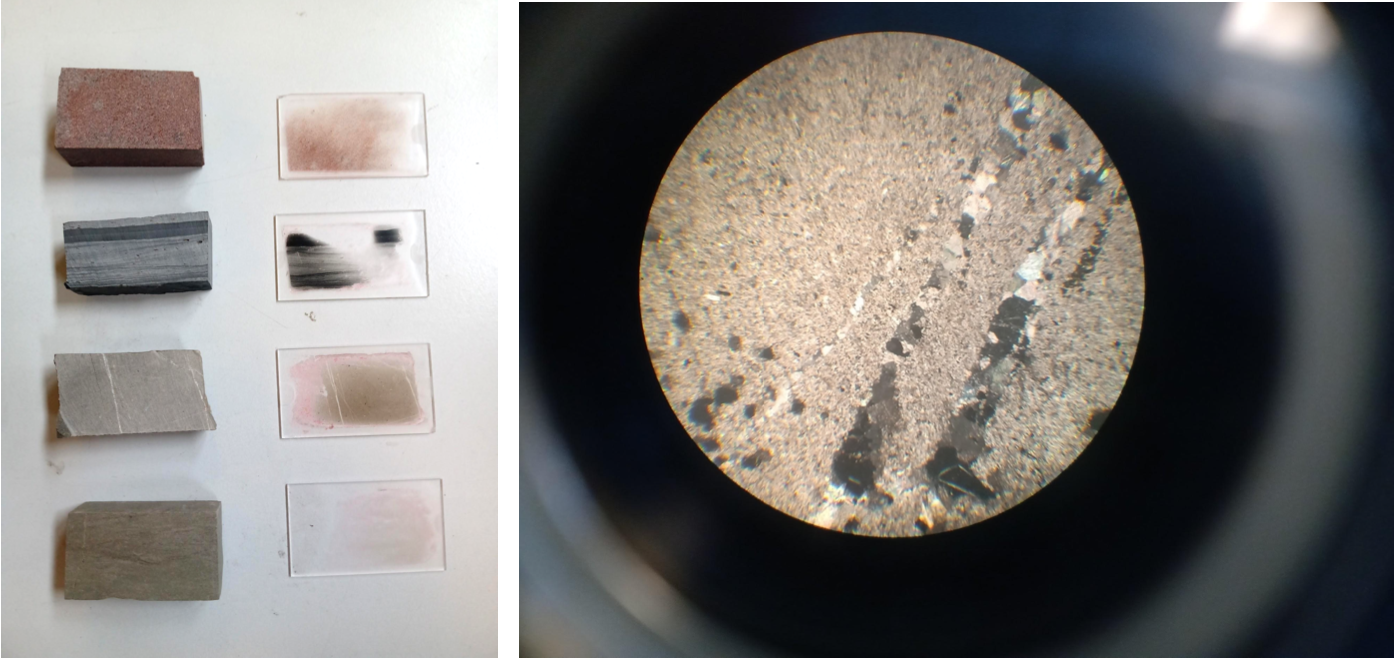
Mathilde has researched further scientific data and created thin sections in the lab at theUniversity of Bristol from rock samples from Doniford beach, as well as undertaking her own creative explorations with the paints and the data.

Sara has been testing the potential of the earth pigment paints, using a variety of surfaces, binders and processing techniques. She has been stretching her explorations of the materials into combinations with other media, including oil-based glaze medium and figuring out the aesthetic and conceptual needs and potential of these works through a range of improvisations.

Convergence | Creative Lab | update 01 (v4)

We document our joint and personal explorations through a shared sketchbook and an online diary. These records have proved invaluable to track our evolving thoughts about the methods, themes, and purpose of the collaboration. Much of the learning is experiential and in the moment, whether walking the terrain, working with the paints or cutting rocks in the lab, so it has been essential to capture it as it emerges and keep each other up-to-date.

Convergence | Creative Lab | update 01 (v4)

We took a decision to remain located in a single rural, coastal environment, rather than traversing across and through the landscape. This has enabled a settling of collected experiences and materials, and offered the potential for a deepened immersion into a geologically-rich location.

Starting with an inhalation of the experience of being on Doniford Beach, we absorbed visual, tactile, geological, multi-sensory, embodied understandings and insights of this complex and dynamic coastal terrain. Back in our studio and laboratory environments, a wealth of questions and avenues for exploration have emerged from handling, processing and interrogating earths, rocks, videos and other visual data gathered from the beach.

Universal and global themes around the value of art and science coming together, rather than a place-specific narrative are emerging. Our choice to focus on one rich place is becoming a locus for expanding into broader, more universal themes.

Some of the strands we are actively working with are:

●  Empathy vs disconnection
Comparing our approaches to data collection and observing the detachment from the natural environment felt in the science lab, in contrast to processing the earths in a mindful and connected way in the studio. Industrial cutting, grinding and polishing in the lab feels disturbing and violent, and emphasises the detachment.
How do scientific methods contribute to the detachment we feel from our environment? And in contrast, how does an artistic approach to manipulating pigments and source material help retain connection? This emergent collaboration explores how this connected artistic approach can infuse into scientific practice.

 Parallels between scientific and artistic processes and analysis Both Sara’s artistic approach in the studio (layering earth paints on 2D surfaces) and Mathilde’s process of making thin sections from rock (grinding them down until they are only 30 micrometres thick) are ways of making flat rocks. What is revealed in these flattening processes, discretely and together?

●  Aesthetics
Beauty (however defined) and its role and value in facilitating emotional connections recurs as a question, in particular when fostering a sense of relationship with a place. We explore both its function in art and its arguable absence in science.

●  Soft; hard; organic; geometric
Considering physical changes to rocks and earth through lab and studio processes, and natural and manmade alterations to the coast through erosion. We are questioning how these changes alter our relationship with the materiality of the natural environment.

●  Other themes arise from the process of making such as the concept of migratory stones, as parallels with other forms of migration, and our ‘becoming one’ with, rather than observing the landscape. These are emergent themes which we want to delve into and further.

Where we’re headed next

We are fascinated by the ways in which the micro and macro forms and dimensions of the environment echo one another and how, along with the strands of inquiry above, they give rise to meta-questioning. The act of working together directly is eliciting new questions and the materials and matter of the place are contributing an additional participant to our work – becoming a third-party in our collaboration. The strands identified above all contribute to refining our collaborative purpose, methods, concepts, activities and outcomes.

We aim to share our works-in-process at an exhibition in September. We anticipate that we will present works which combine raw scientific data and visual storytelling with a strong sense of the materiality of our coastal encounters.

This presentation will be a snapshot. We will continue to develop the works into the autumn, in greater depth. As the artworks near completion, we also envisage a phase of sharing, dialogue, reflection and evaluation of the whole process to refine our collaborative methodology. We would like to document the learnings from our research and share them with others. We anticipate also having a film which documents our evolving process and interprets our emerging collaboration.

We hope ultimately to create a model of deep and purposeful art-science collaboration to share with artistic and scientific research communities.

Convergence / Creative Lab. (Part 1)

In a chapter by Maria Kind called ‘Returning on Bikes: Notes on Social Practice’, she reminds us of something that should hopefully be obvious, namely that: ‘… not all social practice projects are interesting and relevant, just as all painting is not uninteresting and irrelevant’ (in Living As Form: Socially-engaged Art from 1991-2011, ed. Nato Thompson, Creative Time Books, 2012).

Convergence / Creative Lab. is a project being developed by geologist Mathilde Braddock and painter Sara Dudman; one that straddles the type of divide within art world thinking implicit in Kind’s observation. Essentially it’s a material “conversation” between the two women with very different disciplinary backgrounds and sets out to address a number of significant issues: creative, environmental and intellectual. A conversation that I have been privileged to join at a couple of points and hope to continue to do so.

Not the least of the questions this conversation raises is that of the vexed cultural relationship between “art” and “science”. Or, as I have suggested may be a more appropriate designation, between the often highly dogmatic mentalities of aestheticism and scientism. Mentalities based on presuppositions unthinkingly built into specialist disciplinary “languages” and transmitted via the ways those “languages” are used to make claims about how the world is known and understand.

In the remainder of this and the next post I have reconstructed Braddock and Dudman’s first ‘update’ on their work-in-progress. I’ve done so because I believe they are engaged in a project that intends to do something rather different from usual art/science collaborations. These tend to be based on assumptions grounded in deeply unequal “authority” positions. As a result, they tend to produce work that merely illustrates or, as one artist has memorably put it, “sexes-up” scientific work data. Data that would otherwise only be of interest to a specialist scientific audience. In short, that supposedly “popularise” science by refiguring it in a largely spurious “artistic” form’. This project, in contrast, is set to take a very different, and much more genuinely collaborative, approach; one that does not take for granted what so many other art / science projects tend to do.

My hope is that, as this project develops, I will be able to report on its discoveries.

[N.B. All images in this and the following post are copyright of Sara Dudman and Mathilde Braddock].

Can a collaborative art and science interpretation of the geology of a place bring us into deepened connection with the Earth?

This is the question at the core of our Convergence | Creative Lab which brings us – Mathilde Braddock and Sara Dudman – together to explore how a geologist and an artist interpret the landscape, what a deeper collaboration between these disciplines might look like, and define its value by testing its potential and limits.

Over the last six months, we have been combining art and science and the intergenerational perspectives of two women to blur the boundaries and explore our convergent and divergent approaches to interpreting the land and landscape. We have infused and disrupted our own and each other’s practice. We have spent time learning from and about a place, with care and attention for the planet, each other and ourselves as a central principle in all aspects of our work.

We are in the thick of exploring the potential of this collaboration, but some of the themes that are emerging include:

  • Empathy versus disconnection
  • “Flat rocks” – the parallels between our artistic and scientific approaches
  • The role of aesthetics and beauty
  • The contrasts of soft/hard, organic/geometric shapes and processes

Our exploration so far
We kept our methodology open and fluid to enable us to follow research strands that felt most relevant and rich. We have been walking, sitting and spending time immersed in the landscape of the West Somerset coast, foraging for pigments, stories, data, visual and sensory resources.

We also spend time immersed in each other’s professional worlds.

Our exploration so far
We kept our methodology open and fluid to enable us to follow research strands that feltmost relevant and rich. We have been walking, sitting and spending time immersed in the landscape of the West Somerset coast, foraging for pigments, stories, data, visual and sensory resources.

We also spend time immersed in each other’s professional worlds.
in the lab at the University of Bristol pouring over papers, maps and microscope imagery:

and in Sara’s studio processing the earth pigments and exploring the visual information, earth samples and other resources gathered from our site visits:

John Burnside: On Lost Girl Syndrome

Taking as his starting-point the dead girl in Rain Johnson’s 2005 film Brick and the subjects of any number of Victorian paintings – from Ophelia and Arthurian maidens through to G. F. Watt’s Found Drowned – Burnside suggests that such figures are best seen as allegories for a male ‘soul-self’ that is seen as a girl ‘because a seeming girlishness’ is what boys appear ‘to give up in order to be a man’.  Like much of the book in which this appears – I Put a Spell on You: Several Digressions on Love and Glamour – what Burnside has to say in On Lost Girl Syndrome is not about the lost girl at all, or not in any literal sense, but about the problem boys have growing into full manhood in a patriarchal society. Burnside’s preoccupation with this was already present in 1988, the year The Hoop, his first volume of poems, was published. There, in the poem Psyche-Life, he speculates that ‘the soul’ may be a woman or, perhaps, a ‘dialect … of a common tongue’. A poem then that can be read as a prelude to On Lost Girl Syndrome.

My attraction to what Burnside is exploring registered a while back, although I  did not really understand it. It appeared in connection with the image of the young Greek girls who, dedicated to Artemis, were called “little bears”. They took part in a ritual dance that’s described by Paula Meehan in one of the lectures in her Imaginary Bonnets with Real Bees in Them (2016). I first came across this years back in a short essay by the cultural anthropologist Károly Kerény dedicated to his nine-year-old daughter and called A mythological Image of Girlhood. At the it caught my attention as something psychically resonant, but nothing more.

Then, back on October 24th, 2022, I posted the last of Twenty-two Postcards for Utopias Bach on this blog. There I wrote that a momentary sighting in Alston had:

‘answered my question about the “grounding” of all Artemis stands for. A willowy tomboy in cut-off jeans and sweatshirt, maybe eight or ten, appeared from the back of a beaten-up old Landrover. She radiated an absolute self-possession that seemed all of a piece with her make-shift bow – a flexed wand of wood bent taut by its string – that was slung across her shoulder. She then half strode, half danced towards the Co-Op, followed at a respectful distance by her father and younger brother. All three disappeared inside and I saw no more of them’. 

That sighting might best be described as giving me an elusive sense of another way of being, of an as yet “untamed”, intimate knowing of the world. One that I believe is related to what is called in Irish an saol eile (literally “the other life”). It’s this quality that, for me, links the epiphany of that sighting to John Burnside’s chapter.

The images below relate in various ways to these thoughts.

In lieu of making artist’s books.

I am fascinated by the possibilities of artist’s books. I’ve made a few and at one stage set up a little publishing enterprise called Wild Conversations Press. (It faded away because I have no business sense whatsoever). More recently, I’ve used this website to “publish” what I would once have turned into some form of artist’s book. Although doing this is simpler than paper-based publishing, costs readers nothing, and is almost certainly better for the environment, I do miss the physical qualities of a book I can hold in my hands.

A while back I read the American poet and environmental writer Barbara Hurd’s Listening to the Savage: River Notes and Half-Heard Melodies (2016) and was intrigued by her including short phrases she had heard her granddaughter Samantha say. They sounded like lines from poems. Two summers ago, re-reading the book, I noted down some of those phrases and then used them as a starting point for making a series of small images, most of which were not finished until this summer and some of which have been abandoned. Here are some that I’ve kept.

Learning from Poets? (Part Two)

I ended the first part of this piece by summarising my argument in terms of needing to better understand, and then to resist, the “Strict Father’ framing mentality in connection with silly generalisations that distort the complexities of necessary debate. I then suggested that engaging with poetry may be one way to help ourselves do that. Here I want to take up that notion.

Back in 1995 Simon Schama reminded his readers that: ‘to take the many and several ills of the environment seriously does not … require that we trade in our cultural legacy or its posterity’ (1995: p.18). Consequently I’ll start with a relevant aspect of that cultural legacy, the standard claim made against poetry by political activists: namely that it changes nothing. Those making this claim often support it by referencing the second section of W.H. Auden’s poem In Memory of W. B. Yeats (d. Jan. 1939),which includes the line: ‘… poetry makes nothing happen…’ (An argument that ignores what Auden wrote in the poem that follows it – In Memory of Ernst Toller (d. May 1939) – which is that: ‘We are lived by powers we pretend to understand’. But that, I think, is perhaps a separate issue).

In Imaginary Bonnets with Real Bees in Them (2016)Paula Meehan, a poet deeply concerned about both environmental and social issues, takes up what is said ‘about the failure of poets in the face of politics’. She argues that if, as Auden claims, ‘poetry makes nothing happen, maybe it stops something happening, stops time, takes our breath away…Maybe it’s like the negative space in a painting by which what is there is revealed, to be apprehended by human consciousness’ (p.19). I fear that increasing our capacity for wonder in the face of what is, however, is not going to cut much ice with those for whom only the actions about which they are passionate, only literally “making something happen”, counts as worthwhile.  

Another poet, John Burnside, who was also passionately concerned with environmental issues, takes up the question of Auden’s claim in rather more detail. In The Music of Time: Poetry in the Twentieth Century (2021) he points out that those in the English-speaking world who are happiest with seeing poetry as ‘marginal and ineffective’ dismiss it on the basis of ‘a fundamental misunderstanding of how poetry actually works, both on the individual imagination and in the social sphere’ (pp. 18-19). Burnside pointing out just how naïve it is to think that a poem, or a whole life-time writing poetry, could ‘change the world’. Rather, he insists, what poetry actually ‘does, first, is to survive… actively, on its own terms’. It is, he goes on to claim, ‘a way of being, a provider of context, an independent, non-oppositional, entirely autonomous state’. However, by that he does not mean that it has no communal role. Rather he sees it as a discipline, for both writer and reader; one that heightens attention to the world. He goes on: ‘This act of paying due attention is in itself a political act, for it enhances both our appreciative and our critical abilities, which are key to defining a position in a societal sphere in which both these faculties are currently at risk’ (pp.23-25). It’s at this point that I think his argument both aligns with Rebecca Solnit’s musings on the Left’s reaction against aesthetics and throws light on what I suspect is Monbiot’s real motive for making his silly claim about poetry.

It’s also the case, as Burnside goes on to point out, that what he argues about poetry applies equally to the literature and the humanities as ways of resisting what Jonathan Franzen calls ‘cultural totalitarianism’. I would want to add the visual arts to his list, although it’s of course often difficult to maintain his argument in relation to the visual; arts in the face of their increasing commercialisation and trivialisation by the pressures exerted by the “culture industry” and its various State-funded instruments. An industry hell-bent on merging the more “popular” aspects of the arts with commercial entertainment, while maintaining the supposedly “high” or “difficult” arts as fodder for forms of conspicuous consumption and elite posturing (much like “high” fashion). A world documented, if one’s willing to do some reading between the lines, in a book like Sarah Thornton’s 33 Artists in 3 Acts (2014). But all this leads into another whole line of thought, one that I’m not comfortable tackling but that, if I can get through and digest Justin O’Connor’s Culture Is Not An Industry: reclaiming art and culture for the common good (2024), I may feel obliged to return to.                            

Learning from Poets? (Part One).

Sometimes it’s a small thing that snags my attention and, like a thorn caught under the skin, it then has to be slowly worked out into the light of day.

Caroline Lucas begins the sixth chapter of Another England: How to Reclaim Our National Story (2024), entitled ‘English Nature’, by quoting George Monbiot’s pronouncement, in Regenesis (2022)that: ‘One of the greatest threats to life on Earth is poetry’. For any number of reasons, not least because reading poetry helped me get through lockdown and because I choose to coordinate a small poetry-reading group that includes people who write poetry, that pronouncement struck me first as really silly and then as actually potentially dangerous.

One way of introducing what I want to set out in this essay is to suggest a major problem we now face is precisely the use of this type of silly, unqualified, “click-bait” generalisation, a habit that trivialises and so can seriously distort, very necessary debates about important issues, including about environmental issues that may well turn out to be matters of life and death.

I understand that, as a campaigning newspaper journalist who must produce regular copy, Monbiot needs to cultivate habits that enable him to hold the attention of readers and that one way of doing that, given his pitch, is to keep identifying and condemning new “greatest threats to life on Earth”. It was not unreasonable that, after Lula’s victory in the 2022 Brazilian presidential election, for example, he should have tweeted: “Bolsonaro was a threat not only to the lives of Brazilians, but to life on Earth.” I certainly wouldn’t quarrel with the basic sentiment behind that statement. However, as a particular individual politician Bolsonaro was one of a number of self-serving right-wing demagogues like Donald Trump and Nigel Farage; individuals who gain power and/or influence by divisively capitalising on people’s fears, prejudices and unreal desires. “Poetry”, on the other hand, is not of any one particular type, orientation, or set of qualities, not least because it’s been part of human expression across much of the world for several thousand years. (The first poems we know about, written by a woman named Enheduana who lived in what is now called Iraq around 2300 BCE, depict, for example, a world frighteningly subject to change, conflict, chaos, and contradiction beyond human control).

For Monbiot to make such a silly blanket generalisation about poetry, and for Lucas to repeat it, seems to me indicative of something more than just the use of a lazily provocative generalisation. What worries me is that, as a rhetorical habit, these are a milder variation on the kinds of generalised provocations used by Bolsonaro, Trump, Farage, and their kind. The same kind of generalisation, in the last analysis, as Trump’s absurd claim that all Mexicans are: “drug dealers, criminals, and rapists”.  

To be fair to Lucas, she doesn’t simply take Monbiot’s claim as given. She goes on to modify its sentiment so as to criticise what she sees as the effect of the ‘strong elegiac theme running through much of the literature of the English countryside, a mood of loss, mourning what has gone instead of fighting to protect what is left’ (p. 154). Again, I can’t really quarrel with the sentiment behind that view. However, the index of Lucas’ book lists ten references to the nineteenth-century poet John Clare, whose work she claims to admire as reflecting the insights of an ‘agricultural labourer with an intimate knowledge of the realities of rural life’ (p. 129). So how does she square her admiration for the poetry of John Clare with Monbiot’s characterisation of poetry as “one of the greatest threats to life on Earth”? I don’t believe she can, in which case it’s plain silly to use that click-bait quotation.

In an interview with Monbiot in Green European Journal , December 2022 the interviewer raises Monbiot’s generalisation about poetry: ‘you mean that our societies are clinging to a “ridiculous fantasy” of country life [which I presume is a phrase quoted from Monbiot], including the beauties of sheep and cattle herding’. To which Monbiot responds: ‘We have a real problem here that our perception of food policy is very dominated by aesthetics, by poetry, by pictures’. I don’t doubt that many people in the UK have a misplaced perception of the countryside, in no small part the result of a host of complicated historical and cultural factors. These include the war-time propaganda based on an ideal English rurality absorbed by my grandparents’ and parents’ generation, the way literature is traditionally taught in British schools, children’s books and, yes, the aesthetics of photographs, paintings, films, television, and advertising. But to simply dismiss the resulting perceptions as a “ridiculous fantasy” seems to me, at best, wildly patronising and, at worst and in terms of the psychosocial changes we urgently need to make, not just unhelpful but profoundly counter-productive. One question this begs, however, is just who do Monbiot and Lucas take to be their readers?

I suppose, as a lifetime member of the Green Party, I am one type of person they can reasonably expect to read what they write. My commitment to the Greens means that I understand and support both a good many of the changes they call for and, as it happens, share Lucas’ distrust of traditional elegiac pastoral themes. But that doesn’t mean I’m ready to accept silly, and ultimately dangerous, blanket generalisations. And I very much doubt I’m alone in this.

My view of Monbiot’s claim that “we” (?) have a serious problem in that “our” ‘perception of food policy’ is ‘dominated by aesthetics, by poetry, by pictures’, is that it’s underlying reductivism and negativity is informed by an attitude what Rebecca Solnit long ago identified in As Eve Said To The Serpent: On Landscape, Gender, and Art (2001). It’s a book I constantly return to because, as its title suggests (and like her earlier Savage Dreams: A Journey into the Hidden Wars of the American West), her understanding of issues of land and environment is firmly intersectional and inclusive. It’s for that reason that it includes her thoughts on why traditional Leftist thinking often has trouble with aesthetics including, that is, both poetry and beauty. 

Solnit argues that Western culture has had a problem with beauty ever since: ‘Thomas Aquinas disposed of it by asserting that the beautiful was the same as the good, which meant that it had no extramoral, no autonomous power at all’. This view was reinforced by the medieval notion that beauty ‘is mutable and therefore false’ (p. 83). These medieval notions connect in a number of ways to Monbiot‘s generalisation about poetry. One is suggested by Solnit’s understanding that those on ‘the Left would like to deny beauty as a motivating force altogether’ because they want to ‘deny the power of form and embrace content alone – as though the two were separable’. Like medieval moralists, many on the traditional Left seem to link formal beauty in the arts ‘with a corrupt seductiveness’ that might gain ‘power over us rather than we over it’. And here she goes on to identify what I take to be a fundamental issue. Many on the traditional Left enlist science and reason against what they see as the reactionary, emotional, irrationalism of Right-wing demagogies. They want not only ‘to reside in the rational space of the head’, but to weaponise an authoritarian view of reason itself. That inevitably opens them up to the implicit fear that to ‘be seduced’ by art ‘is to be reminded that there are things stronger than reason, than agenda’. A fear that haunts those on the Left animated by a vision of power where ‘authority is the desire to have the last word, to close the conversation’ (pp. 83-84). It’s on this basis that I think we should understand Monbiot’s hostility to poetry. That hostility would then be, at root, a fearful response to the fact that aesthetics, poetry, pictures, etc. have the power, in Solnit’s words, to keep the conversation open, to encourage us, where necessary, to ‘start all over again and again’ (p. 84). Poetry can be, in short, a challenge to the notion of “scientific” reason as a guarantee of authority.                

Monbiot claims to have read over 5,000 scientific papers before writing Regenesis. I can’t help thinking it’s a pity he’s not also read more widely. For example, Simon Schama’s Landscape and Memory (1995) might have helped him understand something of the historical complexities and paradoxes that inevitably underpin environmental debates. It might even have helped him to have read more widely in the scientific literature. Of particular relevance here would be the work of the cognitive scientist and linguist George Lakoff. Lakoff is author of More than Cool Reason: A Field Guide to Poetic Metaphor (1989) – written with Mark Turner ‘in the service of helping the study of poetry function to promote ethical, social and personal awareness’ (p. 214); The Political Mind (2008), which explores how underlying “framings” influence political debate, and the paper ‘Why it Matters How We Frame the Environment’ (2010). Unlike Monbiot Lakoff, a Distinguished Professor of Cognitive Science at the University of California, understands that poets are craftspeople who ‘use basically the same tools we use’ when we speak or write, in particular in their use of metaphor as a form of thought that is ‘indispensable not only to our imagination but also to our reason’. He argues that poets, by using ‘capacities we all share’, are able to ‘illuminate our experience, explore the consequences of our beliefs, challenge the ways we think, and criticise our ideologies’ (1989: p. xi). The value of Lakoff’s work to a journalist or politician turned author would be, at the very least, that it demonstrate why progressive political arguments based on “objective”, “scientific” reasoning are simply not sufficient to change peoples’ minds. But I suspect, having read Lakoff, that Monbiot is too wedded to his belief in the absolute, “scientific” rightness of his own standpoint to genuinely listen to anyone who would challenge or critique his views.

I won’t attempt to summarise the many-stranded argument of The Political Mind here. What I can say is that my concern about Monbiot’s underlying attitude is that while he argues for what he sees as environmentally-sound social and political actions, he all-too-often does so using a rhetoric framed by what Lakoff calls the values of ‘The Strict Father Model’. There’s often nothing wrong, other than his over-emphatic emphasis, with the scientific content of Monbiot’s writing. My problem with it is that his rhetorical assumption of moral righteousness and unwavering belief in his own ability to identify the real sources of evil – anything from Welsh sheep to all the other “greatest threats to life on Earth” he’s named over the years. Underlying assumptions and a self-belief that belong to a mindset grounded in a strict, patriarchal, religious morality that can easily shade into totalitarianism.

As Simon Schama reminds us, writing about the management of woodland under the Third Reich, it’s ‘painful to acknowledge how ecologically conscientious’, and how heavily committed to conservation of the natural environment more generally, the Nazi regime actually was (p. 119). My point being that an absolute commitment to radical Green values is not incompatible with a totalitarian mentality. As Schama points out, the militant wing of Green politics struggles with ‘the normal processes of representative democracy’ because it sees its cause as ‘a revolutionary contestation with bourgeois capitalism for the fate of the earth’ and, in consequence, craves ‘the authority to impose salutary solutions’ for what it presents, not unreasonably as ‘a crisis of paramount importance’ (p. 119). My concern is that, if we care about the fate of the earth and are to find some way to address the “wicked problems” we now face, we will need to find ways of arguing our case that avoids a tacit endorsement of authoritarian attitudes, the greenwash of bourgeois capitalism, and the blind denial of environmental realities adopted by Right-wing demagogues.

To do that we’ll need to be clear that the strict, ultimately authoritarian, paternalism that in different ways frames both radical authoritarianism and right-wing demagogy is best contested by fostering a progressive Green ‘politics of empathy’ predicated on ‘protection, empowerment, and community’ (Lakoff, 2008: p.81). Lakoff argues that narratives ‘are brain structures that we can live out, recognise in others, and imagine, because the same brain structures are used for all three kinds of experience’ (p.93). If an individual or group constructs a self-identity based on internalising the Strict Father Model, he or they are unlikely to listen to, or empathise with, the narratives that are of vital importance to others because, like the Strict Father, they will be convinced that they know best. The result is then likely to be first withdrawal from debate and, ultimately, violent confrontation.

In Monbiot’s case, his insistence that he can and must argue so as to ‘close the conversation’ is underpinned by his belief that his arguments contain the scientific content makes his case incontestable. What this insistence has meant is that, when he tries to put his ideas into practice in contexts where others frame the values of landscape and memory differently, things inevitably go wrong. This happened with his attempts to substantially “re-wild” the Welsh uplands. (See my posts on this blog from 08.03 2022). The problem of a rhetoric based in an unacknowledged “Strict Father” framing, and in particular its implications for any hope of achieving real change, are at the heart of what lies behind my concern about Monbiot’s silly generalisation about poetry.

Of course I fully acknowledge that, for Monbiot and for those Greens for whom he can do no wrong, all this will be an irrelevance, a distraction from winning the argument set out in Regenesis. That being the case, it’s important to add that none of what I have written above means that I dispute the broader trajectory of that argument – namely that we need to radically change how our food is produced. Rather, my concern is that Monbiot’s argument is undermined by underlying assumptions about himself and others, including his contempt for those whose view of country life he dismisses as a “ridiculous fantasy”. That it’s possible to propose alternative routes towards similar ends to Monbiot’s, but without evoking contempt for the historical situation of ordinary people or their attitudes, is suggested by a book like Colin Tudge’s Six Steps Back to the Land (2016).

In short, my argument here boils down to our needing to better understand, and then to resist, evocations of the “Strict Father’ framing mentality, whether we encounter them in the generalisations of a “man of the Left” like Monbiot or of the Right-wing demagogies he quite rightly criticises. Engaging with poetry is, in my view, just one way in which we can help ourselves do both those things. The “how and why” of that claim is the subject of the second part of this essay.

Another Side of the Story

A week ago, when the effects of racist riots were felt all over Britain, I had an online  conversation with Mohamud Mumin, a co-founder and artistic director at Soomaal House of Art, who is also an artist working in photography. We had been introduced virtually by an old friend of mine, Prof. Christine Baeumler at the University of Minnesota, who had suggested that Mohamud get in touch with me to talk about our shared interests in place-based initiatives and deep mapping as positive forms of place-making. Forms that have the potential to strengthen links between communities, rather than generate the kinds of division that were all over the media – here and in relation to the presidential elections in the USA.

I remember noticing a large number of Somalis when I visited Minneapolis St. Pauls some fifteen years ago, but did not know then that the city has the largest Somali diaspora population outside Africa. I learned from taking with Mohamud a little about the ways in which he and others at Soomaal House which, as an organisation, has been built up from scratch, are fostering creative expression and cultural understanding within the Minnesotan East African community. 

I find the degree to which various crude and reductive nationalisms allied to racism have been used to generate a rhetoric of hatred in across Europe, in the USA, the Middle East, India and elsewhere using lies and distortions to feed prejudice, deeply depressing. So it was very cheering to find positive common ground and shared values with Mohamud, who is dedicating his time and energy to encourage, support and educate for a broader, deeper perspective on the world, one that unites rather than divides.  

One of the things that cultural work at its best provides is ways of “translating” thoughts and feelings grounded in very different mentalities. This in turn can help us address what Paul Ricoeur calls: ‘the danger of incommunicability through … protective withdrawal’. A withdrawal that results from refusing to look beyond internalised and fixed attitudes embedded in a given mentality. Shared cultural work and enquiry can give us the ability and willingness to translate and mediate, through creative conversations, between distinct mentalities that are deeply entangled with heritages, both our own and those of others. This relates to the first of Paul Ricoeur’s three models ‘for the integration of identity and alterity’, namely ‘the model of translation’. Also to George Steiner’s observation that translation is central to both culture and consciousness. A view that leads him to argue that, without translation, ‘we would live in arrogant parishes bordered by silence’. This is one significant reason why we need to see the activities we categorise as “the arts” not as the “product” of a “culture industry”, but rather as one vital way in which we can help to cultivate what Ricoeur calls ‘a translational ethos’. An ethos that is central to any society that aspires to being a genuine democracy and one that we need to do all we can to promote.

Another Modernity? Ken Kiff’s Visual Poetics (Part 5).

[N.B All images reproduced in this section are copyright and courtesy of The Estate of Ken Kiff and Hales London and New York. ©The Estate of Ken Kiff. All rights reserved, DACS 2024. No image should be reproduced in any form without the permission of the Estate of Ken Kiff Ltd].

Acceptance: greeting the animal

‘Why do they come to us, the animals? What do they want, inhabiting our dreams’?

James Hillman (in James Hillman & Margot McLean Dream Animals San Francisco, Chronical Books 1997, p. 13).

Ken Kiff Acceptance

Gerhard Richter has claimed that nature is always against us, knows no meaning, pity, or sympathy, because it is absolutely mindless so the antithesis of the human. That Richter’s claim that nature is “mindlessness” now appears somewhat over-simplistic, as the anthropologist Eduardo Kohn has amply demonstrated, is ultimately secondary here. I reference it because it duplicates the mindset of the Western status quo as predicated on assumptions that the Enlightenment inherited from Christianity. These assumptions include the presupposition that nature is lower than and opposed to, human culture; something to transcend, conquer, tame, or exploite. As already indicated, a significant aspect of Kiff’s work lies in his rejection of such assumptions in favour of an inclusive sense of inter related wholeness.

Kiff much admired Sienese painting so will have known Sassetta’s Wolf of Gubbio in the National Gallery in London, an image in which St. Francis takes the wolf’s paw so as to ratify an agreement negotiated on behalf of the townspeople of Gubbio. This visual evocation of a contractual parity between a human and animal is, to my knowledge, unique in Western iconography. As such, it points directly to the quiet, but profoundly radical, nature of Kiff’s painting Acceptance and the images related to it. However, while the topic of The Wolf of Gubbio is significant here, the strict division between urban and natural space in Sassetta’s painting is the antithesis of the unified space in Acceptance. Given his interest in Indian art, it is possible that Kiff also recalled any number of ragamala paintings, many of which depict empathetic face-to-face meetings between a single person and one or more animals – deer, birds, a snake, a bull, etc. If so, these may have influenced his development, over a decade, of the cluster of paintings evoking such meetings that includes Acceptance, given that they show striking similarities of format, simplification, colour and imaginative tenor. (I have in mind works like the Basohli ragamala painting Pancham Raga, c. 1690-1695, reproduced in W.G. Archer’s Indian Paintings from the Punjab Hills 1973, 28, no. 14 (ii). Archer had been Keeper of the Indian Section, Victoria and Albert Museum, London and this work was formally in his private collection).   

Ken Kiff Elements with salamander (Sequence 43)

Acceptance, begun in 1967 and extensively reworked between 1975-8, occupies a pivotal place in Kiff’s work, not least because of its emphatic title. (Kiff’s normal practice was simply to name the entities that form a work’s topic). Acceptance is one of six works begun in 1965 on square boards primed with heavy gesso. In two others, a naked man also communes with a non-human being (a salamander and a fish respectively). Acceptance reworks and simplifies the topic of the earlier Elements with Salamander (S. 43), probably begun in 1972, with its salamander’s inter-elemental associations (they are traditionally associated with fire), and its emergence from water onto land and into air. Kiff also further develops the dominant yellow of the earlier work into an all-embracing, glowing yellow field, which is only qualified in the tree and the small area where the blue of the pool moves through a transitional green that runs through the head and shoulders of the emergent lizard.

Ken Kiff Man and salamander

To understand what is implied by the title Acceptance, we must reference Kiff’s other works that evoke meetings between humans and animals. These include Pink Man and Green Lizard, 1966-70, and Man and Fish, 1968-70 in the same group, together with numerous significant Sequence images. Ubu, Salamander and symbol (S. 134), probably started around the same time as Acceptance was reworked, reconfigures the meeting in the earlier Elements with Salamander (S. 43), where the relationship between the figures is more tentative. The pensive figure in the earlier work is replacing by Alfred Jarry’s anti-hero Ubu, dressed as a portly English gentleman who tentatively reaches out towards a salamander that looks back at him as it walks away on its hind legs. The predominately yellow palette of the earlier work is now restricted to the hill behind Ubu, emphasising the contrast between the figure and the salamander. The inclusion of Ubu – a figure known for his infantile engagement with the world – has today taken on an additional resonance. We might remember, for example, that the UK establishment spends many billions of pounds a year subsidising a fossil fuel industry directly linked both to human deaths from air pollution and to conflict and ecocide across the globe.     

Ken Kiff Ubu, Salamander and symbol (Sequence 134)

The salamander or lizard that reoccurs in many of Kiff’s works from this period also plays an important role in Bonnefoy’s series of poems Du mouvement et de l’immobilité de Douve, suggesting possible ways of reading its recurrence in Kiff’s work. John Naughton draws particular attention to Lieu de la salamandre in his exploration of Bonnefoy’s concern with ‘incarnation’, the state of being he links to moments of: ‘epiphany and oneness’ when we may become conscious of an intuition of the co-existence of the eternal and the here-and-now. This may be as close as we can get to describing the overall mood of Acceptance and related paintings.

Man in desert (Sequence 119)

This does not, of course, limit the many different resonances that attach to the loose cluster of paintings that includes Acceptance. Man in desert (S. 119), begun the same year Kiff resumed work on Acceptance, is a powerful articulation of his view of human/animal relationships. The painting freely reworks the traditional Christian iconography of St Jerome with a lion in the desert, and is indicative of Kiff’s radical unsettling and reconfiguration of traditional presuppositions. Man in desert  reverses the traditional Christian presuppositions of the Great Chain of Being, the hierarchy descending down from God, through the angels, to man, down through woman, to the natural world, concepts that would inform Western culture’s belief in its own exceptionalism, in the superiority of humans over animals, and in various gender differences. The iconography of Kiff’s image directly questions the hierarchical distinction between human saint and lion. Here the lion is powerfully self-composed while the saint, who has acquired the head of a donkey, appears ill at ease as he lifts his eyes from his book, perhaps to contemplate the Miro-like twined signs that float above. Saint and lion are linked by a sweep of blue (a river or stream?) which, in its colour, echoes the crescent form in the abstract configuration above (the “elements” named in Sequence 43).

In conversation Kiff referred to this Miro-like configuration as “the parallelogram and spike”. Although I pressed him on a number of occasions about its specific significance, his response was always ambivalent. He seems to have had two distinct lines of thoughts regarding this configuration. One related to earth, air, fire and water. The other to the material, the elements, from which a painting is made; literally the flat rectangle support, but also brushstrokes, colour, intervals between forms and their echoes, each of the basic aspects of what a painting does. These, then, along with what these evoke in the world. He added that he thought of these elements as a chemist or physicist might, and sometimes thought of them as ‘molecules’. While I understand the reasons for Kiff’s ambivalence, I also think it’s possible to suggest more about the function of the parallelogram and spike in his images, together with its relevance to the cluster of works in which it appears, many of them related to Acceptance.  

Ken Kiff Sun-moon and flower (watercolour)

Elements with Salamander (Sequence no. 43) marks the first appearance of the parallelogram and spike and, unusually, names it as “elements”. The configuration subsequently appears with some variations throughout Kiff’s work, in each case relating to the image as a whole in ways analogous to the placing of figures of Saints or the Virgin in the vernacular art of Catholic retablos. As such, it evokes a sense of another, nameless but perhaps numinous, dimension to the image – one that is, however, without a prior, given, meaning but perhaps analogous to the pairing of yin and yang, the opposing yet complementary forces of Daoism. Any such identification must, however, remain provisional since, in the watercolour Sun-Moon and flower (1997), the title identifies the parallelogram and spike with the sun and moon. I would argue however that the Daoist analogy is not incompatible with Kiff’s inflection of his ‘elements’ as ‘molecules’. The writer Jeremy Lent supports this when he reminds us that Song dynasty Chinese thinkers rejected all notions of transcendent meaning in favour of seeing it as intrinsic to the world all about them. He also notes that their philosophy both remains relevant today and that it shows a remarkable correspondence with findings in contemporary systems and complexity science. There is insufficient space here to pursue the parallels between this claim and the concerns Kiff shares with Bonnefoy. However, I hope their potential is sufficiently clear to encourage any interested reader to explore them further if they so wish.  

In this and the previous section I have touched on synergies between Kiff’s work and Bonnefoy’s concern with the world in its concrete appearing. For Bonnefoy language breaks up the evidence of the world by extracting it from the place of its being, arguing that when we stop reading any text, we of necessity ‘become painters’ because, in the moment we raise our eyes from the text to see the world in its concrete visibility. (A movement that might also be linked back to discussion of Kiff’s images’ in relation to dinnsheanchas). A world of hope and despair, life and death, love and loneliness, because the true painter accepts the world as it is, greets it, opens her or his painting to light and colour, to all the phenomena of the real, which then enter the painting from the world beyond the painting, and in the process make visible how they have entred so that work and world coexist in a constant dialogue and exchange.

It is here that, perhaps, we approach a fuller sense of what works like Acceptance evoke. That Kiff regarded this act – of raising of our eyes from the page (whether written or drawn on) so as to see the world in its concrete visibility – as vitally important is, I think, implicit not only in Man in desert (S. 119), but in images such as Energies (S. 46), Unlikely Angel (S. 67), Typing in the garden (S. 93), Writing (S. 97) and, perhaps most explicitly, in the large pastel Tree with black trunk and person reading (1990). While Bonnefoy identifies this “seeing the world in its concrete visibility” with the work of the painter, I suggest that in terms of a current reading of Kiff’s work, we need to take this thought a little further.

Ken Kiff Tree with black trunk and person reading (pastel)

Another Modernity?

In this essay  I have tried to show how Ken Kiff departed from the mentality underpinning the post-1955 orthodoxies of Modernist visual culture by creating an expanded realism that evokes the process of rediscovering, reclaiming, and bringing into being a new wholeness, one inclusive of both the life inside and outside a self grounded in relationality. I have also indicated how this relates to his sense of the Feminine and, drawing on Martha Kapos, to love. Arguably, then, his work belongs to quite another sense of modernity; one that might in part be identified with the Nobel-winning poet Octavio Paz’s notion of a place where all time, whether past or future, real or imaginary, becomes pure presence and who, in his linking of the present to presence, exactly echoes Yves Bonnefoy’s understanding of incarnation. But only if, along with the poets John Burnside and Randall Jarrell, that sense of presence is seen as inseparable from ‘the dailiness of life’.

If Kiff is to be considered some kind of visionary, this is surely the nature of his vision. Norbert Lynton, Kiff’s long-time critical supporter and friend, observed that: ‘He knew a lot and knew more profoundly than most, for the simple reason that he cared immeasurably. This dual activity, caring through his work and caring through attention, was central to him’. (Thinking about Ken’ in Andrew Lambirth Ken Kiff London, Thames and Hudson 2001, p.8).

This suggests that, for Kiff, making art was never simply a professional activity, but part of a larger caring in which aesthetic concerns were a means, not an end. A way of understanding his relationship to the world at large that is comparable, in a strictly this-worldly, incarnate sense, to that of a traditional icon painter. If that is the case, Lynton’s reference to Kiff’s immeasurable care, which we might also call love understood as agape, begs the question: care or love for, and attention to, who or what? A question that extends the one implicit in Jeremy Deller’s claim that all good artists are socially engaged.

Kiff’s images articulate a concern for the innumerable internal conflicted, and shifting desires, ideals and interests of  human beings in all their complexity; for qualities that, if properly understood and respected, wholly undermine the stereotypical binary of “Us” and “Them” fundamental to current exploitation, inequality and injustice globally. Through making such images, Kiff engaged with processes that permeate all areas of human life in a variety of forms and shapes that cannot be conceptually delimited. They can be visualised, however, as a net of connected relations spreading in all directions without any set trajectory. This echoes those human processes that change as we come use, interpret, reuse and understand them, the processes I suggest The Sequence was intended to evoke. Far from simply painting his own idiosyncratic nightmares, as John Hoyland claimed he did, Kiff was in fact contesting the presuppositions that, as we are now coming to understand, link the climate crisis to a crisis of culture, and finally of imagination; the same understanding that underwrites Amitav Ghosh’s analysis of the roots of the Great Derangement, the consequences of which derangement we are now increasingly suffering.

Kiff’s art evokes what is overlooked or repressed by those with most to gain from maintaining a politics and economics underpinned by possessive individualism, while obscuring their own complicity in that Great Derangement. Their continuation of a modernity that repurposed, rather than broke with, previously religiously sanctioned exceptionalism and hierarchy. The deeply embedded hierarchies of value and entitlement encoded in, and so ultimately reinforced by, much of the West’s visual art. A visual tradition that Kiff, in the spirit of early modern painting, worked to refigure and revalue through a radical visual polysémie that was also open to the cultural values that underwrite the visual traditions of the Indian sub-continent and China. In doing so, he perhaps anticipated Bruno Latour’s insistence that what really counts today, when we must face the possibility of the collapse of our psychic, social and natural ecologies, is to understanding whether we can ‘managing to register, to maintain, to cherish a maximum number of alternative ways of belonging to the world’. (Down to Earth: Politics in the New Climate Cambridge, Polity Press 2018, 93-95 & 16.

This is, surely, as good a way as any to understand the immeasurable sense of care that animates Kiff’s work? 

Ken Kiff Green hill

Coda

I started writing the original essay from which this version is derived in less troubled times. Revisiting it now, during deepening social unease shading into fear and worsening environmental decline, has at times led me to doubt the value of doing this. Against that background I have to set Ken Kiff’s dedication, not only to his own work but to a belief in the value and benefit of the free exercise of an attentive and inclusive imagination as a fundamental human necessity. There is also my sense that life, and perhaps the human world itself, would be impossibly diminished without the many and various arts that help us attend to, value, and so learn to genuinely care for, the world. That remind us that there are values iother than those of the economic bottom line, naked self-interest, lust for power over others, and so on.

Sitting quietly with the reproduction of Ken Kiff‘s Green hill, with its tiny figure going down into a darkness that is also a route to what nourishes the natural world, and with the memory of the vastness of the hill above, is somehow a confirmation that, however difficult the times, it is possible to find a sense of necessary continuity, of the need for care for those who will, hopefully, come after us.