Author Archives: Iain

Telling other stories: ‘Heimatkunde: Explorations of Place and Belonging’

The second part of the title of this post is that of a book described as a ‘Feast-Script’, put together in honour of Prof. Ullrich (Ulli) Kockel, and edited by Mairéad Nic Craith, Katerina Strani and Alastair Mackie. It’s now been published by LIt Verlag Dr. W. Hopf Berlin (2024). Yesterday some thirty-five people – from old friends across Europe to a couple of his current doctoral students – gathered on Zoom to celebrate both the launch of that book and Ulli Kockel’s lifework. It’s an event and a book I’m very proud to have been able to contribute to.

That, however, is not the reason I’m writing about it here. Reading my way through its many essays I have been forcibly reminded that, despite everything that is wrong with the Higher Education system in the UK (and it’s a long list), there are still dedicated people – Ulli and his wife Mairéad being outstanding examples – who are quietly resisting that institutional system’s dominant realpolitik. People who maintain a strong sense of the real value of education as a calling and an act of service. People whose work resolutely points us away from the cult of possessive individualism geared to empowering and enriching small elites. People who resist the State control of research through a reductive audit system that tacitly maintains the myopia that blocks access to the ecosophical understandings needed if we are to face our deepening socio-environmental situation. People with the ability to work within an academic system preoccupied with status and money while still managing to promote values that run counter to its priorities. An ability that reminds me of certain intellectuals working in the USSR just prior to glasnost, people able to navigate the official world dominated by the State and, at the same time, contribute to an unofficial, underground culture with quite other concerns and values.

Ulli Kockel is what I would call a “post-disciplinary” thinker. Someone whose concerns, while grounded in a particular engagement with European Ethnology, extend to interests that range from the social sculpture of Joseph Beuys to indigenous literatures, from philosophy to human ecology.

Something of the consequence of that range of interests and of the curiosity that fuels it is suggested by the title of an essay he wrote for a book I organised and edited back in 2009. His essay is called Old Europe, Debatable Land, or: Why do I feel “at home” in places I’ve never been to? As Katerina Strani perceptively writes in Heimatkunde, Ulli is not an expert in ‘a tiny part’ of a single discipline within an increasingly corporately-determined academic system. Rather he is someone who is ‘resisting, remaining, thinking, enriching academic thought and practice in a creative, stoic, and humble way that is so strikingly different from the contemporary academic norm of pompousness and self-aggrandisement’. (Nic Craith, Strani and Mackie 2024, 39).

On a personal note, yesterday’s meeting was important to me for another reason. Some twenty years ago Ulli organised a seminar for interested staff at the university where we were both teaching to discuss an artist’s book I had just produced called Between Carterhaugh and Tamshiel Rig. During the discussion he pondered the possibility that what I had made might be a creative form of left-field ethnology. As I’ve explained in my contribution to Heimatkunde, that observation was very important to me and to the way I came to see the possibilities of deep mapping. What I learned yesterday is that his pondering my work in that seminar also played a part in his developing the concept of creative ethnology. A concept central to the 9th SIEF Congress, held at the University of Ulster, Derry, in June 2008, where Ulli, as the incoming President, made the liberation of the ethnological imagination central to the congress programme.

To learn that our exchanges in that distant seminar had been mutually beneficial to our thinking and teaching is for me an important reminder that, even in this difficult time when so much of what we do can seem pointless in the face of a culture of gross simplification and outright untruth, the value of sharing original speculative thinking can still feed into living by other, more honest and hopeful, stories.
Where to stand?

I heard some unexpected news from a friend in Ireland recently. She told me that Jem Bendell, formally Professor of Sustainability Leadership at the University of Cumbria and co-author of Deep Adaption, has now decamped to Bali. For anyone who doesn’t know, Bendell is the man who promoted the notion that “our” society, the one founded on colonialism and the “growth” economy of extractive capitalism was in real danger of immanent collapse. It’s a claim that struck me as a bit myopic. For a great many people (as Bendell himself would later admit), not least the chronically poor, the long-term sick, etc. here in the UK, the notion that such a “collapse” was a future event made no sense. It was something they have been living through for much, if not all, their lives. It’s the same “social collapse”, after all, that the political elite under Margaret Thatcher and her kind worked so hard to accelerate as they started to dismantle the societal values that led to the creation of Britain’s Welfare State.

If what my friend tells me is true, I have to wonder what Bendell intends to do in his new home. Will he adopt a subsistence life-style and grow rice? Or will he collect his UK pension and write blog posts and more books? Whatever the case, if what my friend says is true, I find it hard to know what to make of his departure.

What first came to mind when I hear this news was a story told by Sister Anna, a roving nun with one wall eye, who was the daughter of an old neighbour of my parents when I was a child. It went something like this.

One morning a young novice is working in the monastery garden when he has a terrifying and overwhelming vision of the immanent end of the world, something that he understands will happen that very night. Distort, he runs and starts to look for the Father Abbot. Eventually, and rather to his surprise, he finds the Father down on his knees washing the refectory floor. The young man pours out all the details of his vision. He then crys out in the upmost distress: “Father, father, what must we do now that the end of all things is at hand”? To which the old Abbot replies: “Well, my son, I need to finish washing this floor”.

I suspect that, for most of us, going off to Bali is something we can’t do – either because it’s economically impossible or, far more significantly, because of our commitments to the individuals and communities into which our own lives are inextricably woven. For those of us who feel that way moving to Bali or to New Zealand (apparently the location of choice for the likes of Silicon Valley billionaires who don’t have the wealth to try to escape the Earth’s ruination in our very own space vehicle) would not only be practically impossible but, in every sense, soul-destroying. Instead we will have to accept our individual equivalent of “finishing washing the floor”, regardless of the consequences to getting on with those aspects of our psychosocial and environmental engagements that come to hand. That being the case, we can very properly hope to make the best possible job of these while we can, regardless of the eventual outcome.     

Gaza and third level education.

Over the last two years I’ve made three images – part collage, part painting – that probably had their starting-point in my reading poems by the American Palestinian writer Naomi Shihab Nye. Inevitably, given events, these came to relate to the attack by Hamas on Isreal and the subsequent genocide in Gaza. I recently found myself writing, in connection to one of these works, that I make images and write so as to conjoin otherwise isolated fragments of feeling and thought. What follows here is one such attempt.

Seeing evidence of the systematic destruction of Gaza and its population night after night on the evening news, I have become haunted by the terrible circularity implicit in W. H. Auden’s lines:  

I and the public know
What all schoolchildren learn,
Those to whom evil is done
Do evil in return…

Zygmunt Bauman, writing on education, reminds us of Gregory Bateson’s insistence that the tertiary level of education involves “imparting the ability to disassemble and rearrange the prevailing cognitive frame or to dispose of it completely”. Isn’t this pretty much what American university students protesting their Government’s and Universities’ involvement in supporting Israel are attempting to do? Little wonder then, that they’ve been subjected to institutionally sanctioned violence. 

Robert P. Jackson points, in an article in The Conversation on the 3rd May, to aspects of the Gaza protests on US campuses that have been conspicuously missing from most news reports. Some of what he names appears both to correspond to Bateson’s third level of education and to align with aspects of Paul Ricoeur’s understanding of the political imagination needed to create “changes of attitude in the ethos of individuals, groups and peoples”. Of the elements in Jackson’s list “religious celebration”, “diversity”, and “protest against gentrification” particularly struck me. The fact that the “overwhelming majority of students protesting have been modelling the peaceful coexistence of religious expression” corresponds, I suggest, to a dismantling of those mental frameworks that create what Ricoeur refers to as “incommunicability through a protective withdrawal”, in this case one ultimately based on a political exploitation of feelings grounded in fundamentalist theological dogma. Jackson’s outlining of the reasons for students calling for diversity and protest against gentrification seem to me to relate to Ricoeur’s insistence on the need to re-work and re-tell dominant narratives so as to include those habitually excluded from them.

That is not simply challenging a university’s attempt to silence Students for Justice in Palestine and Jewish Voice for Peace but also, by implication, all those engaged in the Black Lives Matter movement, in protests against the repeal of abortion rights, or in Me Too actions. In short, attempts to intimidate or silence anyone who challenges the dehumanisation being advanced on various fronts by those reactionary forces, in American society as elsewhere, preoccupied with returning to a factional set of past “values” and indifferent to human needs in the present.

Unlike those embedded in the culture of big business, which now includes those running universities, student activists understand that there are very real parallels between the drive to “remove” Palestinians from Gaza so that it can be occupied by Israeli settlers and so much gentrification in the USA and elsewhere. In this instance the conflict between those running Columbia University and “neighbouring (predominantly Black and Latinx) communities in Harlem”.

It seems clear to me that the Israeli Government is making every possible effort to ensure that the world is informed that it is always and exclusively the Jewish people that suffer evil in the conflict with their neighbours and, consequently, that their disproportionate response is therefor legitimate. What the Israeli Government seems determined to avoid at all costs, no matter how many innocent women and children are murdered in Gaza, is any notion that the suffering and death of Israelis might be, at least in part, a consequence of evils – the illegal expropriate of Palestinian land on the West Bank, the murder and humiliation of innumerable Palestinians – conducted in the name of, or simply condoned by, the Israeli State.

I can only agree with those who argue that any attempt to justify Israeli genocide in Gaza by linking Hamas’ actions to the Shoah, implicitly or explicitly, is indefensible. Two recent articles in the London Review of Books make the case for this abundantly clear. Furthermore they show how profoundly damaging such attempts are, not only to the credibility of the State of Israel and its allies, but to our collective sense of basic humanity. As Pankaj Mishra writes in the March 21st edition, our understanding of Jewish suffering at the hands of Nazis is: “the foundation on which most descriptions of extreme ideology and atrocity have been built” However that reference point is ‘in danger of disappearing as the Israeli military massacres and starves Palestinians, while denouncing as antisemitic or champions of Hamas all those who plead with it to desist”.

What Mishra names as Israel’s use of the Shoah as the basis of a “manipulative new mythology” has a substantive history and is supports by extensive reference to such diverse Jewish thinkers as Jean Amery, Zygmunt Bauman, Abba Eban, Yeshayahu Leibowitz, Primo Levi and Boaz Evron many of whom, as he also points out, would now be open to charges of anti-Semitism by authorities falling over themselves to avoid seeing how the Shoah is now been weaponised by the current Israeli Government. My understanding of the damage inherent in that weaponisation has been deepened by reading the second article, Azadeh Moaveni’s What They Did to Our Women (May 9th).

This is a careful and measured response to the deeply disturbing Israeli reaction to the Pramila Patten report to the UN concerning claims of sexual violence perpetrated against Israeli women by Hamas. A report misrepresented by Israel so as to try to present sexual violence as something systematic and, as such, carried out exclusively by Hamas and/or its allies. (Sexual violence for which no legally acceptable evidence has as yet been found). The misrepresentation of this report by Israel appears to be yet another attempt to distract attention, not only from the genocide in Gaza, but from the history of Israeli sexual violence against Palestinian women. A history that dates back at least to April 1948 when, as Moaveni notes: ‘Zionist militias attacked the Palestinian village of Deir Yassin, killing more than a hundred civilians’, an attack that also gave rise to extensive ‘accounts of sexual abuse and rape’. 

If the cycle of evil endlessly perpetuated that Auden’s verse identifies is to be broken, we will need to first acknowledge and then set aside what he, “the public” and “all schoolchildren” believe to inevitably be the case. Having done so, we will need to develop the ability to disassemble and rearrange the prevailing cognitive frame that has allowed genocide in Gaza to be possible and, worse, to continue unchecked. Better still, to dispose of that cognitive frame completely. If we fail to do so it seems to me very likely that, given that it is ultimately inseparable from the causes of a deepening global socio-environmental crisis, that same cognitive frame will prove terminal, not simply in the world’s current war zones, but across the globe.

The drift into a totalitarian culture

It’s not by chance that the opening line of Lyndsey Stonebridge’s We Are Free to Change the World: Hannah Arendt’s Lessons in Love and Disobedience reads: ‘In the months following Donald Trump’s election in 2016, Hannah Arendt’s The Origins of Totalitarianism crashed into the Amazon US bestseller lists’.  

One reason I’ve added so little to this blog for quite a while now is that the dire state of the global political situation has made me heartsick. I had no wish to add to the sense of misery and hopelessness I feared that situation had already created. But two events have made me realise that my silence might be irresponsible, even if nobody much cared one way or the other what I wrote. The first was reading Lyndsey Stonebridge’s excellent account of Arendt’s life and work. The second was an hour-long conversation yesterday with my Irish friend Pauline.

Both reminded me that I need to speak (or write) what’s on my mind in order to hear what I think more clearly and, I suspect, this is true for many of us.

Elites in the UK, as in the US, Israel, and many other nations, are increasingly either actively driving their nations into totalitarian stances or simply allowing them to drift that way because it increases their own power and wealth or, in some cases, keeps their figureheads out of jail. The current Tory Government in the UK has continued the Thatcherite programme of dismantling all aspects of civil society that might restrain a rampant capitalism. Whether that’s undermining a tertiary education able to enact what Gregory Bateson identifies as its proper role: the ability ‘to disassemble and rearrange the prevailing cognitive frame or to dispose of it completely’ or dismantling one of a Socialist Britain’s proudest legacies, a National Health Service available to all, regardless of income.

That Government has recently ramped up its programme of dehumanising the mentally troubled or ill, the sick and disabled people – aided and abetted by its supporters in the right-wing press – rather than face the real causes of our long-term sickness problem. Tory ministers would rather announce cuts to disability benefits than face the fact that what their policies have done – including the inevitable economic consequences of Brexit – are reducing an increasing proportion of the British population to a state somewhere between abject despair and a seething, helpless, anger.

How else to respond to a situation in which, for example, probably thousands of people who claim a Personal Independence Payment (Pip) would lose that benefit – at present worth between £29 and £184 a week – under a prospective policy intended to “tighten eligibility” (effectively to save money by attacking those various groups of people least able to protest such changes) and, where possible, to replace their current monthly cash payments with either one off vouchers or access to specialist support. A voucher system that will be utterly demeaning and will almost certainly prove totally unworkable, along with a “promise” of specialist support where the means required to deliver it simply do not exist. So, basically an exercise in a cynical dehumanisation of the most vulnerable. And we wonder why so many Governments will not take firm action to prevent further genocide in Gaza.  

And yes, I do also have a vested interest in all this.

My wife and I currently spend increasingly sleepless nights worrying about how our chronically sick daughter will survive when the two of us – well into the pensionable age – are no longer alive to look after her. A situation compounded by knowing that the same right-wing media that support the present Government are happy to publish articles suggesting that, in future, the mentally troubled or ill, the sick, the disabled, those on pensions – in short all the “economically unproductive” – should be encouraged to opt for voluntary euthanasia or otherwise “remove” themselves from what’s left of British society.

That, for me, is a sign of a creeping capitalist totalitarianism. One that is working hard to reduce every human value until measurable by the single yardstick of “economic profitability”. I only hope that enough people wake up to this fact before that creeping tendency becomes an irreversible gallop into a naked and absolute totalitarianism.  

In dark times …

I notice that I’ve added nothing to this blog since 2023. It’s hard to put writing out into the world in the face of all the deepening horror that surrounds us. Not just the war in eastern Europe and the genocide in Gaza, but the steady erosion of fellow-feeling and human dignity in England. A policy conducted by a political party and their media supporters for which the only real definition of human value is successful engagement in productive “economic activity” and the consumption it enables. A party whose leading ideologues have been asset-stripping the country for their own and their friends’ benefit while the poor, the sick, the disabled and the young are driven to the wall.

Some people pray as a way to address their own and the world’s distress. I’ve not done so since my early teens but, since the beginning of the covid lock-down, I’ve increasingly turned to the work of poets – in particular Paula Meehan and Denise Levertov.

The best poetry seems to me to be a bulwark against the tide of self-interested dehumanisation that is threatening to swamp the country. A quiet gathering-up and platting-together of strands of past and present human experience into a whole that touches and sustains. Of course there are all those who, following Auden, insist that poetry – indeed art more generally – “makes nothing happen”. But as Paula Meehan writes, it’s possible to read that: “nothing” as something positive. She writes:

In gratitude to Paula Meenhan

I have been neglecting this blog for a number of reasons that are of little consequence here.

My return to writing here is prompted by two events. One is the death in a car accident of Judy Tucker, with whom I set up LAND2 back in 2002. The other is the arrival of Paula Meehan’s The Solace of Artemis. The first left me feeling numb and disbelieving. The second has undone that numbness and brought me close to tears. This is an appreciation of a woman whose poetry means more to me than I am able to say.

In an essay that I’ve had to abandon, I wrote that Paula Meehan’s biography, read literally, might be taken to number her among those individuals with a peripatetic and multi-centred relationship to place. But what emerges from reflecting on her biography and work together places her differently. (I’m drawing primarily, but not exclusively, on her 2016 Ireland Chair of Poetry lectures, Imaginary Bonnets With Real Bees In Them, and her 2022 poetry collection The Hungry Ghosts).

Meehan was born to working-class parents in Dublin. Her parents periodically went to London in search of work, so she spent time both there with them and in Dublin with her grandparents. The family later returned to Ireland to live in Finglas, a north western outer suburb of Dublin. Expelled from school there she again lived with her grandparents in an inner city Dublin suburb. At seventeen she began her studies at Trinity College Dublin, during which she took a year out to travel through Europe. After leaving college she again travelled widely in Europe. took up a teaching fellowship in the USA, and later returned to Dublin. She’s travelled, given readings, and taught in Ireland and internationally. She currently lives in Dublin but also spends time on the Greek island of Ikaria. Despite life-experience that can clearly be identified as “peripatetic” and “multi-centred”, it’s easy to imagine a literary publicist claiming that she’s “really” at home in Dublin. Both categorisations, while not simply “wrong”, would neglect the complex and tensioned sense of place that I find in her texts.

One aspect of this relates to a “Dublin” that brings the now absent city of her forbears, childhood and youth into the present. A historical sense of place that has a visceral sense of decaying inner city tenements and social housing, of streets populated by a now absent community that includes her great-grandparents, grandparents, parents, friends from her youth, neighbours, her family’s landlord, and the nuns who taught her and whom she defied. The ghost-haunted “Dublin” of her lectures, of five poems in For the Hungry Ghosts and over thirty in the anthology As If By Magic: selected poems. (Not to mention the eleven in the Museum section of the new book).

The presence of this “Dublin” haunts her work, offering both the poet and her readers a vivid, if absent, “home place” constantly revived and deepened. Attending to the absent city of her grandparents’ childhoods in Monto, at the time the largest red light district in Europe, its reality becomes present to her, despite never having been spoken of by her family. It’s perhaps unsurprising then that, once she felt confirmed in her vocation as a poet, she went back:

‘…home to the deep filthy breath of the river, back to the turf-smoke of north inner city Dublin, the smell of my childhood, to a decrepit room on the elegant Georgian crescent of Beresford Place, on the banks of the river I have loved above all rivers … ‘.  

Nowhere in this do I find evidence of the ‘nostalgic associations’ with “roots” the geographer Edward Relph refers to in his discussion of types of placed-ness. Meehan’s “Dublin” appears marked both by the clear-eyed, unsentimental, tone of her poetry and by her social activism – I refer to her running workshops in the community, in prisons, and in recovery programs.

The publicist evoked earlier might argue that the poet’s roots place her in the mid-twentieth century Dublin of the Catholic, working-class poor. But that would be to ignore her relationship with the Greek island of Ikaria, mythologically Dionysus’ birthplace, which she identifies as a ”home” in the poem The Island. An “Ikaria” that appears to ground Meehan’s mythic sense as it’s developed since, at sixteen, she began studying with the classicist W.B. Stanford. Drawn to the island by W. H. Auden’s description, in Musée des Beaux Arts, of Breughel’s Landscape with the Fall of Icarus, for whom the island’s named, it satisfies her belief that she’s ‘genetically predisposed to live where lemons grow, where the olive grows, in the bee-loud glades and mountains where the bees feed on wild oregano and pine …’. Additionally, it’s on Ikaria that she feels able to:

‘…meditate on the nature of failure, on our contraptions that plunge to earth, again and again and again, but were worth the lift into the blue rapture of what is, after all, inner space. Whatever the cost. For we use the myths as mirrors, as we use dreams, as we use poems’.

Her “Ikaria” appears to place her need for a sensuous portal into the metaxy, the inner space-between, the “thin place”, created by poetry, and out of which both poetry and dreams appear. A “thin place” where the powers of mythic imagination can meet and be reconciled with the presence of her absent, yet hungry, ghosts.  

This brief speculative account of Meehan’s “placed-ness” as I understand it, for all that it is inevitably reductive, suggests that Meehan’s “Dublin” and “Ikaria” might be taken as poles of a tensioned arc between the historically extended community of the “Dublin” of her “roots”; and an island that sensuously grounds her imaginative “flight”; the “thin place between” where she is equally aware of the limitations and failures of such “flight” in ways that echo the thoughts of the poets Don McKay and Miroslav Holub. This productive tension between our need for “roots” and “flight” is a significant part of what I find so valuable and so deeply moving in her poetry.

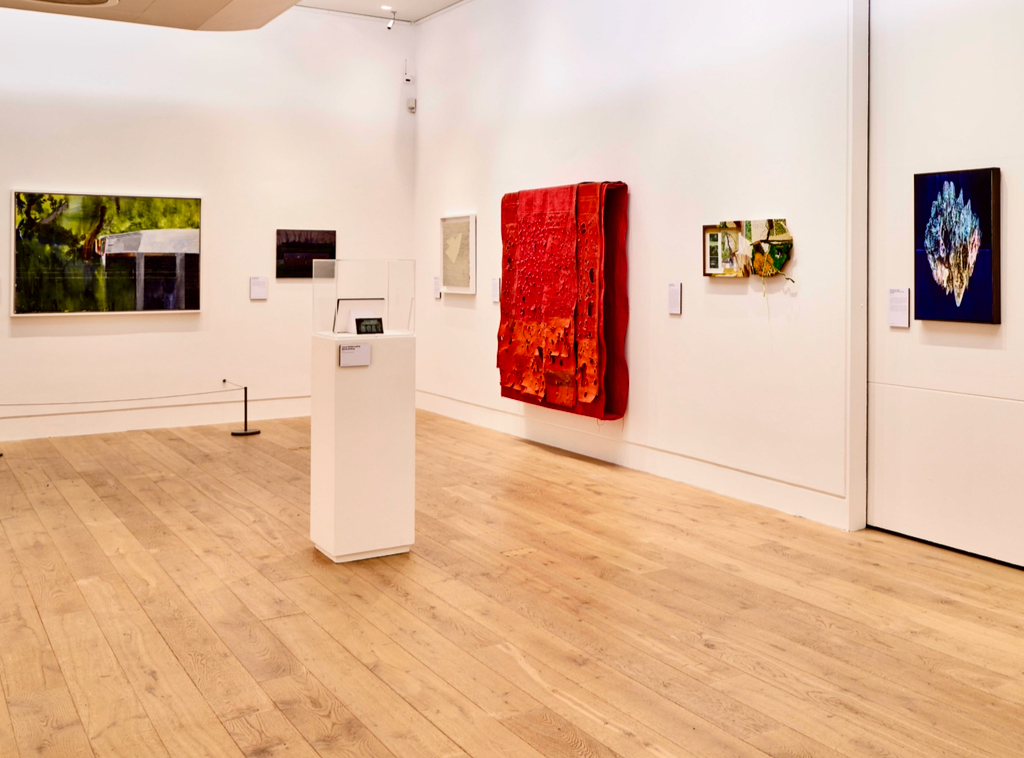
‘Arcadia for All? Rethinking Landscape Painting Now’ 

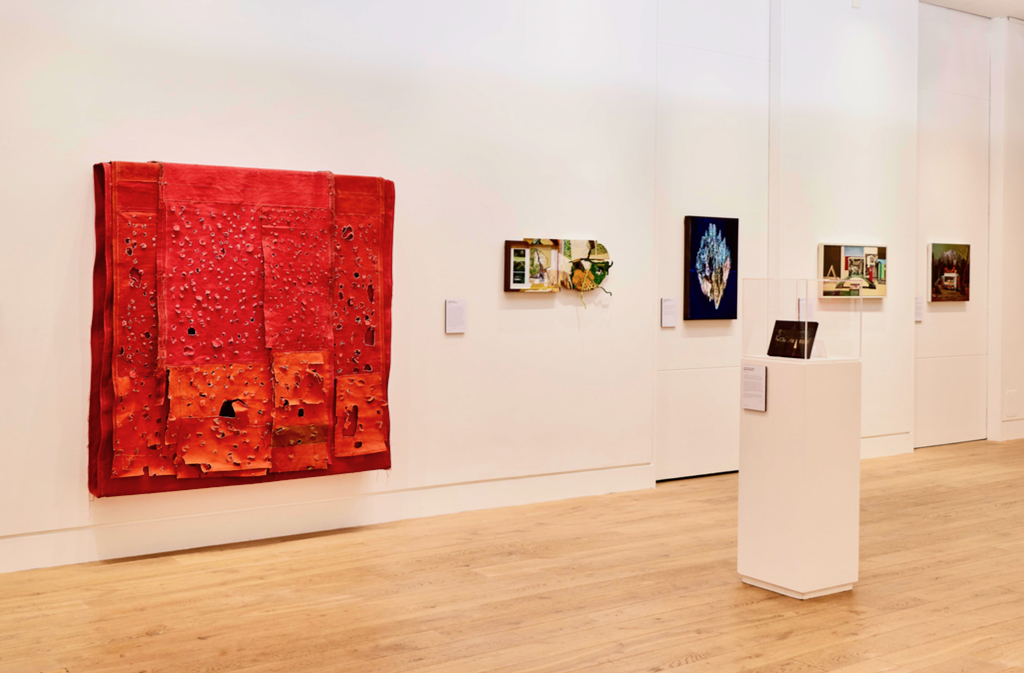
The exhibition runs from 26 April – 29 July 2023 and is at The Stanley & Audrey Burton Gallery, Parkinson Building, University of Leeds. 

An online catalogue is available at:

https://issuu.com/sabgallery/docs/arcadia_for_all_catalogue_full_low_res_pdf

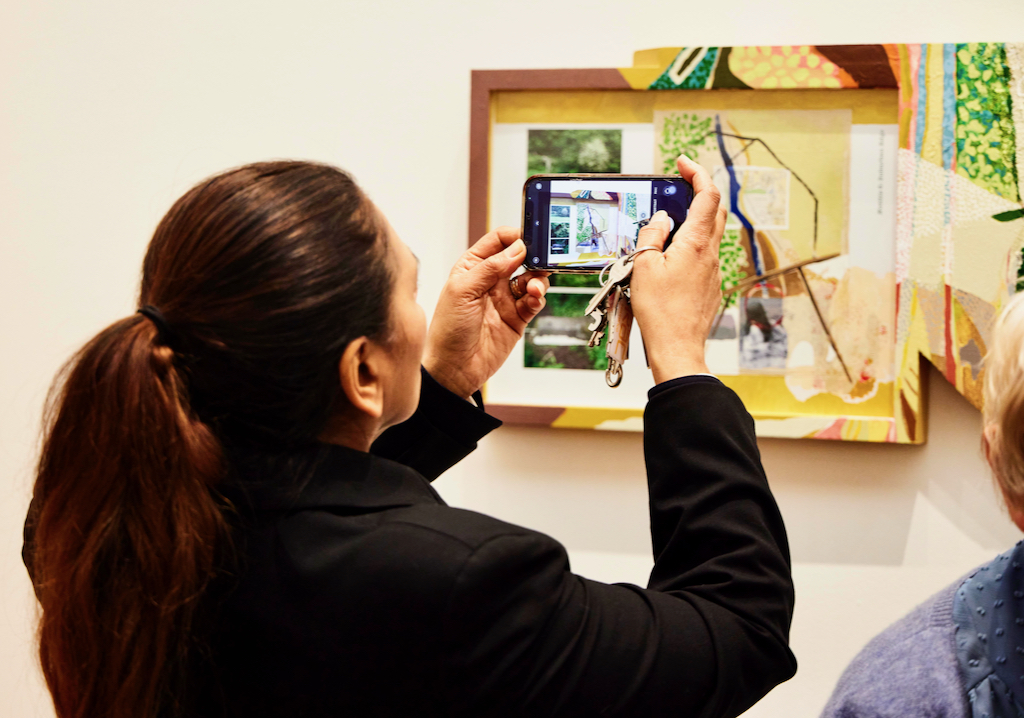
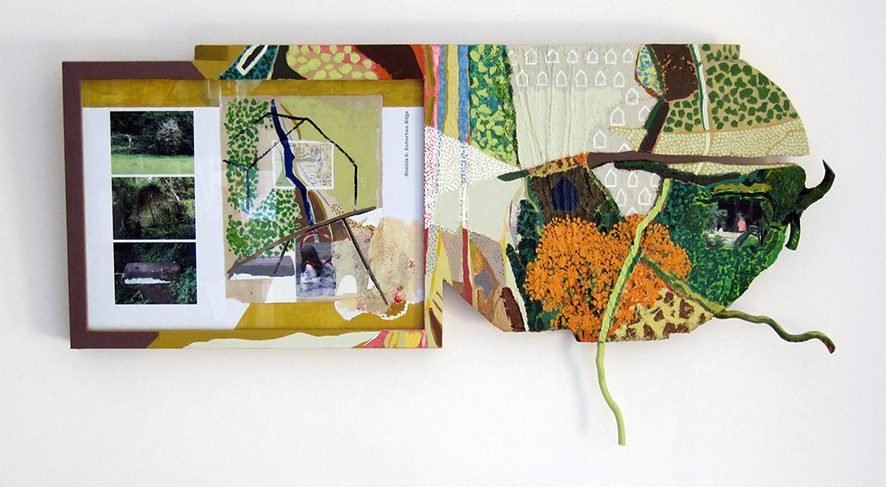
Somewhat to my surprise (and much to my delight), I was invited to contribute a work to this exhibition by one of the curators, Dr Judith Tucker. Below are some images from the exhibition.

My piece is called Notitia 6: Suburban Edge and is one of a series of works in which I tried to carry some of what I learned from my deep mapping work back into the process of making small-scale studio pieces. (The work is quite small – you can find an image of it by scrolling down!)

Image credits:

(above) Leeds University Library Galleries;

(below) Iain Biggs

Mutual Care

Given the world in its current state, I find it hard to find ways to write that are both honest and positive.

I spent much of today physically being with a fairly large group of people, the first time I’ve done that since the beginning of the covid pandemic. Not only was it wonderful to have exchanges unmediated by a computer screen, but I was actually able to meet “in the flesh” three people who I have only known virtually. All of which made the day very special, as did the lovely informal presentations and exchanges that took place.

The resulting sense of being entangled in a growing mesh of networks based on mutual concern and shared creative and environmental interests was deepened by returning home to find an email from my friend Sheila, who is currently working with artists and psychologists in Kiev. I had seen her at a virtual gathering the night before and sent her good wishes, but it was really wonderful to have a long email back from her detailing something of the work she is doing there and passing on links to recent projects. It’s these, and with them a sense of mutual care and positivity, that I want to share here.

Transcending Uncertainties. Art healing for uprooting timeshttps://www.seilafernandezarconada.net/artistic-logbook–blog/transcending-uncertainties-art-healing-for-uprooting-times
Germinating Futures: Collaborative art and care for eco-social (re)balance https://www.seilafernandezarconada.net/artistic-logbook–blog/germinating-futures

About ‘re-wilding’ (again).

Back in March 2022, I put up three linked posts about the thorny issue of re-wilding in response to George Monbiot’s book Feral.

That issue came up again during a recent conversation with Lindsey Colbourne in relation to work we’re both involved in with a collaborative called Utopias Bach. I won’t rehearse my objects to Mombiot’s book again now. Instead I want to share something of what arose from that conversation with Lindsey. A sense later given sharper focus by my starting to re-read Kerri ni Dochartiagh’s Thin Places. (It’s a book by an author who, in many ways, is Monbiot’s antithesis in terms of gender, social background, and lived experience).

What prompts me to reflection here is the convergence of my experience working with Utopias Bach – a collaborative almost entirely made up of women – and the tenor of a brief section of ni Dochartiagh’s book (pp. 14-17). There she reflects on a run she took in Derry just prior to Brexit. An experience that results in an evocation of the inclusiveness of nature, an evocation of openness to nature placed right in the midst of human addiction, degradation, anxiety and violence. What I see as central is that it’s an account that brings her to listening; an account entirely devoid of the curious mix of righteous anger (some of it justified), shaky machismo and tacit escapism that runs just below the surface of so much of Feral. An evocation of the necessity of finding an all-inclusive understanding of our relationship to nature through privileging listening that has been confirmed and strengthened by my contact the Utopias Bach collaborative.