After Disciplinarity? Mutual Accompaniment, ensemble practices, and the climate emergency.

[This is the slightly amended text of a presentation given for a postgraduate conference organised by doctoral students at Cardiff University – Breaking Boundaries – given on May 11th, 2021.]

I’ll start with an observation by Stephen Sterling, Emeritus Professor of Sustainable Learning at the University of Plymouth. He points out that our education system can’t address the Climate Emergency because it’s based on, and helps maintain, the mentality that created that Emergency. This morning I want to look at elements of this situation. As the anthropologist and archaeologist Barbara Bender indicates, the landscapes I study make no sense from a single disciplinary perspective. To explore them I need to draw on many different areas of knowledge. I also needed to walk, listen, read parish records, study old field maps, notice weather patterns, and pay attention to a whole lot of other stuff too odd or ordinary for most academics to consider. So Barbara Bender is right, but her observation also has another, more significant, implication.

If landscapes refuse to be disciplined, if they make a mockery of  oppositions between time [History] and space [Geography], or between nature [Science] and culture [Social Anthropology], then this must apply even more acutely to the psychosocial and more-than-human ecologies of which landscapes are just one part. Which suggests that the Climate Emergency requires us to think carefully about the limits of the disciplinarity education system. Not because there’s a problem with disciplinary knowledge as such, but because of the social effects of an education system that creates separate, specialist groups that competefor intellectual prestige and economic advantage. My concern is with those negative social effects, and how we might minimize them. 

Many of us are angry because the authorities don’t act on the Climate Emergency. But recent research says that what particularly angers young people is that they also dismiss, criminalise, pathologize and patronisetheir feelings and voices. This Mexican retablo – it’s text reads: The girl Rocenda talks with the forest animals. Cure her, Virgin – suggests that’s always happened. But the situation’s gets worse when members of the current Government try to classify Climate Extinction as a terrorist group and propose a ban on teachers talking about climate change in class. 

Late last year a friend asked me whether I thought she should discuss Jem Bendell’s paper – Deep Adaptation: A Map For Navigating Climate Tragedy – with students on this course. A course she set up because she feels Irish art education leaves students eco-illiterate. She accepted Bendell’s analysis that we face (I quote): “the potential, probable, or inevitable collapse of industrial consumer societies due to the direct and indirect impacts of human-caused climate change and environmental degradation”. But, as a tutor to a virtual course, she also knew she couldn’t provide the pastoral support that discussing those possibilities might require. Arguably, we all share something of her dilemma. We can ignore Jem Bendell’s analysis, along with the 500 plus scholars and scientists globally who agree with it. That’s the approach of Jair Bolsonaro, Donald Trump, and those who Bruno Latour calls “out-of-this-world” fantasists. Or we can collectively discuss Bendell’s analysis. But that would require those who would need to initiate that conversation to show care and respect for others, something they all-too-often lack. Even the first step, to genuinely listen to the concerns of others seems too much for them. But, odd as it may seem, our education system actually encourages them not to listen.

It assumes that those with power and authority are entitled to speak, and that those without it should listen. As Gemma Corradi Fiumara points out, it’s a system that binds us into a particular hierarchy. One based on the assumption that those who speak authoritatively do so because they already possess all the necessary knowledge. And, for that reason, they have no obligation to listen to others. It’s a hierarchy that avoids genuine dialogue and, instead, tends to create competing monologues. It doesn’t help that educators have been given less and less time to listen by those who manage them. There’s a bitter irony in the fact that this erosion of time to listen in education has coincided with an ethical turn in the philosophy of science; a shift from focusing on “matters of fact”, to “matters of concern” and, more recently, to “matters of care.

A second bitter irony is the contrast between society’s fetishization of consumption, marketed through notions of unlimited choice, and it’s education system’s limiting of choice by insisting on specialization.Specialisation that denies individuals a broad education and, as a result, limits their understanding by reducing their ability to connect and discriminate across many different types of ideas and practices. No wonder we find it so hard to understand psycho-social and socio-environmental processes and relationships. In short, our education system is structured by the same fractured, exclusionary mentality that has helped create the Climate Emergency. One way we can counter this is by cultivating mutual accompaniment and ensemble practices. But before I talk about them, I need to ground what I’ve just said in particular examples. 

These people are climbing a protective dyke in the province of Groningen in the Netherlands. It protects the province from the sea, but is itself threatened by the increasing number of earthquakes there, caused by years of natural gas extraction. These people had come from three continents to share their experience at a workshop called Resilience, Just Do It, organised by six doctoral students who’d been listening very carefully to people in the regionI was there to talk about artists working with local communities but, because of our different experiences and practices, I started by talking about language. 

I showed this photograph to illustrate how the meaning of words shifts. A photograph of the Bullingdon Clubevokes perhaps the most resilient element in British society – that is, a wealthy elite that does all it can to resist any change that might threaten it’s power. If I use resilience in the context of human society, it quite properly suggests resistance to fundamental political change; a resistance that may not coincide with the wellbeing of our civil society as a whole. But this meaning can be disguised because ‘resilience’ as a term in the ecological sciences is value neutral. It simply refers to an single eco-system’s ability to fend off ormanage threats that might otherwise undermine it. Our society is not, of course, a single eco-system.  

Groningen university is unusual in acting rather more like an eco-system. All its Faculties must contribute to one or more areas of collective concern – Healthy Ageing, Energy, and Sustainable Society. This limits the power and autonomy of those academics whose approach to disciplinarity is in terms of territories that allow them to gain personal power and influence, rather than to contribute knowledge to the collective understanding. It also encourages staff to remember that their research must take account of those people who will bear the consequences of the researchers’ decisions. All this contrasts with a criticism of UK universities made by a former Principal and Vice-chancellor of Aberdeen University. He argues that the UK’s universities are perhaps the most conservative of its major institutions. A situation created and maintained by a realpolitik – that is, the way power and influence actually operates in and through persons and institutions – that’s deeply embedded in the hierarchies that mange the production of disciplinary knowledge. In his view, this makes British universities increasingly unfit for purpose. 

I’m going to give you an example of the relationship between disciplinary realpolitik and political control. While I’m doing that, please keep in mind the UK Government’s recent dismissal – as “barely believable” and “a political stunt” – of the UN’s report on poverty in Britain. A report that finds that (I quote): “much of the glue that has held British society together since the Second World War has been deliberately removed and replaced with a harsh and uncaring ethos”. 

Some years ago, a research team from a major UK university received over five million pounds for a project. This included, for the first time ever, money provided directly by the Department of Work and Pensions. In time the researchers submitted their findings to a leading medical journal. These were peer reviewed, accepted, and published. The most senior British academic in the researchers’ field described the research as “a thing of beauty”. The DWP prepared to use them to help justify cuts to disability spending. Insurance companies prepared to use them to justify paying out less money to claimants with certain disabilities. Then a problem occurred. The research findings directly contradicted the experience of many of the patients suffering the illness the study claimed to research. They alerted other researchers, who asked for access to the team’s data and methodology – access that’s a condition of publication in that journal. The researchers and journal refused. The case eventually went to court and, despite the university spending over two hundred and forty-five thousand pounds, its researchers were ordered to release their data and methodology. External scrutiny then showed conclusively that their findings had been fundamentally distorted by a methodological slight-of-hand. As a result, some universities now use the project to show how not to do such research.      

So why didn’t the peer reviewers spot the problem and why, when asked, wouldn’t the editor and researchers share the data and methodology? Why did a very senior academic publicly praise such flawed work? Why has the journal still not retracted this discredited article? And why did a university go to court, at very considerable expense, to try to hide scientific research from legitimate external scrutiny? Perhaps because of undeclared conflicts of interest, since it later came to light that members of the research team had close links with both the DWP and the insurance companies. Another answer would be: “that’s disciplinary realpolitik for you”. 

Many academics would describe the workshop illustrated here as interdisciplinarity. I see it as an example of mutual accompaniment. What’s the difference? Interdisciplinary thinking still tacitly privileges disciplinarity as the way of structuring knowledge. But at Groningen the organisers made sure that disciplinary knowledge was not privileged over that of farmers, parents, the elderly, community workers, children, local political representatives, or the voluntary maintenance team at the local auxiliary pumping station. They took a non-hierarchical approach to different types of knowledge and understanding. One  that’s central to exploring, through genuine and respectful dialogue, the possibilities for practical, situated, and mutually enacted socio-environmental care. I stress this because we need to question the assumption that disciplinary knowledge – including its ‘inter-‘, ‘trans-‘, and other variations – is the only authoritative basis for understanding and action. If we don’t question that we risk contributing to the devaluingtrivialisingdismissing, or excluding of other forms of knowing and understandingAnd that, in turn, leads to the dismissal, criminalising, pathologizing and patronising of the feelings and thoughts that animate dissident voices, including those of people who want action on the Climate Emergency. 

In case there’s any doubt in your minds, I’ll repeat what I said earlier. I am not questioning the value of disciplinary thinking. What I’m questioning is the mentality that isolates specialist knowledge so as to create exclusive institutional domains; groups more concerned to concentrate their own power than to serve collective needs –  a mentality that has very real social consequences. In a recent report, a senior neuroscientist makes it clear that it’s that mentality that has set Alzheimer’s research back by 10 to 15 years; while another says that millions of people may have died needlessly as a result.

Mary Watkins begins her book Mutual Accompaniment and the Creation of the Commons with a quote from an Aboriginal Activist Group that explicitly challenges the exclusionary, hierarchical and patronising assumptions built into the disciplinary system. It goes: “If you have come here to help me, you are wasting your time. But if you have come because your liberation is bound up with mine, then let us work together”.It’s a request for mutual respect across boundaries that’s central to decolonising knowledge. It’s necessary because of the long-standing entanglement of the effects of colonialization, environmental abuse, social othering, and the disciplinary education systemI’d need a very much more complex diagram than this to visualise that legacy which is, in any case, far too complex a topic to deal with here. Instead I’m going to flip that entanglement over. I want to share, instead, an example of mutual accompaniment that shows how the legacy of that entanglement can be acknowledged and some of its effects healed, if only at an individual level.

Back in March a young South African artist emailed me, part of an ongoing exchange we’d been having about a possible PhD project. I’ll share part of it with you in an edited form.

“Recently I gave a talk to some local Motswana artists. I also discussed my struggle to belong in Africa with them. And they shared their struggles to find their traditions in the shards left after colonialism. Not that Botswana was ever colonized, but their indigenous culture suffered tremendous loss because of European influence. The artist-in-residence here is looking to de-colonize and re-claim, as a Tswana, the practice that European anthropologists categorised as ‘rain making’. That’s a miss-translation – ‘rain asking‘ would be more accurate. Our shared interests mean we’ve continued our conversation on-line, along with a few other Motswana writers and artists. It’s been very enlightening. Being accepted by this group has been very moving for me as an Afrikaner – an undesirable because associated with apartheid. This is the start of a very interesting, unofficial, PhD for me!”

That email suggests why mutual accompaniment in the process of decolonialising thinking helps confront a situation that sociologists of knowledge describe as follows: 

“To the extent that a particular way of producing knowledge is dominant, all other claims will be judged with reference to it. In the extreme case, nothing recognisable as knowledge can be produced outside of the socially dominant form”.

That socially dominant form of producing knowledge currently allows the appropriation and ghettoization of knowledge – for example about Alzheimer’s disease – by disciplinary power groups that claim to speak authoritatively but don’t listen. As Amitav Ghosh so clearly demonstrates in his book The Great Derangement: Climate Change and the Unthinkable, our education system makes it extraordinarily difficult for us to grasp the extent and impact of climate change. It teaches us to assume that only the socially dominant form of knowledge production delivers the “right” views and answers. So our education suggests that alternative views and answers are, almost literally, unthinkable.

Our education system rarely refers to the limits and bias built into our categorically-based knowledge system. But, as the feminist philosopher Geraldine Finn wrote back in 1990:

“…the contingent and changing concrete world always exceeds the ideal categories of thought within which we attempt to express and contain it. And the same is true of people. We are always both more and less than the categories that name and divide us”.

The system’s emphasis on fixed categories and division-through-naming has reinforced a mentality with terrible consequences. It’s naturalised the process of “categorical othering”. The year before Finn’s paper, the sociologist Zygmunt Bauman published a book called Modernity and the Holocaust. In it he argues that the lethal “othering” of Holocaust victims as less than human was not a unique expression of Nazi ideology, but an extreme expression of a foundational presupposition within modernity itself. In particular, of the negative social consequences of modernity’s over-emphasis on an attitude of mind – on the ethically neutral or “objective” detachment which has also made modern techno-industrial progress possible. The ethical neutrality and detachment that erodes what Hannah Arendt calls: “the animal pity by which all normal men are affected in the presence of physical suffering”, and that has fatally distanced the modern world from its relationship to, and dependency on, all other-than-human life. 

I now want to bring all this closer to your immediate context as post-graduate students. Here’s an account sent me by a recently graduated doctoral student. I’ll call her X. In early 2019, X took part in a major international conference where she showed one of her films and talked about how she activates communities towards climate change engagement. She was subsequently invited to submit a paper to a special issue of an environmental science journal. However, following peer review and three rounds of major amendments, her paper was rejected. X knew this is not uncommon and actually got a lot out of the process. What frustrates her is that the peer reviewers and editor acknowledged that her approach to community activation is exactly what their field needs. They also admitted that it can only be done by arts practitioners like herself. Despite moving her manuscript much nearer to the structured format they required, it was still rejected as insufficiently scientific. When X explained to the editor that this was because she’s an artist, she received a very illuminating reply.

Firstly, the editor expressed sincere disappointment at not being able to include X’s work in the journal, conceding that sustainability scientists like to think they work with artists, but instead convert their work into something more acceptably scientific. X was then congratulated for sticking to her position as an artist, and thanked for prompting the editor to consider how the refereeing process undermines what artists can contribute to environmental science’s approach to the climate debate. 

X felt the editor could have shifted just a little, but choose not to – despite recognising the seriousness of the Climate Emergency and X’s contribution to addressing it. I share her frustration but, as a former journal editor, I’m also know something of the pressures editors work under. So I’ll simply remind you that Jem Bendell’s Deep Adaptation: A Map for Navigating Climate Tragedy was also rejected by a major environmental journal as ‘insufficiently scientific’. The question in both cases is simple enough. What is more important, maintaining the boundaries of disciplinary exclusivity or addressing the Climate Emergency? Unfortunately, the academic answer seems to be the first. 

Increasingly, people are finding alternative forms of knowledge, understanding and ways to act that bypassthe socially dominant forms. Some do so through adopting ensemble practices and mutual accompaniment. That’s to say, they’re finding more inclusive, less hierarchical, ways of connecting to their own identity, to each other, and to the contingent and changing concrete world. The immunologist and poet Miroslav Holub points out that specialist disciplinary work is actually located in small, largely confined – if at times pervasive – domains in relation to society as a whole. So that, despite having been educated to identify with a specialism, most of us are engaged in all sorts of other roles and activities. He writes: 

“… for myself, I would say that I spend 95% of my time and energy in fighting my way through the wild vegetation of circumstances, looking for the tiny spots, for the little clearing where I eventually could really work, write or do research …  Why, then, should it make so much difference, being the poet and being the scientist, when 95% of our time we are really secretaries, telephonists, passers-by, carpenters, plumbers, privileged and underprivileged citizens, waiting patients, applicants, household maids, clerks, commuters, offenders, listeners, drivers, runners, patients, losers, subjects and shadows”.

Given this situation, we could choose to accept our multiple identities for what they are – a fluid and changing ensemble of different roles and practices. Not to do so, Holub implies, is to risk indulging in unrealistic, exclusive, even cultish, attitudes. Our lives are now dominated by vast meta-systems of management and manipulation, by an increasingly autonomous merging of corporate and political power. But at least part of their power over us depends on us passively accepting fixed identities.  

One way to challenge this situation is to recognise the link between Holub’s description of our multiple life roles and Bruno Latour’s discussion of the importance of moving beyond binary positions for the emergent Terrestrial politics. He writes that: 

…what counts is not knowing whether you are for or against globalisation, for or against the local; all that counts is understanding whether you are managing to register, to maintain, to cherish, a maximum number of alternative ways of belonging to the world’.

This inclusive approach – both to identity and our encounters in the world – is my cue to introduce you to some ensemble practices. That’s to say to the practices of people productively entangled in both mutual accompaniment and a maximum number of alternative ways of belonging to the world.

Ffion Jones earns a living as a hill farmer and a lecturer in Theatre and Theatre Practices at Aberystwyth University. She both embodies and questions the roles of daughter, mother, and partner in a Welsh-speaking hill farming community. Miroslav Holub saw himself as fighting his way through “the wild vegetation of circumstances” to get to the small space where he could work as a poet and scientist. Ffion, by contrast, has embraced that “wild vegetation of circumstances” as intrinsic to her ensemble practice. One that meets her economic and domestic needs and her desire to actively engage with, and articulate, the pressures on, and changes in, her community. Pressures she spoke about in a recent podcast on issues around re-wilding and re-forestation, as seen from the perspective of a Welsh hill farming community. 

Ffion’s practice-based doctoral research combined performance and rural studies to explore the particular way of life of Welsh hill farmers, specifically their relationship with their livestock. In academic terms, it involved ethnographic fieldwork conducted through conversations with members of her immediate family and the local farming community, mediated through film-making and performance. But to categorise it as an inter-disciplinary project would be to seriously misrepresent it. It’s an ongoing act of mutual accompaniment, a life lived alongsidea particular hill-farming community from within. A giving voice to all the richness and contradictions of acontingent and changing concrete rural world. A lived process that perhaps only an ensemble practice can make possible. 

Liz Hingley, who took these photographs, trained as both a documentary photographer and a visual anthropology. The largest image here is of a shelter on Hampstead Heath, built by a front-line nurse during the COVID-19  pandemic straight after finishing a fourteen-hour night shift. if you look carefully you can see her hands. Because the nurse finds her vision and spatial orientation limited for a period after the long hours of strong lighting and engagement with machines, Liz chose to photograph her in black and white. 

Previously, Liz has explored the systems of belonging and belief that help shape cities around the world, working collaboratively to create connections between disciplines, cultures, audiences, eyes and minds. After projects in Birmingham, Shanghai, London and Austin, Texas, she developed a keen interest in the relationship between art and science, and became an Honorary Research Fellow at the departments of Philosophy and Physics at The University of Birmingham. More recently, she’s modified that interest so as to link her growing environmental concerns with the therapeutic function of woodlands during the pandemic. She’s currently developing a therapeutically-based photographic project with the staff of a London hospital, working alongside an ecologist responsible for Hampstead Heath; a project she hopes to fund through a bursary for a PHD in medical anthropology. 

Ffion and Liz, and the others whose work I’ll briefly refer to, might be loosely identified as artists. A label they accept for pragmatic reasons and, incidentally, the reason I know them. But their work exceeds, and would for many art critics fall short of, the ideal category ART. Their concerns have mutated and, what were once simply matters of intellectual or aesthetic enquiry, are now equally heartfelt concerns requiring commitment and collective caring. Some years ago, Simon Read observed that our eco-social problems require (I quote): “a particular kind of strategy that our culture has yet to develop and promote”. What I’m suggesting this morning is that ensemble practices oriented by mutual accompaniment may provide just such a strategy. 

Cathy Fitzgerald trained and worked as a micro-biologist in her native New Zealand before moving to Ireland. There she studied art, worked on sci-art projects, and for environmental organizations and the Irish Ecology Party. Inspired by Helen Mayer Harrison and Newton Harrison, she started looking for ways to interweave her artistic, scientific, political, and locally situated knowledge and concerns. In 2008 she and her partner moved into a small commercial Sitka Spruce plantation. She began to transform it into a sustainable, mixed species native woodland, something she estimates will take at least forty years. Working with international experts and using innovative methods, she set up exchanges between foresters, policy-makers, artists, environmental writers, philosophers, politicians, cultural geographers, and her local community in County Carlow. Those exchanges were then shared through regular blog posts and part-time teaching. In 2019, needing a steady income, she applied for, and won, funding to develop the on-line Haumea Eco-literacy courses she now co-teaches.

For fourteen years Luci Gorell Barnes was artist-in-residence at Speedwell Nursery School and Children’s Centre in Bristol, and still earns a living as an educator and researcher. Simultaneously, she’s been occupied as a collaborator with her musician partner, as a mother and, more recently, grandmother, and as a writer, illustrator and studio artist. She views all these activities as mutually intra-dependent. Her underlying concern is to develop (I quote) “flexible and responsive processes that enable us to think imaginatively with ourselves and each other”. This concern is particularly clear in her work with socially vulnerable individuals – disadvantaged children and refugee and migrant mothers. She helps transform their sometimes grudging institutional acceptance by a combination of place-making and situated learning, both grounded in forms of mutual accompaniment that embrace her whole immediate neighbourhood. Recently Luci worked on a nation-wide Hydrocitizenship initiative, drawing on her long involvement with water and food security issues. 

Originally a successful London-based studio artist, Simon Read moved with his partner to rural Suffolk, where they and their son lived on a boat. There Simon equipped himself to join environmental planning debates around river and coastal salt marsh management by using his drawing skills to make maps that synthesize data so as to visualize likely future environmental change. This led to him working on a tidal attenuation barrier for the River Debden Association, co-designing it with local engineers and building it with the help of volunteers from a local prison. Simon, who is also an Associate Professor of Fine Art at Middlesex University, has initiated several other projects concerned with coastal salt marsh stabilization, using “soft engineering” that degrades over time. As a result of his environmental experience, he repeatedly stresses the need to reframe the relationship between land, ownership, responsibility, and belonging.

I’d originally planned to take my examples from the UK and Ireland, but realised that misrepresented the ways mutual accompaniment can link people across continents. Mona E. Smith is the founder of Allies media/art. She’s a Sisseton-Wahpeton Dakota, grew up in Redwing, Minnesota, and became a college teacher. After re-discovering her Dakota heritage, she started researching and making documentary videos about problems facing native people in Minneapolis St Paul. She became a media producer and made work on health and other topics related to Dakota lives. She studied with Dakota elders, brought up her children, kept an eye on her elderly mother, and worked on a variety of arts and media projects. We shared work through a network focused on issues around place, and she then adapted a form of deep mapping to create the Bdote Memory Map. It’s a virtual, explorative web site for Dakota people to study their history, language, and traditional knowledge. It also includes guided walks to their sacred sites in and around Minneapolis St. Paul. But it’s also an act of recuperation that invites mutual accompaniment, using Dakota knowledge and experience to invite a change of heart in the descendants of those colonists who first appropriated, and then violated, the land and rivers that the Dakota people had always regarded as their sacred relatives

Lindsey Colbourne lives in North Wales but has travelled and worked internationally. She has twenty five years’ experience as a professional facilitator, trainer, advisor, and designer of participatory processes  particularly conflict resolution and dialogue. She’s also worked for the UK Sustainable Development Commission and as a surveyor for the British Trust for Ornithology. All of which now informs an ensemble practice with art as its catalyst. She uses collaborative and participative inquiry to forge new connections and to work with and through different ways of knowing the world. Her aim in these investigations is to involve as many different people – and perspectives – as possible, an approach that echoes Bruno Latour’s statement quoted earlier. She tries to begin each project from a point of ‘un-knowing’, avoiding disciplinary presuppositions and without anticipating the outcome. She then uses whatever approach – from conversation to photography, gardening, or performance – that seems appropriate and simply “follows her nose”. She writes (I quote): “sometimes the work stays in the process, living in the dialogue and the relationships it creates, with no formal art ‘outcome’ at all”. Hers is a genuinely open-ended approach, a letting go of conditioned expectations, that informs the mutual accompaniment I’m proposing here as onealternative to the disciplinary mentality.

I’ll end, however, by bring this back inside the academy, since that’s were you find yourselves. 

Lindsey’s concern – to live in the dialogue and the relationships it creates – links directly with an account of the real value of Arts and Humanities research from two anthropologists, James Leach and Lee Watson. They show that the institutional criteria used to evaluate Arts and Humanities research bear no relation to how innovation and creativity actually occur. Instead, the real value of such research lies in its being carried by and in persons – as expertise, as confidence, as understanding and orientation to issues, problems, concerns and opportunities, as tools and abilities. All qualities they suggest are best seen as responsivenessor, if you like, as the animation of acts of mutual accompaniment. Leach and Watson also point out that these qualities are probably best understood as aspects of citizenship; as emphasising spaces and opportunities for discussion, argument, critique, and reflection. The spaces in which active collaboration becomes a basis for evaluation

In short, they suggest that Arts and Humanities research needs to be seen as having value as a dialogic process in its own right. That it should be understood, first and foremost, not as an instrumental system for producing disciplinarily-defined “research outcomes”, but as an important, perhaps central, contribution to a proper discussion of what a sustainable education should be.  
Marina Warner and Paul Ricoeur on the mystery of identity.

I am still trying to digest the impact of the virtual gathering, of almost 100 people from some 13 countries, that took place at 5 pm on April 29th., the occasion of the book launch for Mary Modeen and my Creative Engagements with Ecologies of Place: Geopoetics,Deep Mapping and Slow Residency (Routledge 2020).

In a review of Sally Bayley’s No Boys Play Here: A Story of Shakespeare and My Family’s Missing Men for the London Review of Books (6th May, 2021, p. 41), Marina Warner identifies the issue of “personality as contingent, mutable and dispersed, a kind of quantum field psyche that is both here and there at the same time”. She goes on to suggest, via a quotation from Ishiguro’s Klara and the Sun, that the difference between a living person and an AI robot is that: “a person’s uniqueness “ is “distributed among those who love her, and secured by their consciousness of her”. An observation that reminds me of Paul Ricoeur’s discussion of narrative identity in Oneself As Another (1994), where – having identified identity in terms of “the dialectic of self and the other than self (p. 3),  he later asks: “do we not consider human lives to be more readable when they have been interpreted in terms of the stories that people tell about them”? (p.114, note 1).  

For whatever reason, both Warner’s observation and my connecting it back to Ricoeur’s concerns, seem relevant to the impact that the virtual gathering of such a varied and scattered group of people on April 29th. has had on me. Perhaps a recognition of my own contingency, mutability and dispersion, not as something to regret but something to embrace and celebrate?

Deep Adaptation: notes from an exchange with Cathy Fitzgerald

On the 28th of December,  2020, my friend the eco-artist, researcher and educator Cathy Fitzgerald emailed me to ask if I’d  come across the work of Professor Jem Bendell. He’d been on her radar for some time because of his argument about imminent societal collapse – Deep Adaptation: A Map for Navigating Climate Tragedy.  Cathy felt, in my view probably rightly, that this was not something she should teach to course participants on the seven week Haumea Ecoliteracy courses she runs, since such online teaching is not an appropriate space for discussing this without psychosocial support. However, she also felt that it was an important paper that could not simply be ignored and asked me what I thought. I’d read Bendell’s first deep adaptation paper but not its follow-up, written with Katie Carr: Facilitation for Deep Adaptation: enabling loving conversations about our predicament, so I said I’d read both and get back to her.

What follows here is based on my various responses to Cathy’s request since then, intercut with some of her own reflections. 

The first thing to say is that, on the basis of what I know, I accept Bendell’s claim that climate-influenced “societal collapse” in most parts of the world in the coming decades is either “likely, inevitable or already unfolding”. (Since his original paper, he’s qualified this by adding that ‘near-term collapse’ is not inevitable). My personal view, however, is that this ‘collapse’ has indeed been unfolding, in different ways and for many years, in different parts of the world. What needs to be acknowledged is that better-off people in the Global North have not yet, or only recently, begun to acknowledge that this is already unfolding. (I’ll return to this later). 

In what follows I’ll take up Carr and Bendell’s concern: “to help reduce harm, save what we can, and create possibilities for the future while experiencing meaning and joy in the process” by suggesting that what they propose needs to be inflected differently. What follows are, however, very much my provisional thoughts. I stress this because I have sent Bendell some questions, which he’s kindly forwarded to Carr as being best placed to answer them. At the time of writing this I’ve not heard back from her, so I may very well need to qualify what I write here when (if) I do.

I think it may help if we start by seeing Bendell’s prediction about societal collapse as being “likely, inevitable or already unfolding” from a historical perspective. I suggest this because I think we need to generate a more nuanced understanding of what deep adaptation is likely to require if it’s to be helpful to different individuals and communities. Consequently I think it’s important to remember that wide-scale climate-related societal collapse has happened before, even in the West. Our culture has simply chosen to ignore this in favour of adopting the modernist belief in gradual but inevitable progress. (See, on this, Amitav Ghosh’s excellent book The Great Derangement)

Cathy is not sure about this thinking, given that previous examples have not involved mass ecocide. (This is debateable of course. Some might argue that the wholesale destruction of British wildlife that accompanied the enclosure of the Commons exactly anticipates, albeit on a smaller scale, our current situation of interwoven ecocide and social injustice). Be that as it may, I think it’s useful to remember that the Seventeenth Century was a catastrophic period of global crisis and social breakdown, one clearly linked to ‘climate change’ (see Geoffrey Parker Global Crisis: War, Climate Change and Catastrophe in the Seventeenth Century). It took place during what’s often referred to as ‘The Little Ice Age’, extended over a period of more than one hundred years, and had world-wide consequences. (It’s estimated that it killed as much as one-third of the global human population). It’s important, I think, both to remember that humanity as a whole has faced this type of apocalyptic situation before, but equally to acknowledge that our current situation is very probably considerably more serious. Cathy’s view is, I think, that “looking to past ‘climate’ breakdown situations is too narrow”, since the crisis we face is the consequence of “an ecocidal misperception” that, as Bateson and Guattari realised, “has led to gross alienation of the dominant society’s place in the wider community of life. It is a spiritual crisis of misunderstanding life / consciousness / reality as an interwoven experience”. 

I don’t necessarily disagree. However, the aspect of Carr and Bendell’s approach that most troubles me, as someone who has spent a working lifetime in arts and humanities education, is their particular ‘therapeutic’ approach, one based on an amalgamation of Critical Theory and Buddhism, has the appearance of a single ‘silver bullet’ that overlooks the need for other, alternative, possibilities. I should add that I have no quarrel with their approach in itself. However, I do wonder whether it isn’t oriented by its authors’ underlying intellectual ‘centre of gravity’. One that, in my view, means that their approach will be of help primarily to people who share that ‘centre of gravity’. People in different circumstances, from different backgrounds, and with different ‘centres of gravity’ (that is, who are primarily animated by a physical or emotional orientation), will need to come to deep adaptation via other routes.

Cathy’s own reflections on this are particularly helpful. She tells me that she and many of her network see Joanna Macy’s work, also influenced by Buddhism, as hugely important for deep adaptation: “because she so skillfully connects her early Calvinist worldview – and all the trouble that Christianity entails – with her review that Buddhist philosophy and practices for everyday living are more aligned with an ecological worldview of grounded, impermanent, interconnectedness and compassion”. However, I think what is important here is that Cathy, like me, understands that there can be no ‘one-size-fits-all’ approach to deep adaptation if it is to be genuinely inclusive.

Significantly, alongside Macy she references Julian of Norwich, Matthew Fox, and Pope, Francis, alongside Sister Chan Khong’s simple but moving book Learning True Love,  an account of her deep innate desire to help the poor in Vietnam and development of more social focussed practices for Buddhists today – ‘engaged Buddhism’. In short, the clear implication for me is that deep adaptation requires acknowledgement of our living in a pluriverse, one in which there will always need to be multiple approaches to deep adaptation that speak in different ways to different people and communities.

It may also be helpful to look at recent periods of trauma in our own ‘backyard’ if we want to start to identify something of these other routes. I’ve just read Kerri ni Dochartaigh’s book Thin Places, an account of how she discovered a sense of self after being traumatised by growing up in Derry as the child of a Protestant father and Catholic mother, during what are euphemistically called ‘The Troubles’. For myself, that book suggests an alternative, more heart-felt route into deep adaptation to that advocated by Bendell and Carr. I would describe her process of adaptation as made possible by something closer to a (secular or ‘pagan’?)  equivalent to the Hindu concept of bhakti, or to the nature mysticism of St. Francis of Assisi, than to Carr and Bendell’s amalgamation of Critical Theory and Buddhism.

I want to stress that in writing this I am not about arguing for or against any particular route into deep adaptation. I simply want to suggest that people oriented differently will need to develop particular forms of deep adaptation via a variety of different approaches. Also that, importantly, this relates to a need to avoid forms of tacit exclusion that relate to, but cannot simply be reduced to, issues of class, race, gender, etc., as well as to the issue of ‘deconstructing’ power on which Carr and Bendell focus. 

Cathy and I may have a different sense of emphasis here, in that she thinks very firmly that: “we have to move toward understanding the ecological catastrophe as a systemic breakdown and that it will need systemic restoration”. A situation that will require the development of “a real fluency” or “ecoliteracy” that enables us all to understand that “environmental and social challenges are always entangled” Her concern is that we must move out of a mindset that can only “focus on just one symptom of our alienation from life, like that its ‘about’ climate change’, or ‘the pandemic’, or the ‘6th great mass species extinction’ event or ‘mass social injustices’.” She adds: “intersectionality here is so important. But this is hard, especially when ecoliteracy and the fact of thinking this way is new… even our Green politics is riven with camps ‘for social’ or ‘for environmental’ progress but not often working together”. The implication being, of course, that there may need to be an agreed, overarching understanding – a common level of ecoliteracy – if we are to grasp what needs to change. While I understand and respect this view, I also wonder whether the best way to achieve the necessary fundamental change of heart is to undertake it incrementally, by enabling the following of the different routes most appropriate to different individuals and communities?  

The issue of what is practical seems central here. Having discussed the practical, group-based elements of Carr and Bendell’s approach with someone better placed to assess their therapeutic value than me, I’m very happy to accept that these are a practical and effective way forward for the constituencies they address. But it also seems to me that there may be an unacknowledged bias (for want of a better word) towards certain types of individual and community here that, as someone involved in education, I want to keep in mind. The historian David Gange, in his The Frayed Atlantic Edge, draws attention to the means by which remote rural ways of life have survived, despite the increasingly absolute dominance of the urban mentalité. Survived in places that have already experienced, within recent historical times, societal collapse and loss of their previous way of life. (And for reasons intimately bound up with the causes of our current socio-environment crisis). As Gange’s account of the activities of Annie MacSween and others show, “enabling loving conversations about our predicament” might equally take place in more social, that’s to say more collectively-oriented, contexts than those implicit in Carr and Bendell’s professionally-oriented therapeutic concern of “safe and confidential settings” to enable people to talk about, for example, death and dying.    

I wrote earlier that, in my view, the “societal collapse’ that Bendell identifies has indeed been unfolding over many years, even in the Global North. This brings me to what I feel is perhaps one of the most difficult aspects of beginning the process of deep adaptation.

If by ‘society’ we mean the complex, now global systems that ensure that there is food, shelter, education, energy, etc. to be had by the beneficiaries of the dominant ethos, along with the continued production of techno-scientific ‘advances’ to facilitate those systems, then the ‘society’ promulgated by the ethos often referred to as ‘the Global North’ has yet to collapse. If, however, we mean a civil society, a community of citizens linked by shared (if constantly and democratically debated) values and interests, and by collective, mutually sustaining, collective activity, then arguably that civil society has been collapsing for many years. Or, more accurately, it has been steadily eroded from within. By 1987, for example, Margaret Thatcher could announce to the British public that: “there’s no such thing as society. There are individual men and women and there are families”. That view is, of course, as operationally absurd, as fundamentally opposed to any form of deep adaptation, as it is inseparable from the mentalité of possessive individualism that has been a principle driver in generating our current eco-social crisis. However, it was and is an understanding that suits those who gain most from the ‘global society’ of consumer capitalism that thrives on the extractive ethos responsible for ever-increasing levels of ecocide and social injustice. We cannot and should not ignore this socio-political reality.

Why does acknowledging these different understandings matter? Because how we each respond, both intellectually and emotionally, to Bendell’s notion of ‘societal collapse’ will inflect, if not wholly determine, how we approach deep adaptation. Unless we keep this in mind, the phrase itself  risks becoming an increasingly empty catch-all, one that masks fundamental differences that can and are being experienced in different ways in different places. This needs to be understood and acknowledged if we are to have any hope of achieving the inclusivity vital to what Cathy refers to as an effective level of ecoliteracy. 

I cannot, and indeed should not, attempt any single, ‘conclusive’, statement that tries to summarise all this. That’s neither possible nor what is needed.  What’s necessary now, surely, is for us to be participants in an ongoing, heart-felt conversation that builds mutual understanding, respect for differences, and trust. One that’s based on a willingness to genuinely listen, learn and acknowledge that, as Ursula Le Guin reminds us, a sense of commonality – with both the human and the more-than-human in the polyverse – begins in a shared acknowledgement of pain. Building that sense of commonality is, I believe, the greatest task we face and, for myself, I take as both comfort and challenge Bruno Latour’s insistence, in Down to Earth: Politics in the New Climate Regime that, today, ‘what counts is not knowing whether you are for or against globalisation, for or against the local; all that counts is understanding whether you are managing to register, to maintain, to cherish a maximum number of alternative ways of belonging to the world’ (Italics mine).

Travelling in the time of COVID-19: William Least-Heat Moon, Cliff McLucas and Grace Wells.

I have been re-reading William Least-Heat Moon’s PrairyErth: (A Deep Map). I’m doing this both for pleasure and, as it now happens, in preparation for a presentation I hope to be able to deliver in July next year, COVID-19 permitting. I have also been intellectually accompanying a PhD student, registered with the University of Groningen in the Netherlands, who is working on a deep mapping project in Glasgow. In the process, it’s become apparent that the website dedicated to Cliff McLucas, on which his Ten Things I Can Say About These Deep Maps was reproduced, is no longer accessible. (Since this becomes increasingly hard to find, and for those who don’t know this wonderfully provocative manifesto, I’ve reproduced it at the end of this post). 

What re-reading PrairyErth has reminded me is both how much Cliff McLucas, Mike Pearson and Michael Shanks took from it and how much they made what they learned very much their own. Even today, it astonishes me just how rich and varied are the strategies Least Heat-Moon either employs himself or suggests his readers try for themselves. If I were still teaching and had a free hand, I would run an entire transdisciplinary Masters degree in deep mapping as fieldwork on the basis of students making a close reading of those strategies; everything from night walking (‘In the Quadrangle: Homestead’) and the use of totemic ornithology (‘Out of the Totem Hawk Lexicon’) to gathering oral environmental history (‘Upon the First Terrace’) and a good understanding of the politics – both local and national – of the land (‘In the Quadrangle: Elk’). As Shellie Banga has pointed out, the whole weight of PrairyErth lies in its rejection of what Least Heat-Moon refers to as the dominant “egological” culture. Hence, as she observes, its “notable absence of a personal narrative”; an absence predicated on Least-Heat Moon’s aversion to “solipsistic approaches to place-based literature that at times turn books about place into self-indulgent books about writers themselves”. The first essay of the first module of my imaginary Masters degree would be for students to discuss Banga’s reading of PrairyErth in the light of Kathleen Jamie’s A Lone Enraptured Male, her iconic critical review of Robert Macfarlane’s The Wild Places. My aim in asking them to do this would be to substantiate for themselves Amitav Ghosh’s Amitav Ghosh’s insistence, in The Great Derangement: Climate Change and the Unthinkable, that we attend to the renewed awareness that: ”human beings were never alone… have always been surrounded by beings of all sorts”, beings that share “the capacities of will, thought and consciousness”. With this, he argues, comes a renewed sense of our uncanny relationship with the nonhuman. One that is particularly “resistant to the customary frames that literature has applied to ‘Nature’ and that, in turn, confounds “the very idea of ‘Nature writing’ or ecological writing”. While we can read something of all this as being implicit in McLucas’ manifesto, we need to go back to PrairyErth to find an approach to deep mapping that is fully focused on the underlying dilemmas of our time. In this it anticipates, in a very different and ultimately practice-oriented register, what Intake to be the aim of Bruno Latour’s Down to Earth: Politics in the New Climate Regime

So, two questions. First, what has this to do with travelling in the time of COVID-19? Second, where, in all this, does the work of the poet Grace Wells fit in? I’ll try and answer the second question first. It may of course simply be that I had the good fortune, through my friend the Irish eco-artist Cathy Fitzgerald, to hear Grace Wells read two poems at an on-line Samain celebration Cathy organised this year. But I like to think there is more to it than that. 

After that memorable evening, I needed to buy a second-hand copy of Grace Wells’ Fur (Dedalus Press, Dublin, 2015). (When it arrived I noticed that it was signed ‘For Beverley with Best Wishes, Grace Wells’. I have a number of second-hand books of poetry that have been signed by the author. I always find myself wondering what particular set of happenstances has led to them coming into my possession, speculation that suggests one answer to my first question). Towards the end of Fur there’s a poem called I Packed My Bag, which concludes with a sentiment the poet says she’s copied down: ‘Our single purpose is to magnify the light we share between us’.

I read this as another way of articulating Least Heat-Moon’s repeated exhortation to set aside the myths that underwrite our egological mentality; to acknowledge that we are constituted are constituted in and through our innumerable relationships – human and otherwise – our endless and unnameable  attachments  and connections to the pluriverse. Although I Packed My Baghappens, along with Winter, to be the poem that stays closest to me (as it will, maybe, to anyone living through this pandemic who has had to prepare for a period in hospital), there are plenty of others that articulate something of the same insight. Three of her section titles: ‘Animal Encounters’, ‘Being Human’, ‘Becoming Animal’, (in that order) may suggest why, particularly if read in the light of the Irish poet Nuala Ní Dhomhnaill’s claim that ‘even the dogs in the street in West Kerry know’ that an saol eile (“the other life” – an Irish phrase reductively paraphrased in English as “the unconscious”) ’exists’. She adds that there is, embedded in traditional Irish culture – Wells, although born in London, has lived in Ireland since 1991 – an understanding that the flowing-together of everyday life and that “other life” ‘is the most natural thing in the world’.

So, the answer to the question as to what all this has this to do with travelling in the time of COVID-19 lies in what Least Heat-Moon calls ‘dreamtime’ or ‘dreaming’, the richness of which is suggested by a chapter I’ve already referred to: ‘Out of the Totem Hawk Lexicon’. To his question as to whether his encounter at a friend’s Ouija board ‘sound like self-deception, hallucination’ I would answer, following Nuala Ní Dhomhnaill, “no”; that even West Kerry’s dogs know that this is just the flowing-together of everyday life and an saol eile.Here the means to travel becomes what Least Heat-Moon calls ‘a less conscious mind using an emblem to reach toward a vague awareness and push it to the surface where shallow reason can look it over’. Deep mapping? Maybe, although not perhaps in quite the sense Cliff McLucas’ manifesto implies. But certainly in the spirit of poets like Grace Wells and Nuala Ní Dhomhnaill and, I would suggest, certain Surrealist poets and artists. 

All of which is significant, given the parallels between the classic characterisation of Surrealism involving a sewing machine, umbrella and ironing board and Michael Shanks’ claim that deep mapping involves: ‘the forced juxtaposition of evidences that have no intrinsic connection’ relating to a process of ‘metamorphosis or decomposition’ intended to intended to produce ‘amalgams or connections … where there probably should be none’. This suggests to me the need to reconsider our whole understanding of those aspects of modern culture that have acknowledged, tacitly or explicitly, the flowing-together of everyday life and that ‘other life’. A reconsideration undertaken so that we can again learn to travel differently, and in ways that no lockdown can prevent.

Clifford McLucas: Ten Things I Can Say About These Deep Maps

First Deep maps will be big—the issue of resolution and detail is addressed by size.

Second Deep maps will be slow—they will naturally move at a speed of landform or weather.

Third Deep maps will be sumptuous – they will embrace a range of different media or registers in a sophisticated and multilayered orchestration.

Fourth Deep maps will only be achieved by the articulation of a variety of media – they will be genuinely multimedia, not as an aesthetic gesture or affectation, but as a practical necessity.

Fifth Deep maps will have at least three basic elements – a graphic work (large, horizontal or vertical), a time-based media component (film, video, performance), and a database or archival system that remains open and unfinished.

Sixth Deep maps will require the engagement of both the insider and outsider.

Seventh Deep maps will bring together the amateur and the professional, the artist and the scientist, the official and the unofficial, the national and the local.

Eighth Deep maps might only be possible and perhaps imaginable now – the digital processes at the heart of most modern media practices are allowing, for the first time, the easy combination of different orders of material – a new creative space.

Ninth Deep maps will not seek the authority and objectivity of conventional cartography. They will be politicized, passionate, and partisan. They will involve negotiation and contestation over who and what is represented and how. They will give rise to debate about the documentation and portrayal of people and places.

Tenth Deep maps will be unstable, fragile and temporary. They will be a conversation and not a statement.

News of new publications

I have just received a copy of Walking Bodies: Papers, Provocations, Actions edited by Helen Billinghurst, Claire Hind and Phil Smith and published by Triarchy Press. This contains a chapter based on a paper I gave at the Walking’s new Movements conference in Plymouth 2019 and is called: Walking Away? From deep mapping to mutual accompaniment. I also see that Amazon UK is now taking advance orders for the new Routledge Companion to Art in the Public Realm, edited by Cameron Cartiere and Leon Tan, which contains a chapter I have written on Ensemble Practices, located in the Ecology section. This takes as its examples the work of Luci Gorrel Barnes and Simon Read.

Routledge have also recently confirmed that Mary Modeen and my book, Creative Engagements with Ecologies of Place:Geopoetics,Deep Mapping and Slow Residencies, will be published in December.

‘Echoing Sister’ and other concerns.

In 1969-70 the painter and bibliophile R B Kitaj made a series of screenprints that reproduced the covers of books he had collected. He also wrote: “Some books have pictures, and some pictures have books” and, in a related statement:  

“I’ve written some short stories or prose-poems for some of my pictures. They have no life apart from the picture. They illustrate the picture the way pictures have always illustrated books in our lives”.

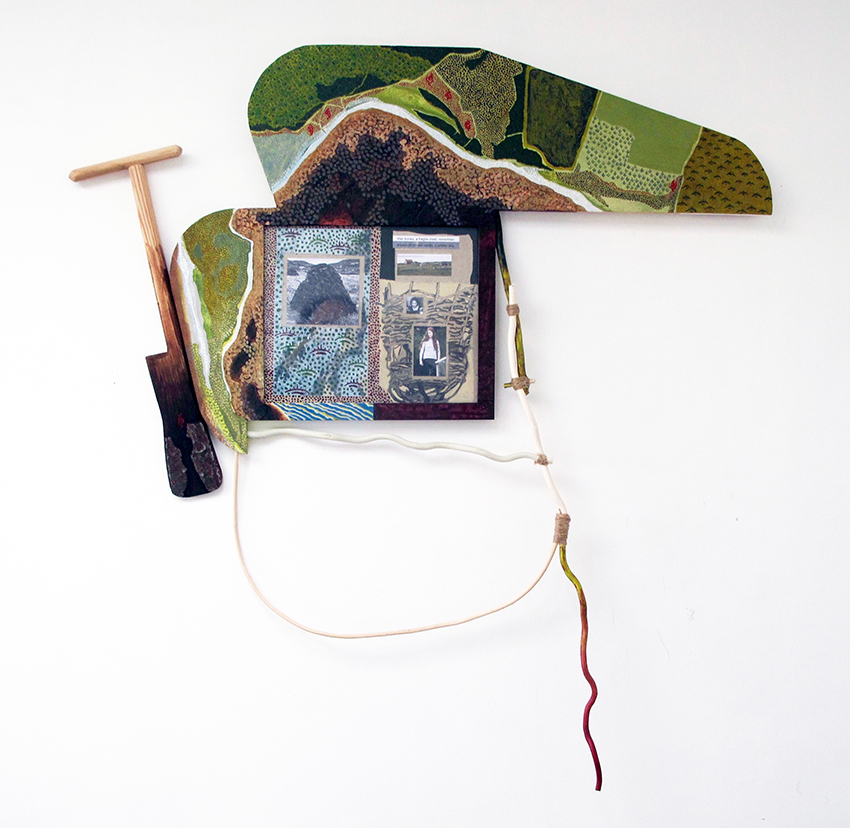
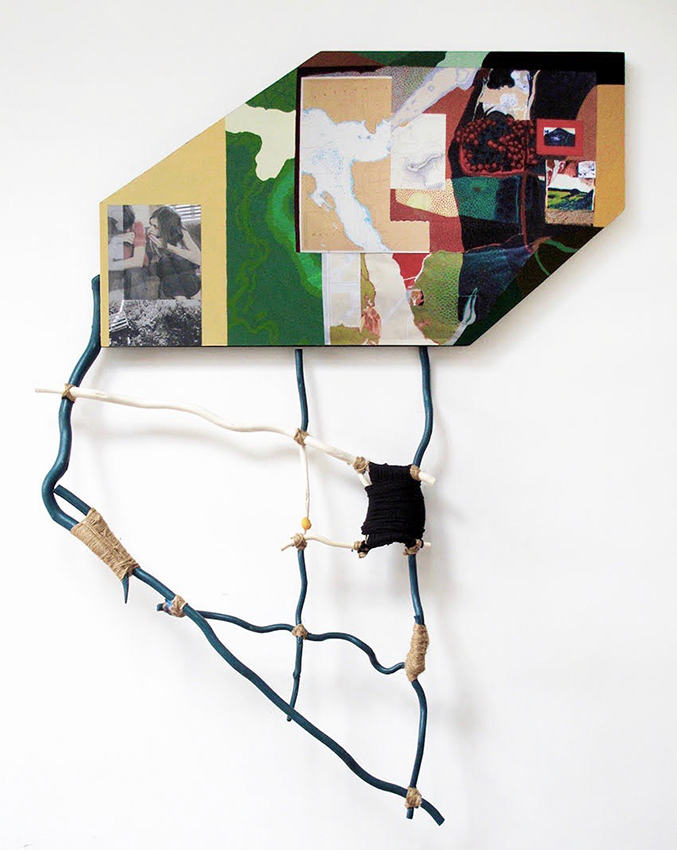
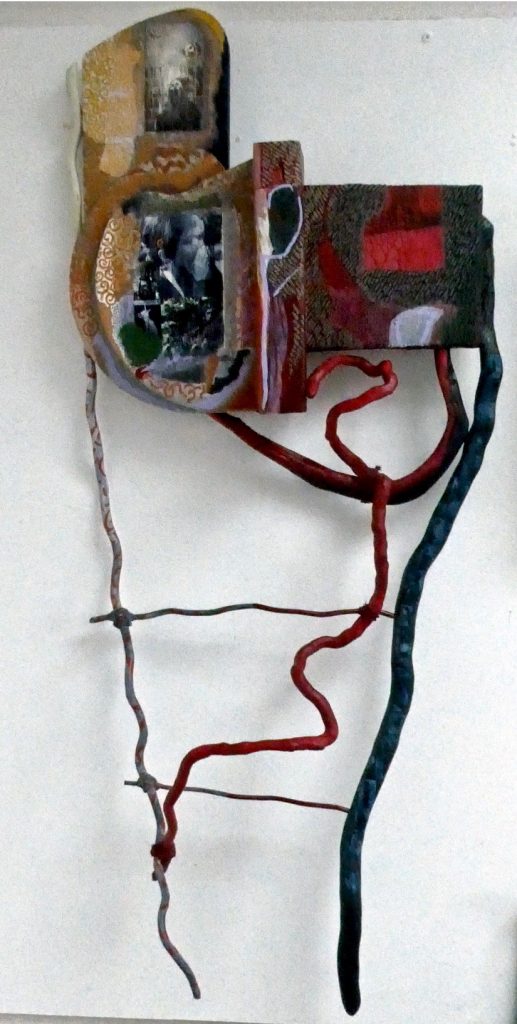
In my last years at school, and as a Foundation student and undergraduate, Kitaj’s work mattered a lot to me. Looking back now, I think I found his eclecticism, his preoccupation with literature and poetry, and his unashamed intellectualism both refreshing and liberating. Ultimately, they helped prepare the ground for my later interest in the complexities of deep mapping. Like Kitaj, I’m something of a bibliophile and I’ve always drawn on my reading to feed my visual work. Faced with the CORVID-19 lockdown, I made plans to make an artist’s book, an updated, and primarily visual, version of Daniel Defoe’s A Journal of The Plague Year. But, as so often happens, my imaginative energies got hijacked by another unconscious urge, in this case to engage with the figure of Medb. This came about via the construction below, called Echoing Sister, made in response to a quotation from James Hillman, who writes: ‘Elusive, mercurial, the unconscious is not a place, not a state, but a dark ironic brother, an echoing sister, reminding’. 

Echoing Sister 2020

I first came across Medb, also called Maebh, Mebh or Maeve, in 2011. (The etymology of her name makes it mean, taken literally, ‘she who intoxicates’). In that year I visited Dublin for the first time and bought a copy of The Táin. I read it and then forgot all about Medb. She reappeared in the title of Eamon Colman’s haunting painting Meabh’s tree on the hill of pain. I was writing about his work at the time and discussed the painting with him at some length. Prompted by that and other conversations with Eamon, I started to read Irish contemporary poets and became increasingly preoccupied with the work of Nuala Ní Dhomhnaill, in part because her poems seemed to me to share an orientation with the paintings of Ken Kiff, which I writing about at the time). That preoccupation deepened. Later I bought Cary A. Shay’s Of Mermaids and Others: An Introduction to the Poetry of Nuala Ní Dhomhnaill and, via the chapter Sexuality and the Myth of Sovereignty, came to her discussion of Ní Dhomhnaill’s poems concerning Medb, whose passionate concern with the dignity she should be afforded struck a powerful cord with the concerns of the Me Too movement. 

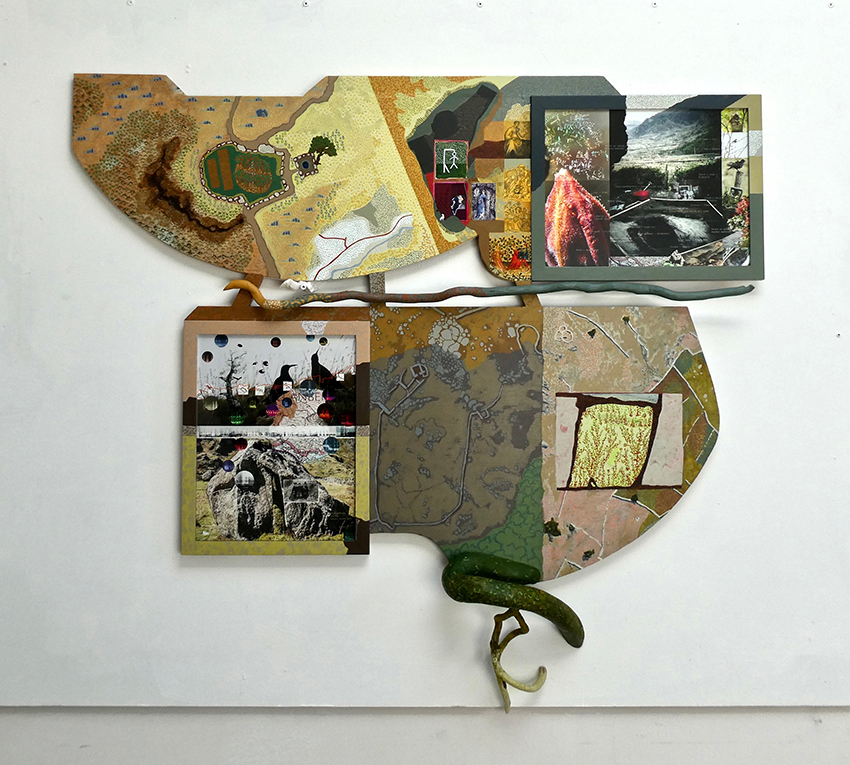
Dinnsheanchas 2020

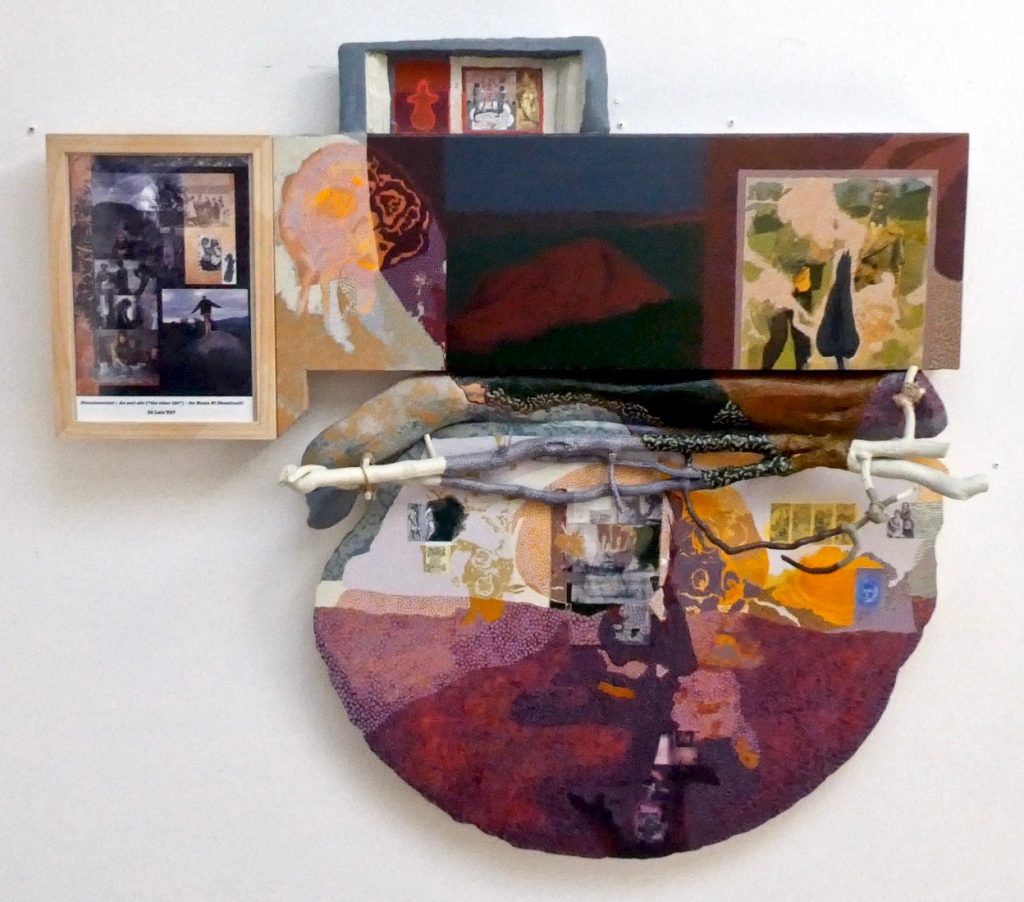
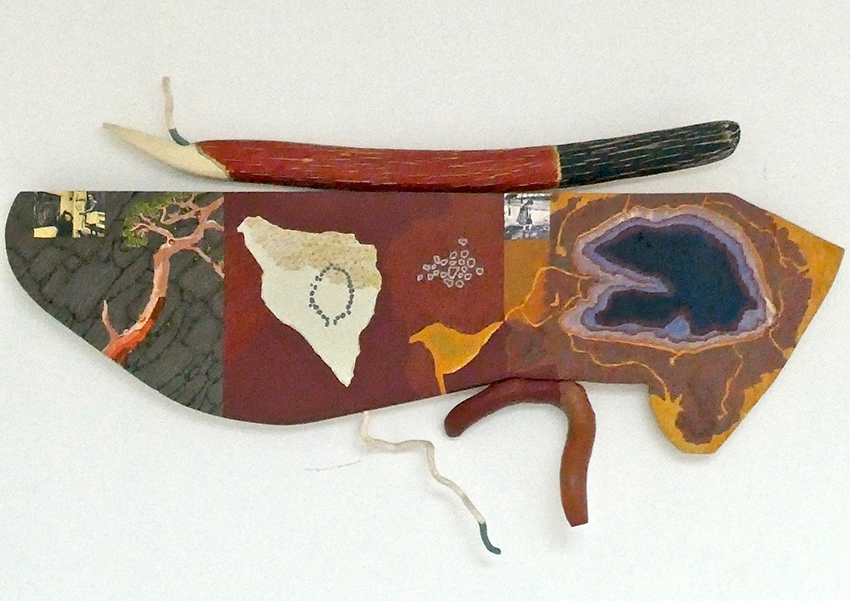
I made a constructed painting that draws on my response to  Ní Dhomhnaill’s poems and essays  –Dinnsheanchas / An saol eile (“the other life”) – for Nuala Ní Dhomhnaill – but, when I finally finished it, still felt instinctively that there was more to imagine around the figure of Medb. This, together with Shay’sdiscussion of the Medb poems, prompted me to hunt for a hard-to-find copy of Ní Dhomhnaill’s Selected Poems: Rogha Dánta, translated by Michael Hartnett. There I found and read his translations of the cluster of Medb poems in that volume that begins with Medb Speaks. All this left me with the question: who (how) was Maebh before all the misogynistic bother about husbands, bulls and heroes that makes up The Táin? There is of course no answer to that, but staying with it resulted in my making Hearsay: the young Madb, which may or may not be finished at this time.

What all this leads me to is something that the artist and printmaker Garner Tullis said about Ken Kiff. ‘Ken is a poet without a tongue as a true painter should always be’. This squares with Ken’s preoccupation with Yves Bonnefoy, who John T. Norton quotes as saying there is “a fundamental unity to everything related to the making of images”. For some, before we are ‘poets’, ‘writers’ or ‘painters’, we are first and foremost makers of images. My respect for painters like Eamon Colman and Ken Kiff Kiff flows from the fact that they imaginatively evoke the flowing-together of everyday life and that “other life” which, as Ní Dhomhnaill puts it,‘even the dogs in the street in West Kerry know … exists’; and where constant movement ‘in and out of it … is the most natural thing in the world’. ‘Poets’, in Garner Tullis’ expanded sense, work precisely by attending, often over long periods of time, to that constant movement as it emerges through making an image. (A movement considered entirely normal in most cultures and times). I hope there may be something valuable to be learned from that. The images made by people like Ní Dhomhnaill and Kiff help us to keep open to the difficult realities ahead of us, realities that governments led by political fantasists like Boris Johnson and Donald Trump are manifestly incapable of facing.  

Speculations on unlikely convergencies and affinities: Eileen Lawrence and Will Maclean.

I have been searching back over what is now a fifty year plus engagement with making images, looking for hints and clues as to what of real value I missed or undervalued.

This involves two distinct but ultimately related activities. One, prompted by the example of two painters I greatly admire, Ken Kiff and Eamon Colman, is reacquainting myself with poetry. That is, re-reading what’s accumulated on my bookshelves since I was an art student at Leeds University. This includes, among others, work by Stevie Smith, Martha Kapos, Leland Bardwell, Penelope Shuttle, Nuala Ní Dhomhnaill, Kathleen Jamie, Naomi Shihab Nye, Paula Meehan, and Anna Saunders, alongside Rilke, Yeats, Eliot, Saint-John Perse, Wallace Stevens, W.H Auden, Anthony Hecht, George Mackay Brown, Seamus Heaney, Ted Hughes, Don McKay, Charles Causley, Robin Robertson, and Octavio Paz. 

Why do this? In part because I am increasingly convinced that Gaston Bachelard is right when he states that: ‘the image cannot give matter to the concept; the concept, by giving stability to the image, would stifle its existence’. This has helped me explain to myself why I feel more imaginative affinity to the work of poets than visual artists for whom self-expression or some conceptual conceit is primary. In part simply because I can take a certain comfort from reading poetry in these difficult times. 

The other activity is to work back through past interests relating to the visual arts, disinterring and re-examining old influences and lines of enquiry, particularly those that animated some aspect of my earlier work. This has taken me back to two contemporary Scottish artists, Eileen Lawrence and Will Maclean. Their work has for many years been of constant interest, if sometimes only visible out on the periphery of current concerns. (Both artists exhibit with Art First in London, whose web site offers examples of their work). I am proud that their work was included in the exhibition Imagined Landscapes at the RWA Bristol in 2016, which I co-curated; just as I regret that my attempts to produce a book on Eileen Lawrence’s work came to nothing. Her work was for a time a direct influence on my own; so much so, however, that I had to set it aside or risk making poor variations on it. I still regard her Piercing the Black Dawn (1988) and Nightsong from Images of Paradise (1989), both painted using watercolour and gold leaf and each a monumental 180 x 260 cms and 170 x 255 cms respectively, as among the most powerfully affecting works produced in the UK in the 20thcentury. 

All of this is an extended introduction to pondering what is, in the last analysis, the implications of a simple enough speculation. 

I recently bought a second-hand copy of the catalogue Will Maclean: Collected Works 1970-2010. This includes the transcript of a conversation between Maclean and the distinguished Scottish painter and teacher Sandy Moffat. In the course of this Maclean notes that it was reading Ben Shahn’s The Shape of Content and seeing R.B. Kitaj’s work that enabled him to work his way out of his own uneasy relationship to the then dominant cult of abstraction and attendant ‘problems of form’. While this experience almost exactly echoes a rite of passage in my own self-education, what interests me now is that Maclean does not refer what I have always taken to be the highly significant influence of Agnes Martin on his work. I should make it clear that I in part assumed that influence because Martin’s paintings were given their first UK showing in Edinburgh in 1974, at a time when Maclean was mixing with Edinburgh art students and reconfiguring his practice in ways that have remained consistent ever since. To be fair the conversation with Moffat, and indeed the catalogue as a whole, has as its principle focus the underlying continuities between Maclean’s work and the culture of the Gàidhealtachd. In that context, reference to Martin might appear out of place, although Maclean is happy enough to reference the work of Giorgio De Chirico, Anselm Kiefer, Joseph Cornell and H C Westerman.    

I now realise that Maclean, unlike Eileen Lawrence, may not acknowledge the influence Martin’s work in that Edinburgh exhibition because no such influence was necessary. He was already subject to forces that they ultimately share in common. Namely an emotional inheritance infused with a profound sense of the value of stripped back means, of a work ethic grounded in simplicity and rigour, although one with a rich poetics derived from the Gaelic language. The inheritance that had helped characterize the lives and spiritual attitudes of their Calvinist ancestors in the Highlands and Isles. (Agnes Martin’s family originally came from the Isle of Skye). 

What I find instructive now is that Maclean should apparently have had no difficulty in squaring such inherited proclivities with the exotic object lessons proffered by Kataj’s cosmopolitan, colorful (in both senses) and eclectic images. Images that draw, for example, on his particular personal interest in Jewish culture, the byways of art history as reveled by Aby Warburg, or moments in nineteenth and early twentieth century leftist political and literary life. Just as Eileen Lawrence had no difficulty, so she told me, in squaring her admiration for Martin’s work with her enthusiasm for that of Joseph Beuys. Yet any obvious affinity with Beuys is entirely absence from  recent works such as Eagle Circle, Greylag Flying North and Owl Habitat (You can find these reproduced here. That is, absent until we remember Beuys’ underlying affinity with the processes of natural phenomena in places like Rannock Moor and his interest in the colour theories of Goethe and Rudolf Steiner.    

The comfort I take from reacquainting myself with this apparently unlikely mesh of affinities is neatly captured by Maclean when, having listed what he refers to as the ‘ingredients’ that have helped shape his work, he adds that: ‘the way they mix and the way they finally evolve is the great mystery of our trade’. To work at any depth as an artist requires, it seems to me, precisely to place one’s trust in the processes that constitute that ‘mystery’ and, having done so, listen to what they bring to us. After that, it’s all a question of finding the appropriate forms for what is waiting to emerge.            

Notes on a practice reconfigured

Introduction

For some years now my practice has been gradually reconfigured, moved away from the conception of deep mapping that had evolved over the previous last twenty years. That conception was ultimately inseparable from walking as a way of engaging with the physicality of place, as a vital counterpoint to its multiplicity of invisible aspects. However, following a course of chemotherapy in 2013 after an operation for bowel cancer, I developed peripheral neuropathy. The resulting discomfort as far as my feet are concerned has been enough to severely restrict my desire to walk the kinds of distances and in the kinds of places previously central to my deep mapping work. 

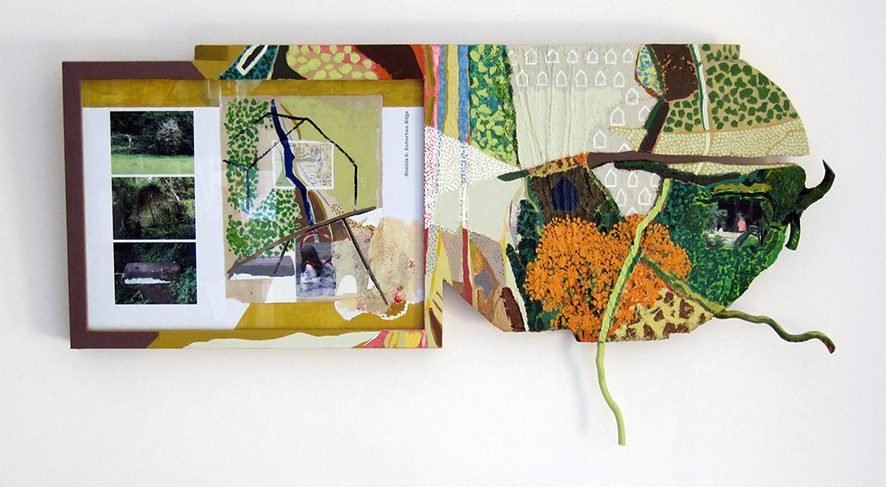
Initially, my solution to this restriction was to make a number of constructed mixed-media pieces – such as Notitia Six Suburban Edge, 2016 (fig. 1) in the Notitia series – based on places I either already knew well or were in themselves small enough in scale to enable me to walk there and absorb something significant about them in a single day. Judith Tucker, in her chapter ‘Walking Backwards’ (in David Borthwick, Pippa Marland and Stenning’s edited collection: Walking, Landscape and Environment, 2020), has given a sympathetic account of how these small-scale ‘polyvocal’ works developed out of my attempts to arrive at a lyrical micro-mapping that both drew on my previous deep mapping work and tried to develop its impulses in another, more ‘painterly’, direction. In short, these works marked the start of a shift away from my deep mapping back towards my earlier practice as a painter, one that allowed me the freedom to play with what Tucker describes as “a constellation of viewpoints, montage, collage and bricolage” that “does not allow any fixed reading of the landscape that is referenced” (p. 137). 

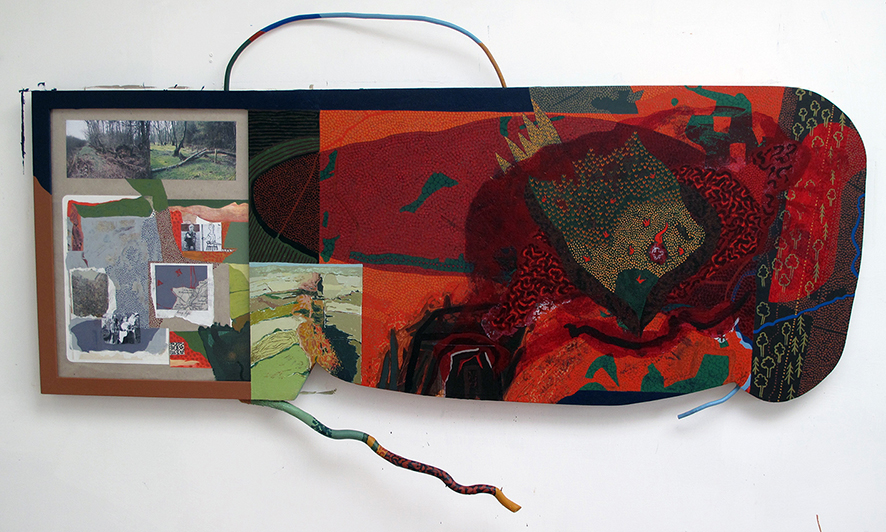
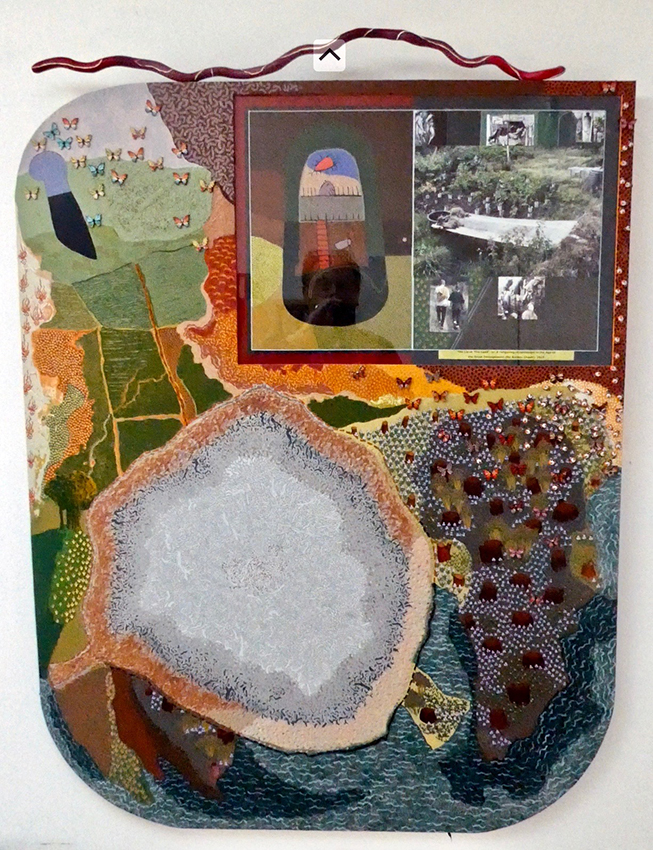
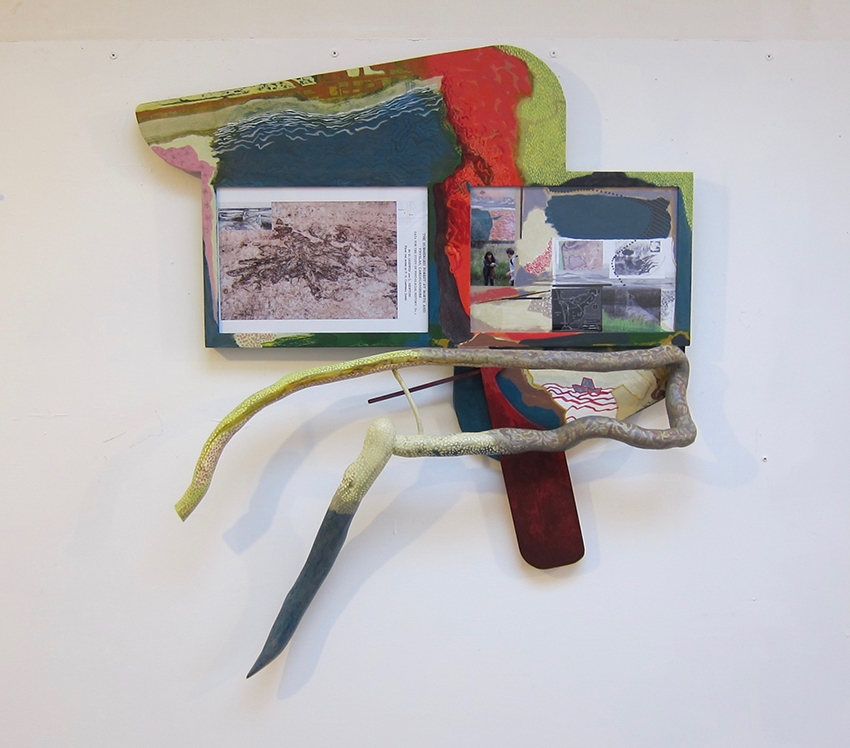
However, while I wanted to continue to enjoy the playfulness with regard to evoking place in these works, particularly what Tucker sees as their “extraordinary range of materials and categories of sign (ibid.), I also found my concerns gradually shifting from a focus on place ‘as such’ towards various social, political and environmental issues associated with it. For example, those of opposition to religious authoritarianism, migration (both physical and in terms of identity), and the problematic nature of any essentialist politics of ‘the land’. Working with these topics in mind on various pieces – for example  At the Border (RIP Anna Campbell), 2018, (fig.2) The Migrants, 2019 (fig. 3), and The Lie of ‘The Land’; or: A refiguring of landscape in the Age of the Great Derangement (for Amitav Ghosh), 2019 – 2020 (fig. 4) has drawn me into a complex set of considerations related to both my growing engagement with issues raised by the work of Irish artists and poets, particularly the painter Eamon Colman, about whose work I’ve written and who encouraged me to read Irish poets, and the work of the poet and essayist Nuala Ní Dhomhnaill. (Issues that, to a considerable extent, have also been raised through my recent collaboration with the Welsh artist Lindsey Colbourne). The purpose of this essay, then, is to give a post-hoc account of this fitfully uneven and ongoing shift so as to try to clearly identify for myself where I now find myself in relation to the trajectory taken by the work.   

Starting to let go: ‘Outliers’ and Irish connections

Inevitably, the reading and writing I’ve been doing over this time has had an impact on what I have been thinking about and doing in the studio. Perhaps the two most significant provocations in the last three years in this respect have been my reading the essays in Outliers and American Vanguard Art, the catalogue to an exhibition of that name instigated by the National gallery of Art, Washington, edited by Lynne Cooke and published by the University of Chicago Press, writing about the work of the painters Ken Kiff and Eamon Colman, and reading the poems (in translation) and then the collected essays, of the Irish language poet Nuala Ní Dhomhnaill. The catalogue essays caused me to reconsider the reasons for my having adopted deep mapping as a practice in the first place; Nuala Ní Dhomhnaill’s work, now bound up with writing on the work of Ken Kiff and Eamon Colman, served as a powerful stimulus to reconsider my approach to imagery and to visual language. I will touch on each of these provocations in turn, since together they have led me to reconsider the whole trajectory of my practice since the mid-1980s. 

Of the essays in Lynne Cooke’s magisterial catalogue, her Boundary Trouble: Navigating Margin and Mainstream, Darby English’s Modernism’s War on Terror and Suzanne Hudson’s Personal Voyages made the strongest impression on me. Cooke unpacks the institutional rigidity …”in the museum, as in the academy” that means that “reparative practices” [retrospective inclusion] “rarely contest the foundational structural hierarchies on which relationships between the margins and mainstream are built”. (p. 24)  English focuses on the same issue but in the context of criticism, reminding us of: 

“The often brutal character of modernist criticism is shown in its insistence on the primacy of external judges, which is another way to describe its tendency not to think of the makers as the primary seers and knowers of their work. No matter how sympathetic to artists, properly vanguard criticism displaces maker’s vision and knowledge in favour of its own rigorously cultivated awareness of how Art (i.e., the feverish machinations of autonomous aesthetic forces) operates in the work at hand”. (p.31)

Finally, and equally importantly, Hudson writes of the importance of considering: 

“the cosmos as a way of dissolving the ostensible distinction between individual subjective experience and the larger world. What might it mean to argue for the fundamental impossibility of being an ‘outsider’ relative to art making? It is to assert that each person, each maker, exists with no greater or lesser salience than another, as physical fact”. (p.118)   

 She continues: 

“As the present exhibition proposes in using the cosmos as an organizing theme of one concluding section, and as this essay upholds relative to the artists brought together under its mantle, world making is central. These artists are both part of a cosmos and they create cosmos.”

 While I have always had an interest in what, following Cooke, I now understand as ‘Outlier’ rather than ‘Outsider’ art, the primary effect of reading these essays was a sense of considerable relief, a final shaking off of residual anxieties and restraints internalised during my long and sometimes difficult sojourn in the world of university art education. Most fundamentally, perhaps, a questioning of the ultimately conceptual or intellectual basis of deep mapping, its intellectual bias. A relief that, in turn, would make clear to me some of the less positive reasons for my taking it up in 1999, which I do not intend to go into here.   

The effects of my engaging with the poetry and essays of Nuala Ní Dhomhnaill are now inseparable from both my return to studying the work of Ken Kiff and my deepening relationship with various artists in Ireland. They are, in consequence, more difficult to summarise. Central, however, is my renewed sense of how, through the physical act of making works in all their visual “musicality”, it may be possible to imaginatively evoke the flowing-together of everyday life in all its multi-faceted variety and the complexity of our relationship to place-time and that “other life” which, as Ní Dhomhnaill notes in her essay: ‘Why I choose to Write in Irish, the Corpse That Sits Up and Talks Back’, ‘even the dogs in the street in West Kerry know … exists’; and where constant movement ‘in and out of it … is the most natural thing in the world’ (Selected Essays 2005 p. 19). I sense something of this psychic inclusiveness as distinguishing aspects of Irish culture from that of England. It is echoed, for example, in the work of the painter Eamon Colman who insists that: “the earth is a living being like you or I … it’s an organism that breaths and communicates.” (In conversation with Brian McAvera: ‘Between Landscape and Abstraction’ in Irish Arts Review Spring 2007 p. 67). It is typified, for example, by his Meabh’s tree on the hill of pain (2017) with its echoes of both the specificity of place directly experienced and the continuing resonance of mytho-historical Irish characters in shaping that culture’s sense of place or, in Irish, dinnsheanchas. To summarise: what both sets of provocation have led me to is a re-evaluation of my priorities, one that now leads me to an emphasis on a poetics of listening that I want increasingly to distinguish from the more programmatic, research-based approach to creative work I adopted at the turn of the century. 

I now see this shift as linked to a renewed interest in the importance of poetry to visual art, something Kiff understood only too well,  particularly of certain types of poetry. For example, in addition to Nuala Ní Dhomhnaill I have been reading the Scottish poet Robin Robertson, who was brought up on that nation’s northeast coast where, as he has said, “history, legend and myth merged cohesively in the landscape.” Furthermore, Robertson’s  interest in the stories of Celtic and Classical myth, the vernacular ballads, and folklore align closely with my own as they fed into my deep mapping work. Perhaps most significant to me now, however, is his terse claim that ”writing poetry has very little to do with the intellect”.

Figs. 5, 6, 7, 8 & 9.

Transition

I’ve now reached a point where, having worked on a number of formally loosely related pieces following on from the Notitia series, I see them as having led me to a point from which I cannot find a way forward. These works include Flight/Paths: (Her bones…) , 2018 (fig. 5), a collaboration earlier this year with Lindsey Colbourne that produced a piece entitled  Côr-lan Siwan – of which title she writes that this phrase: ‘combines something of the sacred (Côr = sanctuary as well as choir, and Siwan [the Lady of Wales] in recognition of her as the connecting element’ – (fig. 6) and, most recently Dinnsheanchas / An saol eile (“the other life”) – for Nuala Ní Dhomhnaill, 2020 (fig. 7). The nature of the problem I face is implicit in what I have already written, namely that I have clung onto the programmatic, research-based approach carried over from my earlier deep mapping work which, while it fed reasonably productively into the works mentioned above, has increasingly come to feel stale and unproductive, a hindrance rather than a necessary support. In retrospect this began to become apparent in works like Wound, 2020 (fig. 8) and Seithenyn Morfa Borth/ Cors Fochno (for Erin Kavanagh), 2020 (fig. 9) For some weeks in late May and early June I was preoccupied with an upwelling of half visualised possibilities but found myself unable to take these into any specific work. This upwelling circled around a statement by James Hillman, as follows:

Elusive, mercurial, the unconscious is not a place, not a state, but a dark ironic brother, an echoing sister, reminding. (On Paranoia 1986 p. 41).

Fig. 10

In mid-June I decided to try and force the issue, starting work on a piece provisionally called Echoing Sister a construction that, in its engagement with unconscious material, reaches back to Double Mapping, 2017 (fig. 10), a work that tries to ‘map’ a recurrent childhood nightmare involving an encounter with a wolf the height of a man. In trying to crystalise a form for the new construction I turned to the work of two artists who make constructed work, Will Maclean and Mimmo Paladino, looking for a way to consolidate and develop the complex construction and imagery I had used in Corlan and Dinnsheanchas / An saol eile. Productive as reviewing their work has been, Echoing Sister now feels like a mis-step, an attempt to move things on formally without addressing the more fundamental issue of a necessary shift of attitude on my part if I am to work out of listening to, and then working in response to, an upwelling of unconscious material rather than constructing what I now see as a programmatic ‘safety net’ of researched material that starts to dictate what is, and is not, present in the work. 

This mis-step became clear when I found myself following a thread of feeling prompted by the name Maebh that had attached itself to an old photograph intended for a project begun in about 2010 and never realised. My first reaction, conditioned by my tendency to always begin by constructing a loose web of meanings through research, one that will then support the constructing of an image, was to ask a friend of Irish descent whether she knew of any material relating to Queen Maebh as a girl. My intention had, as so often before, been to gather the types of historical and vernacular material out of which a sense of place can be illuminated via the processes of deep mapping. But the image of Maebh (as the girl in the photograph has now become), resisted this attempt to imprison her within a scholarly framework of given meanings. What it/she requires, I now understand, is that I allow an imaginal matrix to slowly form, a container into which the additional material necessary to amplify. It appears that all that matters, at least for the present, is that I keep in mind that the name means  “the cause of great joy” or “she who intoxicates” and the description of the adult Medb as a “wolf queen”, an attribute which carries psychic resonances that have been with me since I was a child. 

While I wait for the material that I hope will become a work to start to crystallise around the Maebh photograph, I have been following my nose along apparently random threads of interest in the vast storehouse of images that is Pinterest. This had taken me, to give a few examples, to the extraordinary visual richness of  a book containing 99 pages of swatches or samples of silk, from Lyon and dated 1764, to the drawings of the brain made by Santiago Ramón y Cajal at the end of the 19th century, to posed photographs of heroic Soviet female snipers, and to wonderful examples of the motifs used in the craft of traditional book binding and decoration. At present, all I can do is sift through this material, listening out for whatever speaks to the image of Maebh in the hope that, like a caddisfly larvae, she will gather to her the material she needs to house herself as an image.