Between creative praxis and place governance: four examples

What follows here is the text of a presentation given at the Landscape Values: Place and Praxis conference held at NUI, Galway (29th June – 2nd July). This differs slightly from the text published by the Centre for Landscape Studies in their excellent pre-conference publication in that I felt it was necessary to respond to the situation resulting from the referendum vote that Britain should leave the EU. I will put a detailed account of my experience of the conference up here in due course. 

In her novel The Telling Ursula LeGuin has a character say of her people’s self- destructive adoption of a particular idea that it was a protest: “an assertion of our God-given right to be self-righteous, irrational fools in our own particularly bloody way and not in anybody else’s”. That just about sums up what Britain is going through – the protest essentially the consequence of a massive failure of empathetic imagination on the part of the political and economic elites.

Such failure of empathetic imagination is not of course restricted to the UK. Consequently our landscapes will continue to be subject to bitter conflicts that raise difficult questions about democratic participation in planning and governance processes. New forms of compound or hybrid creative praxis are already helping to catalyse public debate and engagement regarding these processes, but they remain under-utilized. I suspect that those who frame governance debates, along with many special interest groups, often have little or no idea of what these new forms of praxis involve or how they might help them. That needs to change.

Evoking empathetic imagination is as central to democratic politics as accurate information, particularly in relation to the politics of place. Without it different constituencies quickly find excuses to stop listening to each other. Then democratic processes are likely to be perverted or undermined, perpetuating a legacy of popular resentment. Empathetic and informed engagement with issues of place requires imaginative and empathetic translation and mediation between the professional expertize that authorizes governance and the concerns of vernacular life-worlds grounded in rural place.

I’m going to touch on “creative translation” projects by Kathy Fitzgerald, Simon Read, Christine Baeumler and Ffion Jones. Each project is contingent on, and embedded in, a particular landscape and mediates between values grounded in place and a specific set of governance concerns. Although the people animating these projects are arts trained, each employs a whole constellation of different skills. For example, in addition to her training as a performance artist, Ffion Jones’ practice is equally constituted by her skills as a Welsh language speaker, an upland sheep farmer, a scholar, a young mother, and so on. However, at present the value of such constellated practices is largely unrecognized because of the dominant belief in a monolithic identity that says, for example, that someone is either an artist or a farmer.  The Norfolk farmer Richard Wright says of his local Farmers and Wildlife Advisers that they have ‘a very hands-on approach’ and ‘local knowledge of farming as well as conservation’, showing farmers the two can work hand in hand’. But for this hands-on model of cooperation to be extend to actively involve the public more generally, it needs an active cultural dimension and the involvement of artists as people trained to see unlikely connections and possibilities across different sets of concerns and interests.

In Ireland severe winter flooding during 2009-10 and 2015-16 has highlighted the need to plant trees as a step towards flood prevention. Because this would involve issues of land ownership, it will require careful mediation. Cathy Fitzgerald’s Hollywood Project could offer a valuable point of departure for just such mediation. Begun in 2008, this project involves the transformation of an ecologically toxic and aesthetically unattractive Sitka Spruce plantation planted about thirty years earlier. At its heart is her forty-year commitment to facilitating exchanges between the original plantation and local people, silvicultural specialists, wildlife, timber users, artists, and environmental enthusiasts. With the wood as her focus, Fitzgerald’s eco-aesthetic concerns have catalysed complex negotiations between traditional forestry economics and the desire of local people in County Carlow to re-establish broadleaf native trees. This in turn is generating debates about the relationship between the policies of the Irish Council for Forest Research and Development and the ecological, creative, political, and educational concerns of a variety of both local and national constituencies.

Cathy Fitzgerald aims to advance knowledge in aesthetic and eco-critical terms as these relate to forest research, policy and eco-jurisprudence. This reflects the fact that she has degrees in both biology and art. Between 2004-2007 she also worked alongside Irish Green Party Cllr. Mary White, later Junior Minister of State, helping to establish the largest Green Party group in rural Ireland. She now serves on the committee of the forestry group ProSilva Ireland. In short, she is both creatively and politically involved in matters of environmental governance.

The Hollywood project is also a response to the fact that Ireland has the lowest proportion of deciduous trees in Europe after Iceland and Malta, and to the problems thrown up by an extensive forestry policy that, however, has been assembled piecemeal. As the intersection of complex networks of shared practical expertise and environmental knowledge, the project has the potential to rearticulate the relationship between watersheds, tree cover, and pluvial flooding. While Inter-Departmental Committees can initiate new national flood policy, without locally grounded creative individuals and networks engaged in transforming local attitudes to trees and forestry, the resistance to such policy is likely to be substantial. (For a better sense of Cathy’s practice see her recent post and video).

Simon Read works from a barge on the River Deben as an artist, University lecturer, environmental designer, community mediator, and ecological activist. Since 1997 his involvement with the River Debden has led to his working with the Chartered Institute for Water and Environmental Management and ARUP, with geographers through the Royal Geographic Society, and with similar organizations in Ireland and the USA. He has contributed to major workshops on flood planning and, since 2009, has served as an Executive Member of Deben Estuary Partnership in collaboration with the Environment Agency. He’s involved in mediation work with Natural England, the Marine Management Organisation, statutory Government agencies, his Local Planning Authority, and a host of local interest groups. He’s also an Associate of the Art and Environment Network of the Chartered Institute for Water and Environmental Management. Like Cathy Fitzgerald, his work involves a range of skills, knowledge and activity, that go far beyond the stereotypical view of what an artist does.

This type of large imaginative mapping – a response to governance issues relating to the fluid and shifting environments of rivers and coastlines – is now central to Simon’s work They visualize changes between land and water over time by synthesizing large amounts of predictive information from different sources. Simon retrieves, cross-references, and synthesizes this information so as to equip himself and others to engage in complex environmental planning debates about fluvial, estuarine and coastal management in governance contexts. Interacting with both governance and local concerns, it also contributes directly to current eco-social debate around the core issues of communication in relation to the implication of policy.

In addition to his visualizations of the changing local environment, Simon Read is currently worked on the Falkenham Saltmarsh Project. This aspect of his work involves making objects that address the conditions of, and potential for, marsh stabilization within the context of coastal erosion. Working with a range of agencies, including labour from a local prison, he has planned and built barriers that prevent erosion of the saltmarsh by managing tidal flow and encouraging the controlled deposition of silt. Both practical and sculptural, these are soft engineered from timber, brushwood, straw bales, and coir – a natural fibre extracted from the husk of coconuts – and will degrade back into the marsh over time.

Read has responded to the challenges of managing environmental change by acknowledging the need for, and publically working towards, more nuanced and complex solutions necessary to understanding and addressing the socio-cultural implications and dimensions of socio-environmental change. While grounded in the traditional skills of an artist, his work relates directly to a societal re-framing of our understanding of land, ownership, professional and aesthetic responsibility, and belonging.

Christine Baeumler enables a civic environmentalism predicated on ecosophical understanding and animated by a geopoetics attuned to the multiple meanings and contexts of our lived experience of landscape. Working between the production of public environmental art, teaching at the University of Minnesota, curation, and community activism, her expanded creative praxis facilitates both awareness of environmental issues and appropriate responses to them. Drawing on both art and natural science, she contests the reductive treatment of ecosystems and the loss of human experience of specific environments and the species that inhabit them. Like Simon Read she makes eco-social contexts visible so as to inspire creative solutions to environmental dilemmas by imagining alternatives to current approaches. Her ‘slow’ place- and community- based praxis considers historical, cultural, environmental, metaphorical and aesthetic dimensions of place to address pressing eco-political issues constantly in flux. She currently focuses on collective ecological restoration of urban and edgeland spaces, paying particular attention to increasing biodiversity, providing habitat for pollinators, and improving both the water quality and aesthetic dimension of sites.

The particular qualities of Baeumler’s practice appear in her role in the realisation of Bruce Vento Nature Sanctuary Project.  Since 1994 she has worked, as local resident and artist, on community-led ecological restoration initiatives on the East Side of Saint Paul, Minnesota. These projects have been realised through collaborations with local residents, ecologists, hydrologists, engineers, University of Minnesota art students, the Como Park Conservatory Youth program and the East Side Youth Conservation Corps of the Community Design Centre. As a member of the Friends of Swede Hollow Park and a founding member of the Lower Phalen Creek Steering Committee, Baeumler worked with community activists and City officials to transform a twenty-seven acre heavily polluted rail-yard beside the Mississippi into the Bruce Vento Nature Sanctuary, now a city park. An important dimension of the critical translation central to this project is her membership of Healing Place, founded by Dakota artist and activist Mona Smith, which aims to heal connections between people and places formally sacred to the Dakota Nation, of which the park is a significant example.

Chris Baeumler has also served as Artist-in-Residence in the Minnesota Capitol Region and the Ramsey Metro Washington Watershed Districts, working with these governance units on large-scale water infrastructure projects intended to raise the visibility of water infrastructure and quality issues through educational and aesthetic interventions. Her interest in water systems then led her to form the team, including an engineer and ecologist, who created Reconstituting the Landscape: A Tamarack Rooftop Restoration. This micro bog ecosystem is located above the entryway to the Minneapolis College of Art and Design. This calls attention to the fragile tamarack bog ecosystem under threat in Minnesota, replicating it in miniature as green rooftop infrastructure, and led to her making Bogs, A Love Story, a documentary film about six different bog experts.

Baeumler has recently animated both educational and regional governance debates through Pollinators at the Plains project, based on a sustainable redesign of the Plains Art Museum’s outdoor campus in Fargo, North Dakota. This included a youth internship program and work with artist and horticulturist Seitu Jones. The educational focus her links directly to Baeumler’s work at the University of Minnesota teaching courses that engage students in creatively working with systems of water, food, transportation and civic engagement between art, ecology, climatology and social studies. As with both Cathy Fitzgerald and Simon Read – and in the tradition of Joseph Beuys – the educational dimension of her work needs to be seen as inseparable from her expanded creative praxis as a whole.

I want to end by paraphrasing a conversation between Ffion Jones, a representative of Natural Resources Wales, the academic and activist Dr Alex Plows, and others involved in a major Hydro-citizenship project. This took place in Taly Bont memorial hall in February this year and I’m grateful to Alex, who translated this exchange from the Welsh.

Ffion is making a film on local farmers’ relationship to water that addresses their concern about changes that challenge their sense of being primarily food producers from an environmental perspective. To do this she has to mediate between past and present attitudes to water management, dipping, run off, and so on. In the past the Environmental Agency prosecuted local farmers over dipping practices, which had produced both change and a culture of resentment. The official assumption in the discussion was that this was partly because the agency hadn’t done a very good job of educating farmers, so that “stewardship of the countryside” had become negatively associated with enforcing compliance through bureaucratic means, which simply generated resentment and resistance. This was contrasted with practices elsewhere, which had focused on respecting/appreciating farmers’ own “local knowledge”.  This approach was seem as best supported by indirect mediation. This would mean that, rather than an Agency approaching farmers with a view to introducing their environmental agenda – which will then be coloured by a history of resistance – someone like Ffion who shares their values, doesn’t trigger the same reaction. The group then turned to discussing the role of the arts in ‘bridging and translating’, essentially along the lines I’ve outlined here.

What is distinct about the praxis of individuals like Ffion is that it speaks from within a rural life-world – informed by her being a farmer’s daughter, farmer and farmer’s wife but also by critical engagement as an academic and performer. By mediating between the multiple, often antagonistic, dimensions of that life-world, such work presents important insights. It constitutes an important and necessary alternative to top-down official governance perspectives – “we must educate farmers” – and to largely urban-based environmental lobbyists – by providing another informed voice.


For this to happen professionals working with governance and related agencies need to recognise that such praxes can both extend their own understanding and inform a more democratic and productive approach to the governance of place.  While individuals involved in the hands-on running of bodies like the UK’s National Parks are increasingly recognizing the value of such creative translation, they often lack support from those who write policy and control budgets. But today no professional body or governance agency can safely assume that it has the ethical authority, or even the practical ability, to catalyze the informed ‘civic environmentalism’ necessary to address the increasingly complex landscape issues we face.


If citizens are to commit themselves to bettering their environment, sometimes against their own short-term economic interests, new and empathetic forms of understanding need to emerge. This can only happen if the discursive arguments of governance professionals are translated into terms more sympathetic to broader and more empathetic public dialogues. The types of praxis I’ve identified have the power to facilitate a thoughtful and deeply felt mediation between governance professionals and the places and communities that ground rural life-worlds.


Thank you.

The murder of Jo Cox

I keep wondering whether it is wrong to think that Nigel Farage, Boris Johnson, Michael Gove and their ‘Brexit’ friends are directly responsible for whatever seems to have happened in the mind of the man who murdered Jo Cox?

What is clear is that her murder is indicative of what follows on from the kind of near-Fascist anti-immigration sentiments expressed by Farage, aided and abetted by the low, popularist Nationalism of the Brexit camp. Their toxic mix of political opportunism masked as patriotism, Little England xenophobia and their tapping into a repressed post-colonial resentment – the trigger for the endless cant we have been hearing about ‘British sovereignty’ – is now set to drag a country already deeply divided by the unfettered consequences of our culture of possessive individualism into what is starting to look uncomfortably like a replaying of the Fascistic abyss of the 1930s.


Good people in dark times

I have been working away at two texts – a book chapter entitled Re-visioning “North” as an ecosophical context for an education in creative practices – and a presentation for a panel at the Royal Geographical Conference in London in September: The realpolitik of the art/geography nexus as ‘generative encounter’. Both, in very different ways, relate to what I increasingly see as the abject failure of the university system to provide an education appropriate to the situation in which we, as Northern Europeans, now find ourselves both socially and environmentally.

My usual difficulty with writing has been further exacerbated in the case of these two pieces by a couple of additional problems. Firstly, I’ve needed to keep the very real anger about what is happening to good people we know due to the rank abuse of power and privilege by members of the psychiatric and medical establishment out of my writing, since it’s inappropriate in that context. That’s proved very difficult and I’ve had to do a lot of editing and rewriting to achieve it. Secondly, I’ve been struggling to reconcile my sense of that abject failure “in general” with a couple of encounters I’ve had recently with ex-students from arts courses for which I once had responsibility.

Both women have typically compound interests. One now works as a librarian and a volunteer at the Royal West of England Academy. She talked at length about its exhibitions policy and the positive public perception of the current exhibition Gemma Brace and I co-curated there. The other is involved in socially engaged arts practice and facilitation, works part-time in a local gardening center, and is considering applying for a Masters degree in curation. Both recognised me and were clearly pleased to talk to me again. Both are people who, although I had long ago forgotten them, I am pleased to have discovered are still living and working in the city we all share as home. I also feel – perhaps inappropriately – rather proud to have been a part of their education, something that seems somewhat at odds with my current sense of the deepening failure of the academic enterprise. I am starting to wonder, however, whether this is a wholesale institutional failure affecting the outlook and actions of all its members or, alternatively, something more like a virus that infects some members of the institution to varying degrees but not others not at all. While it is tempting to assume the first, the second is almost certainly the case.

Some time in the late 1990s I read Arran E Gare’s Postmodernism and the Environmental Crisis. Of the many observations it contains, few are more chilling than those that occur when he is writing on the class he refers to as ‘the new international bourgeoisie’. This class – which certainly includes many senior academics and academic managers – is, he insists, a class contributing nothing to human welfare; a class whose attitude he believes is “summed up in the words of an economist writing in Business and Society Review: ‘Suppose that, as a result of using up all the world’s resources, human life came to an end. So what?”’ (p.12).

When I first read that I assumed that he was over-reacting to the glib bravado of some aberrant junior economist who, given a chance to make his voice heard, was desperate to impress his equally glib peers in some junior office backroom in an international counting-house. I even imagined the speaker in the image of the type of immature, arrogant, pampered late adolescent who, as a drunk first year Bristol University student, thinks it is daring to shout obscenities at the top of his voice at 2.00 am on a Sunday morning in Clifton (where I used to live). In short, someone unthinking and irresponsible as they are profoundly irritating is, beyond that, hardly a cause for concern.

I now realise I could not have been more wrong.

The attitude Gare identifies is not that of an aberrant individual who, with a bit of luck, will quickly grow up a bit but, exactly as he claims, one that defines the essential orientation of a whole class of people – including many of the political elite running the country. Taken in conjunction with Pascal-Emmanuel Gobry’s recent article Big Science is Broken , the ongoing deconstruction of what is starting to look like blatant scientific fraud in conjunction with the Pace medical trail , which is also featured in George Falkner’s report In The Expectation of Recovery: Misleading Medical Research and Welfare Reform , Gare’s characterization is a stark reminder of the depths to which a substantial proportion of the professional classes have descended in a world now wholly given over to the culture of possessive individualism. What I find particularly distressing, given my own personal employment history, is the extent to which the academic world is implicated in the worst forms of deception and self-serving opportunism that Gorbry and Falkner document.

Going back to my two former students, I’m still left pondering the tension between my sense of their worth and persistence and the increasing degradation of the system through which they passed. Part of that tension is, of course, down to the difference between academic teaching as a vocation – the face-to-face business of a conversational exchange – and the world of academic research that, at least outside the arts and humanities, has now very largely been co-opted by the new ‘entrepreneurial’ orientation of academic senior management – epitomised by the self- identification in financial terms of Vice-chancellors as CEOs.

In the end, however, I’m left with a sense of pride in the achievements of those in whose education I’ve played some small part. Not because of their “achievements” in the sense used by Deans and Vice-chancellors to impress anxious parents on public occasions – although I’m also proud of the extraordinary work my PhD students, for example, do manage to do – but because they have survived into early middle age with their curiosity and spirit intact, have in some indefinable yet very real way found ways in which to be – to borrow from Hannah Arendt’s book title – good people in dark times.

Listening, with others, in the Burren

In January this year I had an invitation from Michaele Cutaya, Katherine Waugh and Connor McGrady to participate in a two-day symposium PROPOSITION: AN ART OF ETHICS. This was to take place at the Burren College of Arts, supported by Clare County Council and the College, from Friday 11- Saturday 12 March 2016. They proposed to bring together around 10 artists, theorists and curators from Ireland and abroad to engage with the notion of Ethics and Art and to keep the form of the symposium as well as individual contribution quite open and responsive.

Michaele wrote to me that what had “prompted this event was on the one hand the feeling that ‘business as usual’ in art and art events organization is rightly challenged, and on the other a growing wariness with the way ethics is imported into the arts with its apparatus of prescriptive norms and judgments. In this context we thought that the immanent ethics of Spinoza might be an interesting proposition to explore: that is an ethics arising through practice and not preceding it. Or as Deleuze put it more eloquently: “Spinoza’s ethics has nothing to do with a morality; he conceives it as an ethology, that is, as a composition of fast and slow speeds, of capacities for affecting and being affected on this plane of immanence. That is why Spinoza calls out to us in the way he does: you do not know beforehand what good or bad you are capable of; you do not know before-hand what a body or a mind can do, in a given encounter, a given arrangement, a given combination.” (Deleuze, Spinoza: Practical Philosophy p. 125)

“This not a philosophy symposium but one aimed at art practices, and an invitation to think through some of the difficulties encountered when one is dealing with both ethical and aesthetic considerations”.

Despite the fact that I have only a fairly hazy notion of Spinoza’s ethics (and indeed of most philosophical debate more generally,(not to mention a perverse tendency to regard Deleuze as that bloke who was Felix Guattari’s sidekick for a while), I happily accepted.

When I arrived in the Burren on Thursday evening this week I discovered that the three organisers had assembled a fascinating collection of participants. These included Maria Kerin (with whom I had corresponded in the past but not met), Suzanne Walsh, Aislinn O’Donnell, Vivienne Dick, Glenn Loughran, Seamus McGuinness, Ciaran Smyth (whose partner Ailbhe Murphy I have met previously in both Dublin and Galway) , Susan Stenger, Connor McGrady, Glen Loughran, and David Burrows. This lively mixing of people and concerns ensured that we had viewpoints evoked from a spectrum of interests across philosophy and theory, music, performance, film, curation, socially-engaged visual art, education, poetry and other forms of writing. The attendants at the event appear to have been either staff and students from the college or a range of interested individuals from the west of Ireland more generally who had travelled the distance to join us.

Having freed us from the constraints of the academic conference and invited us to adopt whatever form of presentation or provocation seems to us appropriate, the organizers generously fed and housed us. They then set us in motion to find our way through our allotted task with the minimum of overt guidance.

A long and sympathetic conversation with the musician, singer, performer and artist Suzanne Walsh, along with a number of others on the Thursday evening, started to open up some interesting shared concerns and possibilities. After I had introduced Suzanne to the lyrics and music of the Borders ballad Tam Lin – neither of us could quite reconstruct the trajectory of the conversation in retrospect – she generously offered to sing some verses as an introduction to my presentation on listening on the Saturday. This despite the fact that it would mean her having to get to grips with an entirely new tune and set of lyrics in a period of little more than what already looked like being a very busy twenty-four hours.

On the Saturday morning, when Suzanne had ‘opened’ for me in this way by singing her chosen verses beautifully, accompanied by a drone from her accordion,  I read the following text:

Listening

There’s a form of listening that enables us to translate across categories, disciplines, hierarchies, boundaries and modes of being. It also allows me to use the art of conversation to navigate the volatile space between various practices – art, activism, teaching, maintaining communities of interest, researching, writing, and so on.

A long monologue about listening and conversation would be self-defeating. Instead I’ll try to evoke, using four related sequences, some difficult conversations with texts and people I respect, hoping that these will seed new conversations.

One

Paul O’Neill suggests there’s a fundamental relationship between art and a certain type of conversation. A conversation that waits for what’s unforeseen, enabling ideas to converse with time itself unrestricted by any fixed or predetermined end. A second curator – Monica Szewczyk – pinpoints the value of this:

“If, as an art, conversation is the creation of worlds, we could say that to choose to have a conversation with someone is to admit them into the field where worlds are constructed. And this ultimately runs the risk of redefining not only the ‘other’ but us as well”.

That risk – or hope – of mutual redefinition might be linked to socially engaged art but it also raises questions about the identity ‘artist’.

The practice of conversation as an art relates closely to Gemma Corradi Fiumara’s work on listening as an attempt to recover: “the neglected and perhaps deeper roots of what we call thinking”. Necessary work because we have internalised a mentality that: ‘knows how to speak but not to listen’ that, in turn, feeds a culture of ‘competing monologues’, of possessive individualism.

This conditions our relationship to others, but also to ourselves. If we don’t listen to our own ‘several-ness’, our different personas, how can we recognise them as the internalization of community constituted by our multiple attachments, connections and relationships? So listening in Fiumara’s sense is both political and ethical. It challenges possessive individualism’s silencing of our communal constitution, our multiplicity, our porosity, our sharing the contingencies and connectivities that animate the ‘us’ that we are.

Two

A David Napier writes that what is extraordinary is not how radical artists can be, but that their sense of their persona as ‘artist’ can be so conservative – a persona that, because of its assumptions about unique personal creativity, tends to exclude all other activities that define a person’s connectedness and ontological status. This presumption of monolithic singularity and uniqueness is used to model creativity by possessive individualism. This not only permeates our culture, politics, and social organisations, it informs the more fundamental complex of assumptions we make about personhood, nature and society.

Having examined the relationship between art and science, the Czech poet and immunologist Miroslav Holub argues that to focus on their differences is to distort social reality. Both modes of creativity receive only a tiny percentage of their practitioner’s time. The bulk of that time is actually spent on numerous other tasks, many of them mundane and unrelated to their specialisms yet, despite that, rarely wholly uncreative. Any conversation is necessarily enmeshed in, and partly determined by, all the synergies and tensions of our multiple tasks. This state of affairs is perfectly captured in Geraldine Finn’s observation that: “we are always both more and less than the categories that name and divide us”.

Pauline O’Connell once characterised her practice to me, in a memorably ironic tone of voice, as that of a ‘compound cur’. (We had been talking earlier about attitudes to working dogs in rural Ireland). That conversation gave me an image of the spectrum of artist’s ambition – from those who compete to be “best of breed” to those who –perhaps sometimes reluctantly – can celebrate the values of the “compound cur”. I share this image with you because it relates to Yuriko Saito’s challenge to ‘the aesthetics of exclusion’, to her argument that ‘everyday aesthetics’ informs and supports the emergent ethics of civic environmentalism.

Three

For years I’ve work with doctoral students, usually artists interested in questions about links between memory, place and identity. I have two main tasks. To help them navigate the Byzantine world of academic research protocols, and to act as a critical and solicitous fellow traveller. Both tasks involve numerous conversations to translate between our different values, skills, concerns and framings. There seem to be similarities here with the work of socially engaged artists like Jay Koh and Petra Johnson, who use conversation, focused by listening, to act on particular intersections of social, political, and ethical space.

That said, I’m often uncomfortable with the discourse of socially engaged art. For example, Grant Kester begins Conversation Pieces by setting aside object makers as content providers, to focus instead on the performative, process-based approach of context providers. I find this unnecessarily reductive. The work I do sometimes generates objects that focus or conclude some aspect of an on-going, performative, process. Those objects may be exhibited, published or performed. But it remains the case that their production also renews or extends contexts for on-going conversational work.

I wonder if these discriminations within art discourse aren’t sometimes a way of avoiding more controversial issues like the hierarchical distinctions between art and other modes of creativity? Claire Bishop, for example, reluctantly accepts teaching as an artistic medium, although she worries about the resulting epistemological problems. But, faced with the possibility of art as a medium for teaching, she falls silent. That silence returns me to a very brief conversation I had with Joseph Beuys in 1972. It ended with him saying: “always remember, education is more important than art”.

Four

As I understand them ‘art’, ‘education’, ‘ethics’, and ‘conversation’ share a common precondition – listening as active noticing. For Mary Watkins this is: “a careful, noticing attention that is sustained, patient, subtly attuned to images and metaphor”, and “able to track both hidden meanings and surface presentations”. It has a subversive dimension because it resists the mania for hyperactivity, including the frantic pursuit of cultural novelty, that possessive individualism needs to perpetuate itself. Instead it allows us to participate, slowly and observantly, in the specific particularities of our life-worlds as these happen to manifest themselves. It’s inclusive, open to the materiality of the world and to modes of non-human being. So the poet Kathleen Jamie, asked by a neighbour if she had prayed for her partner while he was dangerously ill in hospital, replied that she hadn’t. She writes, however, that she:

“… had noticed, more than noticed, the cobwebs, and the shoaling light, and the way the doctor listened, and the flecked tweed of her skirt, and the speckled bird and the sickle-cell man’s slim feet. Isn’t that a kind of prayer? The care and maintenance of the web of our noticing, the paying heed?”

I’ve very grateful to  Michaele, Katherine and Connor for organising this fascinating event. It not only allowed me to test out some thoughts in public, and to meet up with old friends like Pauline O’Connell, but also to make a whole host of new friends with whom I look forward to working in one way or another with in future.

Which leaves only the vexed question of the relationship between art and ethics. I’m not sure I have anything much to add here to what I said on Saturday morning, despite a fascinating three days of exchange, powerful impressions and debate. I was moved by the slow intensity of the movement piece performed by Maria Kerin and her movement partner, as I was by Seamus McGuinness’ work with the families of young suicides. I found plenty to interest and provoke me. including papers by both Glenn Loughran and Aislinn O’Donnell – each challenging and encouraging in their rather different ways. I was both intrigued and moved by the film by Vivienne Dick and by the musician Susan Stenger’s extraordinary musical journey, which has recently led her to  make Sound Strata of Coastal Northumberland which I can only call a sonic deep mapping of the Northumbrian coast. That said, I’m uncertain as to what it all adds up too.

This is absolutely not in any sense to suggest that we “didn’t get anywhere”. Only, perhaps, that the “where” in this case is best understood as a highly specific form of localised and particularly constellated relationally; one that, in addition to a willingness to listen, was (and maybe still is) contingent on degrees of openness, goodwill, modest aspirations in terms of what can reasonably be expected to be done, and the necessary attributes of human kindness and consideration that make living possible in a world without any hope of redemption but not, for that reason, without enchantment or certain forms of joy. Samuel Becket’s words will serve as a suitable coda here.

Fail, fail again, fail better.


Towards Hydro-citizenship? Speaking with Trevor Roberts

I spent the best part of two days at the beginning of this month at a Hydrocitizenship research project full team meeting held at the Windmill Hill City Farm in south Bristol. Some of that time I spent talking with ex-policeman and Canal Connections Director Trevor Roberts. Trevor and I first met properly at an earlier National Team meeting in Shipley in February 2015. (See earlier posts Troubling ‘epistemological/methodological’ waters? Parts 1 & 2) and I have come to value and enjoy his company.

Canal Connections is a social enterprise that explores opportunities for social regeneration. It does this through the medium of “waterways and their environs by the innovative engagement of individuals, families, communities and organisations (corporate, statutory and voluntary) whilst enhancing the built and natural heritage of that environment”.  This approach is based on the belief that “the canal environment provides a unique learning environment, particularly for those who benefit through a practical and vocational experience”. They see the canal environment as an under-utilized asset “for both individuals and agencies … seeking an alternative to traditional methods of engagement and empowerment”. As an enterprise Canal Connections embraces the potential of the canals for connecting with people on a variety of levels and they aim to use that environment as a stimulus to support those who want to develop new found skills and experiences and to encourage them to embrace opportunities. In particular those that will enable them to promote themselves and the area through the delivery of services or development of products for widespread community benefit. But there is also a strong desire to encourage individuals to learn more and, in the process, become ambassadors within and for their own communities.

I particularly enjoy talking with Trevor because he is an intensely practical and pragmatic man and, being neither artist nor academic, is less caught up in the tensions between conceptual projections and personal ambitions and anxieties that tend to complicate participation in any big research project of this kind. That’s not to say there aren’t things he’d like to get out of the project on a personal level, since he is obviously keen to build on what he’s learning, but only that he’s more open and straightforward about how his personal and collective concerns are related. Anyway, I enjoy talking with him both for the pleasure of it and because doing so helps me understand more clearly the internal dynamics of the research project as a whole.

Trevor is clearly a pragmatic manager who tries to do whatever is required of him to get things done. The emphasis in his work on giving others practical and vocational experience clearly reflects his own values and experience and there is no a trace of the ‘high altitude’ assumptions that are second nature to so many academics or artists (who, ironically, are often the first to criticise this tendency in academics).

I’m currently very interested in Gemma Corradi Fiumara’s work on listening as an attempt to recover: “the neglected and perhaps deeper roots of what we call thinking”. (See her The Other Side Of Language: A philosophy of listening Routledge 1990). Necessary work because the academic and cultural worlds in particular have internalised a mentality that: ‘knows how to speak but not to listen’; and that, in turn, feeds the culture of ‘competing monologues’ on which possessive individualism is predicated. Much of what Trevor and I discussed relates, albeit indirectly, to the business of face-to-face listening as a way of validating practical experience.

I’ll summarise this in my own terms, rather than those of the conversations themselves, but very much with Trevor’s approach in mind. We spoke about the value of managing creative tensions – of listening in the spaces between polarised positions so as to shift attitudes, and of the necessity of linking listening to those normally not heard to practical, transformative, action. We spoke about the need to enable communities of place and interest that have little or no voice with regard to the authorities who determine significant aspects of their lives – something I see as replicated in the sphere of academic management. We spoke about the way in which specialist academic and cultural language and practical ambitions need very careful mediation if they are to become something of value to communities.  We spoke about the importance of enacting terms like  ‘listening’, ‘validating’, ‘learning’, ‘translation’, acknowledging multiple ‘voices’, etc. so as to encourage people to change the way in which they relate to each other, and we spoke about the time necessary to developing transformative conversations. 


Ireland in March and other concerns.

I will be travelling to Ireland in March to take place in the event below.


“Proposition: an Art of Ethics is a two day symposium which will take place at the Burren College of Art on Friday 11th and Saturday 12th March 2016. The event is supported by Clare County Council, NUI Galway and the Burren College of Art and is co-organised by Michaële Cutaya, Katherine Waugh and Conor McGrady (Dean of Academic Affairs Burren College of Art).

Participants include: Iain Biggs, David Burrows, Vivienne Dick, Maria Kerin, Glenn Loughran, Seamus McGuinness, Aislinn O’Donnell, Ciaran Smyth, Susan Stenger, Judith Stewart, Suzanne Walsh.

“Spinoza’s ethics has nothing to do with a morality; he conceives it as an ethology, that is, as a composition of fast and slow speeds, of capacities for affecting and being affected on this plane of immanence. That is why Spinoza calls out to us in the way he does: you do not know beforehand what good or bad you are capable of; you do not know beforehand what a body or a mind can do, in a given encounter, a given arrangement, a given combination.”
Gilles Deleuze Spinoza:Practical Philosophy

This symposium gathers together artists, theorists and curators for two days of research and experimentation. All contributors have been invited to engage through their practice with ideas relating to a conception of ethics which differs substantially from dominant notions of morality. The starting point of the symposium – its founding ‘proposition’ – is philosopher Gilles Deleuze’s reading of Spinoza, given Spinoza’s extensive influence on recent artistic practice and thought around the ‘ethical’ in art. For Deleuze, Spinoza’s ethics was a “a long affair of experimentation” which re-conceptualised the relationship between life, thought and practice, and this symposium will attempt to foster such an ethos of experimentation in its content and structure – proposing ethics as a methodology in contrast to the rigid principles of morality. The many nuanced and singular methodologies required in artistic practice will be addressed in a variety of presentational formats by the invited participants: from art and music, film and writing to conversation itself. A continuous dynamic of responsiveness and discussion will be facilitated between both participants and attendees. Spontaneous forays into the surrounding countryside will also be considered.

In ‘Towards an Aesthetics of Ethics’ (Whitechapel/MIT Documents of Contemporary Art, Ethics, 2015) , Walead Beshty’s notes:
“While moral criteria are always external to the circumstances to which they are applied, the ethical is immanent to the site of its deployment […]A turn to ethics is a turn to the affirmative question of art, not art as negation, allegory or critique, but the description of an art that operates directly upon the world it is situated in; it is a definition of art that is not at all premised on representation.”

Nietzsche asked “What is the mode of existence of the person who utters a given proposition?” and this symposium will take what is often seen as the “minor” tradition of ethical thought, an ethics of immanent practice, as its foundational proposition, allowing in turn a multiplicity of other propositions to take shape and develop over two days.

The symposium is free to all and food and refreshments will be served.
For further details on participants and updated information please see:
https://www.burrencollege.ie/news/proposition-art-ethics-symposium

I’ve not added to this blog recently because I’ve been preparing for this event, reading material for doctoral candidates, and working on two book chapters due in the late Spring. I hope to post more regularly again when I’m more on top of these commitments.

The “Imagined Places” exhibition at the RWA, Bristol

IMG_2481

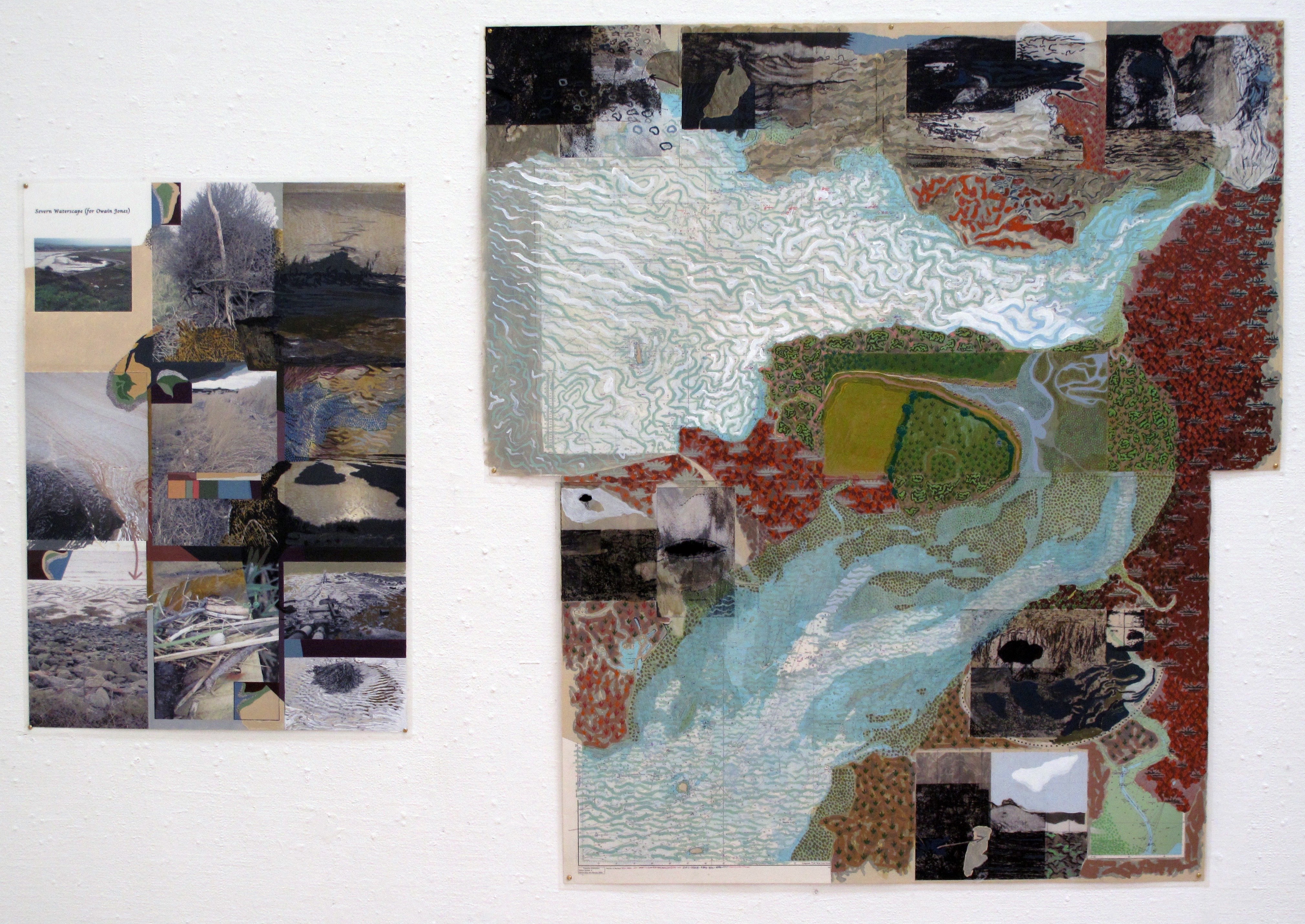
I’ve been working on Severn Waterscape (for Owain Jones)  a mixed media diptych (see above ). This piece has been made specifically for an exhibition at the RWA Bristol called Imagined Landscapes. The exhibition will open next week (on Friday February 5th) and then runs until June 12th.

Early on in the planning of this exhibition Gemma Brace, the RWA’s curator, kindly asked me if I would suggest some people whose work might be relevant, so in addition to her showing my own piece, I feel I’ve had some degree of input into the exhibition as a whole. Of the various artists whose work I suggested she might look at, I’m particularly pleased that she’s chosen to include works by Eileen Lawrence and Will Mclean, two outstanding senior Scottish artists who in my view are not given their proper due south of the Border, and the work of two very interesting younger Bristol-based artists – Seila Fernandez Arconada and Jethro Brice – who often work collaboratively.

Gemma writes that Imagined Landscapes “explores an alternative understanding of place in contemporary art and the role of the artist as spatial narrator, cartographer and geographer”, an approach which links closely to my own concerns with deep and narrative mappings. Originally based around the idea of asking artists to respond to the notion of ‘Wessex’ – as much Thomas Hardy’s imagined literary place as any kind of physical or historical entity– I think that the resulting multi-disciplinary group exhibition will reflect, to a greater or lesser extent, on the intersection of literal and imaginal spaces, sites where physical location, memory and the imaginal or even mythic constellate landscape as place. As Gemma also notes the exhibition is, perhaps inevitably, haunted by environmental concerns. I write ‘perhaps inevitably’ because I hold to Edward S. Casey’s understanding of place, one in which he differentiates between a position, taken as “a fixed posit of an established culture”, and our experiencing of place which, notwithstanding its normally settled appearance, he characterizes as “an essay in experimental living within a changing culture”.(Getting Back into Place: Towards a Renewed Understanding of the Place-World 1993 p. 31) Such a definition of place in our present time cannot but have some powerful sense of environmental concern inextricably woven into it.

The artists involved include: Jethro Brice, Stephen Felmingham, Seila Fernandez Arconada, Paul Fieldsend-Danks, Paul Gough RWA, Lydia Halcrow, Tim Harrisson RWA, Rae Hicks, Eileen Lawrence RSA, Will Mclean, Gill Rocca, Melanie Rose, Jem Southam, Veronica Vickery and myself.

The politics of ‘flood defence’ – land management and social justice

“David Cameron has promised to invest £400 million a year on shoring up flood defences over the next six years; but official data shows spending was cut sharply at the start of the last parliament, from £360m in 2010-11, to less than £270m in 2012-13” (The Guardian 31.12.2015: 1). 

I do not believe that David Cameron’s Government will deliver on this statement but, be that as it may, there is still something pathetic about his pottering around flood-ravaged England dispensing platitudes about funding ‘flood defences’. It is pathetic because the Government is clinging to thinking about water management that it knows is practically ineffective, socially unworkable and,  additionally, defies expert opinion.

After the flooding of the Somerset Levels the Government, having consistently cut back funding to the Environment Agency tried, in desperation, to blame it for the consequences of the Government’s own policies. It was forced to back down and the ensuing climb-down involved consultation with a range of top water management experts. They told the Government that it needed to avoid the temptation to revert to dredging and start putting in place inclusive, catchment-wide thinking about the causes and prevention of flooding. (I’ve written about this before – see ‘Won’t Wash’ or: ‘high and dry thinking in a wide, wet, world’ The Government then proceeded to totally ignore this advice because it was going to be unpopular with regional Tory supporters.

Inclusive, catchment-wide thinking in relation to flooding is primarily about prevention rather than defence and, as such, requires fundamental changes in attitudes to rural governance. On Exmoor, for example, this thinking has meant reversing long-established assumptions – not least that water needs to be drained off the high moor as fast as possible (largely with a view to improving the land for grazing). The new policy reverses this, trying to ensure that the water stays on the moor for as long as possible and drains off it as slowly as possible, thus minimising both the risk of flooding downstream in the short term and substantially reducing the amount of soil washed down to silt up rivers in the middle to long term. This change in thinking is really only possible because since 1954 Exmoor has been a National Park, with its governance initially coordinated by local government and, since 1997, by a free standing Exmoor National Park Authority. What this means in practice is that this area of land is managed through a council made up of elected individuals who, in accordance with democratic convention, must act in the public interest and demonstrate that they will do so by publically declaring their personal and pecuniary interests. In short on Exmoor there is the possibility of genuine democratic debate as to the basis for its governance, thus distinguishing it sharply from the bulk of uplands in the UK. These largely remain in private ownership and are managed on the basis of the personal interests of individuals like the “exuberant hedgefund billionaire Crispin Odey”, singled out as a typical grouse moor owner by Telegraph reporter Clive Aslet 

This is where the issue of flooding and social justice start to converge. In 2014 the same Government that chose to ignore the call for inclusive, catchment-wide thinking in relation to the Somerset Levels almost doubled the subsidy to landowners who own grouse moors (from £30 to £56 per hectare). Unfortunately what is good in terms of raising grouse for shooting is bad for flood prevention. By increasing the grouse moor subsidy the Government has effectively subsidised miss-management of hundreds of thousands of hectares, both in terms of flood prevention and of opportunities to link good environmental governance and increased rural employment more generally. In short, the wealthy and privileged few are being rewarded for perpetuating a situation that brings misery to tens of thousands of their fellow citizens. (For a direct link between grouse moor management and flooding see George Monbiot’s recent blog entry). Misery that in this last round of flooding alone is estimated to be going to cost the country in excess of five billion pounds. My point is simple. David Cameron’s promised £2,400 million is not just about “shoring up” flood defences, its also about shoring up an exclusive and deeply anachronistic version of rural life and economy – one that the right to continue fox hunting and grouse shooting have come to symbolise in the minds of those who claim to defend ‘our’ rural way of life.

It will be blindingly obvious to anyone with any political sense that a Tory Government will not risk upsetting the wealthy landowning classes – whether in the name of flood prevention or any other eco-social concern. If they were to do so, we can be sure that organisations like the Countryside Alliance and Country Land and Business Association would do everything they can to defend the rural mythology that supports the status quo. (An example of such a defence is provided by Charles Clove in an article in praise of the ownership of rural land ownership (which, he suggests, was never “likely to attract capitalists who were not born into it as a way of life – unless for social reasons, or for sport” – a sport, however, where rich individuals from around the world pay something in the region of £140 for the privilege of killing two birds).

This leaves us with the practical question of what is to be done.

In my view there is little or no point in adopting a rigidly adversarial approach towards the rural establishment, not least because it is politically and economically very powerful (for good or ill), and often holds attitudes that are likely to harden further if blindly opposed. Nor is there any ‘magic bullet’ that can solve the complex of issues involved. The real solution to the worsening flooding in the UK lies in a whole cluster of changes, some of which have no obvious connection to water management.

These include the move to proportional representation that is necessary to restore something approaching a genuine democratic system of government to the UK, and without which serious land management reform will never take place. But it also requires serious work at many levels on ending the ignorance and calculated prejudice that is used to perpetuate the rural/urban divide – a divide that plays straight into the hands of those whose only real concern is the perpetuation of a status quo that, increasingly, has become both socially and environmentally toxic. This requires us to build dialogue and a degree of trust that, inevitably, with mean building new alliances and, inevitably, some compromise of long-cherished views on both sides of that divide. There are examples that point to new possibilities in this respect, for example The BurrenLIFE project – Farming for Conservation in the Burren in the west of Ireland. The aims of this project include: 

  • Implementing best-known management practices on 2,000ha of the Burren, including new feeding systems, redeployment of existing livestock and targeted scrub removal.
    Increasing understanding of the relationship between land management practices and the natural heritage of the Burren;
  • Developing new support mechanisms for the sustainable management of the Burren habitats;
  • Enhancing awareness and skills relating to the heritage of the Burren and its management through a range of practical initiatives aimed at empowering local communities;
  • Disseminating information relating to the agricultural management of areas of high nature and cultural conservation value through literature and the media.

 Indicatively, it may be that the second and last of these aims are the most pressing. Developing ‘new support mechanisms for … sustainable management’ in any rural area has to involve looking long and hard at its eco-economic viability, which in turn will often require developing forms of employment that, in order to genuinely ’empower local communities’, will challenge a rural status quo that still takes its right to pursue activities like grouse shooting as a given. That in turn raises important governance, educational and cultural issues, including that of raising external understanding and support during what will inevitably be periods of difficult transition in such communities. It is here that the dissemination of information (and not only that relating to the environmental and agricultural management of an area) informed by inclusive catchment thinking – particularly through literature, the arts and the media – comes into play.   


Assemble

I’ve just read an article by Charlotte Higgins in the Guardian (09/12/15) about Assemble winning the Turner Prize. Their winning is (I hope obviously?) a very real cause for celebration. But it is also a reflection of just how slow the official ‘art world’ has been to recognise the sea change taking place on its wilder shores.

As Higgins points out, to some people giving the prize to a collective of young architects is going to look like “a monumental category error, like giving the Man Booker to, say, an oral poet”. And it’s that ‘category error’ by the Art Establishment, surely, that is the most fundamental cause for celebration. Art as we have reinvented it, ‘art with a capital A’, will be with us for just as long as there are elites who can use it as a sign of their ‘wealth’ – whether in terms of economic or cultural capital – and social exclusivity (or ‘taste’ if you prefer the polite term). What has been happening for many years now, however, is a slow withering away at the edges of the categorical exclusivity, in relation to the arts as to all other disciplines, that separates our skills and knowledges into separate and exclusive silos. In academia this is glossed as the ‘inter-disciplinarity turn’ (an unfortunate term that tacitly continues to perpetuate the myth of the superiority of disciplinary knowledge).

In actuality, however, what is taking place, albeit often below the radar on which cultural pundits depend, is the acknowledgement that we live in a polyverse in which it makes no sense to ghettoise any set of skills or form of knowledge on the basis of traditional professional hierarchies. (This is, I think, the most important insight behind Felix Guattari’s notion of ‘ecosophy’, despite his tendency to lionise aesthetics and the ‘artist’ over against science).

When Maria Lisogorskaya and Louis Schulz, two of the ‘eighteen or so’ members of Assemble, tell Higgins that they are indifferent to whether they are categorised as artists or not, that their focus is on “doing good projects”, which in turn is sometimes “about doing really good plumbing”, they give us a very clear indication of where the resurgence of an aesthetics of the everyday may be taking us.

Some years back my old friend Simon Read – who teaches art students at Middlesex University, makes extraordinary and beautiful predictive coastal maps, other kinds of large drawings, sculptural environmental interventions in the salt marshes on and around the River Deben, and is also practically engaged in the debates around environmental governance of the region in which he lives – told me a story. He was at the opening of a major exhibition in London when a friend introduced him as an artist to a well-known art critic. The critic asked Simon what he did. When Simon told him the critic’s response was: “how worthy”, with which comment he turned and walked away.

I hope that Assemble’s success will mean that, even if it’s for all the wrong reasons, the cultural influence represented by that critic will now be a little less dismissive of those for whom the skills of an artist are wholly compatible with getting productively engaged with the messy and complex  everyday realities of our crumbling psycho-social environment.

Invisible Landscapes

On Friday last week I found myself at the Invisible Landscapes: Exploring Embedded Approaches to Place-Based Contemporary Art Practice seminar. This was organised by Simon Lee Dicker for OSR/Projects , who are based in West Coker in Somerset.

I had originally intended to skip this interesting looking event, simply because there is so much to do at home but, as it turned out, it provided the only opportunity for a meeting with three friends with overlapping interests – the artist and geographer Jethro Brice; Owain Jones, Professor of Environmental Humanities at Bath Spa University; and John Fanshawe, an ornithologist and artist who is currently working with the Cambridge Conservation Initiative (CCI) . An added bonus was the chance to catch up with Jethro’s news during the drive down. Jethro is currently doing AHRC-funded doctoral research in the Geography Department at Bristol University into ‘crane cultures’ – the birds, not the machines – by drawing multi-species wetland narratives from the field and archives. (The purpose of the four of us meeting was to talk about whether we can initiate some productive interactions with CCI, and it seems we may have the basis for doing so. However, it’s far too early to write about that here).

After a brief introduction by Simon, we listened to two very different talks. Sally Watkins – co-artistic director and curator for b-side – talked very informatively about b-side’s work, particularly on Portland, which included drawing out the various different ways in which that organization understands notions of ‘site-responsiveness’ and ‘embeddedness’ in practice.  The second talk of the morning was by Owain.

I have trouble knowing how best to write about this talk. (I’d heard a version of it before at a conference in Newcastle and raised some of the issues that concerned me with Owain then). Put briefly, this is because I think his take on our current situation is warped by a number of factors. The most significant is his stressing – referencing Felix Guattari – the aesthetic in opposition to science. While that position obviously went down well with an audience almost entirely made up of people from the arts, it seems to me to be a wrong-headed unless its heavily qualified, and may in any case – following Bruno Latour – be an outdated, binary position of the kind we badly need to avoid. I won’t go further into the reasoning behind this view here but I’ve discussed the question of scientism and aestheticism in contemporary culture at length in a chapter called ‘Beyond Aestheticism and Scientism: Notes towards An “Ecosophical” Praxis’ in Art, Science and Cultural Understanding, edited by Brett Wilson, Barbara Hawkins, and Stuart Sim and published in 2014. While Owain’s take on the chronically destructive nature of our current eco-social position is, at one level, as passionately argued as it is intellectually well-informed, it is in my view also saturated with – and in my view seriously distorted by – his own emotional discomfort with his inability, as an academic, to ‘know what to do’. (One antidote to which might be a careful reading of David Abram’s Becoming Animal: An Earthly Cosmology, published in 2010).

And this highlights a major ecosophical issue with regard to all articulations of our situation by those who earn their living providing “authoritative” accounts of that situation. Put simply, the personal ecology of the academic makes him or her singularly ill-suited to providing a helpful approach to our situation, simply because any such approach requires us to by-pass or overcome the fundamental presuppositions on which academic knowledge, and the whole material mesh and realpolitik in which it is embedded, rests. I found it sad and deeply ironic that, while Owain was rightly sceptical of all contemporary politics, he failed to acknowledge that the underlying psycho-social assumptions that underpin those politics also underpin the authority of academia. And no amount of aesthetic or imaginative work will change that situation until we acknowledge it for what it is.

Anyway, after an excellent lunch of bread and soup in a local pub we hear an informative talk from Sally Laburn, an artist and the co-director of The Drawing Shed, which is based in east London. This was followed by three parallel workshops run by Alexander Stevenson, Jethro and Tim Martin. I went to Jethro’s, in which we used mud to think about our relationship to non-human thinking, which involved me and my two peers in our group in an interesting and wide-ranging series of thoughts and reflections.

I enjoyed the day on a number of levels, and recognise just how important these types of gathering are to the regional arts community. However, one of the questions it left me with is around the issue of how we exchange with each other – starting with our terms of reference and vocabulary. If they also leave me somewhat saddened it is because I fear they may reinforce the very thing they appear to seek to overcome – the huddling together of individuals on the basis of a monolithic, disciplinary-based, world view – almost every speaker introduced him or her self by saying “I am an artist” – in a constellated world in which only the understanding that we now live in a polyverse will allow us to mitigate the extraordinary difficulties we increasingly face.