Assemble

I’ve just read an article by Charlotte Higgins in the Guardian (09/12/15) about Assemble winning the Turner Prize. Their winning is (I hope obviously?) a very real cause for celebration. But it is also a reflection of just how slow the official ‘art world’ has been to recognise the sea change taking place on its wilder shores.

As Higgins points out, to some people giving the prize to a collective of young architects is going to look like “a monumental category error, like giving the Man Booker to, say, an oral poet”. And it’s that ‘category error’ by the Art Establishment, surely, that is the most fundamental cause for celebration. Art as we have reinvented it, ‘art with a capital A’, will be with us for just as long as there are elites who can use it as a sign of their ‘wealth’ – whether in terms of economic or cultural capital – and social exclusivity (or ‘taste’ if you prefer the polite term). What has been happening for many years now, however, is a slow withering away at the edges of the categorical exclusivity, in relation to the arts as to all other disciplines, that separates our skills and knowledges into separate and exclusive silos. In academia this is glossed as the ‘inter-disciplinarity turn’ (an unfortunate term that tacitly continues to perpetuate the myth of the superiority of disciplinary knowledge).

In actuality, however, what is taking place, albeit often below the radar on which cultural pundits depend, is the acknowledgement that we live in a polyverse in which it makes no sense to ghettoise any set of skills or form of knowledge on the basis of traditional professional hierarchies. (This is, I think, the most important insight behind Felix Guattari’s notion of ‘ecosophy’, despite his tendency to lionise aesthetics and the ‘artist’ over against science).

When Maria Lisogorskaya and Louis Schulz, two of the ‘eighteen or so’ members of Assemble, tell Higgins that they are indifferent to whether they are categorised as artists or not, that their focus is on “doing good projects”, which in turn is sometimes “about doing really good plumbing”, they give us a very clear indication of where the resurgence of an aesthetics of the everyday may be taking us.

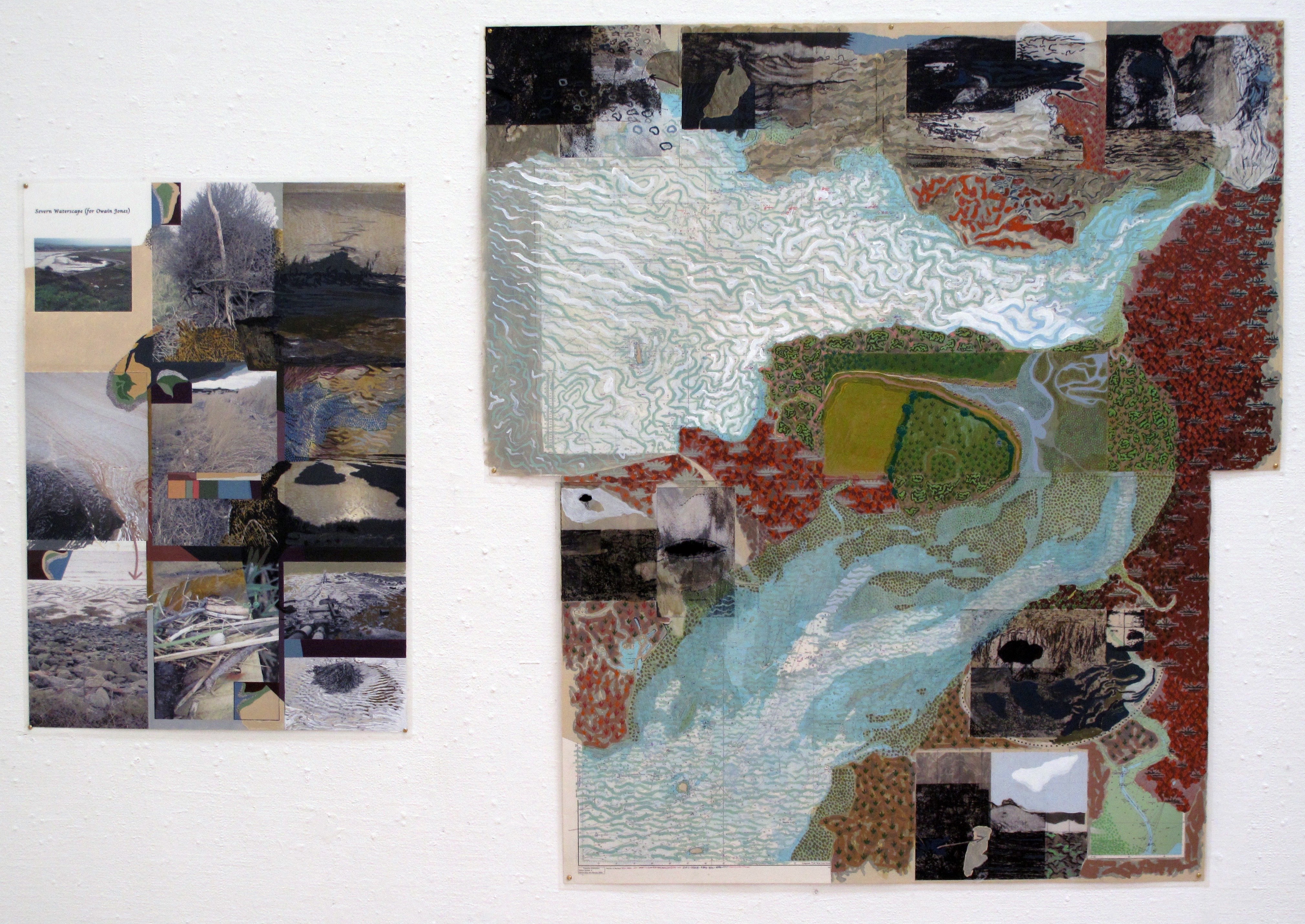
Some years back my old friend Simon Read – who teaches art students at Middlesex University, makes extraordinary and beautiful predictive coastal maps, other kinds of large drawings, sculptural environmental interventions in the salt marshes on and around the River Deben, and is also practically engaged in the debates around environmental governance of the region in which he lives – told me a story. He was at the opening of a major exhibition in London when a friend introduced him as an artist to a well-known art critic. The critic asked Simon what he did. When Simon told him the critic’s response was: “how worthy”, with which comment he turned and walked away.

I hope that Assemble’s success will mean that, even if it’s for all the wrong reasons, the cultural influence represented by that critic will now be a little less dismissive of those for whom the skills of an artist are wholly compatible with getting productively engaged with the messy and complex  everyday realities of our crumbling psycho-social environment.

Invisible Landscapes

On Friday last week I found myself at the Invisible Landscapes: Exploring Embedded Approaches to Place-Based Contemporary Art Practice seminar. This was organised by Simon Lee Dicker for OSR/Projects , who are based in West Coker in Somerset.

I had originally intended to skip this interesting looking event, simply because there is so much to do at home but, as it turned out, it provided the only opportunity for a meeting with three friends with overlapping interests – the artist and geographer Jethro Brice; Owain Jones, Professor of Environmental Humanities at Bath Spa University; and John Fanshawe, an ornithologist and artist who is currently working with the Cambridge Conservation Initiative (CCI) . An added bonus was the chance to catch up with Jethro’s news during the drive down. Jethro is currently doing AHRC-funded doctoral research in the Geography Department at Bristol University into ‘crane cultures’ – the birds, not the machines – by drawing multi-species wetland narratives from the field and archives. (The purpose of the four of us meeting was to talk about whether we can initiate some productive interactions with CCI, and it seems we may have the basis for doing so. However, it’s far too early to write about that here).

After a brief introduction by Simon, we listened to two very different talks. Sally Watkins – co-artistic director and curator for b-side – talked very informatively about b-side’s work, particularly on Portland, which included drawing out the various different ways in which that organization understands notions of ‘site-responsiveness’ and ‘embeddedness’ in practice.  The second talk of the morning was by Owain.

I have trouble knowing how best to write about this talk. (I’d heard a version of it before at a conference in Newcastle and raised some of the issues that concerned me with Owain then). Put briefly, this is because I think his take on our current situation is warped by a number of factors. The most significant is his stressing – referencing Felix Guattari – the aesthetic in opposition to science. While that position obviously went down well with an audience almost entirely made up of people from the arts, it seems to me to be a wrong-headed unless its heavily qualified, and may in any case – following Bruno Latour – be an outdated, binary position of the kind we badly need to avoid. I won’t go further into the reasoning behind this view here but I’ve discussed the question of scientism and aestheticism in contemporary culture at length in a chapter called ‘Beyond Aestheticism and Scientism: Notes towards An “Ecosophical” Praxis’ in Art, Science and Cultural Understanding, edited by Brett Wilson, Barbara Hawkins, and Stuart Sim and published in 2014. While Owain’s take on the chronically destructive nature of our current eco-social position is, at one level, as passionately argued as it is intellectually well-informed, it is in my view also saturated with – and in my view seriously distorted by – his own emotional discomfort with his inability, as an academic, to ‘know what to do’. (One antidote to which might be a careful reading of David Abram’s Becoming Animal: An Earthly Cosmology, published in 2010).

And this highlights a major ecosophical issue with regard to all articulations of our situation by those who earn their living providing “authoritative” accounts of that situation. Put simply, the personal ecology of the academic makes him or her singularly ill-suited to providing a helpful approach to our situation, simply because any such approach requires us to by-pass or overcome the fundamental presuppositions on which academic knowledge, and the whole material mesh and realpolitik in which it is embedded, rests. I found it sad and deeply ironic that, while Owain was rightly sceptical of all contemporary politics, he failed to acknowledge that the underlying psycho-social assumptions that underpin those politics also underpin the authority of academia. And no amount of aesthetic or imaginative work will change that situation until we acknowledge it for what it is.

Anyway, after an excellent lunch of bread and soup in a local pub we hear an informative talk from Sally Laburn, an artist and the co-director of The Drawing Shed, which is based in east London. This was followed by three parallel workshops run by Alexander Stevenson, Jethro and Tim Martin. I went to Jethro’s, in which we used mud to think about our relationship to non-human thinking, which involved me and my two peers in our group in an interesting and wide-ranging series of thoughts and reflections.

I enjoyed the day on a number of levels, and recognise just how important these types of gathering are to the regional arts community. However, one of the questions it left me with is around the issue of how we exchange with each other – starting with our terms of reference and vocabulary. If they also leave me somewhat saddened it is because I fear they may reinforce the very thing they appear to seek to overcome – the huddling together of individuals on the basis of a monolithic, disciplinary-based, world view – almost every speaker introduced him or her self by saying “I am an artist” – in a constellated world in which only the understanding that we now live in a polyverse will allow us to mitigate the extraordinary difficulties we increasingly face.


‘Erdkunde’ revisited: some thoughts on art and time

IMG_2101

I’m re-reading Adam Nicolson’s Sea Room, a beautifully written account of his relationship to the Shiant Islands, which lie some five miles off the Isle of Lewis, and of the world in which they are enmeshed. It is one of a number of books about a specific place that seem to me to convey something of the essential concerns that underlie what, out of habit rather than conviction, I continue to refer to as deep mapping.

Yesterday I found myself speaking as a ‘representative’ of those concens as a panel member at the City Museum and Art Gallery in Bristol in a public discussion of the Museum’s Erdkunde exhibition. (I should say at once that John Wood and Paul Harrison’s work has grown on me to an unexpected degree since I referred to it in an earlier blog – their understated yet multilayered video and the surrounding material taking on a much greater richness and resonance as a result of my making an additional visit and through turning over elements of the work in memory).

Two connections with Nicolson’s book appear to me relevant to the exchanges during that panel talk and the questions from the audience that followed it. The first is the question of our experience of time, something to which we kept returning in various ways. Perhaps thinking about geology inevitably leads to thoughts of deep time and, in this case, its contrast with the sense of instantaneousness associated with so many of our new technologies. The second connection is not unconnected to this and has to do with what I can only call the politics (small p) of making worthwhile art, an activity which it may now be increasingly important to understand (given that any form of ‘Political art making’ is already captured within the dominant categories and networks of our existing culture).

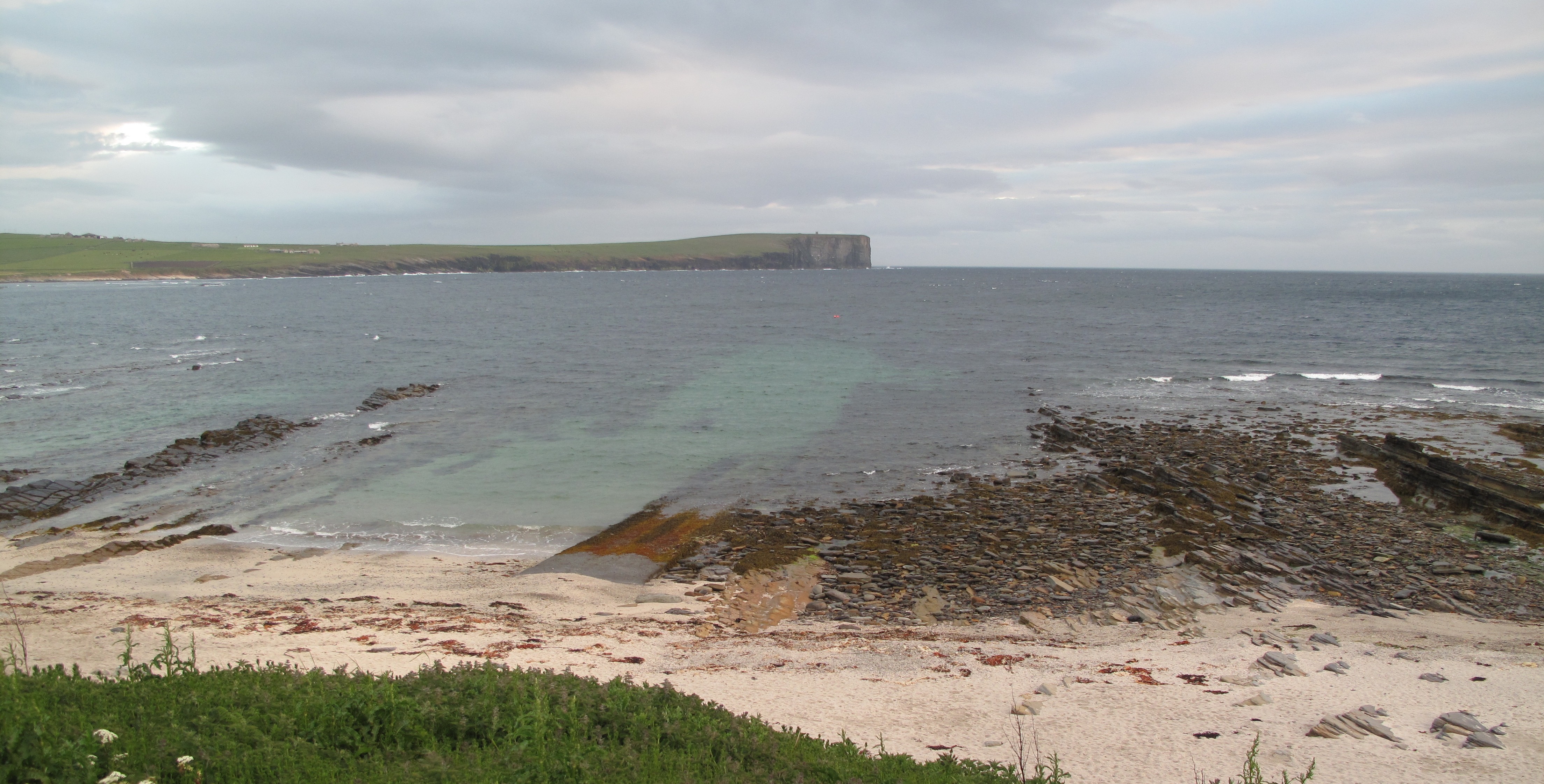
In a beautiful account of gathering water from local springs close to the dwelling where he stayed on the islands, Nicolson writes (page 67) about the way in which, in the simple act of collecting water, his sense of time became no longer linear – that is part of the sweeping away of the past in the present towards the future that dominates so much of our lives. Instead his experience of time shifted, becoming what he refers to as the awareness of “a laminar flow”, one in which “different sheets of time” move at different speeds, “one over another, like the currents in the sea”. This is I suggest the same awareness of multiple, co-existing temporalities that we can move into when walking at a steady pace along a windswept rocky shore, one where the seemingly frozen geological movement of folded cliff strata and the low cliff edge blackthorns distorted by years of subjection to the constant of a prevailing wind are counterpointed by the just perceptible shift in the tide and, in another register again, the rapid passage of sea birds and the constant scudding of clouds.

The second point, what I have clumsily referred to as ‘the politics (small p) of making worthwhile art’, relates for me to what Nicolson writes about a particular form of thought. He identifies this (page 101) with the help of a phrase from Denise Levertov’s poem Overland to the Islands. There she names it as “intently haphazard”. Nicolson then draws  attention to her presenting this in the image of a dog that is always moving, notices everything, frequently changes its “pace and approach” while retaining its overall direction; the act of an animal for which “every step” is “an arrival”. This, it seems to me, is the territory in which the materialised thinking – although ‘thinking’ is perhaps the wrong word here, James Hillman’s ‘the thought of the heart’ might be closer to the mark – that we intuit through examining the products of the activity we call art. One that is able to sidestep, even to a degree counter, the all-consuming instrumentality that increasingly dominates every aspect of our waking lives. And it’s in this territory too, and perhaps for similar reasons, that the spaces appear in which we are able to apprehend time as sinuous, as not strictly linear; that “laminar flow” that allows us to experience the complexities and contradictions, the currents and counter currents, that carry the present out of the past.

It was in this context that it dawned on me, reading a review of Massimo Bacigalupo’s Ezra Pound: Posthumous Cantos, that Pound’s magnus opus too might be thought of as related to the impulses that underlie the deep mapping project. A somewhat sobering thought that perhaps leads to difficult questions about the relation between the desire of inclusiveness (or should that be the fear of not being in control) and a certain brand of politics? However, it appears that these last, posthumous, Cantos tell a somewhat different story and one that, I must admit, I now want to hear.

Although not planned that way, I now realise that my re-reading Sea Room has turned out to be an unconscious act of preparation for one of my periodic periods of self-immersion in some aspect of Scottish culture. I’ve just bought a second hand copy of Lewis Grassic Gibbon’s A Scots Quair, the first part of which is said to be the most single most popular book with readers in Scotland. I have resisted examine this impulse, part of my sense of an increasingly dominant in-between-ness in my life. Perhaps reading A Scots Quair will finally prompt that examination.

Landscape Values: Place and Praxis – 29 June-2 July 2016

IMG_1735

I don’t usually use this blog to advertise events but this conference, set up by the Centre for Landscape Studies at NUI, Galway, looks to be really interesting in a number of respects. What particularly caught my interest was the following:

“Arranging the contributions around four themes: Place Values; Places in Action; Place Thinking; and Place Governance; the conference aims to reflect and critique the journey of values from their genesis and expression in place, through how they are recorded and documented, to the position they command or are accorded in governance and contemporary social praxis”.

“All of the human sciences recognise the important role that the collective values engendered in place-making have in building and reinforcing community cohesion. However, a 2015 survey by the Heritage Council reveals that, in Ireland, the public rank built and natural heritage equally. In fact, though the gap is statistically insignificant, nature is ranked ahead of monuments and buildings as heritage. This suggests that the values associated with nature are not only scientific, that ecosystems service more than just the biological needs of society, and that topophilia and biophilia are deeply intertwined. In short, place has ecological dimensions which, in terms of management, can be honoured by initiatives such as Natura 2000, Green Infrastructure and High Nature Value Farming”.

Typically, however, many of the cultural values attaching to landscape are expressed only in the languages of poetry and the creative arts. Though uniquely sensitive to the synaptic and protean nature of the relationship between people and place, such expressions are commonly deprived of their force and agency during the decision-making process. When it comes to regional, national and international business and governance, historical and cultural values are usually required to cede to biophysical and economic ones, leading to an inversion of value-hierarchies customarily associated with community projects“.

I know (or have met) a number of the people involved in setting up this conference and, as a result, I’m further encouraged to enthuse about it in advance.

But anyone interested in submitting will need to get their skates  on as abstracts (not exceeding 800 characters) and nomination of one conference theme has to be in by 17:00 (GMT) 27th November 2015 using the online abstract form located on the Landscape Values: Place and Praxis web site hosted by www.conference.ie.

Autumn (and art) in suburbia

Slide01

Last night I worked for the first time in about three months. With my friend Luci Gorell Barnes I run a workshop that responded to the artists John Wood and Paul Harrison’s Erdkunde – itself a new video work responding to Bristol City Museum’s collections. (These were not, it has to be said, much in direct evidence in the film, but so be it). After meeting at the Bristol City Museum and Art Gallery to watch the Erdkunde film we walked up to the RWA (where Luci and I had already spent a frustrating half hour struggling to get PowerPoint up and working) and assembled in the small upstairs studio. I started us off by linking some of the key features of a deep map to what we’d just seen. What I said is pretty much as follows.

The word “Erdkunde” can be literally translated as ‘physical geography’ – but in German ‘Erde’ can mean ‘world’, ‘ground’ or ‘earth’, so it’s a very inclusive term. That makes it a perfect title for John Wood and Paul Harrison’s work. Their interest in collecting, cataloguing, and displaying various kinds of information – through notes, sketches, photographs, thoughts, ideas – questions how we look at things, identify them, talk about them. To do all that we use given systems of classification, even though our actual experience is always somehow both more and less than the systems and categories we use to tidy up the world. Deep mapping asks questions about the official categories we apply to space when we start to think about our experience of place.


So ‘deep mapping’, like the Erdkunde exhibition, is a way of questioning the relationship between official classifications of what is or is not important and our own immediate experience. Of course all places are shared to some extent, so our sense of place is always a combination of lived experience, given information, and various kinds of memory. Any deep mapping exercise begins by asking: “what needs to go onto a map of this particular place” and, because a place is always changing, being re-shaped, deep mapping is in turn always as much about time as it is about space.

Slide04

I can identify each of these four snapshots taken in Bristol in terms of a particular place, but they are also evocations of different times – the slow change and decay of architecture periods over against the span of a human life or the growth of a sunflower.


We make sense of places through sharing stories, which are like crossroads where what’s important to us personally meets shared histories and social values. Here’s a story about a place in Bristol that’s no longer there. This was a medieval church dedicated to Saint Leonard – patron saint of prisoners – down on the Westgate, one of the original entrances to the medieval city, which became known as St Leonard’s Gate. This medieval church was in the way of ‘improvements’ to this area of the city that, in the C18th, needed to rework itself as a port in order to accommodate its expanding trade. So the civic authorities destroyed an ancient religious building dedicated to a saint who, according to legend, had the right to liberate prisoners and, having done so, to gave them land to live off. Ironically, they did this in order to facilitate the slave trade. I’m telling you this because one of the things deep mapping does is try to make visible the tensions between what’s remembered and what’s forgotten in constructing a sense of place. In doing so it inevitably asks questions about our values.


So deep mapping is a way of visualising the mesh of social tensions – both productive and unproductive – inherent in the processes of remembering and forgetting. Since these processes happen at the point where the personal and the public meet, deep mapping is always in some way collaborative. This slide shows a project by Rebecca Krinke called Seen / Unseen – the mapping of joy and pain  where she and her students took a plywood relief map of Minneapolis / St Paul into the park and asked people to map where they had experienced joy and pain in their city. It’s purpose, however, was really as much to make an intimate public space for people to share their experiences and the stories that make Minneapolis / St Paul not just a city on a map but a lifeworld held in common as it was to make a specific art work.

Luci then talked about her Atlas of Human Kindness and opened up the parameter of the evening’s thinking  by referring to ‘narrative mapping’ rather than ‘deep mapping’.

We then asked the participants to plot particular locations that mattered to them onto a big map of Bristol, using PostIts colour-coded according to three general types of experience, so as to create a high-speed pro-deep map of Bristol. Here are three photographs Luci took:

High speed deep map 1

High speed deep map 2

High speed deep map 3

It seems to have been a good evening for the participants and it was certainly good for me to be ‘back in the saddle’ in terms of doing something educational, having been wholly emersed in family matters and the new house for so long.  

So what has any of this to do with ‘autumn in suburbia’? Perhaps nothing, literally speaking, but I find it increasingly hard to take things entirely literally these days or, indeed, to keep the separate elements and levels of my life from seeping into each other across the usual boundaries we erect. At sixty-five and recovering from six weeks illness in a house that’s been half building site, I am tending to feel a bit autumnal myself, so very much in tune with the current season of ‘mellow fruitfulness’ and decay. And to find myself living in suburbia is, for me, to be living in a space that is neither truly urban – I got something of a buzz from being out on Queen’s Road at seven at night yesterday, the familiar feeling of the street on Friday night just starting to get busy – nor (despite the plentiful evidence of foxes, owls, etc.) rural in any meaningful way.

The world in which I now live is characterised by reticence – there’s little sense of neighbourly communication – on one hand and excess on the other. (Oddly, John Wood and Paul Harrison’s reticence in their film seemed to me to resonate oddly with the suburban world, their piece a kind of absurdist ‘Janet and John’ exercise directly at the culturally sophisticated). Excess out here, on the other hand, has seemed to me to be personified by the plethora of vast 4x4s – often two to a house – that I see driven by small, determined women in a hurry with little sense of how to manage the mechanical beast they’re in charge of. (Yesterday I watched as one such women took three goes at backing into her own drive, reversing clearly being something of a problem). Their husbands, large, corporate types, tend to have a better grasp of the beast, but seem to regard speed limits as some kind of personal affront.

I could go on but there’s no point in airing my prejudices – unnecessary consumption and similar forms of selfishness and excess are hardly the prerogative of the Bristol suburbanite!

Keeping on keeping on

As so often when things are difficult, I find myself turning to music as a way of steading myself, making space for something else to well up into whatever troubled place I currently happen to be in. (This will hardly be news to anyone who reads this blog regularly).

As I write this, in hopefully the dog days of a long bout of ‘flu that went to my chest, I’m listening to a new CD – by Alela Diane and the guitarist Ryan Francesconi – called Cold Moon. This sounds like the necessary and inevitable followup to her beautiful About Farewell and somehow perfectly matches where I find myself just now. If you’re into this kind of music – which is almost impossible to categorise (although she sometimes reminds me of the spirit of Sandy Denny, the intensely personal narrative refigured through the lens of a sense of the collective that belongs to any folk tradition) – start with the tracks Cold Moon and Shapeless and, if those press your buttons, listen to the whole CD.

And, while I adjust to the changes emerging in my life and try to pick up my health again, all manner of bigger and more serious storms rage elsewhere – not least in the political world and in the lives of some of my friends. The first are too large to think about in my current state and the second too personal to be included here. I am, however, turning once again to trying to realise a recurrent desire – the idea of organising a ‘hedge school’ for those whose I know whose creative potential in all its ecosophical dimensions has somehow been failed by their encounter with the university system. That desire, and an unexpected enquiry from a Dutch friend, remind me that there is still a great deal of interesting work to do out in that currently distant quarter of my life, no matter the current difficulties and sense of restriction.

Just a question, as always, of ‘keeping on keeping on’.

Up in the air

It’s been one of those weeks. As if fate wanted to throw a different light on all the usual, necessary stuff that has to goes on regardless, I heard that my uncle – my mother’s half-brother – died in his sleep after a brief period in hospital. So the family will be gathering for his funeral next week (some of whom I will not have seen since the last family funeral).

During the week I also discovered that I have won something called “the Derek Balmer PPRWA Painting Prize” at this year’s RWA Annual Open Exhibition for my piece Washington & Vicinity (Arlington betrayed), a work in part inspired by talking with my friend Mona Smith about the history and mis-treatment of the Dakota people. (See the earlier post Two works for the Annual Exhibition at the RWA). Apparently the prize is awarded “for excellence in painting”, something I was under the impression I no longer really ‘did’, at least in the traditional sense!

Then today – although in fact, since I’m writing this in the early hours of the morning, actually yesterday – I helped my elder son, who has been semi-camping here in our new house, and his partner move into their own new home. It’s great for them and that move is a serious milestone in any parent’s life. And then my younger son, who has been very ill for a while, has come to get some rest and a bit of help with his work. Meanwhile my wife and daughter are still up north, and sadly must stay there, until this house is in a state where they can come back to a functioning home with proper heating, etc. However the building work proceeds a pace and hopefully, despite the endless and inevitable minor problems that that process throws up, I hope it will continue to do so. And finally, I thought (wrongly) that I had recovered from a nasty cold and discovered today that I haven’t. Just another week in the polyverse.

Meanwhile, of course, everyone else continues to pursue their own priorities and, where those involve me, to hope that I will put their’s at the top of my Urgent List. And no doubt I’ll try to do what I can.


Two works for the Annual Exhibition at the RWA

animist

Arlington

This year I’m sticking out my neck (in RWA terms) and submitting unframed work, basically reconfigured maps of Washington. It will be interesting to see what the response is, particularly given that I am due to work with the RWA and Bristol City Museum and Art Gallery in conjunction with an exhibition that has the archive and mapping as one of its starting points.

Conversations

On Monday this week I caught up with Alyson Hallett who, although we don’t know each other well, I’ve now come to think of as a real friend. Alyson recently finished her term as the second Charles Causley poet-in-residence, and was also the first to actually live out her residency in Causley’s house – Cypress Well – on Ridgegrove Hill in Launceston. Appropriately, the hill then gave its name to the collection of poems she created during her residency. She was over in Bristol to visit Bristol university, where as Dr Hallett she works as a Royal Literary Fund  Advisory Fellow, a post which places her in the university to help students develop their writing. We first met through her presenting her Stone Library work at a PLaCE event and had been in touch about her most recent book, On Ridgegrove Hill, which is now published by Atlantic Press. The book is the fruit of Alyson’s Charles Causley residency and has been beautifully designed and illustrated by Phyllida Bluemel, a current student on the MA Illustration course at Falmouth University.

I’m ashamed to say I had never heard of the Cornish poet Charles Causley, let alone read any of his work, until I read Alyson’s own poems. On the strength of her obvious empathy for Causley and his world (and perhaps because I spent three years working on a project in north Cornwall), I then bought a second-hand copy of his collected poems. I then read it more or less straight though, as I might a really good novel. I can highly recommend both poets’ work to anyone who is interested in place and its being interwoven with our attention to language, notably in Causley’s case with the particularities of vernacular speech.

My pleasure in talking with Alyson is in part in her own delight in, and genuine relishing of lively, freewheeling conversation, which she described in an email as “a banquet of ideas and thoughts and pathways”. It is also because of her wide-ranging knowledge and understanding. This is exemplified by what she says on the video Encountering Iceland – reading from 6 Days in Iceland by Alyson Hallett and Chris Caseldine. This gives an indicative sense of her work on, and of the poems resulting from, a field trip to Iceland with the physical geographer Chris Caseldine and his students, part of her residency in the Geography Department at Exeter University. They read from the book that came out of their trip with the students  – 6 Days in Iceland – which combines poetry, geographical text and photographic images. It is typical that Alyson should have encountered Iceland as a poet but alongside a professional earth scientist and his students, and that she should have been fascinated by the ways in which these two rather different fields of study – at least when seen from a disciplinary perspective – can in actuality inform, enliven and enrich one another.

My conversation with Alyson reminds me what a privilege it is to have worked in a university – notwithstanding all the deepening problems of that archaic institution – because of the friendships and contacts that work creates. I have been having very interesting exchanges on line with two individuals  with an interest in deep mapping. One is Siri Linn Brandsoy, who is working on a Masters project around deep mapping a small island in the north of Norway. She is a students on the M.A program in Visual Anthropology in Manchester and will be showing work in an exhibition with her fellow students on October 15-17. If anyone reading this gets the chance, you should go and see what, form my contact with Siri and others, I think will be an interesting exhibition of work combining ethnography with art practices and filmmaking.

The second person I’ve been enjoying an exchange with is Erin Kavanagh, who is working with Archaeology, Cultural Anthropology and Historical Anthropology and much more besides at the University of Wales, Trinity Saint David, Lampeter. I think of Erin as a new (or maybe very old) kind of en-placed teller of multi-dimensional stories. She is currently working on a paper on deep mapping to be presented at the University of Vienna, along side much else, and writes: “Four papers in under four months, that’s do-able on top of a full time work load and organizing publications, right…?”, reminding me of aspects of academic life I am happy to do without.


New start?

Transgression 13

We moved into our new home just a week ago and, after what seems rather longer grappling with a sea of brown cardboard boxes, problems with drains, and all the other dubious joys of domesticity associated with moving house, I returned briefly to another of my lives today.

I have been in Exeter giving a joint presentation at the Royal Geographical Society annual conference with Antony Lyons as part of the session Geo-aesthetics in an Anthropogenic World. The convenors, Deborah Dixon (Glasgow) and Dominic Walker (Exeter), had kindly given us a double ‘slot’, which allowed us to show Antony’s most recent edit of Transgression (Rising Waters) immediately followed by a textual ‘duet’ in which we each read in turn a short response to fifteen of the words listed on the digital drawings I made for that project. (See one example above). Given that we had not had any time to rehearse this it went surprisingly well, largely because Antony had carefully structured the presentation so that the drawings gave us a clear ‘time slot’.

Our abstract – which does more or less reflect what we delivered (!) reads as follows:

We take as our starting point the definition of ‘Transgression’, as a geological term describing an advance of the sea over land-areas: ‘a relative rise in sea level resulting in deposition of marine strata over terrestrial strata. The sequence of sedimentary strata formed by transgressions and regressions provides information about the changes in sea level during a particular geologic time’’

This moving-image work is based on a combination of fieldwork, archival research, creative conversations and inter-media collage. Drawing on our shared interest in place, environmental change, and water landscapes, we explore questions rooted in physical, social and cultural relationships between land and sea. In an era that many now term the ‘Anthropocene’, it can be argued that we face the prospect of human-influenced marine transgressions. Using strategies of poetic juxtaposition and conjecture, we focus special attention on coastal change/resilience/adaptation along the Severn Estuary coast, as well as wider afield. Our hybrid composition incorporates photographic and other visual content, accompanied by voice, song and soundscape. It weaves together original and archival material to create an imaginative bridging and transgressing of both disciplinary thinking and the culture of possessive individualism that underpins it. The method is influenced by Lyons’ work as a geoscientist and landscape-based artist; and by Biggs’ academic and artistic work embracing ‘deep-mapping’ as a creative paradigm. Our many antecedents include films such as Chris Marker’s Sans Soleil and the socio-ecological thinking of Deleuze and Guattari, coupled with Pearson and Shanks’ re-visioning of ‘deep mapping’ as a regionalist performative creative strategy. Transgression (Rising Waters) is closely linked to a Lyons’ longer-term Arts Council funded project ‘Inundation – Drowned Lands’ and to his artist residency project on the Severn Estuary, called ‘Sabrina Dreaming’.

Of particular interest to me about the session as a whole was that the collaborative presentation – by Rebecca Ellis (a social anthropologist with interests in science, technology and cultural geography) and the artist Sarah Casey – that preceded ours. Titled Porous topologies of (Im)perceptibility’s as creative process, the abstract for this reads as follows:

Two reflections from theoretical cosmology provide the inspiration for this paper. The first is an acknowledgement that light is but a one-dimensional signal of (non)human knowability of the properties of the universe. The second is the claim that properties as-of-yet unknowable are mathematically thinkable, albeit in the absence of observational verification. Current cosmological debates concerning the (non)existence of manifold topologies of the multiverse (e.g. Smolin 2015) provide a rich context in which to both stay with and trouble claims for (un)knowability as a resource for tentatively grasping the radically insensible (Yusoff 2013). Indeed the deep recesses of the (non)existent multiverse promise to usefully probe further the very meanings of (non)human perceptibility. This paper will practice a recent interdisciplinary experiment between an artist, anthropologist and cosmologist as they exchange theoretical and material resources with which they individually and collectively trouble the limits of (im)perceptibility posed by the example given. Theoretical reflection on the status of mathematics as (non)human signal, will tentatively steer between accounts of mathematical ontology (Badiou, Meillassoux) and feminist materialist consideration of mathematics as human-nonhuman semiotic exchange (e.g. Kirby). We reflect upon the problem of seeking ‘illumination’ of dark objects through the example of Art practice, where ‘knowing’ is deliberately postponed and a state of being ‘in the dark’ is essential to enriched understanding (Jones 2013).The paper will be framed by a wider-arching question concerning the possibilities of the utter (ir)relevance of such radically ‘dark spaces’ for anthropocenic thinking.  

There was something in all this that reminded me of the Hebrew mystical concept of Ein Sof, which in the study of the Kabbalah is understood as God prior to his self-manifestation in the production of any spiritual realm. In this line of thought, it is only by withdrawing into absence that the Divine can allow anything (else) to come into being. There was a sense of a queer interdependence/distance, of an ‘oscillation’, hinted at in the paper that was fascinating. Anyway, and probably rather to everyone’s surprise, there turned out to be a number of tantalising overlaps between this presentation and our own. These appeared in various ways, not least in Rebecca Ellis’ question to me about my use of the term ‘polyverse’ (against the more usual ‘multiverse’). Strangely, it seems Antony and I have been edging towards a possible convergence with thinking in mathematical speculation about multiverses, along with the debates for and against Object Oriented Ontology. Two particularly interesting lines of enquiry (for me) came out of this heady stuff. Firstly, a recommendation that I read Mary Jane Rubenstein’s The Many Worlds of the Multiverse. But secondly (for me) the positive provocation of Sarah Casey’s resonant and technically deeply thoughtful approach to her drawings.

So much food for thought before my re-imersion in the sea of brown cardboard boxes!