Bird Brained? Notes on work in progress.

I sometimes worry about my being ‘bird-brained’. By which I mean unfocused in my reading of both texts and other people’s art work. Unfocused in the sense that ‘my’ thinking moves me across different fields and areas of interest somewhat in the same way a small bird might flit from seed source to seed source or, like a swallow, hunt insects on the wing by darting here and there. What reassures me somewhat is that, like these birds, this apparently erratic activity is driven by a desire to feed.

So while it’s true that my attention seems, at least on the surface, to flit randomly from one field or idea to another, this way and that, there is I believe some sort of pattern being played out in this process.

These thoughts are prompted by the fact that I have been immersed in an extended bout of reading, one that has recently taken me, for reasons I can only half-identify, from Claude Lecouteux’s Witches, Werwolves and Fairies: Shapeshifters and Astral Doubles in the Middle Ages to Eduardo Kohn’s How Forests Think which, although I’ve only just finished it, I’ve now started to re-read in tandem with Kaja Silverman’s extraordinary Flesh of My Flesh (which I picked up on because Kohn quotes it). I suspect that what each of these texts does, each in its own very different way, is encourage me to ask fundamental questions about our presuppositions as to what constitutes ‘an individual’. So, somewhere behind this birdbrained flitting, there is I think a half-formulated desire to open myself out more fully to the multi-natural, multi-cultural polyverse I’ve been trying to engage with intellectually.

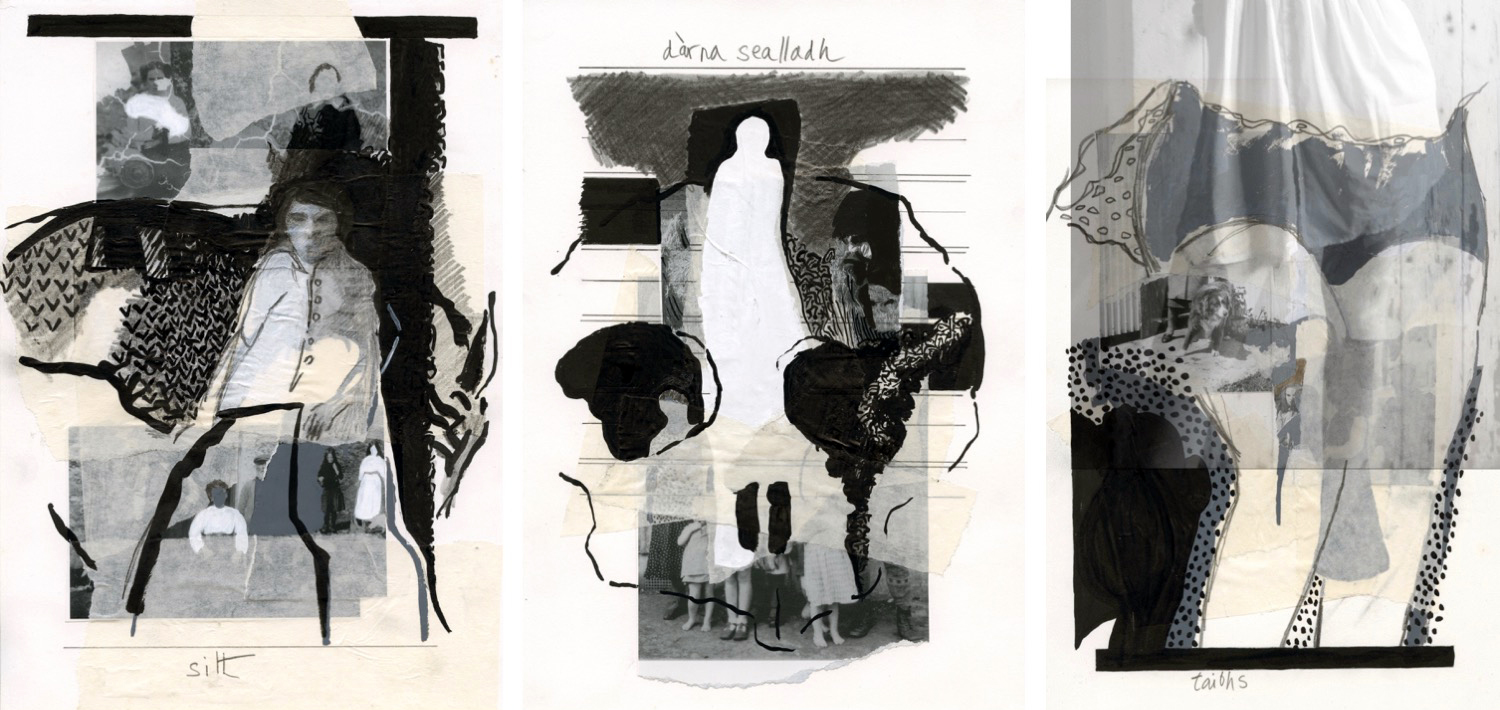
This sense of ‘opening out’ has already had a practical impact, sending me back to making object/images.

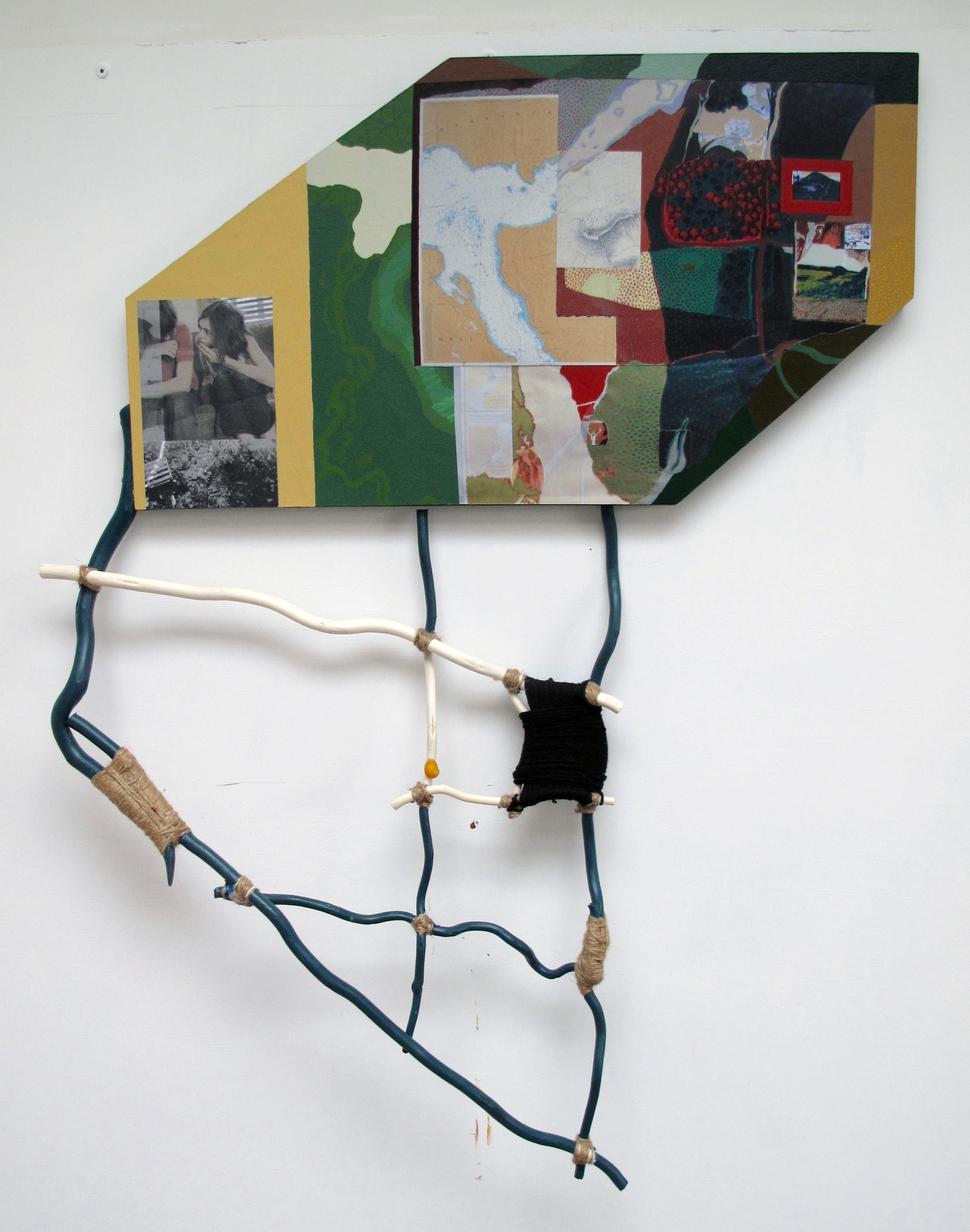
The fragment below, made up of map elements, is based on two aspects of my childhood that involve my father: a recurrent nightmare on one hand and his identification with the west of Scotland and, more specifically, with Skye, on the other. Half-way through working on the original piece from which this fragment is taken,  I remembered the Marshall Islands stick charts that I used to include in talks on deep mapping because they so immediately represent a mapping ‘read’ through the hand as much as through the eye (or so I like to imagine).

In the context of my first ‘mapping’ this remembrance became linked to Kohn’s discussion of the value the people of Avila place on multi-perspectivalism (which I found resonated with my own concern with the polyverse) and, retrospectively, with Silverman’s discussion of translation, something I’ve been pondering in an art context for a while as part and parcel of conversation as an art. Anyway, the result of this process of intuition, reflection, and digestion appears below. That the occasion that this double mapping responds to is, primarily, my childhood nightmare of a recurrent meeting with an enormous wolf (see The Prelude to Between Carterhaugh and Tamshiel Rig: a borderline episode pp. 16-17) seems to me ultimately less important than the desire to bring together two distinct ways of accounting for an event in a specific place, a double mapping.

When I came across the original image of the whispering girl now reworked and adapted and included on the left hand side of this piece, it immediately resonated very powerfully with me. I now sense that it acts as a vivid analogy for the figure of the Fylgja discussed in Lecouteux’s book; that she resonates with my response to Silverman’s discussion of Rilke’s dead sister as an Eurydice figure, and that all this ‘unspeakable’ convergence of different resonances appears to have been taken up through the making process in the wing-like form of the piece above.

The danger of writing about this is that it could appear that what I am making is dependent on, or seeks to illustrate, what I’ve been reading. That’s not how I see it. What animated my reading Lecouteux in the first place was a gut feeling that, while there is for me great value in Guattari’s notion of ecosophy, what is neglected in my relationship to it – and I suspect this is not just a personal issue – is attention to it’s relationship to making in terms of the ecology of the personal, psychic, dimension. That’s to say, we may be unable to think the social and the environment differently until we can think our multiple selves differently. This thought is, it seems to me, implicit in Kohn’s call (after Ghassan Hage) for “an ‘alter-politics’ – a politics that grows not from opposition to or critique of our current systems” (the basis of so much ‘alternative’ activity in the arts and academia), but rather “one that grows from attention to another way of being, one … that involves other kinds of living beings” (p.14). And, if both Silverman and Kohn (supported by James Hillman) are correct, ‘living beings’ here also includes the dead, understood in the context of Richard Kearney’s conception of testimonial imagination.

Intellectually speaking, I am rather out of my depth here, simply feeling my way intuitively on the basis of the liveliness of an inner response to texts containing ideas I only half understand, and even that half imperfectly. So the making I find myself doing is an attempt to both ‘ground’ and ‘map’ the movement of an powerful intuition, using my own experience, in dream or otherwise, as a route into the living space these books are opening up for me. Another form of ‘deep mapping’, maybe?

Deep Mapping and the importance of ‘listening to the dead’

Introduction

Since 1999, when I began concerning myself with what I would come to know as deep mapping, I have been vexed by the question of what role, if any, the first of Felix Guattari’s three ecologies – namely the ecology of the ‘self’ – should play in such work. That question has been deepened by the work of two recent doctoral projects that I helped to supervise: Dr. Ciara Healy-Musson’s Thin Place: An Alternative Approach to Curatorial Practice (2015) and Dr. Davina Kirkpatrick’s Grief and Loss; Living with the Presence of Absence. A Practice-based Study of Personal Grief Narratives and Participatory Projects (2016). Both, in my view, point up the inadequacy of current conceptions of the relationship between ‘self’, society, environment and the past by focusing on different aspects of our relationship to the dead.

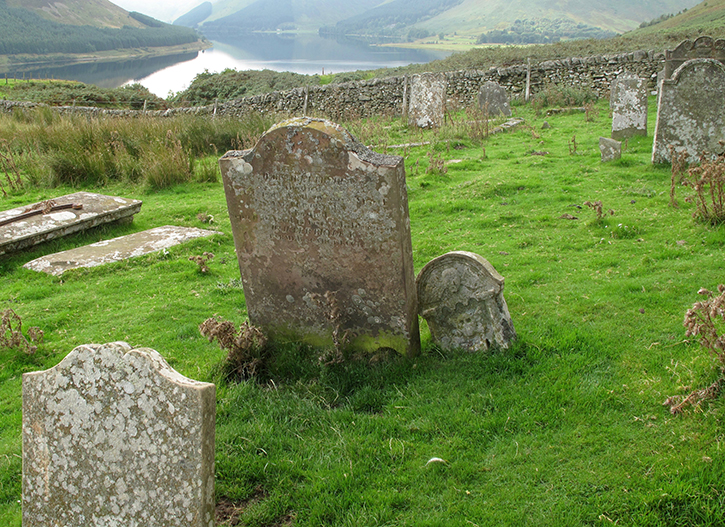
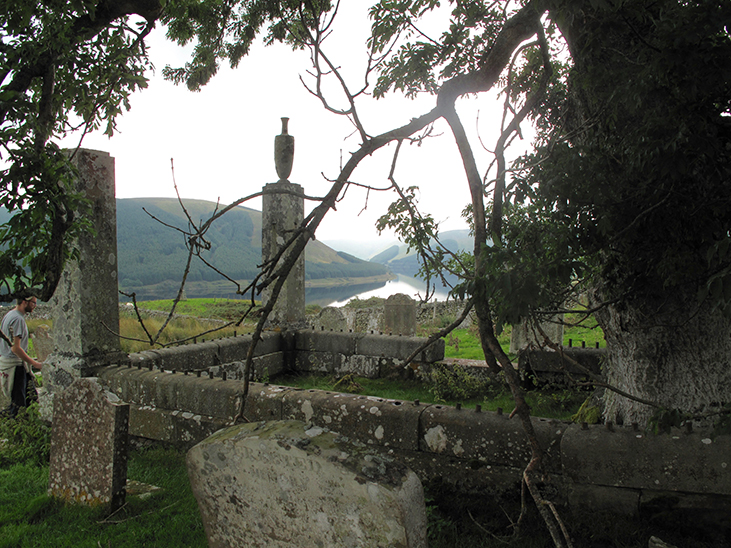
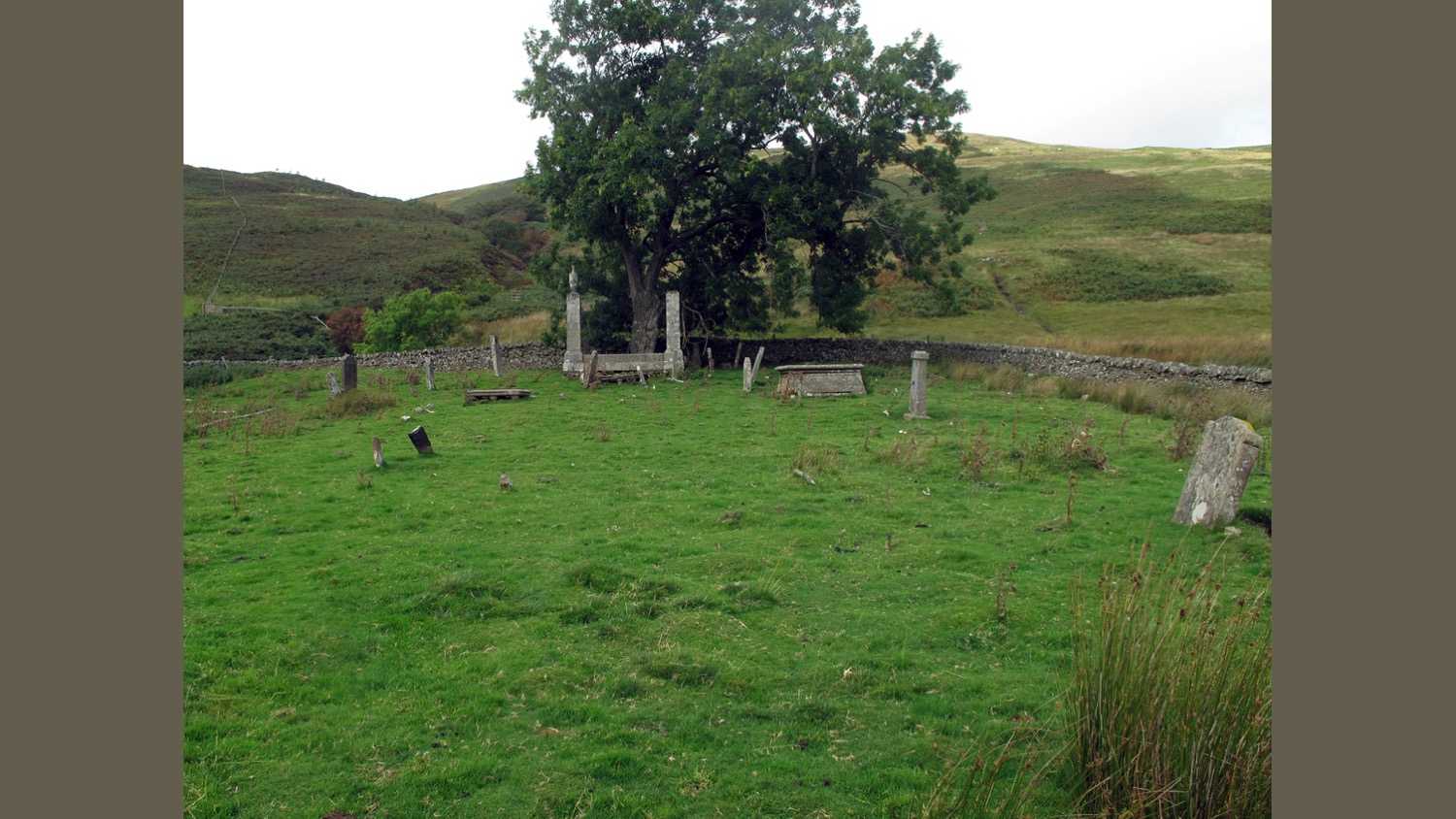
In December 2016, I gave a presentation at the Theoretical Archaeology Group (TAG) conference in Southampton entitled: ‘Hearing’ heritage: The Kirkyard of St Mary’s of the Lowes, in which I explored the possible relationship between two traditional ‘supernatural’ ballads and that abandoned Kirkyard. It is probably fair to say that it got a mixed reception. No doubt my failure to time the presentation accurately did not help but, more critically, one emphatic commentator insisted that it is simply academically inappropriate to ‘speculate’ where there is no verifiable historical record (e.g. written documentation) to support that speculation. In short, I was told that ballads can only be taken to be suggestive of a mentalité once they have been written down.

Although I don’t accept that assumption, believing with Lizanne Henderson and Edward J. Cowan that “ballads can contain factual truths not found in the often scanty records, and can contain certain emotional truths, the attitudes and reactions of the ballad-sing folk to the world around them” (Scottish Fairy Belief 2001: p. 5), I found this critique of my speculations dispiriting. (It was delivered with all the assurance of one delivering a scientific truth). What follows, however, is a reworking of that original presentation that simply ignores that ‘scientistic’ assumption. It is also made in the light of my subsequent reading of three texts: James Hillman and Sonu Shamdasani’s Lament of the Dead: Psychology after Jung’s Red Book (2013), Claude Lecouteux’s Witches, Werewolves and Fairies: Shapeshifters and Astral Doubles in the Middle Ages (1992, translated into English 2003) and Richard Firth Green’s Elf Queens and Holy Friars: Fairy Beliefs and the Medieval Church (2016) and attempts to address, in a limited way, the issue of the importance for those engaged in deep mapping and related activity of ‘listening to the dead’.


The updated presentation

In Archaeological Narratives and Other Ways of Telling, Mark Pluciennik argues that a more democratic approach to narrative might offer fresh opportunities to reflect on the roles and possibilities of both narrative and non‐narrative writings of archaeology. I’d want to extend his argument by linking it to Gemma Corradi Fiumara’s call that we return to a listening that attempts to recover the neglected and perhaps deeper roots of thinking. Also to the geographer Karen Till’s argument that acknowledging the historic ‘wounds’ associated with particular sites enables the memory-work needed to create healthy places, citizens and states. This, along with listening to two old Borders ballads, frames my thinking about how the The Kirkyard of St Mary’s of the Lowes might be narrated so as to evoke something of its complexities and paradoxes.

Prof. Arthur Watson – an artist, teacher, author, and the twenty-first President of the Royal Scottish Academy of Art & Architecture (RSA) – has participated as a singer in the oral tradition of the Scottish Traveler community since he was fifteen. Within this oral tradition old ballads like Tam Lin have been passed down from singer to singer for many hundreds of years. Professor Watson sees that oral tradition as supported by notions of memory and authority that are the antithesis of academic thinking, in my view entirely correctly. I mention this because much of my work connected to deep or narrative mapping over almost twenty years has happened in the creative space between those two notions of what is to be taken as ‘authoritative’.

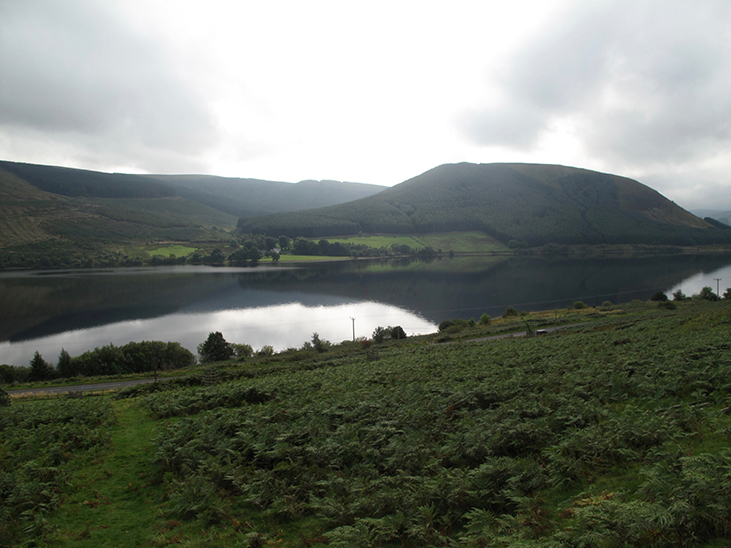
The Kirkyard of St Mary’s of the Lowes overlooks St Mary’s loch in the Scottish Borders and is situated just off the A708 between Selkirk and Moffat. It sits in the valley of the Yarrow and Ettrick Waters, a location central to a variety of ballads extending from pre-16th century ballads like Tam Lin, through to late Seventeenth Century ballads like The Battle of Philiphaugh. In short, the kirkyard in question is situated in both a physical landscape and a highly charged vernacular songscape.

This site is currently the object of two quite distinct public narratives. The first is the on-line archeological account given by the Borders Archeology Company. Although the author is careful to make it clear that his account is provisional, it tacitly evokes the objective authority of ‘fact’ as underwritten by the academic disciplines of history, archeology and etymology. This narrative begins by citing archival evidence for the existence of the now-vanished chapel in 13th century documents and works its way back in time, citing both archeological and etymological evidence to support its provisional findings. This narrative proposes that the kirk, abandoned in 1640, once stood near an earlier ‘kil’ or cell occupied by a hermit. The name ‘Lowes’ derives from the Cumbric term for a lake. Since the site was also originally located in the Cumbric diocese of Glasgow, the implication is that the cell was Cumbric in origin and may have been established as early as the 6th century. Archeological material in the surrounding landscape also suggests that the site may have had some pre-Christian significance.


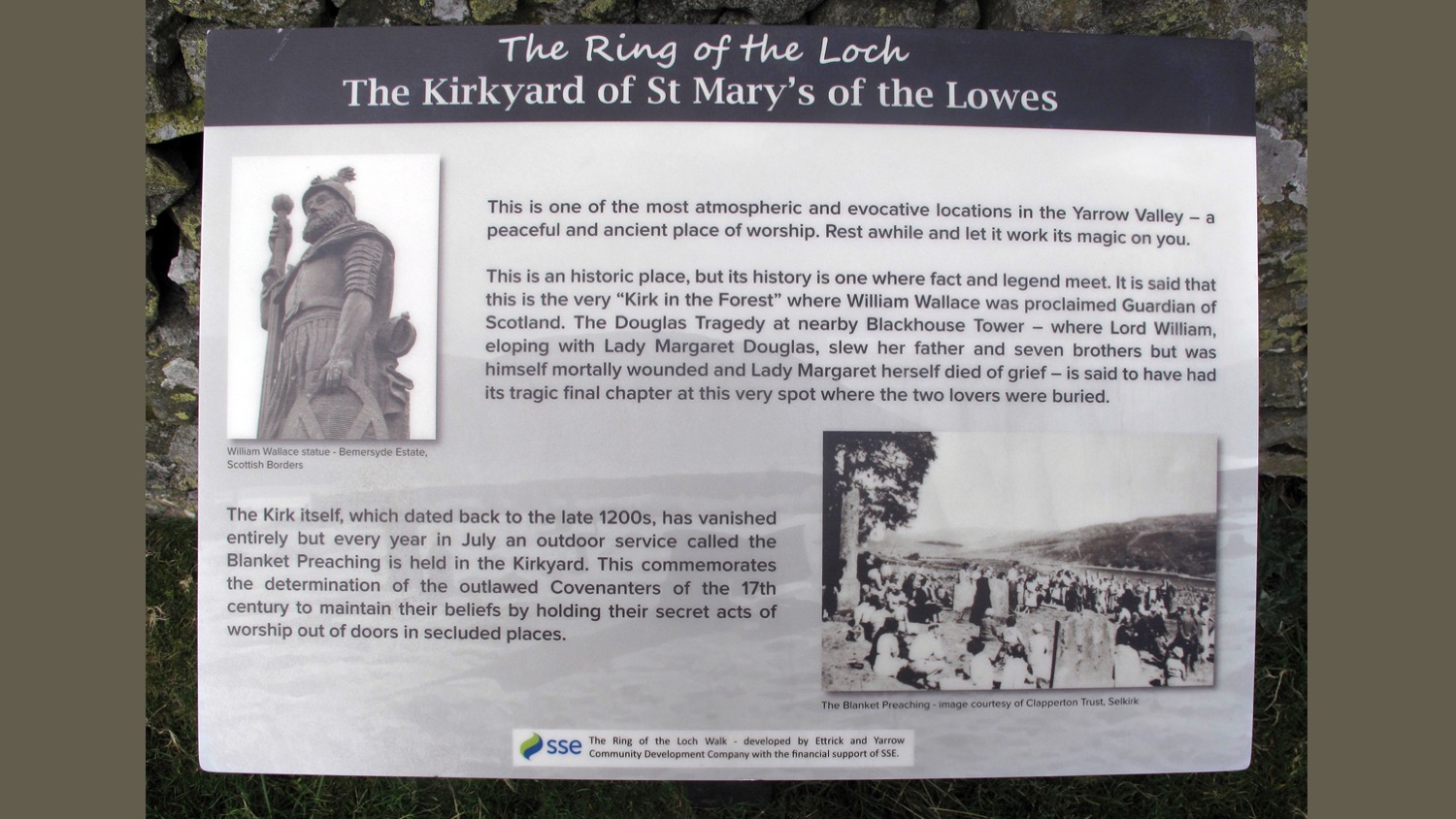
A second narrative, provided by the Etterick and Jarrow Community and Development Company, is found at the site itself. Its wording meets the needs of a Borders heritage industry catering to those people, frequently Americans, visiting the Borders in search of their roots. Archaeology doesn’t feature here. The information board is one of a set distributed around a circular walk that starts and ends at the statue of James Hogg at the head of the loch. The board presents the site as: “a peaceful and ancient place of worship”, encouraging us to “rest awhile and let its magic work on you”. It then invokes two major heritage tropes – Scots nationalism and radical Protestant dissent. In the first case by positing a link between the site and William Wallace, in the second by drawing attention to the annual Blanket Preaching in commemoration of the Covenanters held on the site. This second reference also authenticates the site as one of enacted remembrance. A further reference to a tragic romance connected to the Douglas family – still major regional landowners today – adds local colour. I’ll come back to this reference later.

What interests me is, however, absent from both these narratives.

 As already mentioned, this site is situated within a songscape dominated by what are called the “supernatural” ballads, versions of which first enter the written record in the late 14th century. These are old, layered and fractured sung narratives that contain both explicitly Christian and non-Christian folk material. I’m particularly interested in the traces of the non-Christian medieval lifeworld, because they resonate with current theorizations of ‘a sensible materialism’ and of ecological concerns by thinkers such as Isabelle Stengers, Jane Bennett, Donna Haraway, and Bruno Latour. I see these traces as a basis for work with testimonial imagination that might bridge a neglected aspect of the history of the psyche, current high theory, and an emergent attitude present in contemporary popular culture. Something of this emergent attitude is implicit in two verses from the song Resurrection, by the American singer Rita Hosking.

I’ll have no rebirth but I will be in the bark of trees and the breath of air

I’ll not be in a church, but in the cells of leaves and maybe I’ll see you there.

Significantly, Hosking relates her work to the tradition of Appalachian ‘mountain music’ which, among other sources, draws on the old Borders ballads.

The valley in which St. Mary’s kirkyard sits is haunted by two ballads in particular – Dowie Dens of Yarrow and Tam Lin. Before Hogg became the public figure commemorated here, he was the shepherd grandchild of Will O’Phaup, reputedly the last man in Scotland to converse with the fairies. Which is only to say that, as a child he internalized a heterodox ontology, radically at odds with the strict monotheism of Calvinism. The land-owning and professional classes memorialised at St. Mary’s kirkyard had adopted Calvinism a century before Hogg’s birth. But some of the rural laboring class resisted Calvinism, preserving a now banned oral tradition of ballads populated by transgressive women, revenants, prophetic dreamers, and uncanny figures like Thomas the Rhymer, taken by its Queen into fairyland. 

I need to clarify something at this point. There is a physical location known as “Tam Lin’s Well” in Carterhaugh Wood on the Etterick, down-stream from St Mary’s loch. Sir Walter Scott indicated, and numerous people still believe, that this is where Janet, Jennet or Lady Margaret met Tam Lin – the young grandson of the Earl of Roxbrugh who’d been abducted by the Queen of Elfland. I’ve no interest in such literalism, but neither do I see the content of the old ballads as picturesque nonsense. I hear these songs as echoing a vernacular lifeworld regarded by the Christian authorities as heretical, marginal, foolish, or otherwise unacceptable; a life-world that, in consequence, is largely absent from both the historical and archeological record. Aspects of that lifeworld are now being recovered by scholars like Emma Wilby, who analysis and contextualize material common to both the supernatural ballads and testimony given by individuals accused of witchcraft, and by students of medieval literature like Claude Lecouteux and Richard Firth Green.

The information board at the kirkyard refers to events narrated in a ballad called The Douglas Tragedy. This tells the story of the elopement of Lady Margaret Douglas, during which her lover kills her father and seven brothers, only to be mortally wounded himself. Margaret then dies of grief. The suggestion is that the lovers may have been buried in St. Mary’s kirkyard. An older ballad, the Dowie Dens of Yarrow, has a broadly similar plot but differs in being both framed and fractured by the devise of a prophetic dream. In this dream a mother and daughter learn that the daughter’s lover – a plowboy – has fought with nine local gentlemen for the right to marry her. The plowboy kills three of these men, three withdraw, and he badly wounds three more. At which point he’s stabbed from behind by the girl’s brother.

The significant qualities distinguish this ballad from The Douglas Tragedy. Characters accurately foresee a future event, class appears to be substituted for generational conflict over inheritance, and the landscape itself is treaded as a participant in the narrative. To what degree this is the case depends on how carefully the original collectors of this ballad listened to what was being sung. If what was hear was the words ‘dowie dens of Yarrow’, this is best rendered in English as ‘dismal narrow wooded valleys’. However, if what in fact was sung were the words ‘downie dens of Yarrow’, the reference is to fairy hills (Henderson & Cowan 2001: p. 9), a reading that would be supported by the remains of pre-historical remains in the area. This would suggest that, rather than the plowboy lover who has defeated nine men being treacherously killed because he comes from the wrong class, that the girl’s brother stabs him from behind because he suspects that the plowboy’s prowess comes from an uncanny source. In short, that he is either a fairy warrior or, like Tam Lin, a mortal associated with the fairies. (Of course, this second possibility does not exclude the issue of class). Both the attributes of ‘dowie’ and ‘downie’ to the landscape are consistent with a mentalité vividly represented by the opening lines of the anonymous C8th Irish ballad, Donal Og. These translate as:

It is late last night the dog was speaking of you  

The snipe was speaking of you in her deep marsh

 It is you are the lonely bird throughout the woods

And that you may be without a mate until you find me.

However, if we hear ‘downie’ rather than ‘dowie’, then the ballad is firmly located in a liminal landscape in which the boundaries between the day and night world of dream, the human and uncanny worlds, are acknowledged to be porous.

I want to suggest that, in addition to offering an alternative context for narrating this site, the supernatural ballads also point up an alternative approach to narrative. I’ll now elaborate on this suggestion.

While Dowie (or Downie) Dens of Yarrow and Tam Lin clearly have a beginning, middle and end, they also give a powerful sense of being embedded within an oral tradition in which the strict linear sequence of past, present and future is disrupted by magic or prophesy. From this point of view The Douglas Tragedy and Dowie (or Downie) Dens of Yarrow reflect competing worldviews. Attempts by illustrators to visualize a supernatural ballad like Tam Lin by using a single visual style are always problematic because they are visually ‘monovocal’ in the sense that illustrators conventionally maintain stylistic consistency to evoke a sense of affective or conceptual unity. But the ballads themselves don’t employ a single narrative perspective, voice or affective register.

Instead they deploy a weave of several, sometimes mutually antagonistic, perspectives. In Tam Lin we can hear the Christian orthodoxy of the landowning class rubbing up against the beliefs of a quasi-pagan peasant culture. We hear exchanges between gendered and socially differentiated voices – human and non-human – that warn, defy, expose, mock, promise, and threaten from within a polyverse rather than a universe. This polyvocality unsettles linear narratives that are further unsettled by the fact that a ballad often share lines, or even whole verses, with others, suggesting their embeddedness within a larger mesh of stories. And then, of course, each ballad exists in multiple variations.

All these characteristics allow singers to inflect the meaning of the version they’re singing by hinting at variations that resonate in the listener’s memory. Consequently, the song’s meaning, like that of our own narrative identity, is kept open to question and contestation. Arguably, then, our experience of hearing such a ballad is creatively tensioned between an unstable linear narrative woven from multiple voices and a matrix of other – perhaps antagonistic – variations situated within the space of a larger songscape.

An alternative narrative mapping of the kirkyard of St Mary’s of the Lowes might amplify the provisional archeological information. Through listening to and referencing Tam Lin it might evoke the longevity of elements of a quasi-pagan life-world in the region and to its relationship to Cumbic or Welsh Christian theology. The Dowie (or Downie) Dens of Yarrow raises questions about the relationship between class, land ownership, multiple worlds. It might point us both to the suppression of the tripartite nature of the ‘self’ or ‘soul’ suppressed by the medieval church, and to a dubious history of Scottish nationalism personified by William Wallace. Wallace’s surname derived from the Old English “wullish”, meaning “foreigner” or “Welshman”. Where his family economic migrants from Wales or members of a Cumbric-speaking ethnic minority in Strathclyde? In either case, what does this say about the construction of a Scottish nationalism that takes him as a central figure? (There is a further possibility attached to this Welsh connection, which persisted through the speaking of Welsh in areas of the lowlands as late as the twelfth century. As Henderson and Cowan point out, this means that it is “just possible” that Southern Scots learned of the Welsh tale of Elixir’s journey into fairyland from such people and that it served as one source for Thomas Rhymer’s own journey).

The Covenanter history celebrated at the annual Blanket Preaching sits uncomfortably with the consequences of Sir David Lesly’s 1645 victory at Philiphaugh, on the bank of Ettrick Water. The Ballad of Philiphaugh which celebrates that victory makes no reference to the murder of fifty Irish Royalists who surrendered on being promised safe quarter. Nor to the killing of three hundred camp followers – mainly women and children – who were then thrown into a mass grave. Given that it was his army’s Covenanter ministers who encouraged Sir David Lesly to authorize these sectarian murders, local Covenanter history sits somewhat uneasily with the characterization of St. Mary’s kirkyard as a “peaceful and ancient place of worship”.


Conclusion

In referencing ballads to suggest possibilities for re-narrating or re-mapping this isolated Borders site, I’ve evoking multiple voices of the dead so as to thicken and contest any simply ‘factual’ account – whether archaeological (scientific) or touristic (popular). Roger Strand argues that we need to set aside the increasingly toxic culture authorised by “merely fact-minded sciences”; an authority that, he suggests, privileges the views of “merely fact-minded people” at the expense of values that contribute to “a genuine humanity”. Following Mark Pluciennik, I am suggesting that to evoke a genuinely democratic and humanitarian relationship to an archaeological (or indeed any other) site, we need to interweave multiple stories and images that invite individuals to listen out for and relish the evocation of our multiple heritages and conflicting interpretations. That can only happen if we are willing to both hear and ponder the voices and beliefs of the dead, including and perhaps particularly those ancestors who held very different views of what constituted the ‘self’, society and the environment to those that dominate our current culture.

Zygmunt Bauman (1925-2017)

There are four books on one of my shelves written or co-authored by Zygmunt Bauman, an internationally significant sociologist who died at the age of ninety-one on January 9th. As his obituary in today’s Guardian makes very clear, Bauman was a man with a passionate concern to promote the ethics and values necessary to “a socially progressive Europe”. This was, no doubt, in part the fruit of his own experience as someone who, at different times, had been victimised by both the Nazis and the Communists. All these books continue to be valuable to me (if that was not the case, they wouldn’t have survived the rigorous culling of my books that’s necessary each time we move house). But it’s perhaps the Introduction to Intimations of Postmodernity (1992), and its first essay – ‘Legislators and Interpreters: Culture as the ideology of intellectuals” – that I’ve returned to most often. The other three texts Postmodern Ethics (1993), On Education, written with Riccardo Mazzeo (2012), and Moral Blindness: The Loss of Sensitivity in Liquid Modernity, written with Leonidas Donskis (2013), have all been valuable, but less central to forming my thinking.

There is a second, far less direct, reason why Zygmunt Bauman has been important to me. One of his three daughters, Lydia, is a landscape painter and, in 1997, the feminist art historian Griselda Pollock wrote: ‘The Poetic Image in the Field of the Uncanny’  about her work, the preface to an exhibition catalogue of Landscapes at the National Gallery of Contemporary Art, Warsaw, Poland. A version of this was later published in the catalogue to the first LAND2 exhibition and reproduced on the LAND2 web site. In addition to the valuable insights into aspects of landscape painting this essay offers, Pollock closes by citing a “revealing insight” from Gaston Bachelard’s The Poetics of Space, (1958/1964 p. 4):

The poetic image is not an echo of the past. On the contrary: through the brilliance of an image, the distant past resounds with echoes, reverberates, and it is hard to know at what depth these echoes will reverberate and die away.

The resonances of this essay’s conclusion stayed with me, and were later to encourage me to follow a line of thinking that would finally become clear only when I read the Irish philosopher Richard Kearney on ‘testimonial imagination’, which I now understand to be the central animating force for ‘open’ deep mapping. So, both directly and indirectly, I owe Zygmunt Bauman a profound debt of gratitude.

The undervalued third: reflections on enacting ecosophy through ‘deep’ or ‘narrative’ mappings

It’s worried me for a while now that, although there’s some understanding of the interaction of the social and environmental ecologies among those who might claim to be working ‘ecosophically’ in this area of ‘mappings, there seems little or no understanding of the necessary psychic challenges involved. This might seem odd, given where Guattari was coming from, namely psychology, but then the last thing most artists or academics are concerned with is reflecting on the psychic processes in which they’re caught up.

Sometimes I do things that I don’t understand at the time, things that seem extreme and out of character. When this happens, it can take quite a while for an understanding to emerge of what, in the moment, was experienced as an overwhelming need to act decisively without being entirely clear as to why. Recently an example of this, combined with attending the recent Theoretical Archaeology Group (TAG) conference, has pushed me to confront the fact that, in a culture of possessive individualism, it’s only through accepting a major change in self-understanding that any genuinely creative ecosophical praxis can appear. Until that happens it’s all-too-often the case that a sophisticated rhetoric manages to mask the fact that supposedly ‘radical’ individuals are in actuality ‘sheep in wolves’ clothing’. (That is, despite their self-presentation, they continue to enact at the level of psychic ecology the given roles or stereotypes engendered by possessive individualism, to manifest ‘life as’ an Artist, an Academic, etc.).

I’ve tried to think through this issue in various ways, most obviously by developing the notion of the spectrum of positions between the individual oriented by a monolithic sense of self (‘life as’), that’s animated by the desire to be ‘best of breed’ – the radical Artist, Professor, or whatever –  and what my friend Pauline O’Connell once referred to as the position of ‘compound cur’. But as the poet, artist and mytho-archaeologist Erin Kavanagh has led me to see, that spectrum is both too static and too simplistic. She writes in an email that:

“The problem to my mind with ‘compound curring’ is that one becomes a ‘bestest mongrel’ very quickly. It’s the whole ‘interdisciplinary practice becoming disciplined’ dilemma isn’t it. By doing it well we both show how ridiculous these boundaries are and simultaneously create more. It’s a conceptual ouroboros. I’ve found thus far that I have to be ‘good enough’ to hold my own in everybody’s fields in order to be taken seriously, so for me it’s a little more like being a Collie who shows, trials, does flyball / obedience / agility and will still play with the kids at home afterwards. On the plus side, we don’t get bored!”

Erin’s image of the ‘good enough’ Collie is an effective visualisation of what I’ve seen as ‘self as polyverse’ but, even as it clarifies my concerns, taken in conjunction with her recent presentation at the 2016 TAG conference, it also points up something I have failed to draw out sufficiently in the past. This is that ‘compound curring’ as I understand it is also centrally linked to testimonial imagination (seen as a vital counterweight to the ‘best of breed’ emphasis on generating novelty, difference, progress, a new or utopian vision, and so on). All of this has been thrown into high relief as I’ve read James Hillman and Sonu Shamdasani’s book: Lament of the Dead: Psychology after Jung’s Red Book’. (It’s not wholly insignificant, perhaps, that Deleuze and Guattari’s A thousand plateaus: capitalism and schizophrenia declares that Jung is profounder than Freud). The link here is with Shamdasani’s insistence that Jung breaks with the linear, the monomyth, insisting instead on “a serpentine path” that draws on the encyclopedic knowledge of a great storyteller, on “a plurality of myths, a plurality of templates” (pp. 88-90). This is, then, precisely not the personal or exclusive work epitomized by the figure of the Modernist artist or the lone scholar, each of whom is so anxious to guard the uniqueness of an individual creation. Instead it’s the work of testimonial imagination or, in Sonu Shamdasani’s terms, a “taking up the tasks left by the dead” so that the “present is then animated by the past” (p. 85). This is, then, quite the opposite of the (ultimately Modernist) desire to escape or overthrow the past. Rather it depends on a surrendering to porosity, to what, to borrow from Donna Haraway, I’d call a ‘staying with the trouble’, by letting it flow in all its variation and complexity through our own lives.

All of which is particularly relevant to my own concerns. Lament of the Dead: Psychology after Jung’s Red Book sheds considerable light on my fascination with the old Borders ballads as an imaginal playing out of one of our deepest psychic tensions, the “the conflict between the ancient and the modern, between the pagan and the Christian” (p. 58), seen not as belief systems but as modes of being or mentalities. What is important is not, in the last analysis,  the historical veracity of the claims I’ve made for those ballads as quasi-pagan, as retaining traces of  a once pervasive  animist mentality. It’s understanding my own willingness to stay with an act of testimonial imagination with regard to those ballads; to listen for the dead who still speak to us through them.

Being in Place, The Highs and Lows of Sited Practices


PLaCE International 5th Annual Postgraduate Conference in Art & Humanities, University of Dundee

I’d like to thank all those who helped organise and all those who attended this event and the accompanying exhibition. The following people gave presentations.

Gini Lee On Gardening and Travelling: revealing untold ecologies for a practiced place. // Andrew Roberts The Uncaninness of Place and Space in John Burnside’s Poetry. Essays and Memoirs. // Jerry Walton Antonin Artaud -the intimate relationships between site, historical context and institutionalisation. // Jan Johnson How Low Can You Go? Surface and the Underside. // Pauline O’Connell Drawing the Water-a contested public art project. // Arthur Watson From the Highland Peaks to the Slough of Despond in 2 Songs and 2 Fragments // Hayden Lorimer Writing the Future of Place // Susan Trangmar The ‘highs and lows’ of responding as an artist to the theme of landscape and memory connected to the film work ‘UNFOUND.’ // Laura Donkers Slow residency in a taskscape: the haunting process of critical reflection and creative experimentation whilst living in the same place as the people and things I study. // Jelena Stankovic The lost and recovered Identity of Banja Luka. // Joanna Foster A troubadour’s journey- place sited through creative action. //  John Dummett Between where we weren’t and where we won’t be.’ A parti of the city // Simone Kenyon Walking out of the body and into the Mountain’: dancing, mountaineering and embodied ways of knowing. // Nuala Ni Fhlathin Ideas of accumulation and loss in language and landscape in the minority language province of Friesland // Ciara Healy and Adam Stead Already the World: A Post Humanist Dialogue // Cathy Fitzgerald Entering the Symbiocene: A transversal Ecosophy-Action Research Framework to Reverse ‘Silent Spring.

I give the following brief Introductory talk on the first day of this two day event.

“I was asked to speak about the ‘highs’ of sited practice in relation to Nan Shepherd’s The Living Mountain. That’s tricky for me because I distrust the Apollonian association of mountains with solitary ‘highs’, elevated states, spiritual insights, or what Geraldine Finn calls “high altitude thinking’. So, I’m going to cheat just a little, while still drawing on Nan Shepherd’s book.

Shepherd writes:

Early in the season the water may be so cold that one has no sensation except of cold; the whole being retracts itself, uses all its resources to endure this icy delight. But in heat the freshness of the water slides over the skin like shadow. The whole skin has this delightful sensitivity; it feels the sun, it feels the wind running inside one’s garment, it feels water closing on it as one slips under – the catch in the breath, like a wave held back, the glow that releases one’s entire cosmos, running to the ends of the body as the spent wave runs out upon the sand. This plunge into the cold water of a mountain pool seems for a brief moment to disintegrate the very self; it is not to be borne: one is lost: stricken: annihilated. Then life pours back.

This passage might remind us that sited practice is grounded in bodily being and doing; is animated as much by an ‘expanded’ or ‘elemental’ erotics of materiality and sensation as by any high concept or ideal. Instead of focusing on a ‘high’, with its association with climbing up, I want to follow Shepherd’s images of plunging in, and of disintegration and return.

Starting sited work can produce a “sense of retraction”. I need to “endure” the “icy delight” of being assaulted by a flood of new and unfamiliar impressions, sensations, thoughts and practical demands. As the project ‘heats up’, that unfamiliarity becomes a source of heightened sensitivity. And that, in turn, can “release one’s entire cosmos” – that is, momentarily shake me free of tired associations, meanings and understandings. Immersion in a new place can be wave-like, carry me away, knock me sideways. Then plunging in temporarily disintegrates my familiar working persona, temporarily “others” me. I may welcome this or, alternatively, feel threatened: “lost: stricken: annihilated”. Either way, practical demands quickly return, requiring my attention. But once I’ve experienced that sensation of dis-integration that comes with plunging into a new place, a particular ‘space-between’ appears.

Sited practice necessarily demands time and energy. Like walking in the mountains, it needs planning, attention and care. So my focus on plunging in here is simply a reminder that, in addition to all our various intellectual and practical skills, we need the space-between of the listener. Perhaps because, as Shepherd reminds us, “water” – and by implication all that flows – is always “speaking”. I’ve read Shepherd here from a Dionysian viewpoint to counter conventional Apollonian associations with the ‘highs’ of climbing mountains. And, following Ginette Paris, because Dionysus: “shatters the positivistic perspective, for which there is only one interpretation, one truth, one definite place for everything and everyone”. So this is simply a way of reminding myself not to let the desire for heroic, single-minded Apollonian ‘highs’ distract me from the otherness in place; it’s being strange, uncanny. That reminder is necessary because, to meet the many different demands that sited practice makes on me, I need an awareness of otherness, and of my own between-ness that allows me to meet that otherness.

Shepherd’s writing on water touches me in relation to practice, in relation to its flow, power and mystery. Water goes through highs and lows without end, neither being more important to its cycle than the other. It’s the whole cycle that reduces high mountains to pebbles and sand. Shepherd ends her book with a short chapter on Being – the “I am” that is her ultimate high – and finds this to be: “the final grace accorded from the mountain”. Well and good. But personally, it’s her plunging in, and with it the oscillation between “disintegrate of self” and “life pouring back” that for me speaks most directly of the heart of sited practice.

I also think that oscillation between “disintegrate of self” and “life pouring back” is central to something Donna Haraway proposes in Staying with the Trouble. That we need to make “kin in lines of inventive connection as a practice of learning to live and die well with each other in a thick present. Our task is to make trouble, to stir up potent response to devastating events, as well as settle troubled waters and rebuild quiet places”. Maybe that’s one part of why we’re here together in Dundee?

Thank you”.


Dialogue in Place: Volume III / Shifting Perspectives

evite-shifting-perspectives2

This publication, to coincide with the exhibition in Leeds, contains an essay I wrote about the work of Joyce Lyon and Andrea Thoma a while back, called The Conversational Weave (another place). (This can also be found on this web site in the section Texts, Talks, etc.).

Something Joyce wrote when she contacted me to tell me about the exhibition seems particularly pertinent at present, in that it demonstrates the value of a mutual, open engagement that’s not predicated on known positions. She writes:

“I need to tell you that in preparing and proofreading the book, I experienced a deeper intimacy with your essay that allowed me to see and appreciate it for and as itself, which I did not fully have before. I recognized that what I was then hoping for was a more fixed disciplinary appraisal! I see now that what you offered us, in all its “gappy”, thoughtful fluidity and movement towards home was so much richer and more significant. I am grateful to have been, with Andrea, catalysts in the development of your ideas”.

I would encourage anyone who is able to visit this exhibition.


Women in dark times

It seems to me that Hannah Arendt’s wonderful book Men in Dark Times needs a sequel for our times. I think she would have wanted to recognise the practical thoughtfulness of Michelle Obama, for example. Be that as it may, on the recommendation of a friend I have started reading Donna Haraway’s extraordinary Staying with the Trouble (from which I quote below). It is wonderful to find a book that, for example, understands the value of the work of an artist like Ursula Le Guin at a time when so much of what passes for art is simply an exercise in either exemplifying possessive individualism or the corrosive cynicism that shadows it. This is a book that speaks to many pressing concerns – its ‘string figure’ motif also strikes me as a powerful analogue for what I would characterise as ‘deep’ or ‘narrative’ mapping –  and is enormously encouraging to read at a moment when bigotry and demagogy, personified by men like Trump and Farage, appear to be the dominant forces in both the UK and the USA.

But, as we all know, appearances are deceptive.

Gina Miller now needs police protection for herself and her family from the death threats that have flooded in as a result of her having spoken up for the rule of law. But, on the strength of her interview in the Guardian today, she remains exactly the type of exemplary citizen and businesswoman we need to make kin with in what Haraway wants us to see as the Chthulucene age. I am enormously fortunate to know some women in the USA who, as Elizabeth Warren has urged, will I know do everything they can in their own places to recuperate and amplify what is response-able and generous in American culture. They may, to quote my Dakota friend Mona Smith, still be trembling from the result of the election. However they know, as she writes, that now: “we have to hold tight to our visions for the earth and it’s critters. One step in front of the other. One hand held out at a time. Our need to be kind to each other is so clear. I am seeking things that bring me hope”. She sites the fact that the American Civil Liberties Union  is “declaring war” on Trump and points to the fact that Standing Rock water protectors are standing firm and gathering support. And, like Haraway, she recognises that one of our biggest challenges is not to succumb to the worst case pictures that keep creeping into our heads.

Like many people I am troubled, indeed tired to the bone, from struggling against the specific injustices and misery created by a system dominated by the commonplace thoughtlessness which, as Haraway reminds us by drawing on Hannah Arendt, engenders the banality of evil. The same evil Arendt saw personified in Adolf Eichmann. In a man who: “could not be a wayfarer, could not entangle, could not track the lines of living and dying, could not cultivate response-ability.” All because he already knew who he was and what he needed to do, and so didn’t need to think in Arendt’s sense of that word. As Haraway reminds us, thinking, thought, is not “disciplinary knowledge or science rooted in evidence, or the sorting of truth and belief or fact and opinion or good and bad”. It’s important to remember this, less we imagine that the thoughtless are somehow unintelligent. No, they are simply people who are too busy with: “assessing information, determining friends and enemies, and doing busy jobs” to attend carefully to the ebb and flow of the world as it is. They are too busy ‘being’ a particular role: a scientist, activist, artist, academic, business person, or whatever, to have time to become, to be ‘entangled’ into newness, as Haraway might put it.

Anyway I can’t help thinking that, if Hannah Arendt were alive today, she might well write a sequel to her earlier book, one entitled Woman in Dark Times.

Thank you, Gina Miller

Britain, the USA, and perhaps Europe as a whole, seem increasingly to be falling under the sway of cynical demagogues who practice a polarising and self-serving politics based on fear and loathing, ably assisted by the majority in the media. (Typically, in the UK the Daily Mail has just branded three high court judges ‘enemies of the people’ for upholding the rule of law). In this context, we owe a profound debt of gratitude to Gina Miller. The long-established world view predicated on the elite narratives of high capitalism and the culture of possessive individualism is turning increasingly toxic in both its psycho-social and environmental dimensions. As a result, those happy to cynically exploit fear come to the fore, intimidating or denigrating anyone who disagrees with them. (This has long been a popular managerial tactic in big institutions, as it is in totalitarian states). It takes very real courage to stand against this in a country where demagogues and their media allies appear hell-bent on re-creating the kind of atmosphere that allowed fascism to come into power in Germany and Italy in the 1930s.

Unlike those whose Brexit politics are based on mixing gross lies and vague half-truths, she has had the courage to do what they claimed to be doing. She has insisted on publically arguing for the sovereignty of the British Parliament as the cornerstone of our particular brand of democracy. That private individuals have had to do what Parliament should itself have done speaks volumes about the shameful situation in which we now find ourselves.

I took part in a meeting yesterday that ended in a discussion in which a number of us openly challenged some of the presuppositions that underwrite the work of the academic status quo. I was particularly interested in one line of argument that appeared during that discussion. Namely, that the difficulties we were bringing to light were simply – or primarily – the result of clashes of personality. This seemed to me to parallel the argument that any questioning of, or opposition to, the desires of the Brexit camp is just people being ‘bad losers’, ‘whingers’ – is, in short, the product of personal defects at an individual level. What this allows those who argue in this way to side-step is the fact that, while of course our differences are always expressed at a personal level, they can never be reduced, monolithically, to manifestations of individual personality. We are social beings. To argue that how we manifest ourselves is simply an individual mater, and so by implication is not interwoven with and influenced by the cultural, structural and institutional norms that are written into our collective lives, is simply a way of avoiding the uncomfortable realities of our current situation.

It is time that, like Gina Miller, we find the courage to publically name and address those uncomfortable realities; to acknowledge them for what they are and look collectively for ways to address them.      

The realpolitik of the art/geography nexus as ‘generative encounter’.

This post largely consists of a longer (originally written for a twenty minute presentation, of the text read at a “Beyond Interdisciplinarity: situating practice in the art/geography nexus” session at the Royal Geographical Society conference in London on September 1st, 2016.

It was prompted by my growing sense of the gap between the openness of the creative projects undertaken by the arts practice-led doctoral students I have been involved with as a supervisor over the last 15 or so years, and the various academically-led “interdisciplinary” research projects I have been attached to over approximately the same period of time.

While the former have by and large become more adventurous and reflexive and less inclined to locate themselves using conventional terms such as ‘interdisciplinarity’, the later have become increasingly mired by constraints imposed by a thinking that, while adopting the rhetoric of ‘interdisciplinary’, remains tacitly in thrall to the presuppositions of the disciplinary mentality. This is sometimes the result of senior academic staff passively adopting assumptions that fail to address questions of the nexus of power, intellectual authority, and terminology within the academy. For example, by tacitly accepting that philosophy, as ‘queen of the sciences’ sits at the top of a hierarchy of value and so provides the trump card in terms of authority vis a vis epistemological differences. However, the constraints are sometimes nothing to do with the projects themselves as intellectual constructs. Rather that are caused by the deadening consequence of academics being required to internalise a risk-averse governance culture that uses audit (including the REF) to reinforce an exclusive disciplinary regime predicated on a logocratic realpolitik. 


Mike Pearson teaching


This presentation is intended as a provocation and, as such, involves an element of caricature

My topic is the realpolitik that determines institutionally funded encounters between art and geography. However, keeping in mind Isabelle Stengers’ stress on the need for epistemological bridge-building, I’ll try to keep my distance from what Gemma Corradi Fiumara calls the logocratic culture of ‘competing monologues’. Rather than assume a monolithic professional persona, I’m going to speak as a constellated self with multiple and tensioned concerns – in education, place oriented research, social activism, and the imaginal arts.

Barbara Bender’s observation that: “Landscapes refuse to be disciplined. They make a mockery of the oppositions that we create between time [History] and space [Geography], or between nature [Science] and culture [Social Anthropology]” – indicates why I have a problem with conceptualizing “contemporary art as a mode of spatial enquiry”. This conceptualization would also appear to have missed the richly and densely interwoven existing conversations between geography, the arts, landscape architecture, visual anthropology, and uncategorizable compound practices. These conversations are important because, while academic geographers are subject to a disciplinary realpolitik as a condition of their employment – and so look to interdisciplinarity for change – that polyvocal conversation takes place in an extra-academic elsewhere. So any proposal to dissolve boundaries that’s articulated in academic terms signals a certain degree of belatedness. I suspect this is the consequence of a dilemma within “non-“, “anti-“ or “more than” representational geography, but I’ll come to that later.

Because of this misunderstanding I’m going to employ a quite different differentiation, one that cuts across the categories “art” and “geography”. This is the psychosocial spectrum used by sociologists Paul Heelas and Linda Woodhead to distinguish between different citizens of Kendall, one that arcs between “life-as” and “being-as-becoming”. I’ve modified their approach using terms suggested by Pauline O’Connell – between individuals focused on achieving “best of breed” status and those who accept, given our worsening socio-environmental situation, the uncertain status of “compound cur”. The first position internalizes possessive individualism’s insistence on the primacy of the autonomous self to the point where the desire to be “best of breed” in a given professional field – say “art” or “geography” – takes precedence over all other concerns and connectivities. The resulting life-world is framed hierarchically by, ultimately, the same historical presuppositions that link the terms “university” and “universe”. By contrast, the inclusive and compound imaginal/material activity of “compound curs” is constituted through negotiating the epistemological differences and cognitive dissonances that flow from living in a polyverse. There constellated selves are constituted through internalising commonality as a multiplicity of attachments, connections, and relationships. In reality of course each one of us lives in a state of uneasy oscillation somewhere between these two poles.

The imaginal/material practices of a “compound cur” interweave multiple forms of creative work and share techniques and intensions across a host of different skill sets and fields of concern. The academic term “interdisciplinary” is a pale discursive shadow of performative, constellated, practices that are so intertwined in participation, sociality, conversation, and ‘the civic’’ as to elude categorization. Of course like everyone else “compound curs” still have to live with the consequences of the given professional categories that govern employment and the realpolitik that underwrites professional authority.

The current relationship between geography and constellated imaginal/material practices is indebted to the AHRC’s Landscape and Environment Programme between 2006 and 2012, which catalysed certain on-going transformations. I know from personal experience that it transformed three informal networks that continue to facilitate constellated imaginal/material practices across and between the arts, activism, the humanities and the social sciences – and despite an increasingly hostile institutional environment. The effects of that Programme also inform current research projects like the AHRC-funded Towards Hydro-citizenship, in which I’m involved and that informs this presentation.

I was a co-ordinator for a network funded by the Landscape and Environment programme – Living in a Material World: A cross-disciplinary location-based enquiry into the performativity of emptiness. This developed a vibrant conversational exchange between individuals engaged in a wide range of practices. Significantly, four of the five coordinators had constellated practices – working in and between performing or visual arts, a commitment to the radical pedagogy that’s implicit in good arts education, and various forms of place-oriented research. Other participants included archaeologists, historians, artists, and the geographers Stephan Daniels, Hayden Lorimer, J.D. Dewsbury, Owain Jones and John Wylie. This conversational project informed the 2009 Living Landscapes conference in Aberystwyth, a watershed event organized by Mike Pearson and Stephen Daniels.

The Material World network was animated by conversation as an imaginal/material field-based method for working-across a wide range of disparate skills, practices, engagements, and lines of thought. A concurrent project involving Patrick Keiller and Doreen Massey adopted the same approach to produce the film Robinson in Ruins and the installation The Robinson Institute at Tate Britain in 2012. That creative exposition included film, curated artefacts, and carefully researched polyvocal texts, interweaving diverse historical and contemporary material in telling juxtapositions. The project as a whole is an exemplary indication of what collaboration that privileges an extra-academic context can achieve.

SPUD is an on-going imaginal/material conversation initiated by Deirdre O’Mahony. It works with cultural and agricultural concerns and involves both a South American research institute and the Loy Association in Ireland. Initially a way of presenting a more nuanced understand of the potato’s role in Irish culture – particularly in relation to food security and globalized food production – it has developed into an understandable and accessible entry point for a public discourse on sustainability, food security, and tacit cultivation knowledge. Its lazy-beds were recently displayed as “useful art” outside the Irish Museum of Modern Art.

A project like SPUD requires its coordinator to identify and acknowledge the limitations of different epistemological assumptions. This enables a collective mind-set comparable to that of a “compound cur” to develop. Without this grounding in “epistemological agnosticism”, collaborative academic projects continue by default to be framed by the realpolitik of the logocratic order because that is what frames their funders’ criteria. Criteria in turn based on a consensus that categorizes the arts as “other” and subaltern. This framing is independent of the views of individual academics. Academic research governance systematically enforces its consensus on the basis of the “epistemological error” identified by Gregory Bateson. In a paper called Stepping from the wreckage, Owain Jones summarizes this error as: “the enlightenment/modern aspirations of progress towards truth through the elimination of doubt and the application of reason, language and power” – the tripartite basis of the logocratic order – so as to divide, sort, represent and fix the world. Academic realpolitik enforces this logocratic order. Even if all the individuals in a collaborative team would claim to reject the error Bateson identifies, that realpolitik subordinates the outcomes of consensus-based research to that order, or else marginalizes or negates them. In short, consensually based Research Council funded projects always ultimately conform to the requirements of a logos that divides, sorts, represents, analyses and fixes the world.

At this point it may be useful if I indicate what I see as the dilemma of “non-“, “anti-“ or “more than” representational geography. Intellectually it repudiates the epistemological error Jones’ identifies. But while a geographer like John Wylie may wish he and his peers could “engage freely with the techniques and presentational forms of the creative arts”, their academic authority still largely rests on a typical logocratic strategy. This is the use of philosophy to re-conceptualize – that is re-divide, re-sort, and re-represent – previous discursive conceptualizations of the world. It does so in philosophically saturated texts that, somewhat ironically, privilege the concept of ’embodied’ experience’ – texts on which its academic authority depends. However, some geographers are also aware that, to paraphrase Gemma Corradi Fiumara, the logocratic order is based on knowing how to speak rather than how to listen – hence perhaps J. D. Dewsbury’s emphasis on “witnessing” – a form of listening in Fiumara’s sense. All of which indicates why this geographical tendency talks of wanting to distance itself from the logocratic order through hybridization with arts practices. However, to do so in practice would be to put its status within the academic hierarchy at risk. In the terms of academic realpolitik a non-rep geographer gains status by citing Gilles Deleuze, not by emulating Joseph Beuys or Susan Stenger.

This dilemma is best addressed using attentive listening as the basis for adversarial collaboration basedon disciplinary agnosticism. This obliges us to acknowledge and openly converse across openly acknowledged epistemological differences – a process that replicates that of the imaginal/material practices of “compound curs”. It requires cultivating the agnosticism mentioned earlier to enable us to explicitly acknowledge, and then work with and across, both our own epistemological presuppositions and those of others. This process is sharply distinguished from collaboration based on the assumption of a consensus that ignores, represses or marginalizes difference. Put very simply, adversarial collaboration works with epistemological difference to create vibrant, generative contrasts.

I’ve been assuming a particular understanding of conversation that I need to make explicit. Conversation is an art grounded in active listening. As Monica Shev-chick argues, to choose to have a conversation with a person is to admit them into the field where worlds are constructed. However, this choice ultimately runs the risk of redefining not only the ‘other’ but myself as well. The art of conversation has the capacity to stay open to and wait for what is unforeseen. As such it enables ideas to converse with time, unrestricted by given or predetermined ends. In this way it challenges the instrumentality of Funding Councils and the REF emphasis on outcomes and impact.

The risk of redefinition through conversation is, however, equally present in adversarial collaboration. There is immense pressure on geographers and artists to live a “life-as best of breed”. This means that to engage in adversarial collaboration – which necessitates acquiring some real understanding of, and respect for, lived epistemologies other than one’s own – is to risk transformations that may be professionally damaging.

The dilemma of “non-“, “anti” or “more than” representational geography as I see it appears in the nexus of method and authority. The Czech poet and immunologist Miroslav Holub argues that poetry – and by implication the arts – is predicated on the inadequacy of its means, enabling it to evoke our lived experience as always exceeding and falling short of conceptual definition. This inadequacy is deeply problematic from the perspective of a logocratic order underpinned by reason, language and power. That order’s authority lies in it claims as to the adequacy, or at least temporary adequacy, of its methodologies and categories – particularly those of philosophy as the peak of the logocratic hierarchy. Yet it appears that some geographers want to step away from the wreckage of the logocratic order that, paradoxically, still underwrites their existing authority. This is a paradox familiar to any “compound cur” working in tertiary education.

Constellated selves working with compound imaginal/material practices in Arts or Landscape Architecture Departments follow the example of dissidents in the Soviet Union prior to Glasnost. They pay lip service to exclusive disciplinary categories and the academic governance system. They struggle to work within institutional frameworks while enacting quite other values. And, like supporters of perestroika, they work below the parapet in pursuit of larger priorities. I hope this also happens in Geography Departments. In terms of any genuine nexus then, perhaps our first priority should be conversations about the type of “productive deception” I’ve identified in relation to doctoral supervision. This is a variant of what Paulo Freire refers to as a ‘limit act’ – one that, through shared witnessing, reflecting, acting and reimagining, can detach us from logocratic framings.

Maria Kerin writes of the collaborative artists’ collective Outriders that it operates on the principle of hospitality, generosity and reciprocal support, using its own resources and a minimum of public funding. This enables it to remain largely independent of systems it views as no longer fit for purpose – the same systems that underwrite academically-led arts/geography projects. The example of Outriders makes me wary of Sarah Whatmore’s call for “hybrid geographies” that are (I quote):

“not defined as/by academic disputes like the so-called ‘science wars’, important though these are, but in which the stakes are thoroughly and promiscuously distributed through the messy attachments, skills and intensities of differently embodied lives whose everyday conduct exceeds and perverts the designs of parliament, corporations and labour” (p.162).

I’m wary, not because I lack sympathy with her sentiments, but because of my own experience of the unholy alliance between academic realpolitik and the possessive individualism of best-of-breed actants. Wary too because I suspect that hybridity, like resilience, all-too easily becomes the means by which a system maintains the status quo while mimicking transformation. Finally, wary because of the context that frames the invention of Landström and Whatmore’s ‘competency group’. As with Rancière’s silence on the active tradition of critical pedagogy in The Ignorant Schoolmaster, I have to assume that they are unaware of parallels between their “invention” and strategies long used by both socially engaged artists and liberation psychologists.

Given the economic situation, there are no shortage of artists willing to sign up to interdisciplinary projects with geographers – despite the unresolved issues of power, epistemology, and financial reward involved. However I want to close on another note.

Les Roberts has identified the core of this problem of authority when he claims that my call for an ‘open deep mapping’ only makes sense insofar as its openness is sufficiently diffuse to invalidate deep mapping as a category. But this claim precisely presupposes a disciplinary perspective, one predicated on the authority of fixed categories. Like any “compound cur” however, I understand my practice to be predicated on inadequacy and, in consequence, subject to a perpetual erosion of any categorical identity it may temporarily acquire.

One alternative to the proposed academic nexus would be for interested individuals to adopt the position of the Irish collaborative collective Outriders. This operates on the principle of hospitality, generosity and reciprocal support, drawing on its members’ own extra-institutional resources and a minimum of public funding. Adopting such a strategy would minimize interaction with the realpolitik that will otherwise frame any proposed nexus as ‘interdisciplinary’. But taking such a step requires academics to lead double lives with regard to

I want to end on a different note. Writing about deep mapping in north Cornwall, Jane Bailey and I describe our working process as: ‘observing, listening, walking, conversing, writing and exchanging … of selecting, reflecting, naming and generating … and of digitalizing, interweaving, offering and inviting’. Taking up Lee Roberts’ observations on our claim, I suggest we were no more involved in “a mode of spatial enquiry” than we were in any literal form of mapping. As Roberts notes, we immersed ourselves: ‘in the warp and weft of a lived and fundamentally intersubjective…creative coalescence of structures, forms, affects, energies, narratives, connections, memories, imaginaries, mythologies, voices, identities, temporalities, images and textualities’. So whatever name we give to what we were doing, it’s not helpful to frame it as “spatial enquiry” or some form of interdisciplinary nexus.

Economic necessity and intellectual curiosity will ensure that artists look to work with geographers, at least while geographers continue to engage with the techniques and presentational forms of the arts.  I hope both camps will start to adopt reflexive forms of collaboration, or else strategies like those of the Outriders collective. However, that will require them to enter conversations predicated on disciplinary agnosticism. That in turn will put both parties at risk of emerging with wholly other forms of praxis, those of compound curs.

I look forward to that happening.


Landscape Values: Place and Praxis – a personal response

[N.B. All the images are used with the permission of the person whose work is referred to].

Introduction

At the end of June I went to the west of Ireland to attend a conference – Landscape Values: Place and Praxis – organised by Tim Collins, Gesche Kindermann, Conor Newman and Nessa Cronin for the Centre for Landscape Studies at NUI, Galway. The conference was at NUI Galway because the university is a member of the UNISCAPE network, a Europe-wide group of universities concerned with landscape research, education, and the implementation of the European Landscape Convention. This gave the event its particular flavour and orientation. INSCAPE’s member institutions are drawn from across Europe, although universities in the UK and Germany are conspicuous by their absence. I’ll come back to the significance of all this later.

I have known Nessa for some time, originally through the Mapping Spectral Traces network and through a shared interest in deep mapping, and met Tim and Conor while I was working as a visiting researcher at NUI, Galway. Knowing them, I guessed this was likely to be an interesting and worthwhile event. Their thoughtfulness as individuals – and of Unescape as an organisation – was confirmed early on when all speakers were asked to submit written versions of their papers well ahead of the event itself. These appeared in a beautifully produced paperback book that was in our conference packs when we arrived. This enabling us to choose more productively which sessions we wanted to attend, without all the usual concern about missing altogether something vital by making the wrong choice on the basis of a short abstract.

What follows here is a personal reflection on the event as a whole although, I must admit, one filtered through my own interests in activities such as deep mapping. (Those unfamiliar with this  cluster of practices might want to look at the Humanities Special Issue “Deep Mapping”, which can be downloaded for free and includes an article by Silvia Loeffler, whose work is referred to below).

Grounding empathetic imagination

I went to Galway two days early. I wanted to take the opportunity to catch up with my friend and former PhD student Dr Ciara Healy; also to meet with Nessa and Nuala Ni Fhlathuin – a doctoral student with whom we will be working (together with Deirdre O’Mahony). Arriving early also enabled me to unwind a bit before the event started.

Of the various presentations and events on the first day for myself the most memorable by far was the performance related to the Tim Robinson Archive: Artists in the Archive Project initiated by Nessa. This combined live music written by Tim Collins, choreography and dance by Ríonach Ní Néill, text, song, and a film by Deirdre O’Mahony. This performance provided a wonderful sensuously knowledgable counterpoint to the more general governance-oriented and other perspectives offered earlier in the day. As such it grounding my thinking back into the complexities of lived experience, lived traditions, and the tacit paradoxes that haunt the creation of the new Tim Robinson Archive, recently established in the James Hardiman Library at NUI, Galway, following his decision to return to London.

The second day of the conference extended that sense of grounding, with all conference attendees going out into the region on one of four carefully themed and structured field trips. Having an interest in bogs – practically through my friend Christine Baeumler and as archetypal psycho-geographical sites through James Hillman and others, I joined the trip to the turf bog at Lough Boora, which included a visit to Ballinsloe and the Shannon. Direct contact with several active members of the local community there, who are trying to work out a future in the face of the scaling-back of turf cutting, enabled us to get a clearer sense of the difficulties and opportunities that result from the implementation of environmental policy. In a small way it also gave us an opportunity to contribute ideas and information that might be of some use to the community.

The work that has been undertaken at Lough Boora is impressive and the dedication of those trying to construct an alternative future was as inspiring as it was humbling. The EU’s shift to restrict turf cutting on environmental grounds, still highly controversial in Ireland, has led to a great deal of innovative action by the community. My overall impression from our discussions was of their willingness to open themselves to new possibilities and of the pressing need for people in academia and the cultural sector (individuals with specialist knowledge) to listen, and try to try respond appropriately, to the needs of local communities hungry to find ways to save themselves from what is effectively social annihilation by decisions made elsewhere. Often with too little consideration as to how their impact ‘on the ground’ might be mediated and transformed into possibilities rather than what must often seem like a slow death sentence. That Conor Newman, who organised our trip, had clearly gone to some trouble to build a relationship with the group who met us was reflected in the warmth and appreciation they brought to our exchanges.

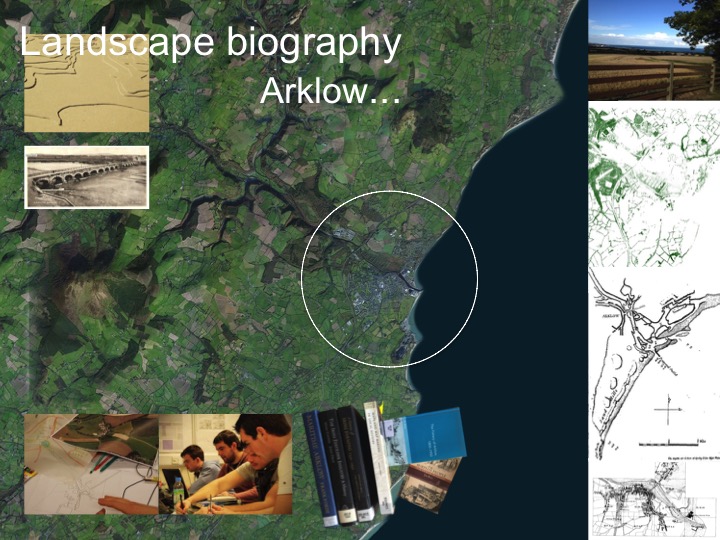
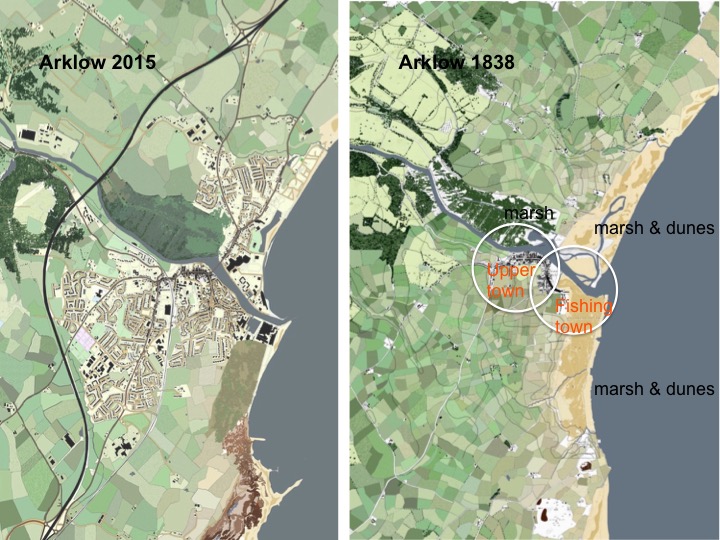
Following our visit three speakers presented in a small church in the afternoon. One was Patrick Devine-Wright (from Exeter University), whose presentation on Varieties of place attachments and community responses to energy infrastructures: a mixed method approach reinforced my earlier impressions and suggested ways in which the kind of alternative mappings that interest me might be deployed in such contexts. This set up interesting suppositions in relation to another of the presentation, by Sophia Meeres, on Infrastructural struggles: the making of modern Arklow, Ireland. This showed how architecture students working in a learning context can make use of deep mapping processes to plot a city as a changing taskscape, where the detailing of its infrastructure struggles over a two-hundred-year period become the basis of an analysis of the decisions that inform the space of a communal lifeworld.

Given the length of the conference and number of parallel sessions that I could (and could not) attend, it will be obvious that I can’t possibly comment even on those presentations I did attend. Consequently, I will concentrate on a few that particularly spoke to me in terms of my own interests – by Jacques Abelman, Aoife Kavanagh, Silvia Loeffler, Sophia Meeres (touched on above), and Eilis Ni Dhuill. (I deliberately did not go to sessions at which my friends Simon Read, Ciara Healy, Geared O hAllmhurrain, Harriet Taro and Judy Tucker and Karen Till and and Gerry Kearns presented, since I wanted to experience ideas from people I didn’t know. However their essays in the conference publication are well worth reading).

 Jacques Abelman works as a landscape architect and is currently based in the Netherlands (but will move shortly to teach in the USA). His presentation – Cultivating the City: Infrastructureof Abundance in Urban Brazil – interested me both for its content and because it’s tenor seemed to me to reflect his broad education and experience. This took place in the USA, England and the Netherlands (his first degree is in environmental science with fine arts and philosophy), and he worked as an environmental artist, ecological builder, and garden designer before moving into sustainable design and landscape architecture. The presentation provided a succinct and intriguing introduction to his Urban L.A.C.E. / Renda da Mata project. (L.A.C.E. stands for Local Agroforestry, Collective Engagement, while Renda da Mata means “Forest Lace” in Portuguese), which I won’t try to outline or discuss here since it can be much better explored via his web site.  However, what particularly impressed me was the way in which it built on sustained fieldwork on the ground – resulting in an impressive and well-grounded range and depth of knowledge. In a sense this project provides an exemplary model for the type of practically-oriented ‘deep’ approach to researching the basis for a socio-environmentally responsible landscape architecture of which I had a brief and tantalising taste when discussing deep mapping with landscape architect students and their teachers at Virginia Tech some years ago.

Perhaps unsurprisingly, Jacques’ presentation raised a number of issues around landscape democracy and questions of de-professionalism (as underwritten by disciplinarily) and given the claim that ‘citizens do not operate within disciplines’. However during the exchange after the presentation I was somewhat rebuked by one audience member for apparently suggesting a ‘bottom up’ rather than ‘top-down’ model in relation to specialist/vernacular collaborations and issues of responsibility for the Commons. This led to a brief but fruitful exchange about the need to set aside supposedly ‘modernist’ and ‘authoritarian’ notions of the professional or specialist (which in my view are not restricted to the modern period but rather embedded in the culture of possessive individualism), towards notions of an ability to make authoritative specialist contributions to debate and action with regard to the Common Good. Here the example of Brexit might be seen as indicative of what happens when populist political views predicated on prejudice and outright lies gain the upper hand. Given Michael Gove’s now notorious execration of ‘experts’ this seemed a point well worth absorbing.

Aoife Kavanagh

Aoife Kavanagh is a professional musician (piano, violin, flute, and viola) and music teacher who is currently undertaking a PhD on music, place-making and artistic practice in the Geography Department at NUI, Maynooth. Her presentation – Making Music and Making Place: Mapping Musical Practice in Smaller Places – is based on the working premise that places, perhaps particularly in Ireland, may have a ‘musical ecology’ that extends well beyond performance by professional musicians and that understanding that ecology spatially, through ‘community deep mappings of of music and place’, can give a ‘voice to people in places to uncover and document that which might otherwise be overlooked’. In certain ways her approach seems to me to resonate quite closely with that employed by Luci Gorell Barns’ Cartographers of compassion: community mapping of human kindness project in Bristol, albeit in a different register. Interesting, she has built on Rebecca Krinke’s (2010) project Mapping of Joy and Pain, with it’s particular emotional focus, while adapting this approach as a way to collectively ‘map’ more nuanced and complicated ‘musical stories’. Of particular interest to me were Aoife’s comments on the challenges involved in this project, since these tend to reinforce my own views. Namely that a combination of positions – those of  ‘insider’ (in her case the importance of being a musician/music teacher who understands the passions and limitations of the ‘lifeworld’ in which she is working) and ‘outsider’ (researcher/cartographically-oriented artist) – is a central aspect of this type of work. This first became clear to me in relation to Ffion Jones’ work in mid-Wales, which took her parents’ sheep farm – Cwmrhaiadr – as the focus of her PhD project. One in which this dual role was central to her concern with ‘woollying the boundaries’ between the world of upland sheep farming in Wales and academic understandings of rural life. This seems particularly important when the researcher is also embedded in the lifeworld of a particular community and so must act as a ‘bridge’ between worlds distinguished by emphasis on performativity on one hand and discourse on the other.

Silvia Loeffler
humanities-04-00457-g006-1024

humanities-04-00457-g003-1024

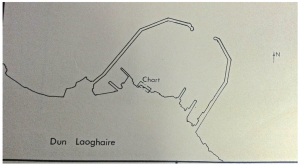
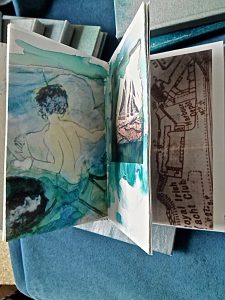
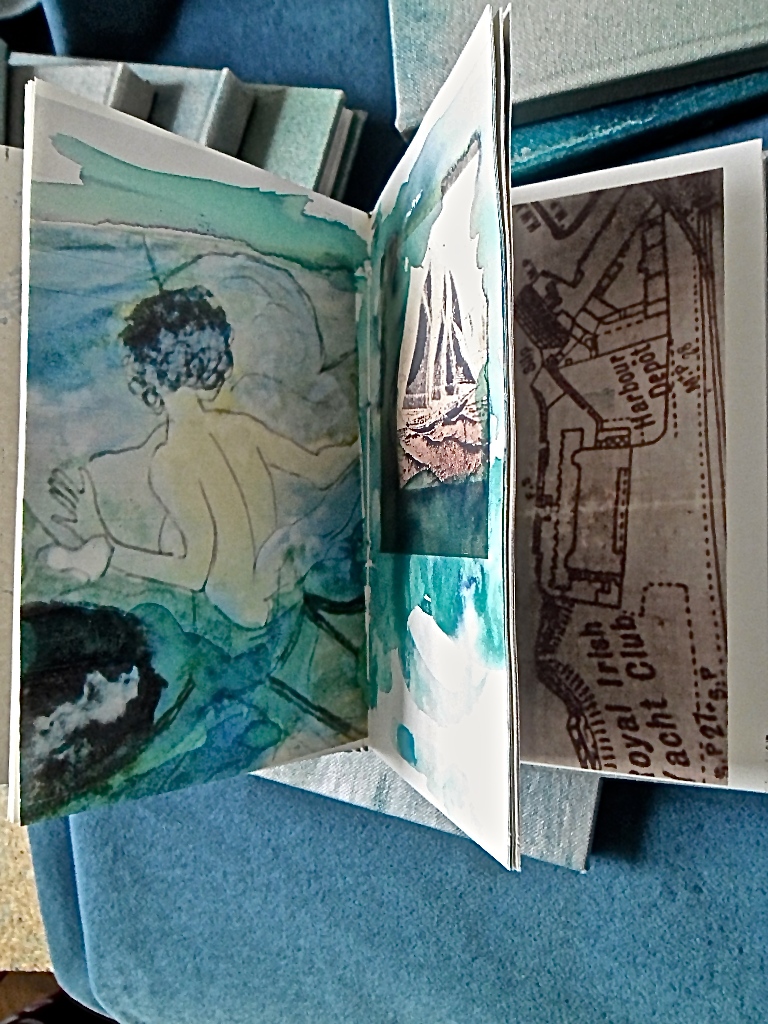
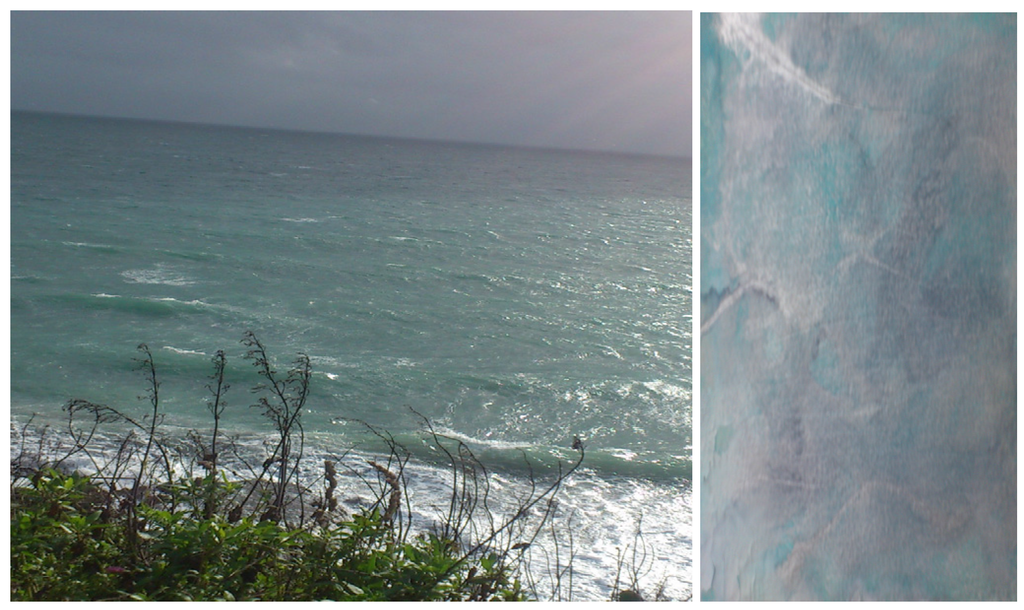
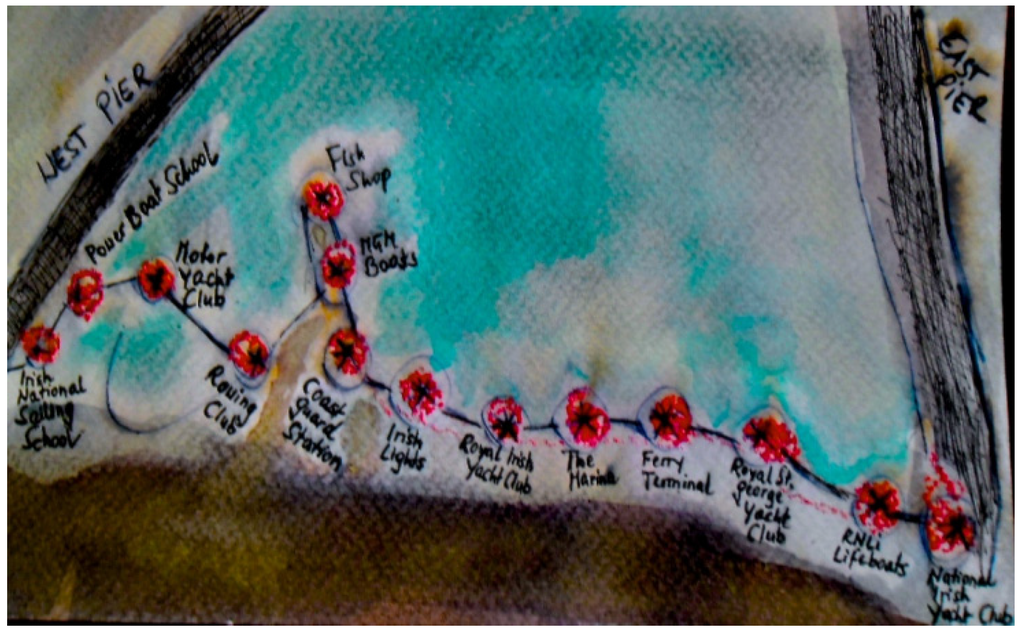
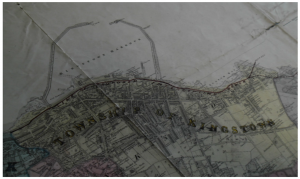
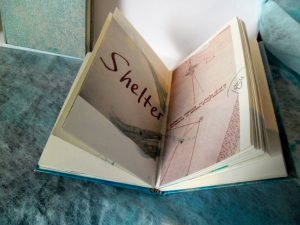
Silvia Loeffler is a post-doctoral researcher at NUI, Maynooth and currently holds an Irish Research Council Government of Ireland Postdoctoral Fellowship for her project Glas Journal, A Deep Mapping of Dún Laoghaire Harbour, which was the subject of her conference paper. She has also published an illuminating article on the project – Glas Journal: Deep Mappings of a Harbour or the Charting of Fragments, Traces and Possibilities .which I would recommend to readers interested in this area of work.
SAM_0739

SAM_0973

Taken together, these two texts provide a valuable record of the project and make a useful contribution to on-going discussions about this type of chronotopic mapping work. Although her title for the conference paper – Place Values – Glas Journal: A Deep Mapping of Dun Laoghaire Harbour (2014-2016) – uses the term ‘deep mapping’, she spoke of her work primarily in terms of both ‘liquid’ and ‘tender’ mappings (with the inevitable resonance of Giuliana Bruno’s discussion of Madaleine de Scullery’s Carte du pays de Tendre in her Atlas of Emotion: Journeys in Art, Architecture, and Film).

This seems entirely appropriate for a ‘collaborative, multidisciplinary cartography project that explores the layered emotional geographies of Dún Laoghaire Harbour, Dublin, that focuses on ‘performatively mapping the intimate rituals and everyday performances of those individuals who live and work in the harbour’. In the abstract to the Humanities article, Silvia refers to the work as ‘a hybrid ethnographic project’ concerned with ‘the cultural mapping of spaces we intimately inhabit’. She adds that by developed the project with the participation of local inhabitants of Dún Laoghaire Harbour, the project is able to explore the maritime environment as a liminal space, one in which the character of buildings and the area’s economic implications ‘determine our relationship to space as much as our daily spatial rhythms and feelings of safety’.
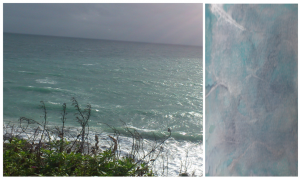
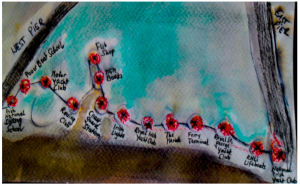
humanities-04-00457-g005-1024

humanities-04-00457-g001-1024

The project is as ambitious as it is complex. Currently Silvia is working with fourteen individuals who live and work in the harbour to produce handmade books that will constitute a record of ‘what the harbour space means to the residents based in the old coastguard station along with individuals involved with a host of other harbour related organisations and clubs. What seems to me particularly valuable about this project is summed up in relation to the richness and complexity of reference and evocation in Glas Journal Border Map (Sept. 2014) and other work illustrated above. She summarises ‘the interactions between human beings and their habitat’ as  existing as: ‘a constant flux of appearance, disappearance and reappearance that may be compared to a tidal system regulating liquid states of times and places’. Given the preoccupation throughout the conference with issues of heritage this statement seems to me to evoke a powerful lesson that, in our often over-literal haste to preserve the past, we are still reluctant to take on board.

Sophia Meeres
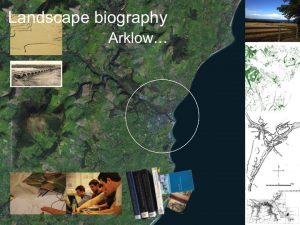
Slide08

Sophia Meeres has taught in the School of Architecture, Planning and Environmental Planning at University College, Dublin since 2004. As mentioned above, she gave a presentation entitled Infrastructural struggles: the making of modern Arklow, Ireland. This described a long-term collaborative project with her Masters students that relates directly to her teaching at UCD, which places an emphasis on ‘resilience, sustainable design and development’ and is taught within a multi-disciplinary context and a an ‘understanding of site-specific processes’ with a focus on research and analysis ‘seen as a creative act’. The overarching concern is ‘to help uncover local opportunities and potential for future directions’, something that spoke directly to the experience of speaking with the various individuals working to create a new understanding of Lough Boora and the communities linked to it. It is indicative that an earlier paper – A Biographical Approach to Understanding the Landscape (a contribution to the Landscape and Imagination. Towards a new baseline for education in a changing world ) – proposes a biographical approach to landscape that: ‘seeks to better understand local cultural conditions, issues and circumstances, disclosed through stake-holder participation and by other means, by linking present conditions to the past physical, social and economic “life” of a place and its people.’
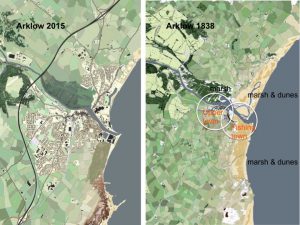
Slide14

The aim of such an approach is to better understand a place in ways I would see as aligning to both deep mapping and to Kenneth Frampton’s notion of Critical Regionalism in that it’s focus is on gaining: ‘greater and more detailed understanding of a settlement in its milieu’ with a view to articulating ‘development proposals that respond better to place’ Sophia believes – rightly in my view – that this “biographical approach” ‘has potential in terms of practice, research and landscape architectural education’, a belief that clearly animates the work she and her students have undertaken in relation to Arklow.
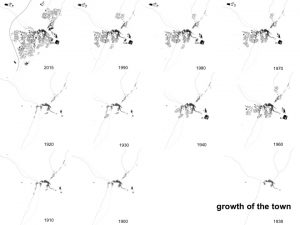
Slide16

Eilís Ní Dhúill

Eilís Ní Dhúill is a polymath whose research interests include storytelling, folklore and film. She has a particular interest in the use of film to present Irish-language literature, drama and culture and has published in this area. She gave a presentation entitled: Sounds of the past in west Kerry: Creating, recalling and transmitting cultural values through place-names and associated narratives. I find it hard to give a clear account of this presentation because I became fascinated by resonances in what Eilís was saying as these might relate to my interest in the English/Scottish Borders region. Her focus on the way in which Irish place-names catalyse story-telling in west Kerry led me to ask her whether these stories were in any sense gendered – that is whether men and women told different stories about the same places. It appears that they do, a point I would link to the implications of different categories of Border ballads. That said, the nature of our conversation is probably too particular to my rather idiosyncratic interests in folk lore to be of general concern.

Afterthoughts

Although at one level I found the bulk of the conference very enjoyable and rewarding, I also have a strange feeling that the conference I experienced it was probably not that experienced by the majority of attendees. This may be due to the fact that we tended to fall into rather different categories with interests that, while they undoubtedly overlapped, may have had less in common in terms of framing and orientation than UNISCAPE may assume. My experience may also have be influenced by the fact that I live in a country utterly divided socially and politically, and not just over Europe. A country whose government’s austerity measures and social security reforms have, for example, just been the subject of a United Nation’s Committee on Economic, Social and Cultural Rights report that confirms these are in breach of their obligations to human rights. This gives me continual pause for thought in relation to those whose power and authority is linked to forms of cultural and intellectual capital sanctioned by the status quo – including those who represent their institutions as part of bodies like UNISCAPE.

It is significant that just before the conference opened UNISCAPE held its General Assembly (the institutional equivalent to a business AGM), an fact that no doubt ensured that many attendees were senior academics representing member institutions. In short, UNISCAPE is deeply enmeshed in the realpolitik of a resilient neo-liberal status quo and these senior academics are members of an elite that can expect to engage directly with effecting issues of planning and governance. They  also appeared to be for the most part from Social Science disciplines and landscape architecture practices. They and their proteges were also the keynote conference speakers. A second, more diverse contingency was made up of people with a background in the visual arts or music and an interest in ecological and landscape issues, including those related to environmental and heritage governance. A third group crossed between these two categories, many of them landscape architects with a practical interest in the uses of creative fieldwork.

It seems to me that what the first group have in common is a professional interest in landscape research, education, and the implementation of the European Landscape Convention through reform and  governance relating to landscape planning and heritage. However, my underlying sense of this interest is that it is heavily framed by a detached/’objective’ thinking about landscape (including place as heritage), rather than direct emersion in specific places as an active constituent of their own particular lifeworld. As such their interests often seemed to lack either the psycho-cultural dimensions of what James Hillman calls the ‘thought of the heart’ or the empathetic imagination that, as Paul Ricoeur reminds us, is necessary to any effective political mediation. (And this at a time when the authority and ‘objectivity’ of science – for example as practiced in the medical field in the UK – has been shown to be utterly degraded, simply a debased ‘post-factual’ science in thrall to our debased ‘post-factual’ politics).

So I sometimes had the sense that individuals in these two different groups were, often without realising it, quite simply talking past each other. There was very little transformative conversation as I understand it. This may, of course, be largely a reflection of my own prejudgements and bias. That said I sensed that, for the first group, the second were in the last analysis an irrelevance, except in so far as they enabled reflection on some aspect of ‘heritage’ as traditionally defined. The engaged arts as a living, socio-political energy is simply not something they can acknowledge. This may be to put the case too strongly but it relates directly to a conversation I had with Teresa Pinto Coreia, from ICAAM – Instituto de Ciências Agrárias e Ambientais Mediterrânicas, Universidade de Évora, after she had given a very interesting presentation called: Landscape values under pressure: tensions in the management of extensive silvo-pastoral systems in Southern Iberia. 

I recognised many of the difficult issues she spoke of from my own interest in conflicted rural areas. Whether in terms of the difficulties facing farmers in upland regions in the UK, in rural Ireland in relation to small-scale family turf-cutting,  or from what I know of the history of local resistance to the formation the Wadden Sea National Parks in Denmark, Germany and the Netherlands and that, in Germany and Denmark, constitute the UNESCO World Heritage Site of the Wadden Sea. Put simply, it is the problem of a clash between small-scale largely rural communities in which authority still largely  based on specific forms of performativity in a given taskscape, and the worlds of academic research and governance which take as given an understanding of authority predicated on their own methodological and discursive sophistication as underwritten by a logocratic realpolitik. Two radically different ways of understanding and so acting in the world. Her response to my making something of the points outlined above was polite incomprehension and the view that, by working with students in the university, they would find a way forward.

The whole point of people like myself, Simon Read, Ciara Healy and others with an imaginal arts aspect to their compound practice attending the conference might be said, as I tried to explain to Teresa Pinto Coreia, to show that certain types of art practice are ideally placed to mediate between these two radically different ways of understanding and acting in the world. However, if that brief conversation was anything to go by, I certainly failed to do so. Not I believe for any lack of trying on either of our parts but because, as a professional group, those in the arts remain mentally marginalised by academic thinking, located as we are off to one side of the logocratic hierarchy that underwrites its realpolitik. (As a fairly distinct group we presented no keynote to the assembled attendees that could have facilitated such an exchange at the level of intellectual debate). Because of this institutional marginalisation the arts as an informed way of knowing the world – other perhaps than landscape architecture seen as an art – has no real role in UNISCAPE as an alliance of European institutions other than as ‘passive heritage’. This in turn reflects, of course, the marginal place of arts and music education as an alternative mode of understanding in the education system as a whole. The consequences of this fundamental lack in a culture of possessive individualism are now horribly clear in the political and socio-environmental situation of the UK.

It’s not for me to suggest how, as an international organisation, UNISCAPE might address this situation. However, if an initiative to address this were to be launched, it might perhaps be done from Ireland. There ‘cultural heritage’ in the sense of place or landscape may be somewhat less isolated from living forms of imaginative culture and thinking than in many other countries. So, while in some senses I was deeply disappointed by the situation I’ve tried to indicate (perhaps too clumsily) above, I still see Ireland as a site of promise and a source of guarded optimism, particularly now that the UK has turned it’s back on the EU project rather than trying to reform it. I also see UNISCAPE as an important international organisation with an annual conference I was more than glad to attend, if only because it enabled me to see the issues outlined above more clearly.