Considerations of ‘The Map is Not the Territory’: an essay

Slide1Slide1

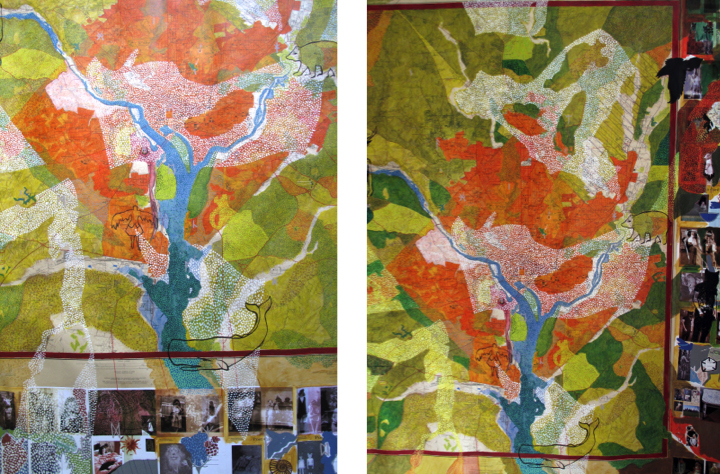
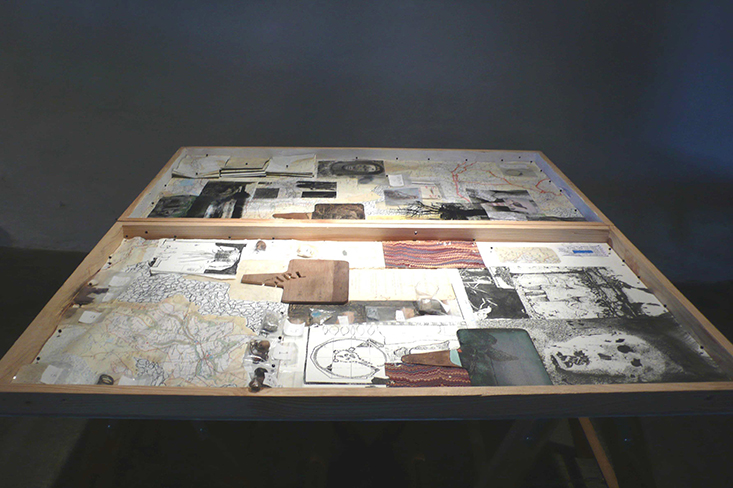
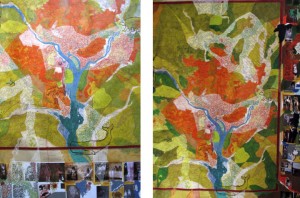
(Two detail shots from a work-in-progress provisionally called: An animist’s re-mapping of Washington and the vicinity) 

“Looking up from dealing with the socks and you hear an oystercatcher – why should these things be separate”? Kathleen Jamie (from her public lecture: Poetry, the Land, and Nature)

Introduction

This essay is in part prompted by a visit to an international touring exhibition, currently at the P21 Gallery in London, called: The Map is Not the Territory”: Parallel Paths – Palestinians, Native American, Irish and by reading the accompanying catalogue, edited by Jennifer Heath and published by Backsun Books & Arts for social and environmental justice in 2015. (My friend Nessa Cronin, who has contributed a chapter to this catalogue, alerted me to both it and the exhibition). But it is also concerned with the wider implications of the phrase ‘the map is not the territory’, particularly as these might apply to those of us who are engaged in cultural and educational work.

What follows is also prompted by a growing sense of discomfort at my own inability to address paintings within the scope of the writing I’m now doing, particularly those paintings I’ve long admired and been drawn to – works by Paula Rego, Ken Kiff, Andrzej Jackowski and Eileen Lawrence, for example. (This sense is partly because I referenced Paula Rego’s work in a talk for a conference on the Gothic in Limerick last year, which indicated that I’ve been neglecting a valuable resource). I want to find appropriate ways to think about paintings in the context of ecosophical praxis, but to date have largely been unable to do so. This now pushes me to try to find a more inclusive approach to writing. One that can respond openly and fluidly to what such work might show me about the continuous and particular exchanges and tensions within and between the fields of the psyche, the social, and the environment that constitute lifeworlds.

I think this requires developing a multi-stranded and openly narrative – as opposed to primarily analytic – style of writing. A narrative that is inclusive and stays open to the many interwoven strands of our lifeworld as polyverse, strands that are continually ravelling up and then and unravelling. I take this need to evoke a lifeworld as polyverse to be central now.

As James Hillman argued long ago, the ‘Monotheistic’ (or more simply ‘monolithic’) mentalité – the worldview that Enlightenment science inherited from the Religions of the Book – should not have survived the Holocaust. Yet it continues to dominate our culture. In one of the chapters in The Map is Not the Territory, Valerie Behiery draws attention to the cultural politics and economic power that makes it extraordinarily hard for an American curator to present a Palestinian cultural event in the USA. As she observes, any such attempt is faced – whether tacitly or directly – with accusations of being “anti-American and anti-Israeli propaganda and a glorification of terrorism and murder”. (p. 34) In a global mainstream culture still dominated by the presuppositions of ‘either-or’ thinking that is the most tenacious legacy of the monolithic mentalité, it is all too easy for a powerful coalition of Republican, Christian fundamentalist, and Jewish pro-Israel interests in the US to do this. This hides, along with much else, the fact that Zionist terrorism was central to the creation of the Israeli state. Lohamei Herut Israel (Lehi – otherwise called ‘the Stern gang’ after its founder, Avraham Stern), whose former leader Yitzhak Shamir became Israeli Prime Minister in 1983, openly operated on the basis of the assumption that: “Neither Jewish ethics nor Jewish tradition can disqualify terrorism as a means of combat”. (In He Khazit, an underground publication of Lehi, Issue 2, August 1943. No author is given, as was usual for this publication). So cultural threats enable a powerful political lobby to avoid addressing the question of why, if it was legitimate for Jews to use terrorism against the British in order to gain a homeland, Palestinians should not do the same. Particularly if they find themselves placed in a situation infinitely more oppressive than that faced by Lehi?

Yet in a ‘monoverse’ underwritten by the absolute dualism that ultimately flows from fundamentalist readings of the Religions of the Book, this question is not just irrelevant, it’s un-ask-able. In that monoverse, if you’re in America or Israel you are expected to be either for or against Israel. If you’re in a country where Isis or its equivalents are at large, you are expected to be either for or against a highly selective misreading of Islam. Two sides of the same coin, since in both instances there is nothing to consider beyond the playground question: “whose side are you on”? No room then, for the complexities of history, issues of common sense, a considerations of the millions now caught up in a murderous realpolitik, and certainly no room for compassion or fellow feeling. And this childish and ultimately murderous reductivism is, in the last analysis, the reality behind American support for Israel, behind Israel’s policy towards the Palestinians, and behind radical Islamic fundamentalism. The “them or us” question that cuts short all other, more nuanced, considerations.

So trying to think, write and otherwise act out of the reality of our living in a many-stranded polyverse is now, in my view, an absolute necessity. It gives us some purchase on the resources that allow us to resist the mentalité that continues to generate massive levels of socio-environmental destruction globally. In short, the old monolithic mappings we inherited are indeed not the territory. Indeed, their disinformation is now terminally toxic.

A day out

I went to London for three reasons: to see my brother, to visit the P21 exhibition, and to see Agnes Martin’s work on show at Tate Modern. I have had an ‘at-a-distance’ fascination with Martin’s work – I’d seen almost none other than in reproduction until my visit to London – that was first set in motion by Thomas McEvilley’s Gray Geese Descending: The Art of Agnes Martin. This was amplified by the Scottish artist Eileen Lawrence, who told me that two important influences on her work were encounters with the work of Joseph Beuys and Agnes Martin. Like Martin, Lawrence could so easily have said that she does not paint gray geese, but “the emotions we have when we feel gray geese descending” (quoted in McEvilley 1993, p. 71). (If I was asked to illustrate the chronic cultural provincialism of the Tate, it’s abject failure to properly represent British art in all its richness and complexity, I would point to its shamefully neglect of Lawrence’s extraordinary work, of which it owns a single example. Is it any wonder that so many Scots want their independence)?

Given the very different reasons behind my three excursions, I had no expectation that my day in London would develop any kind of coherence beyond doing what I’d set out to do, but this essay is an attempt to give some account of just such coherence. 

At the P21 gallery

I had agreed to meet my brother at the P21 Gallery at 11.30 but it was still closed when I arrived late – I’d neglected to discover that it does not open until 12.00 – and, just as I found it, he phoned to say he too was running late. I enquired from the office below the gallery when it would open. Very shortly, I was told, and at once invited to sit and wait there until it did. The young man whose work I’d interrupted was both courteous and inquiring, asking almost at once what I made of the Palestinian situation. I quickly sensed that in this place a hospitable courtesy, political awareness and cultural curiosity were seamlessly joined. This impression was confirmed when I was taken up into the gallery foyer. I was immediately thanked for coming to see the exhibition, with thanks followed by further enquires as to my reasons for doing so as my guide busied himself with the rituals of opening a gallery. After a little while, when alarms had been disarmed and doors unlocked, I got to see some of the work. (Some I did not. It was in a downstairs room and my brother, who needed to catch a train after meeting me, had gone to another address. I could only buy a copy of the catalogue and go to the British Library to meet him).

What I saw at P21 was interesting in a variety of ways. One image of many that stays with me is Najat El-Taji El-Khairy’s The Rock of Palestine in Basel. This depicts a small island of rock in the shape of Palestine, situated just off the bank of the Rhine in Basel. There is an almost hallucinogenic sadness in the conjunction of the title and image, something amplified further by the artist’s comment that: “My land follows me everywhere … Ironic, isn’t it? To discover this little rock, shaped like the map of Palestine right were the First Zionist Congress took place in 1897, the first step in the condemnation of our people to suffering, injustice and oppression”. (p. 58). This rich and nuanced interplay of image and text, and of carefully located personal experience – this insignificant rock was discovered on a stroll with the artist’s three-year-old grandson along Sankt Alban-Rheinweg Street – with imaginative reverie, historical knowledge and the political, is indicative of the way in which the exhibition avoids a crude polemic and offers instead ways of addressing, in a number of dimensions, what John Halaka acknowledges – alongside the multiple needs for restorative justice – is the necessity of recognizing that what has been inflicted means that Palestinians “can never recreate their shattered past or reset the hands of time”. (p. 72) An observation that, although in far less extreme circumstances and with less drastic effects, constitutes an aspect of our common reality. By inviting our cognizance of that fact, the exhibition points up grounds for human solidarity rarely acknowledged by work in this vein.

In one sense, however, the exhibition had done its work even before I set eyes on it. It had created a vivid occasion for openness, for exchange, and in doing so expanded my existing felt understanding of the dynamics of a complex, conversational relationship. That conversational relationship – in which I was already a minor participant through exchanges with one of the catalogue/book’s authors, Nessa Cronin – is now woven into, and so challenges me to remember and reconsider, my existing connections to the people whose lifeworlds find echoes in this exhibition. To the Palestinian artist Alexandra Handal (alexandrahandal.org/), to my friend Mona M. Smith, a Sisseton-Wahpeton Dakota media artist, educator and the owner of Allies: media/art , and to a widening and heterogeneous group of friends and colleagues in Ireland – perhaps in particular Nessa Cronin, Deirdre O’Mahony, Cathy Fitzgerald, Pauline O’Connell, and some of (the staff at Limerick College of Art and Design. But also to the painter Samira Abbassy (born in Ahwaz, Iran, but now resident in New York) who, coincidentally, currently has a show of complementary work in London, entitled Love & Ammunition.

All of which is really only to say that cultural experience is never either wholly aesthetic or disinterested. It is always at some level bound up with lives, with friendships (and enmities), with all the textures and trajectories of lived experience. This is, I think, what I have been trying to find ways to reflect in my writing.

Much of the work on view in the exhibition consists, inevitably in the circumstances, of reproductions of work too large or costly to transport, an obvious and striking example of this necessity being the small print of Hani Zurob’s large painting Flying Lesson no. 04. Zurob’s approach in this and other works in the series is indicative of that presented in much of other work. It flows from a question asked by his young son Qoudsi as to why his father cannot travel with his family to Jerusalem. The painting, which shows the tiny figure of Qoudsi in his toy car contrasted with the almost surreal nature of the suspended apparatus by which one enters and exits aircraft, evokes space and distance in the context of the fragility of love rather than any overt sense of political message. And is all the more eloquent for doing so. Michele Horrigan, a photographic artist, evokes something similar in her images of abandoned houses in Leitrim, one of the poorest areas of rural Ireland. This is representative of a whole body of powerful Irish work, another example being Deirdre O’Mahony’s Abandoned Clare series, a collection of 54 photographs that also exists as a free magazine, Abridged 0 – 20: Abandoned Clare .

There is much more than could be said about the various works on show, but ultimately what I took from the exhibition was a powerful sense of a collective attempt to map the un-map-able (an attempt that, in line with George Steiner’s take on the translation of poetry, is both impossible and vital if we are to avoid living in “arrogant [and indeed murderous] parishes bordered by silence”). A form of collective deep mapping of the absences that haunt diaspora and the events that give rise to it, and of the savage indifference to the basic human need to place ourselves and have a sense of being ‘at home’ in the world, to say the least. (Although, as Deirdre O’Mahony has reminded me in the course of a long and fascinating conversation in Galway, for some our ‘at-home-ness’ may need to be other than literal).

In all this I am also somewhat uncomfortably aware that, historically speaking, my people are implicated in what the dedication to the book refers to as the desecration, by “invasion, occupation and colonization”, of their “lands, cultures and ecologies”. I may have some direct experience of the powerlessness that haunts the situations to which the P21 exhibition artists refer. (The result of our many years of dealing with the authorities that seek to dictate just what can and cannot happen to my chronically sick daughter). But this cannot give me more that a distant glimpse of lifeworlds largely framed by such desecration.

 On the play of differences and similarities

My brief exchange about Ireland during the opening up of P21 reinforced something of the sense of commonality shared by the Irish, Palestinians and Native Americans that the exhibition addresses and the book elaborates. However, my academic habits are such that my thinking quickly turned to differences. I found myself noting that, whatever the strengths of those commonalities, there are significant differences between the situations of each. But this way of thinking is, I suspect, an evasion of something more important. Jennifer Heath begins the book by reminding us of this by using a quotation from Immanuel Wallerstein: “We can always pinpoint difference, it is the easiest of all scholarly tasks, since everything is always different in some ways from everything else across time and space. What is harder and takes priority is to discover similarities”. It is, after all, on similarities that we can best start to built a sense of common human solidarity and compassion for all beings, human and otherwise.

Wallerstein’s observation is, I think, a profoundly challenging one. Much of the contemporary academic and cultural enterprise is based on an education that provides students with analytic tools designed to highlight difference. This is another byproduct of the dominance of the monolithic mentalité. It seems to me that there is now an urgent need to modify those tools and to re-orient their use, perhaps taking as a guideline Paul Ricoeur’s notion of a philosophy of ‘critical solicitude’. Education too is, arguably, a mapping or re-mapping exercise of sorts and, as Nessa Cronin very rightly reminds us in her book chapter, the authority of any mapping exercise always needs to be put in question, even where such a mapping is bent on “revealing, authenticating, and legitimizing a previously silenced history” (p. 95). What is essential, however, is that due consideration or solicitude is given to the lived experience and historical context that informs such mappings. It is then possible for contestation to become a conversation rather than an argument based on a taking up of monolithic positions.

That four letter word – ‘love’

As my friend the artist and academic Mary Modeen has pointed out, to speak of ‘love’ in the context of academic work is to question a taboo. In a paper given at a PLaCE symposium in Bristol in 2011”, she said:

“To those of us who are academics … love is a four-letter word. It is immeasurable and therefore by its very nature outside academic territory. It cannot be calculated, predicted or even adequately defined except perhaps normatively, as enacted by individuals, new in its manifestation each and every time. Even though it is as old as humans themselves, probably predating that which we know as human, shared (we are certain) by many fellow creatures in the animal kingdom, and known as well as ‘the force that through the green fuse that drives the flower’, it is not academic properly speaking, not to be trusted, best avoided for other less risky terms. And yet…it is the best word I can think of to discuss the ways in which we interact with our environment.”

Topophilia (the love of place) tends to be regarded with considerable suspicion in academic and cultural circles. It is (often quite correctly) seen as a smiling mask that hides exclusionary nationalistic and other xenophobic sentiments. But as Mary Modeen and, more recently, George Mombiot remind us, it is a fundamental aspect of our relationship to the world. Loving relationships to place, however understood, are in some sense essential to our wellbeing and, in the context of the present eco-social situation, also very possibly to our future survival. It is senses of this that permeates the more interesting work in the P21 gallery and, as a result, makes it possible for me to write this essay.

In a text reproduced in the catalogue to the Tate Modern’s Agnes Martin exhibition, Martin ponders matters of beauty and happiness (pp. 158-9) However, I think that in her writing about beauty “as an awareness in the mind” she comes close to evoking what I would call ‘a loving attention to the world’. I can offer no hard and fast definition of what I mean by this phrase. Instead I invoke a statement by the poet and essayist Kathleen Jamie. When asked by a friend if she had prayed for her chronically sick partner when he was in hospital, she said she’d not. She adds, however, that she: “… had noticed, more than noticed, the cobwebs, and the shoaling light, and the way the doctor listened, and the flecked tweed of her skirt, and the speckled bird and the sickle-cell man’s slim feet. Isn’t that a kind of prayer? The care and maintenance of the web of our noticing, the paying heed. ” (Kathleen Jamie Findings 2005, p. 109).

It’s a sense of this “care and maintenance of the web of our noticing”, of “paying heed”, that I detect behind Agnes Martin’s statements and, more directly, as present in some of her work. And it’s resistance to the socio-political denial of any normal or familial context for such care and maintenance, such paying heed, that I sense unites many of the artists in the P21 exhibition. A shorthand term for this cruelly denied quality is, of course, the exercise of love. In short, one of the experiences that has been and/or is denied to the Palestinians, the Native Americans and the Irish by the cruelties of their historical situation, is an important aspect of the fundamental human need to exercise that capacity to love in its fullest sense.  A specific form of love that primarily takes part in, and with the aid of, familiar or familial, places, with the ability to ‘be-at-home’ somewhere.

The relationship between this situation and some of Agnes Martin’s work is powerfully evoked by four works in the exhibition: two works from 1963 – Friendship and A Grey StoneWhite Stone from 1965, and Untitled 12 from 1984. What I experienced as uniting these (and what links them to the twelve paintings in The Islands series of 1979 that forms the centrepiece of the exhibition) is that loving, attentive and care-filled engagement with the ineffable hæcceity or inscape (to borrow the poet Gerard Manley Hopkins’ term) of a particular ‘homely’ landscape. Agnes Martin’s term for what is produced by this engagement is ‘joy’. Looking at these paintings I can recognise the joy that, for example, accompanies the revelation of the connection between transient beauty and our mortality that occurs when the drifting shadows of small clouds move over the land landscape on a sunny day (White Stone). Or when my eye is absorbed in the mottle and granulation of a stone (Untitled 12 and A Grey Stone). In these works there is a palpable sense of loving attention transmuted into a cooly distilled painterly image that I find intensely moving. But for me the key work, perhaps because of its affinities to works by Eileen Lawrence that it may or may not have influenced, is Friendship. Here a rich, warm red under-painting shows through the incised gold leaf. The result is an icon without explicit subject or inflection, an evocation of the immanent, sensual warmth of … what? Of warm desert earth, of sunlight, of joy? I don’t and cannot know. But I am as certain as I can be that the memory of what it is that this painting evokes, and what has been done to deny the Irish, Native Americans and Palestinians certain fundamental human needs associated with that, is what the work at P21 speaks of..

George Mombiot, whose article The Pope can see what many atheist greens will not (Guardian June 17th 2015  I read on the train on my way to London, quotes Michael McCarthy on the need for a certain closeness to nature, on our capacity to be “surprised by joy”. In terms Agnes Martin might have recognised, he quotes McCarthy’s reference to: “A happiness with an overtone of something more, which we might term an elevated or, indeed, a spiritual quality”. He goes on to put his finger on the question that I think the P21 exhibition tries to address. “If the acknowledgement of love becomes the means by which we inspire environmentalism” – or indeed any other form of eco-social responsibility – in others, how do we translate it into political change”?

I am wagering here that one why to answer to Mombiot’s question is to better understand what is necessary to acts of translation. As I’ve indicated elsewhere, I think this can be linked to forms of collective deep mapping to which Nessa Cronin refers towards the end of her chapter. These help us to maintain a fluid and open engagement with place, encouraging us to narrate and evoke it in all its temporal depth and ambiguity. Also to honour shifting connectivities and conversations between multiple voices, all against the background of an ethics that asks that we seek to live the good life, with and for others (including non-human others), in just institutions and environments.


July 8th – Edge & Shore – a conversation with Helen Carnac and Laïla Diallo

Iain Biggs 1-1

(detail of one installation of Terra Infirma – all grass is flesh from the touring exhibition Drawing, Permanence, and Place) 

Yesterday I spoke at length on the phone with Helen Carnac, whose various activities exemplify the way that imaginative work constantly mutates and is reconfigured so as to find new ways of feeding our need for balancing imaginal engagement with, and active reflection on, the contingencies and astonishments of our lifeworlds.

Helen describes herself as “a maker, curator and academic” and is involved in “drawing, mark-making, the explicit connections between material, process and maker and an emphasis on deliberation and reflection”, which she sees as constellated by her work as a maker and thinker. She runs: “an environmentally grounded practice, developing projects using design methodologies that are rooted in an acute awareness of physical location, place and working practices. The populated environment is of key importance to me and through my practice and projects I aim to bring people together, creating social and creative engagement and collaboration in an open-ended design process”. (For more information on her work, see her web site – link below – from which these quotes are taken).

The reason we where speaking together is that on July 8th Helen, the dancer Laïla Diallo and I will be ‘in conversation’ at the Arnolfini, starting at 6.30pm. This relates to their collaborative work Edge and Shore: Acts of Doing 2, a performance residency there. (Please see http://www.arnolfini.org.uk/whatson/edge-and-shore-acts-of-doing – you need to book to come to the talk).

I know Helen as an innovative maker using enamel, through our both having exhibited in a PLaCE-sponsored international touring show (Drawing, Permanence and Place) which owed a great deal to the inspiration of our mutual friend, the enamel artist Elizabeth Turrell. However, we also have common interests in thinking about an expanded, not exclusive aesthetic, and in creative practices such as attentive walking. You can find her web site, which gives a very good sense of the breadth and depth of her concerns and activities and is well worth a visit, at https://helencarnac.wordpress.com  I have yet to meet Laïla Diallo, a dancer with Siobhan Davies Dance, and am very much looking forward to doing so. I know from Helen that they have been working together since 2012 when they were invited by  to work alongside each other in the residency ‘Side By Side’, having never met before.

Experiments in digital deep mapping (DDM)

IMG_1804

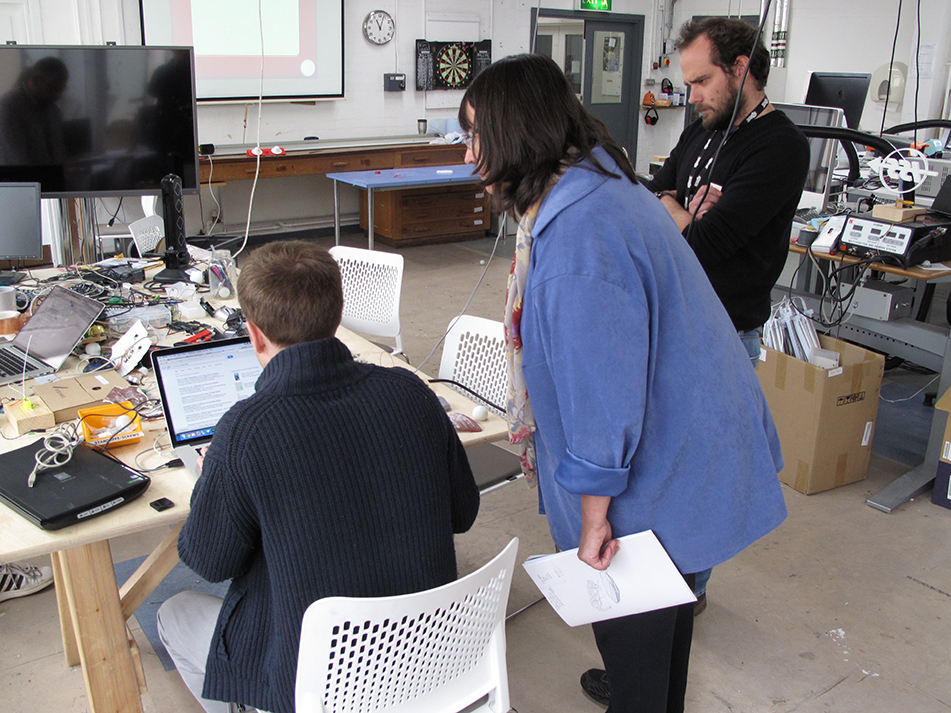
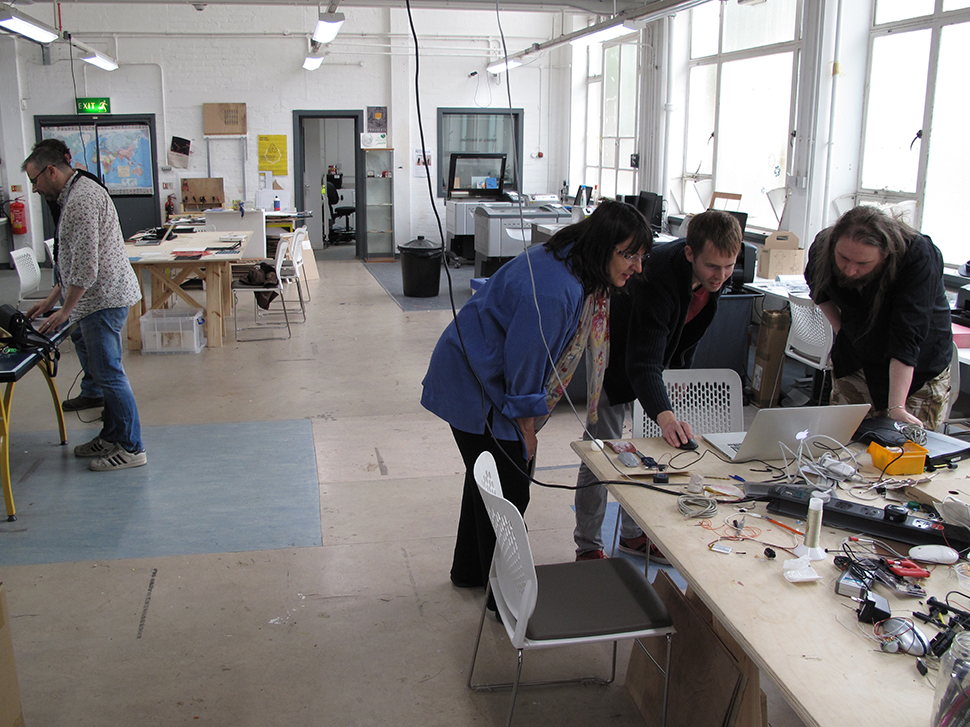
At the beginning of this month I attended a three-day research workshop set up by Mary Modeen at Duncan of Jordanstone College of Art and Design in Dundee. This involving herself, the sculptor Ben Whitney (a DJCAD graduate), and me working with the staff at DJCAD’s Digital Making Unit.

(Mary and Ben are the two standing in the photograph to the left here).

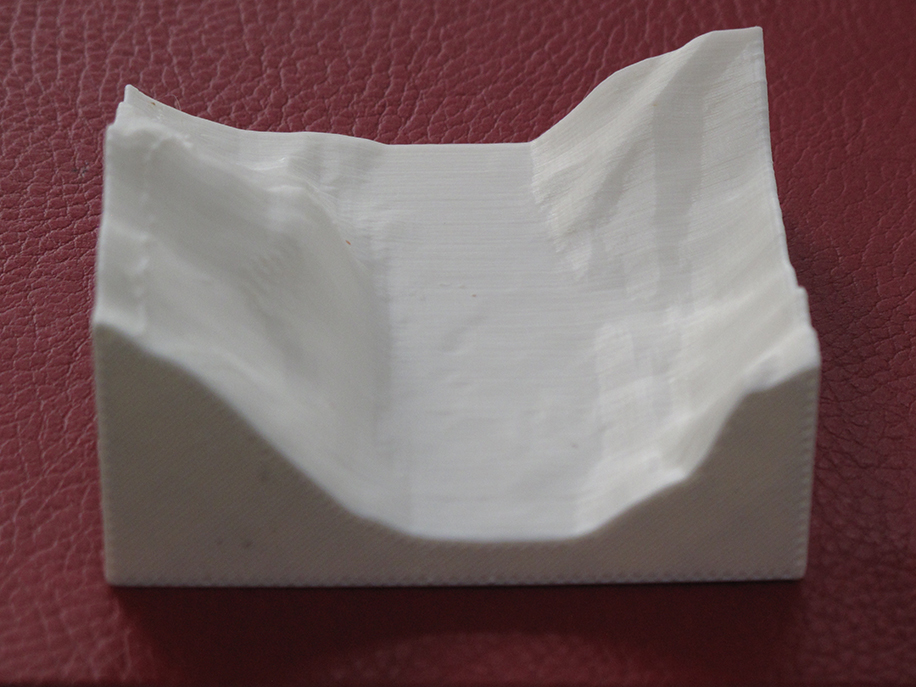
Our aim was to test out a number of approaches to combining an information rich digital delivery with a variety of technical means designed to evoke something of the sensuous specificities of any particular landscape location. What we wanted to work out were some of the technical issues and related practicalities that would be involved in creating a (at present hypothetical) digital deep mapping installation or DDMI.

We started from the simple supposition that any worthwhile DDMI needs to take as its starting point the creation of a physical installation that is specifically designed to maintain some sense of the sensual specifics of the particular physical location under consideration, while at the same time optimising the possibilities for communicating the complex layering of information made available by digital technologies. To do that would be to set up the basis from which to construct a physical SSMI. We were  particularly interested in how we might articulate the spatial/temporal dimensions opened up by the possibilities inherent in DDM.

Over the three days we were able to establish the working basis for constructing a practical physical unit – a viable ‘model’/digital projection scenario – that would provide just such a working model. This in turn has opened the door to the evocative articulation of multiple scales of location/information/narrative in relation to, for example: a core site, that core site within (for example) its watershed, and that watershed within the larger region, etc. – all within a single installation or exhibition space.

On a slightly different note, part of what made the whole event so enjoyable is that DJCAD clearly sets out to maintain an ‘Art School’ environment where it was not only possible for this kind of ‘blue skys’ experimentation to happen, but ensures that it does so in an atmosphere where students using the facility clearly felt comfortable with asking us questions and, in one case, sitting in at Mary’s invitation on our deliberations. Some of this appears to be a result of faculty policy, some of the particular relationship Mary builds with her Masters students.

Having worked for many years in an institution that had comparable technological facilities, but always appeared to have a tacit policy of discouraged anyone who was not a researcher on a grant-funded project from using them, it was a real joy to be working in such a genuinely educational environment.

I’ve included some general images below. (There’s other stuff, but it will remain ‘in the private domain’ for the present.

My thanks to all involved, particularly to Mary who made it all possible despite having 101 other things to do.

IMG_1802

IMG_1836

IMG_1872IMG_1898

Art, and Science, and ……?

I was in London yesterday to give one of five short talks at Central St Martins as part of the London LASER series. (Our Chair was Barbara Hawkins, who organised the evening, her partner and co-founder of Project Dialogue the scientist Brett Wilson, together with four artists – Helen Pynor, Simon ReadShelley James and myself).  This was part of an international series of informal talks at the intersection of art, science and technology in association with Leonardo ISAST.

Apparently Initial feedback has been really positive. To our presenting a collection of talks covering a range of disciplinary perspectives and practices. (There was some tweeting, so if you use twitter search under the hashtag #LondonLASER to find comments and pictures). The event was recorded on video and the videos will go online in a week or two. I will let you know when they go live. They will be available in the archive section at http://londonlaser.net

Going through my email this morning I noticed links to a couple of short films that struck me as resonating with the presiding spirit of our presentations the evening before. The first is a little talk: Blood sweat and ears: Musical pathways | Laura Veirs and Tucker Martine. I’ve been a bit of a fan of these two for years, hooked initially by Laura’s geologically informed songs on Carbon Glacier and Year of Meteors and Tucker’s work with her using unorthodox (from a folk/blues perspective) musicians and production work. 

The second film relates to the work of my friends Harriet Tarlo (poet and university teacher) and Judy Tucker (painter and university teacher). The filmmaker Annabel Court has made a short film about a place where they’ve been working together, which gives a context to their collaboration. This can be found at https://vimeo.com/84864272

Enjoy.

Some thoughts on multiple lifeworlds: identity, culture & politics (2nd version)

Shortly after I’d posted this I opened today’s Guardian and found Neal Ascherson’s article Independence day has already dawnedSince it relates to much of what I’d written, it seems sensible to amend what I’d written earlier so as to take account of some of Ascherson’s comments. 

I find it a bit odd when someone gives themselves a monolithic identity – as in ‘I’m English’.  This may be because I was born in London, had a Scottish grandmother, spent my childhood in Kent, Dorset, and Inverness-shire, took my degrees in Leeds and London, now live in Bristol (while spending part of each summer in County Durham), have working links to Europe (the Netherlands and the Irish Republic recently), carry a British passport, and am close to good friends in the USA and Australia. Or it may be because I understand myself as inhabiting a polyverse, one in which it makes no more sense to think reductively about identity than to try to configure my lifeworld as a monolithic ‘life-as’.

Whatever the the case, I wonder if I’m the only person to sense something weirdly indicative about Sarah Lucas representing Britain at the Venice Biennale, given the political situation in Britain following the election?

It seems to me that Lucas, along with Tracy Emin, has always been a poster girl for a particular cultural position – the knowing metropolitan ‘bohemianism’ of the YBAs if you like –  that is highly specific to London and the South East, while presenting itself as something much more ‘representative’. (If that seems too big a generalisation, think about what might have been if their cultural sensibilities reflected the urban worlds of, say, Cardiff, Glasgow, or even Newcastle. If they’d been working in those cities – famous for their Hen Nights and heavy drinking, in-your-face party girls – their work would almost certainly had other elements in the mix, other specific cultural and historical traces entirely absence from the bland literalism that signifies so much of the YBA’s work).

But why place Lucas in the political context thrown up by the British election, given that the critic Laura Cumming writes that at the Biennale her work “stands out purely by having no political content whatsoever”? Because, as Ascherson points out, the question of ‘Great Britain’, of “how to save the union” is now quite simply meaningless because “the 1707 union between England and Scotland is already dead. As a piece of architecture, it was abandoned in 1999, when the devolved Scottish parliament met” … “Today, what exists instead is a constantly changing set of relationships between London and Edinburgh, confused by feeble constitutional wheezes that arrive too late”. So what exactly is this notion of a cultural ‘British-ness’ that Sarah Lucas is supposed to be in some sense representing? In my view it’s a political slight-of-hand we’d do well to dispense with.

What is increasingly clear about the rise of the SNP is that, while in one sense it can be said to represent a ‘Nationalist’ politics (although not, I would suggest, in the narrow sense that Plaid Cymru does because of the issue of the Welsh language). Rather it is intended to deliberately evoke an alternative set of social values. In short, the SNP is in large part about contesting the assumptions of the two traditional mainstream parties, for whom both the Westminster status quo and the economics of austerity are simply taken as given. My feeling then is that Sarah Lucas represents ‘Britain’ in very much the same way that the recently elected Tory Government does. That Government, as Ascherson notes, is now working from the presupposition that: “Westminster is well on the way to becoming an English parliament anyway. As Michael Kenny writes in his book The Politics of English Nationhood, ‘As an unintended consequence of devolution … an increasingly Anglicised polity has quietly emerged as an incubus at the heart of the UK state … the Westminster parliament is gradually evolving into an English-focused one'”. And an England that, increasingly, is identified by those in power with the City of London and the South East.

I’m suggesting then that both Lucas’ art and the Tory party ideology are, in their different ways, inseparable from a tacit understanding of an anachronistic and exclusive ‘English-ness’ dominated by a particular (and particularly arrogant), set of parochial cultural and economic presuppositions that regard London and the South East as ‘the heart of Britain’. (As Lucy Lippard observed in The Lure of the Local (1997): “The urban ego is in fact parochial; New Yorkers (like Parisians or Bostonians) are among the most provincial people in the world” I would argue that this is equally true of the London art world). I see just that kind of provincialism reflected in much work by the YBAs (now not so young, of course), and by the fact that Lucas was one of 200 public figures who signed a letter to The Guardian opposing Scottish independence in the run-up to the referendum. That stance, after all, was really little more than a reactionary denial of the different values that let those living in Scotland to reject Tory ideology.

Whether my view is justifiable depends, in no small part, on whether you think the SNP is primarily motivated by the nationalism that socialism still tends to reject out of hand. (Notwithstanding that it is capitalism, and not socialism, that dominates the global stage). Personally, and as Nicola Sturgeon has made very plain post-referendum, I see the SNP as first and foremost an anti-austerity party that, in the name of those living in Scotland, rejects a political and cultural status quo that sees the term ‘Britain’ as largely referring to an ‘England’ that presupposes the superiority of the South east – of London and the Home Counties. (Ascherson appears to share this view, writing that Sturgeon’s “nationalism is instrumental rather than existential: independence as the means to social justice and prosperity, not the end”).

Acknowledging other lifeworlds

I first came across Lois Williams when she was studying to be a teacher at Goldsmiths College in 1975-6. (My wife studied there the same year). However, I only really registered her work when it was included in the New North exhibition at Tate Liverpool in 1990. Later I read the exchange between Williams and Iwan Bala in his Certain Welsh Artists: Custodial Aesthetics in Contemporary Welsh Art (1999). My interest in her work is part and parcel of a wider interest in the cultural mechanisms that ignore and suppress lifeworlds that do not conform to the presuppositions of the status quo; that reduce them to monolithic identities or a ‘life-as’. Cultural work that opposes those mechanisms is what animates my interest in the Irish artist Deirdre O’Mahony and the farmer and and performer artist Ffion Jones, both of who I mentioned in my last post, and in projects like Hannah Leighton-Boyce’s The Event Of The Thread

It is sometimes said that ‘comparisons are odious’ but, thinking about social tensions as articulated in contemporary politics and culture in the UK recently, I can’t help ponder the differences between Williams’ A Living Position (1997), Lucas’ Au Naturel (1994), and Tracy Emin’s My Bed (1998) – all of which use found objects located within a bed-like space.

Williams’ contribution to the chapter co-authored with Iwan Bala seems to me to set her apart from the values of the ‘British’ (in actuality ‘South Eastern English’) art world of which I’m suggesting Sarah Lucas’ work is indicative. In that chapter Williams writes: “I have always been interested in the parallels between art and farming” (Bala p. 142), something I cannot imagine a contemporary ‘English’ artist saying. Equally ‘un-English’ (in the reductive sense I’ve indicated) is Williams’ willingness to teach for many years in a secondary school in Sheffield while practicing as an artist, part of her clear sense of the importance of maintaining her links with Cefn, St Asaph.

Nothing could be further from the cultural presuppositions that inform Tracy Emin’s My Bed that, with its overwhelming emphasis on the artist as isolated individual – the stained bed sheets and litter of condoms, period stained pair of knickers and personal everyday objects. That work seems to me to stand as an embodiment of the preoccupations of those YBAs who evoked the reductive hedonism and consequent anxieties of the culture of possessive individualism. A culture predicated on the consumption of a  ‘quasi-bohemianism’ as fundamental to the ad-man’s focus on consumption, sex, and identity conceived in terms of money as a route to a rampant individualistic exceptionalism (to celebrity, to put it at its simplest). Both Tory politics and the art world that sends Lucas to ‘represent Britain’ in Venice can only maintain power and status by ignoring or marginalising alternative, less reductive, values.

What in my view links the work of Lois Williams and Hannah Leighton-Boyce’s The Event Of The Thread is precisely what is absent in the work of Sarah Lucas and Tracy Emin. Both Williams and Leighton-Boyce are, it seems to me, centrally concerned with the specificity of community and place as these are constellated in and through a particular taskscape. In short, they understand that working relationships, rather than leisure and consumption, as the formative element in social identity. In Williams’ case the relationship  of the Welsh farmer to the land farmed and those whom it feeds, and in Leighton-Boyce’s the traditional relationship between cloth manufacture, place, weather, the act of stretching woollen cloth on tenter frames, and their resilient trace in language despite massive social change in areas such as the Rossendale Valley (also known as the Forest of Rossendale) in Lancashire. To work out of that understanding is already to act politically – not as a metropolitan provincial but as someone conscious of being placed in the multiplicity of relationships that Felix Guattari characterises as constituting ecosophy. Which is why just how we approach creative work has everything to do with issues of multiple lifeworlds, identity, culture, and politics.

In Hannah Leighton-Boyce’s book documenting and celebrating The Event Of The Thread, there are two photographs of her spinning wool (one publicly, outside the Robin Hood pub in Helmshore, the other on the great wheel at Helmshore Mills Textile Museum). For me these are extraordinarily resonant in a variety of ways with elements in both Ffion Jones’ performance Dear Mike Jagger – in which she span wool in order to enwrap a ram’s skull – and with Lois Williams use of wadding in works like Journey (1989) and A Living Position (1997). These acts and traces of acts, taken together, evoke the constitution of a weave of resonances that speaks of the interdependence of social, individual, and animal tasks capes; of a mycelial mesh of place, activity and identity, that in turn evoke a sense of cultural – and ultimately political – value utterly at odds with both a reductive Tory ideology predicated on the global economic bottom line and the maintenance of existing wealth and power, and with the values of the London-based cultural mandarinate that sent Sarah Lucas to represent ‘Britain’ at Venice.


Winner takes all? Re-greening democracy to overcome the culture of possessive individualism

Slide1

It’s hard to write anything positive in the wake of the election results this morning.

Although the final results were not all in as I write this post it’s very clear that, once again, a tired and morally bankrupt status quo has managed to perpetuate itself by playing on the fear and manufactured ignorance of a large part of the electorate. It no longer matters whether this manifests itself via the Conservative mainstream, its supposedly ‘down-to-earth’ UKIP shadow, or a Labour Party that has become little more than Conservativelite. What is very clear is that we are seeing the triumph of the culture of possessive individualism epitomised by Margaret Thatcher’s “there’s no such thing as society” – an ideology that has managed to play on a multitude of fears to ensure that the rich will continue to get richer and the sick, poor, and the majority of young people will suffer further as a result.

To put this in perspective, it’s worth looking at the Executive Summary of a report published by Church Action on Poverty, The Trussell Trust and Oxfam in June 2014. This points out that, while the UK is the seventh richest country in the world it is increasingly deeply unequal. The richest 1% owns the same amount of wealth as 54% of the population. Furthermore the 1,000 richest people in the country saw a 100% increase in their wealth in the past five years and, of course, are now set to see this growth continue while the millions of families in the UK living below the breadline see their situation worsen. The report notes that Oxfam and Church Action on Poverty calculate that in excess of 20,247,042 meals were given to people in food poverty in 2013/14, a 54% increase on 2012/13. Add to this that “more than half a million children in the UK are now living in families who are unable to provide a minimally acceptable diet” and you get a very clear sense of just what Margaret Thatcher’s much vaunted “return to Victorian values” has meant in practice.

In the run up to the election the Tories have argued that they have increased jobs, yet “despite their best efforts, many people cannot earn enough to live on”. The report points out that:

“UK food prices have increased by 43.5 per cent in the eight years to July 2013 and food expenditure as a proportion of total household expenditure has continued to rise. The UK has one of the highest levels of housing costs in Europe, while between 2010 and 2013 energy prices for households rose by 37 per cent. At the same time, low and stagnant wages, insecure and zero-hours contracts mean that for many low-income households, the money they are bringing home is less every month than their essential outgoings”.

The summary adds: “Evidence shows that changes to the social security system are a driver of food poverty. Cuts to social security since April 2013 have had a severe impact on poor and vulnerable families across the UK. These cuts have been coupled with an increasingly strict and often misapplied sanctions regime – 58% of sanctions decisions are successfully challenged”. This is both evidence of the punitive ideology driving Tory policy, and indicative of the fact that “many people needlessly suffer a loss of income through no fault of their own. The abolition of the Social Fund has prevented thousands of households from being able to access crisis loans. The Trussell Trust, the largest food bank network in the UK, estimates that 49 percent of people referred to food banks are there due to problems with social security payments or because they have been refused a crisis loan”.

And the ideologically-driven war on the poor, sick, and marginalised that these facts and figures represent will now be intensified.

On the positive side, however, the election has meant that the Liberal Democrats have quite properly been wiped out as a credible political party. They have paid the price for the cynical betrayal of their electoral pledge on education last time round and for propping up of a Tory Government hell-bent on delivering a punitive austerity programme that is as unethical as it is unnecessary. As I write the Liberal Democrats have received just 1% of the total vote – in contrast to, for example, the anti-austerity Scottish National Party’s 9%. In this context it’s worth reflecting on comments made by Caroline Lucas, who won Brighton Pavilion for the Greens on an increased majority.  Ironically, in noting that “almost a million people voting Green” she is echoing UKIP’s Mark Reckless in pointing out that the results have shown “the political system in this country is broken”. She adds: “it’s ever clearer tonight that the time for electoral reform is long overdue, and it’s only proportional representation that will deliver a Parliament that is truly legitimate and better reflects the people it is meant to represent.”

So the choice is clear. If anything like a representative democracy is to be restored to these Isles, the unrepresentative system that sustains the current toxic status quo must be dismantled. But of course I’m hardly neutral in all this. My daughter – subject to a long-term chronic illness and denied medicines that would help her – is in the front line of the Tory’s ideological war.

For her and her friends the results of this election are not simply profoundly depressing, they are potentially lethal.

“Global Crisis – War, Climate Change And Catastrophe In The C17th”

IMG_0958

Perhaps as an unconscious way of preparing myself for the UK’s pending General Election – we vote on Thursday of this week – I have just started reading Geoffrey Parker’s monumental book Global Crisis – War, Climate Change And Catastrophe In The Seventeenth Century (2013). And I’m not using the term ‘monumental’ loosely since the main body of the text alone is 708 pages long.

This is a history of genuinely global scope, and one based on an astonishingly detailed and wide-ranging reading of human and natural archival material from across Europe, Asia, Central America, and the Far East. In addition to the many and diverse elements that make up the human historical archive – Parker lists oral histories, written texts, reported numerical information, pictorial representations, epigraphic or archaeological information, and instrumental data –  he draws on the ‘nature archive’ of ice cores and glaciology, palynology (pollen and spore deposits), dendrochronology (growth rings in trees),  and speleothems (deposits formed by groundwater as stalactites). It’s not easy to summarise this book’s various aims, but put very simply it challenges the presupposition of generations of historians who, like Emanuel Le Roy Ladurie, have dismissed the consequences of climate change on human affairs as ‘slight, perhaps negligible’. That’s to say it sets out “to link the climatologists’ Little Ice Age [1640s – 1690s] with the historians’ General Crisis” that occurred during the C17th.

So for anyone interested in encouraging the formation of ‘hydro-citizens’ today (as I am currently signed up to be, although the term ‘hydro-citizen’ already seems an unnecessary limitation on the more appropriate notion of eco-citizenship), then I can see that this is going to be an important book.

Long and detailed this book may be but, even before I’ve finished the Prologue, it has me completely hooked. In addition to the interest of its argument itself, it is clearly going to be a book that anyone who understands the epistemological implications of Felix Guattari’s notion of ecosophy for the explanatory power of narrowly discipline-based approaches such as ‘economic history’ (and, of course, has the necessary time) should be sure to read. Although I’m only twenty pages in I’m already aware of the many ways the global situation during the Seventeenth Century bristles with ominous resonances with our own current situation.

Some visual work under way …

Slide26                            Slide01

I’ve not been adding much to this blog for quite a while because, apart from the usual stuff noted in the last post, I’ve been trying to pull together some visual work that I began about three years ago. The sense of this project has been slow to emerge, and at present it’s provisionally called: Remembrance (Debatable Lands) and may finally turn out to be the conclusion of the Debatable Lands project that I began in 1999.

To date the material consists of a sequence of initial images – many based on on a series of drawings/installations made in the studio – along some of my landscape photographs from the Borders. Each of these square images is then given a ‘heading made up of an additional pair of images. These have been made from a combination of ‘found’ and my own photographic images. I’ve now got to the point where these have all been brought together as a series of thirty two digital collages. Each of these composite collaged images (see examples) will be digitally printed, worked over in various ways, scanned and, when this process of alteration and re-scanning is completed, “bagged” in some way – perhaps with other small objects – to form a sequence of object/images.

Slide31 copy Slide02 Slide08

Marina Warner on HE: a postscript to the previous post

The day after I wrote the previous post I picked up the latest edition of the London Review of Books (19th March 2015) to see that Marina Warner had written a lengthy article with the headline: Learning My Lesson Marina Warner on the disfiguring of Higher Education. 

It is a damning indictment of a Byzantine system of ‘audit as weapon’ that is driven by a callous executive class who know little and care less about anything that the average ‘chalk-face’ lecturer with a vocation would call education. A system run by an executive elite that have abjectly embraced what Warner calls “the new managerialist philistinism” and whose average salary is in excess of £250,000 a year. As she notes “the major parties have had almost nothing to say” – unsurprisingly since the Coalition began with the Liberal Democrats shameful betrayal of their pre-election promise on fees – and it is only the Greens who “have the right ideas”. But at the end of the day her most significant insight is that the current politics with regard to education is not just a by-product of economic policy. It is ideological, and its aim is to wreak “the ideal of emancipation through learning” through a process of exclusion. Which takes me back to my original concerns.     

I would strongly recommend anyone interested in both Higher Education and its relationship to a genuine democracy to read what Marina Warner has to say, not least because it helps chart the means by which the basis of that system is being undermined by an increasingly totalitarian version of capitalism.