On The Road

IMG_1198

I have been out and about a good deal – ‘on the road’ in a return to how things were when I first began working as a peripatetic visiting lecturer back in the 1980s. Odd.

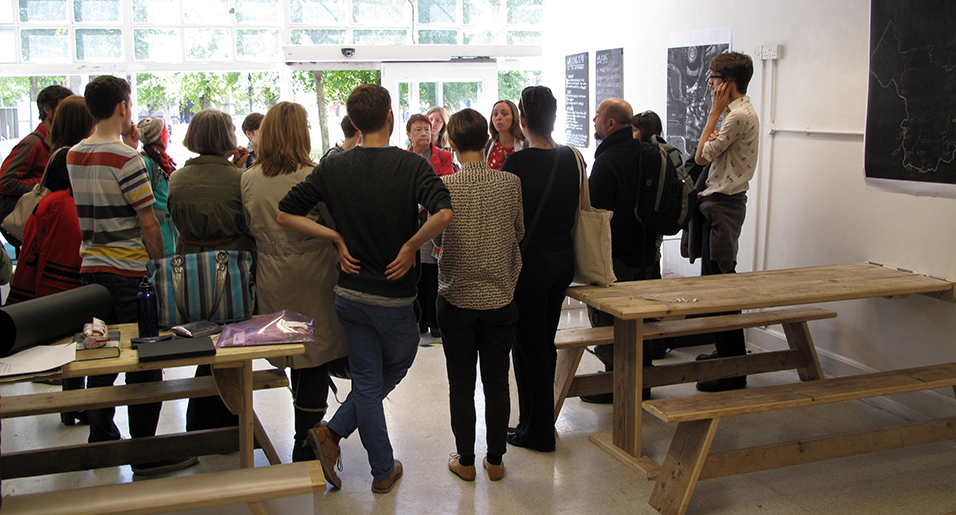
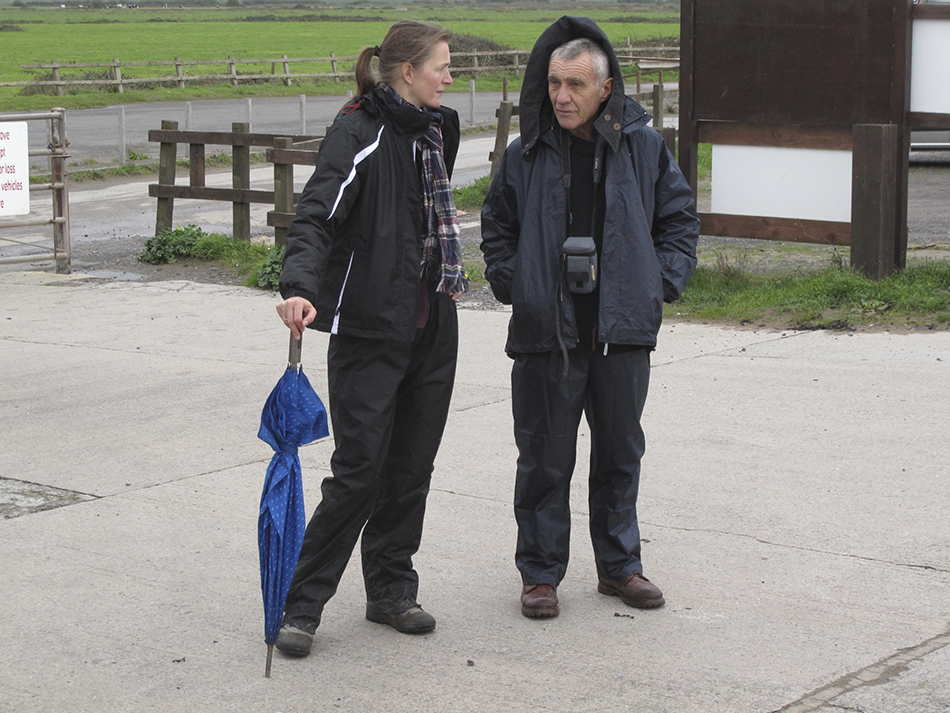
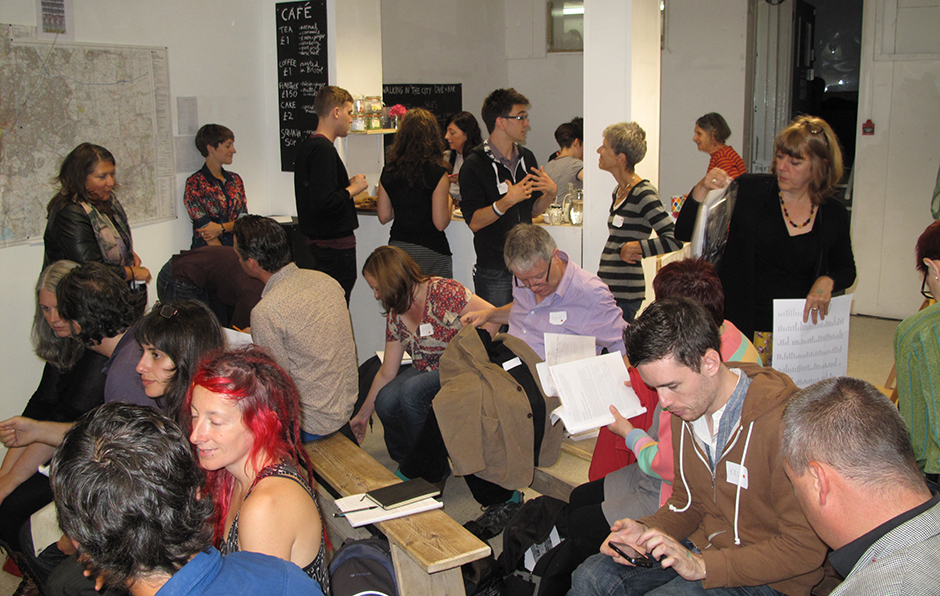
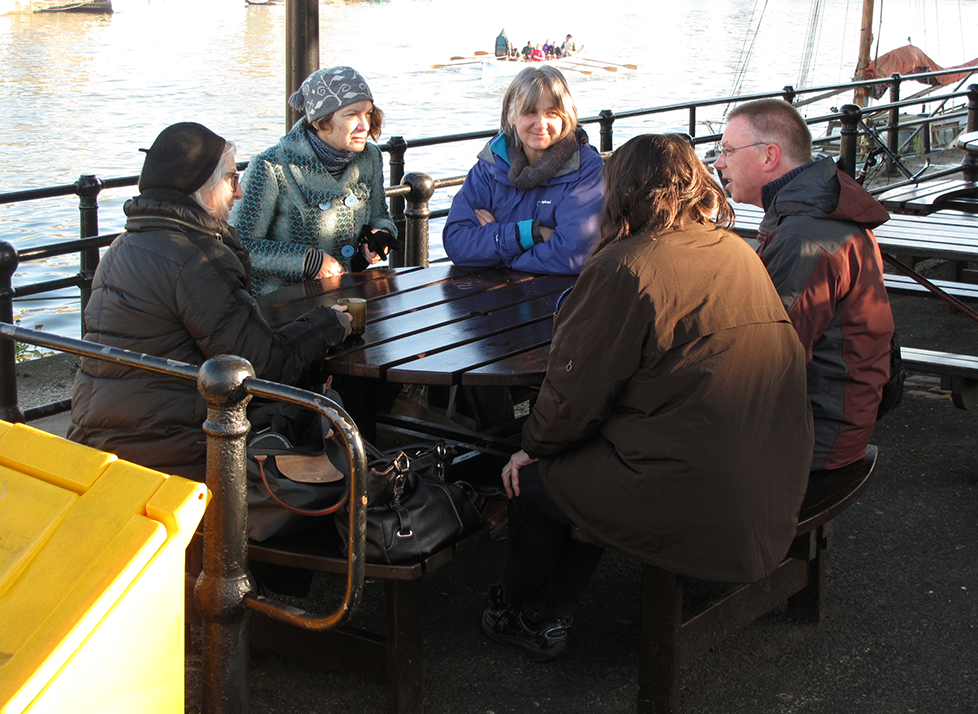
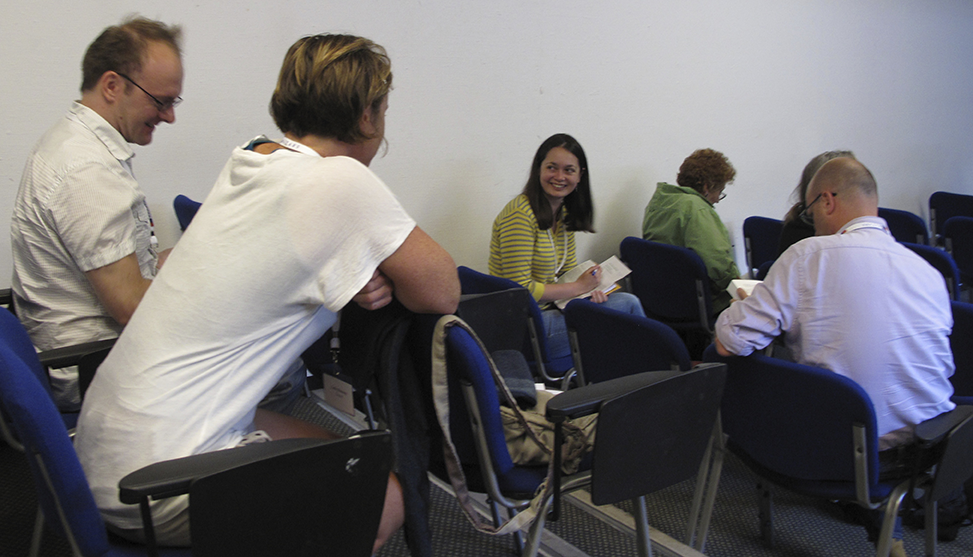
First, however, there were two very interesting days at the Transgressions conference here in Bristol, where Antony Lyons and I presented our seventeen minute film of the same name. It was very good to meet up with old friends and fellow travellers – the photo above is of (left and then clockwise) Gini Lee from Melbourne, Rebecca Krinke from Minneapolis St Paul, the film-maker and ME/CFS patient advocate Natalie Boulton (who is also my wife), David Smith from UWE here in Bristol, and Mary Modeen from Dundee – and to meet a bunch of new and interesting people. Among the material generated by those new (to me) people I was particularly impressed by Renata Tyszczuk’s presentation – The Satelite and the Fly – which offered an extraordinarily concise and effective ‘ecosophical’ insight into our current environmental situation. (You can find her research at http://www.shef.ac.uk/architecture/people/tyszczuk_r). I then flew north with Mary to spend two days working at Dundee, mostly with her Arts and Humanities MA students, before going south again with them to Leeds, where Judy Tucker had organised a two day symposium around issues of place. There I caught up again with Judy and the poet Harriet Tarlo (with whom Judy collaborates), along with other old friends who teach at the university there.

Three lectures, two seminars, a dash of studio teaching, and the usual level of participation in a symposium when you’re an ‘elder’, may seem a lot of work in under a week but, talking with Gini, Rebecca, Dave Littlefield (who was an organiser of Transgressions), Mary, Judy, Harriet and others with whom I share common cause was a great pleasure and a source of real energy.

Perhaps because of all this travelling I notice I’ve even started to learn to be more patient, knowing that it takes time to process images and ideas and for them to find their place in my imaginative processes.

Photographs I took during my previous trip to Dundee in the summer are only now beginning to surface in a creative context. Where they’ll finally come to rest I don’t know, but at present the centre of gravity for imaginal work remains the proposed third bookwork in the Debatable Lands series. This is currently looking like being a novelistic evocation of life on the Borders, a lengthy mix of image and text (currently running to almost 60,000 words) dealing with three generations across the C20th and into the C21st in which two sisters, Lizzy and Kate Oliver, play a central part. Not at all what I had intended but, like Between Carterhaugh & Tamshiel Rig where the whole Borders project started, as much a matter of ‘inner necessity’ as anything else!

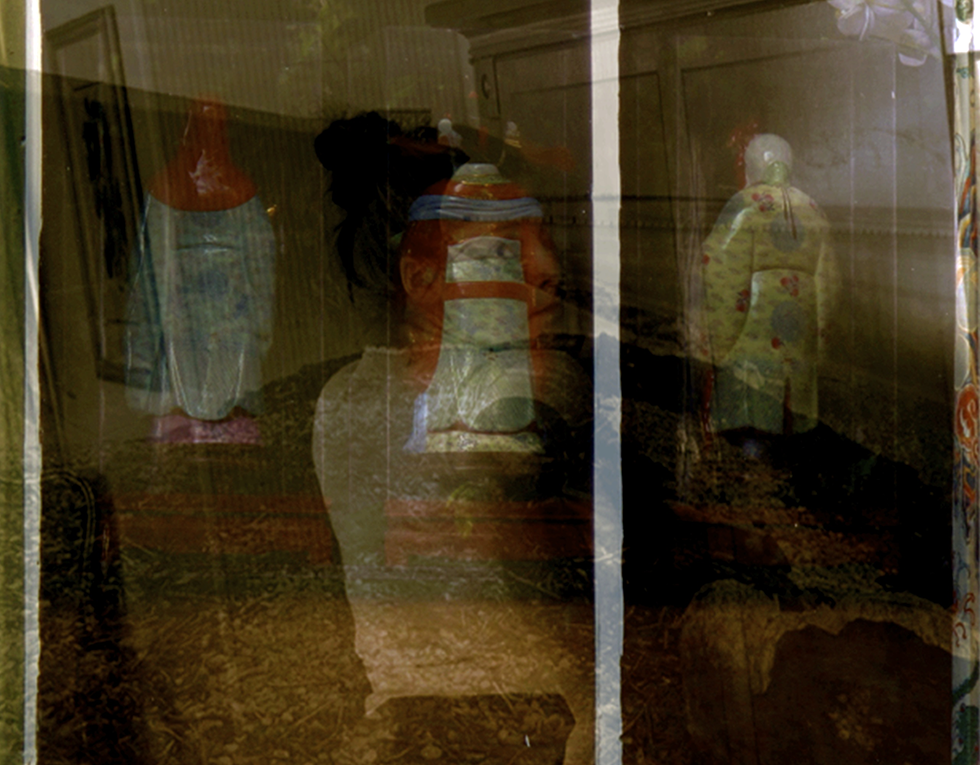
I include one of Kate’s photographs for this work below, which utilises a photograph taken in Dundee. So it goes.
Kate's photo

PS re ‘different voices in education’

Having posted some thoughts on the different voices coming out of universities yesterday and subsequently finally caught up with my newspaper reading, I now see a headline in The Guardian Financial section that reads: “Economics lecturers accused of clinging to pre-crash fallacies”. Of course to those of us who know how the academy works, this kind of comment will come as no surprise. My wife Natalie Boulton, a film-maker and patient advocate, is constantly having to point up the fact that supposedly up-to-date dictionaries and medical textbooks continue to perpetuate damaging nonsense that has been disproved years ago but which continues to serve certain powerful vested interest groups whose status and ability to win lucrative research grants depends on that act of perpetuation. It now appears that this situation is equally common in economics. All of which needs to be considered in a broader context. My friend Cathy Fitzgerald has just drawn my attention to an interesting and powerfully argued piece at:  http://opinionator.blogs.nytimes.com/2013/11/10/learning-how-to-die-in-the-anthropocene/?_r=2& which includes the observation:

“The biggest problem we face is a philosophical one: understanding that this civilization is already dead. The sooner we confront this problem, and the sooner we realize there’s nothing we can do to save ourselves, the sooner we can get down to the hard work of adapting, with mortal humility, to our new reality”.

If by a civilisation we mean a certain dominant mentality and way of acting, which here I would see as the exclusive, narrow, disciplinary basis of our hyper-professionalised world predicated on possessive individualism, then this sounds to me about right. Professionals, whether they are economists, psychiatrists, senior university administrators, or whatever, will it seems always prefer to perpetuate the theories and explanations that maintain their own authority, no matter how powerfully the reality of events has demonstrated them to be entirely wrong. No wonder, as Michael Gibbons, Camille Limoges, Helga Nowotney, Simon Schwartzman, Peter Scott, and Martin Trow point out in their The New Production of Knowledge: The Dynamics of Science and Research in Contemporary Societies (1994), that it frequently require a whole generation of professionals in a discipline area to die before anything genuinely new can appear jun that discipline’s thinking!


Different ‘voices’ in Higher Education

IMG_3711

Despite my semi-retirement I retain a keen interest in what’s happening in Higher Education, not least because it’s supposed to be where the best brains of the future are being educated. (More on that in a moment). So I’m fascinated by the very different kinds of blogs that seek to reflect on the current state of HE. On the positive side there’s the blog written by Ferdinand von Prondzynski, Principal and Vice-Chancellor of Robert Gordon University, Aberdeen, Scotland, who was formally President of Dublin City University, Ireland, between July 2000 and July 2010. A lawyer by training, and with some voluntary and business interests, he is also known as a writer, public commentator and photographer. He almost always has something interesting to say and I always look forward to seeing what he’s added to http://universitydiary.wordpress.com/

Part of the fascination of von Prondzynski’s Diary is that he is quite willing to speak his mind on controversial issues. This characteristic stricks me as being fairly unusual in Vice-Chancellors – who in my rather limited experience tend to favour the safely bland and platitudinous. A good example of von Prondzynski’s critical ruminators – and the one that first caught my attention – is on the chronic failure of the disciplinary mindset to meet the obligations of society. (His thoughts on this topic and on its wider social implications can be found at the post for 2010/10/14.

In this post he makes it clear that for some time he has thought that: “attachment to the traditional disciplines is making it harder for universities to adapt to changing circumstances”. Quoting Professor Elaine Ecklund of Rice University’s Institute for Urban Research, he suggests that it may now “be necessary to abandon disciplines in order to ‘think beyond old boundaries’”. This is the case because “the problems universities are asked to help solve all tend to lie between disciplines”. Yet universities – which are still overwelmingly organised on a disciplinary basis for administrative reasons and, more fundamentally, because it is the ground of the power of the status quo in academic realpolitik – have endlessly pontificated about embracing interdisciplinary methodologies while, in practice, doing very little or nothing to move on from the disciplinary stranglehold. Von Prondzynski is under no illusions as to the tenacity of the disciplinary system – suggesting that breaking it down “would be very difficult and could meet very significant resistance”; while indicating that change is necessary if universities are to “regain society’s trust and confidence”.

While I’m wholly in agreement with Von Prondzynski, I had wondered about how one might identify the practical impact of this archaic system on the body politic. A recent TV programme answered that question in no uncertain way. In this a Swedish statistician looked at the myths that surround issues like family size and literacy in the ‘developing’ world and demonstrated that, in England, the general population who left school after secondary education are better informed about these issues that those with a university education.

At the other end of the spectrum of HE commentators there’s The Secret Administrator, a (possibly dyslexic) individual who writes about the University of the West of England which is, of course, where I used to work. His/her blog is basically a one-institution version of Laurie Taylor’s regular pieces for the THE, drawing attention to what the writer sees as the vanities and other short-comings of the university’s senior management. While it would clearly be foolish of me to comment on the detail of this blog what I can say is that, as somebody who has visited a great many different universities in the last few years, its general tenor is pretty indicative of how the ‘foot soldiers’ who deliver HE on a daily basis feel about their managers. (And, I might add, how most of the nurses I met during my cancer treatment in Bristol felt about theirs).

It’s not difficult to understand why this is the case. Put very simply, we have an increasingly harassed – some would say bullied –  ‘shop floor’ workforce which is still, to a considerable degree, motivated by a sense of a people-oriented vocation. And this group is now managed by an (ultimately parasitic) administrative / managerial class that – with honourable exceptions – appears to have wholly internalised a culture of audit based on distrust. This class appears to be very largely motivated by a mixture of self-aggrandisement and an abject conformity to the demands of the dominant political ideology. What is blindingly clear is that this situation is not good for education or for health care. What is not clear is how, given the pervasiveness of the mindset that has produced it, we can change this.


A trip to Ireland, some recent photos, and mycelial thinking …

IMG_1059

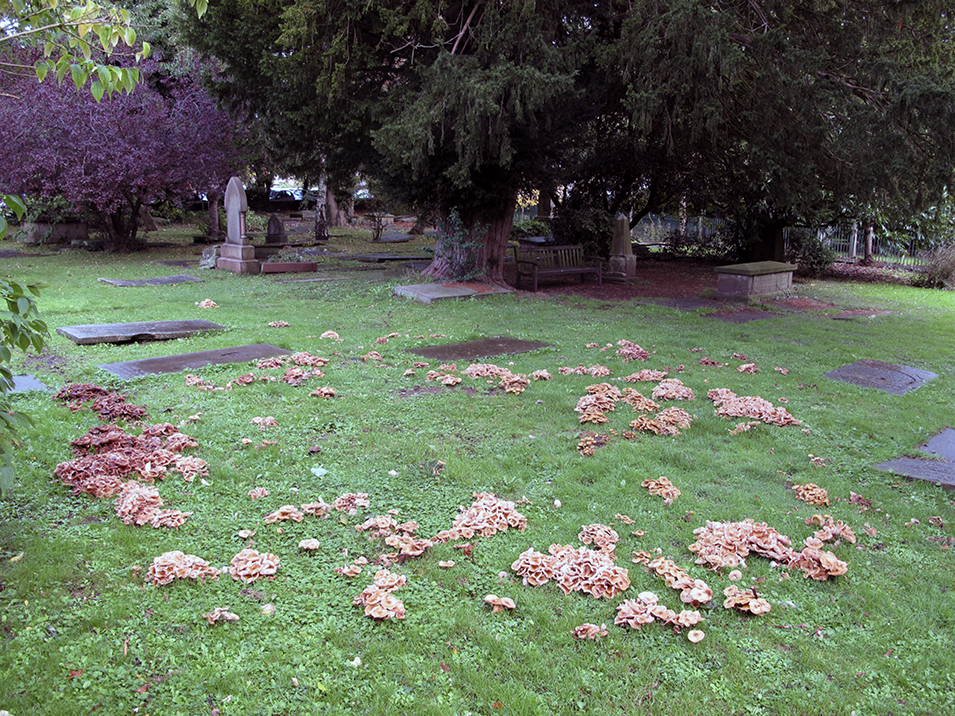
Recently we had a sudden and brief eruption of fungal growth resulting a a ragged version of a ‘fairy ring’ in the old graveyard in Clifton – new life from old. I’ve had the no doubt extensive mycelial mesh beneath these strange fruit on my mind since I took this photograph. This image has now become linked in my mind with the fact that I have just returned from three days of animated conversation and warm hospitality in Ireland, during which time I stayed with two artists with whom I’ve been working who are each part of wider mycelial networks of their own. These two were Cathy Fitzgerald (http://www.cathyfitzgerald.ie) who I stayed with at her home in the middle of Hollywood – now officially on the map, as Cathy proudly showed me – and Pauline O’Connell (http://paulineoconnell.com), along with Eamon Colman and their son Ruben in Kilkenny.

I was in Ireland for a number of different but finally linked reasons, the most fundamental of which was my continuing search to find, listen to, and establish links with creative people of all kinds who are open to working for the development of a multi-constituency thinking. A thinking that, following conversations with Antony Lyons, I’ve come to think of as ‘mycelial’ in its approach to building connectivity and the potential for active community. The trip was very productive in that I think there is an understanding of the importance of cultural engagement with rural issues in Ireland that chimes very closely with my own concerns. I sense this as part of a shifting pattern of energies that, like Eamon Colman’s paintings, brings a sense of occasional joy despite the general gloom.

Of course this can be misconstrued – I’m not interested in the rural as something ‘other’ set over against the urban – but because I think our deepening ecological problems are most visible there – sometimes starkly so. These are problems that can only be addressed ecosophically, that’s to say as at once environmental, social and personal, each level of activity shifting in response to the other. Fortunately there seem to be a growing number of people willing and able to sense and respond to the demands of these shifting forces.

IMG_1169IMG_1132

IMG_1176

IMG_1142

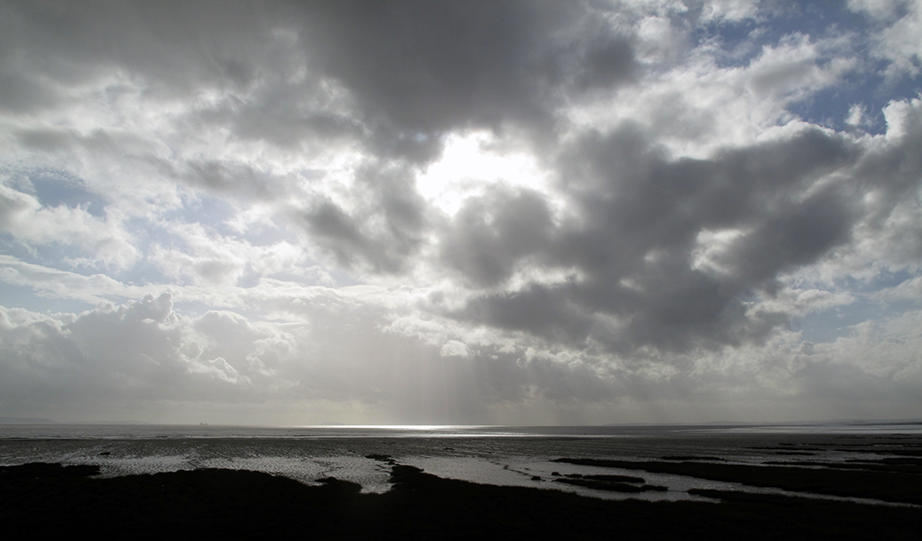
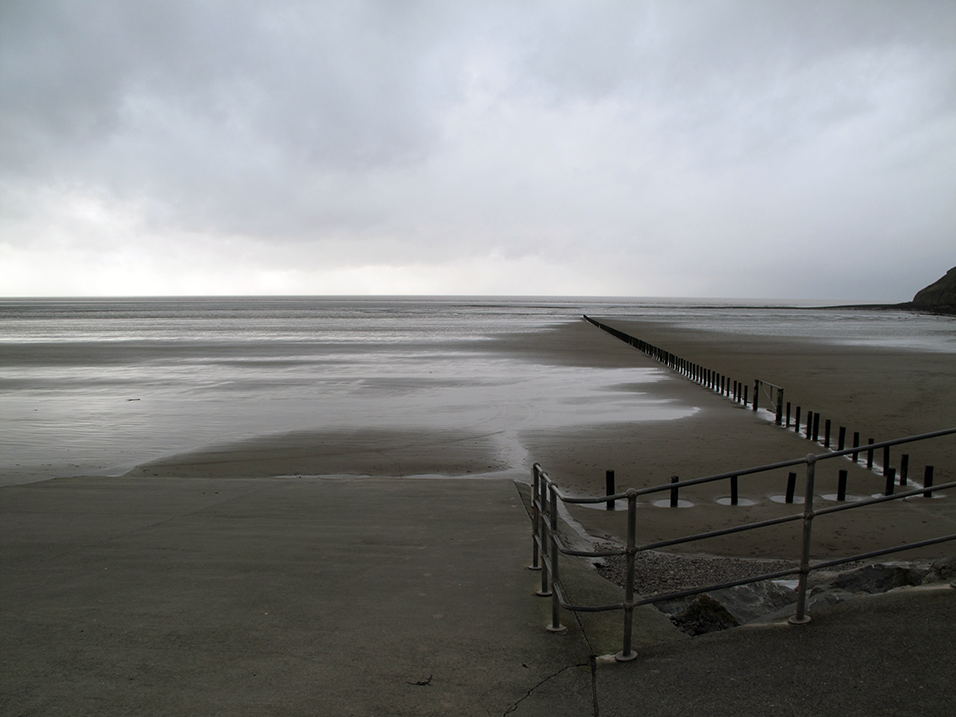
Before I went to Ireland I had been working with an international group who are thinking about problems of coastal flooding and all that involves. The project – a series of Between The Tides workshops – was organised by Owain Jones, Antony Lyons and Bettina van Hoven and has enabled me to start to think about possible future work in that area and to open up links with ongoing research that relates to the deep mapping project I was responsible for in Cornwall.

The image below is of Bettina van Hoven and my old friend Simon Read, who has been working tirelessly on environmental issues around coastal erosion and the protection of salt marsh over many years. The photograph was taken down on the levels below Brean Down.

Simon and bettina


Predictability, security, and creative mutations


Slide1

It’s often productive to read more than one text at a time because of the unexpected cross-fertilization that result. This has been the case for me with reading the International Federation of Red Cross and Red Crescent Societies’ Think differently, Humanitarian impacts of the economic crisis in Europe – see http://www.ifrc.org/en/news-and-media/features/european-economic-crisis/ – in the middle of working my way through Tom Finkelpearl’s What We Made: Conversations on Art and Social Cooperation (Duke University Press 2013). The particular cross-fertilization I want to pick up on here is between observations made by Daniel Joseph Martinez – a professor of theory, practice, and the mediation of contemporary art at the University of California, Irvine – and the opening statement of the IFRC’s report. This reads:

“Creating a sense of predictability and security has traditionally been attributed to what a society offers to its citizens.

Today, as the economic crisis has planted its roots, millions of Europeans live with insecurity, uncertain about what the future holds.

This is one of the worst psychological states of mind for human beings and we now see a quiet desperation spreading among Europeans, resulting in depression, resignation and loss of hope for their future”.

I know quite enough about living with insecurity – in my case to do with unpredictability around medical responses to my daughter’s longterm illness – not to wish unpredictability and insecurity on anybody at the level of their familial, day-to-day life. However, the assumption that the function of society has traditionally been first and foremost to create a sense of predictability and security for its citizens seems to me a little simplistic to say the least and, at least in my view, needs contextualising. There are, I suggest, some very particular modern and secular assumptions at work that don’t necessarily sit very well with what we know of European history.

It’s in this context that Martinez’s observations seem particularly pertinent.

Asked about changes in his practice in the mid-1990s he refers to the importance of mutation, of being willing to see practice as “unpredictable and uncontrollable”, and of the value of this as a basis for ideas where the emphasis is on creativity in a social context as in “perpetual motion, constant flux” (Finkelpearl 2013: 70). The contrast between this understanding of creative arts practices – and as someone much influenced by Joseph Beuys’ notion of Social Sculpture we can be reasonably certain he would extend this to creativity more generally – and the emphasis, in the IFRC’s report, on predictability and security strikes me as worth exploring. After all, in the context of creative imagination it’s fairly obvious that a degree of uncertainty about what the future holds can be a useful, indeed highly productive, state of mind.

A book that made a very marked impression on me in terms of mapping shifts and clashes in historical mentalités is Emma Wilby’s The Visions of Isobel Gowdie: Magic, Witchcraft and Dark Shamanism in Seventeenth-Century Scotland (Sussex Academic Press, 2010). It illuminates, in extraordinary detail, the point of interaction between two radically different mentalités: on the one hand that of a traditional peasant culture in which vernacular quasi-pagan beliefs co-existed both with residual elements of the Catholic faith and of the new Protestantism and, on the other hand, the new social order predicated on an essentially middle and upper class Calvinism. What is particularly significant about this clash here is that each of these mentalités, which uneasily co-existed for a while, would have understood predictability and security in very distinct ways and have valued them very differently. For example, for the vast majority of the rural poor in Calvinist Seventeenth-Century Scotland one of the very few things they know for certain was that their social status would not improve in this life and that, as born sinners who found themselves within a religious orthodoxy based on predestination, they were almost certainly condemned to the fires of Hell in the next. In terms of predictability, Wilby also makes very clear the almost unbelievable predictability, monotony and restrictions of the ordinary life or a Scottish peasant at that time.

While I have clearly chosen extreme examples, I want to make the point that neither predictability nor security need necessarily be the unalloyed or necessarily obvious ‘good’ that the report assumes them to be. What we take to be predictable – be it eternal damnation or, in the case of the mentalité of possessive individualism, the ‘sustainability of economic growth’ – may be nothing more than a delusory phantom, one on which we become so fixated that we cannot imagine an “otherwise”. Arguably it was precisely because of her creative ability to imagine an “otherwise”  through a creative synthesis of vernacular and other traditions and beliefs that Isobel Gowdie was executed. The predictabilities and securities we buy into may, then, also be the means by which we are manipulated by those who hold power in a society.

Which returns us to Martinez’s points about creativity and the unpredictability of mutability.

I don’t want to labour the point here, not least because I really do not in any way wish to imply that predictability and security are not vitally important to human society and wellbeing. My point is simply that unpredictability and insecurity, particularly as these help us see through phantasmagoric worlds such as that created by the current British government (which is actively working against both the spirit and practice of all six of the recommendations of the IFRC’s report), have their place too. Particularly where they act as a spur to a creativity that allows us to imagine the world “otherwise”.

Slide1    

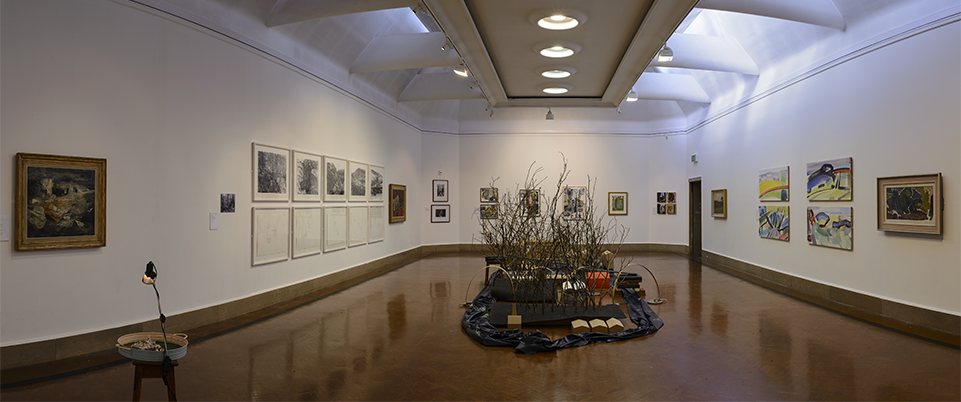
Works in Landscape, Art and Uncertainty exhibition at Southampton City Art Gallery

pano1

Installation shot of exhibition on from 7 September 2013 – 5 January 2014
Gallery 8 (photo Christian Shaw)

IMG_0916

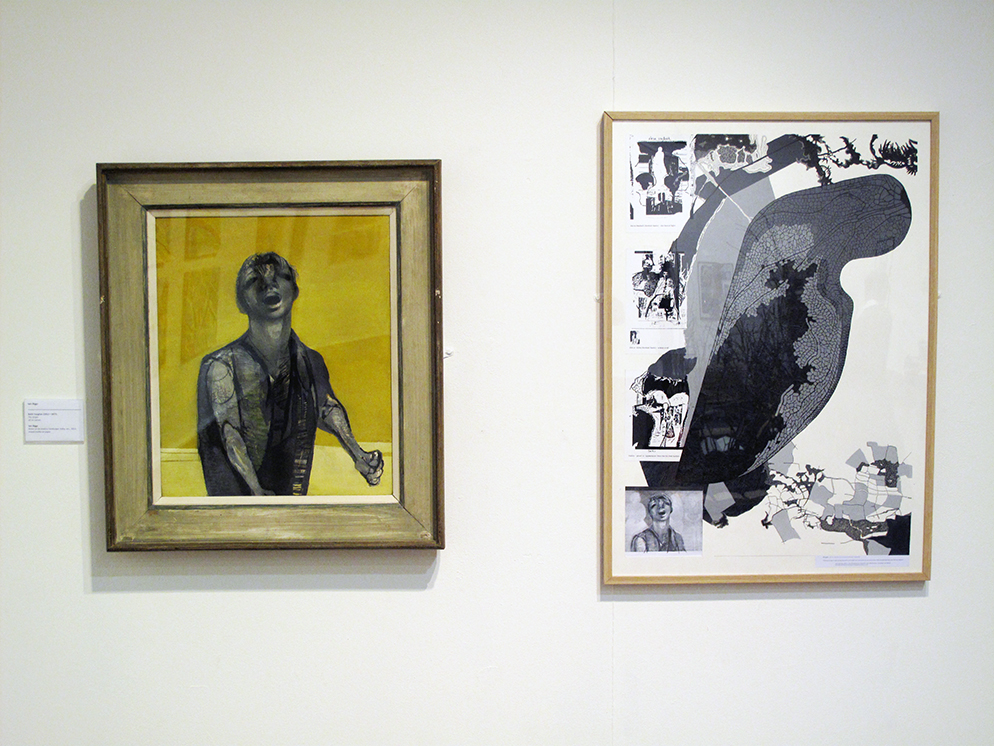
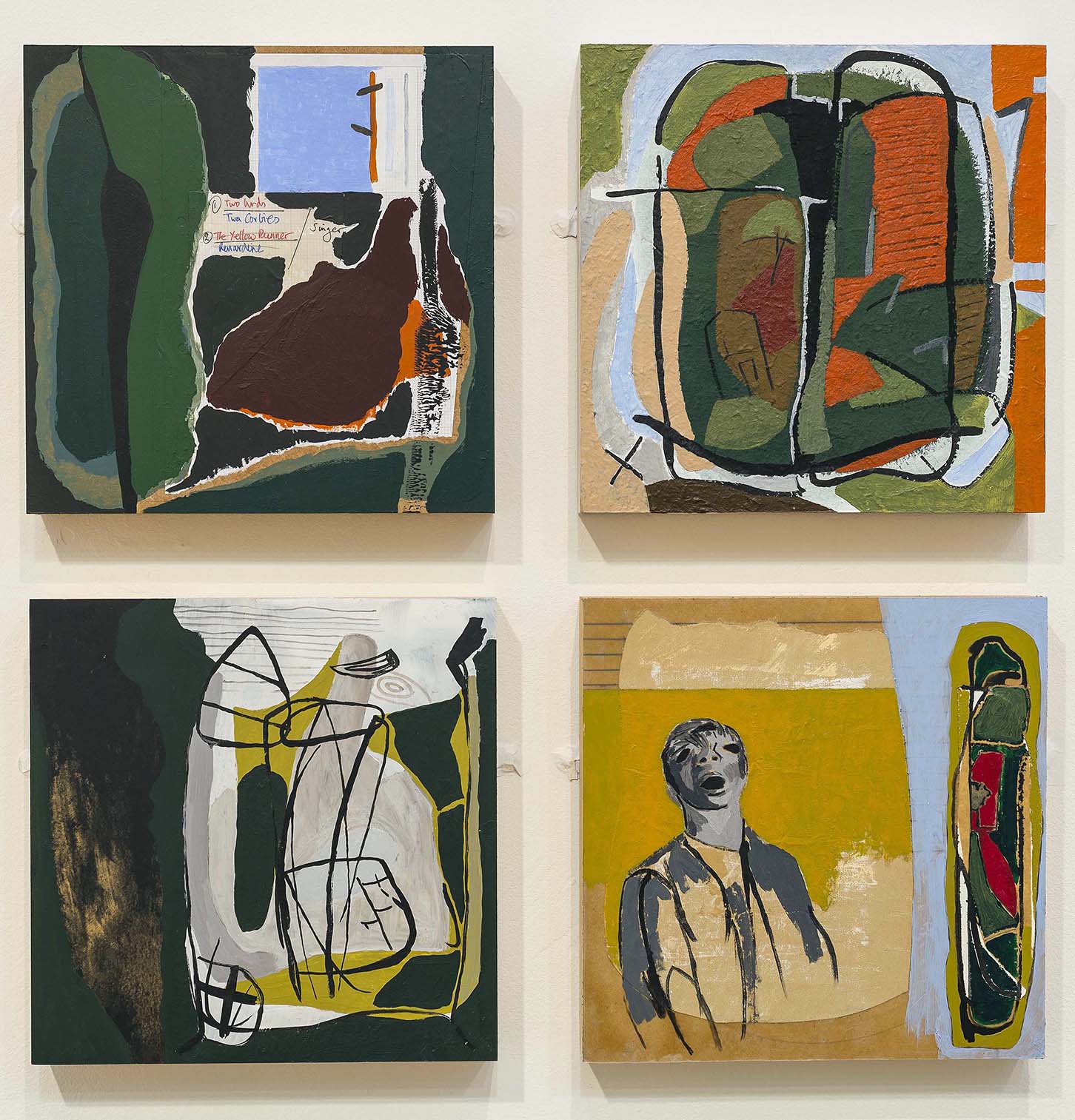
(Left) Keith Vaughan The Singer (Right) Notes on an anxious landscape: Sidhe, etc. (2013), mixed media on paper

This work takes Keith Vaughan’s The Singer as its point of departure, along with scattered thoughts and visual notes on aspects of vernacular music in general and the post-war folk music revival in particular. The term sidhe (fairy) refers both to the central role of the ‘good neighbours’ in the supernatural Borders ballads central to the British vernacular song tradition and to Vaughan’s otherness as a homosexual.

066

Notes on an anxious landscape: Women/Place (2013), mixed media on paper (photo Christian Shaw)

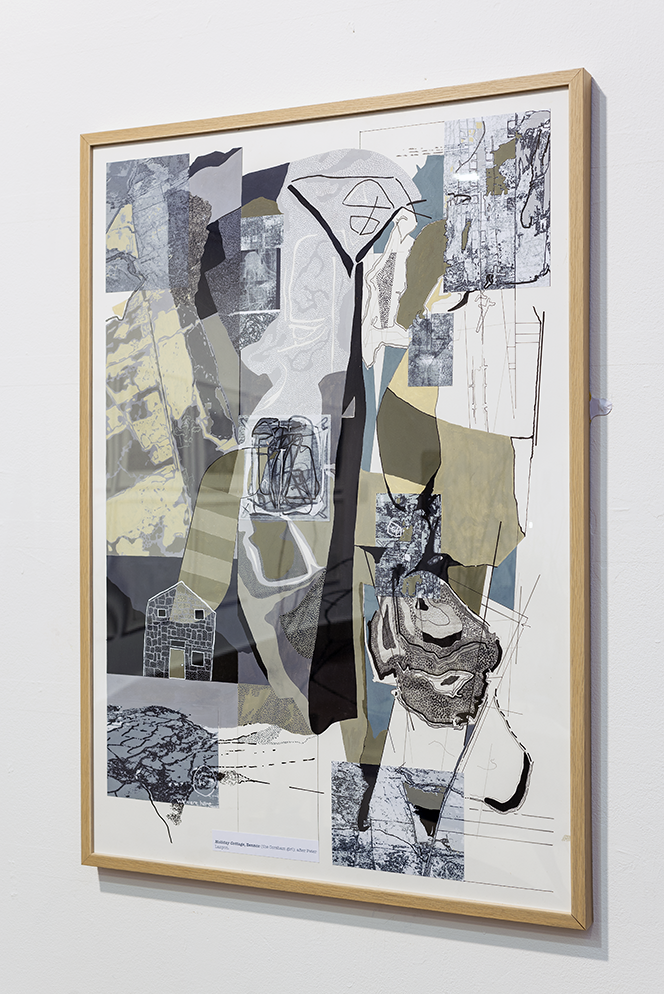
This work takes Peter Lanyon’s images of Zennor and other Cornish Towns as its point of departure. It is a musing on the possible interrelationship of two aspects of his work: the extra-marital relationships with various lovers said to be central to his experience of place, and the claim that he largely transformed the English landscape painting tradition by shifting its focus from landscape traditionally understood to place. The image also owes something to my long-standing interest in ‘deep mapping’.

068

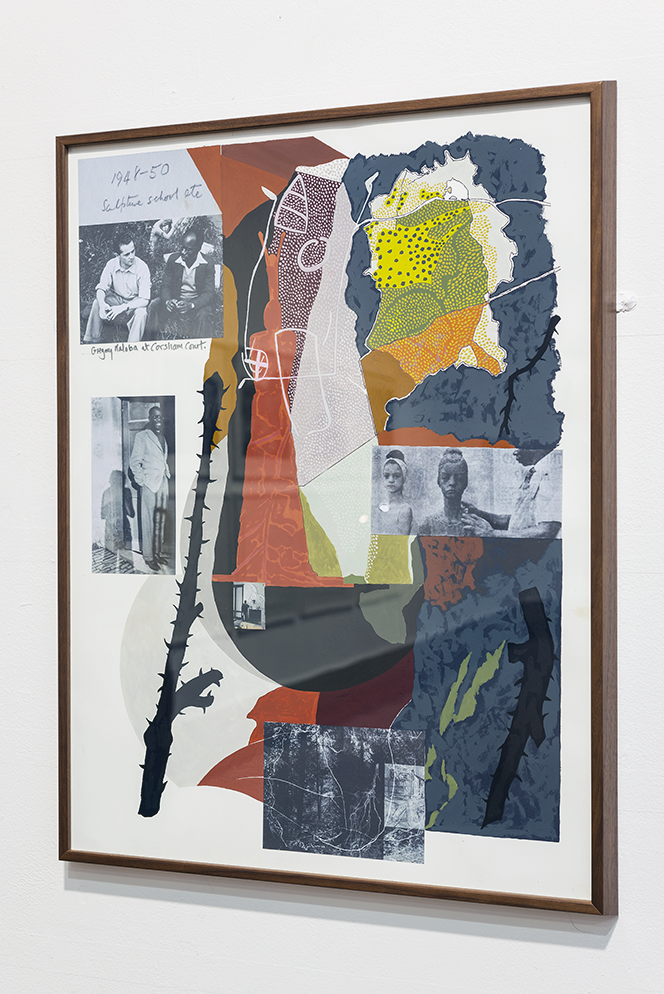
Gregory Maloba at Corsham Court (for Reg Boulton and ‘Rikki’ Richardson) (2013), mixed media on paper (photo Christian Shaw)

Before their marriage my parents-in-law – Reg Boulton and ‘Rikki’ Richardson as they then were – both studied art at Corsham Court (where Lanyon taught part-time). My father-in-law also attended a short painting course with Keith Vaughan, whose work he much admired. This image includes three photographs of Gregory Maloba, a Kenyan student at Corsham and friend of Rikki’s, together with material from a newspaper, as its point of departure. Other elements derive from Maloba’s vast concrete independence monument in Kampala and a map of the Corsham estate. After leaving Corsham, Maloba studied and taught art at Makerere University, where he had an incalculable impact on contemporary East African art.

069

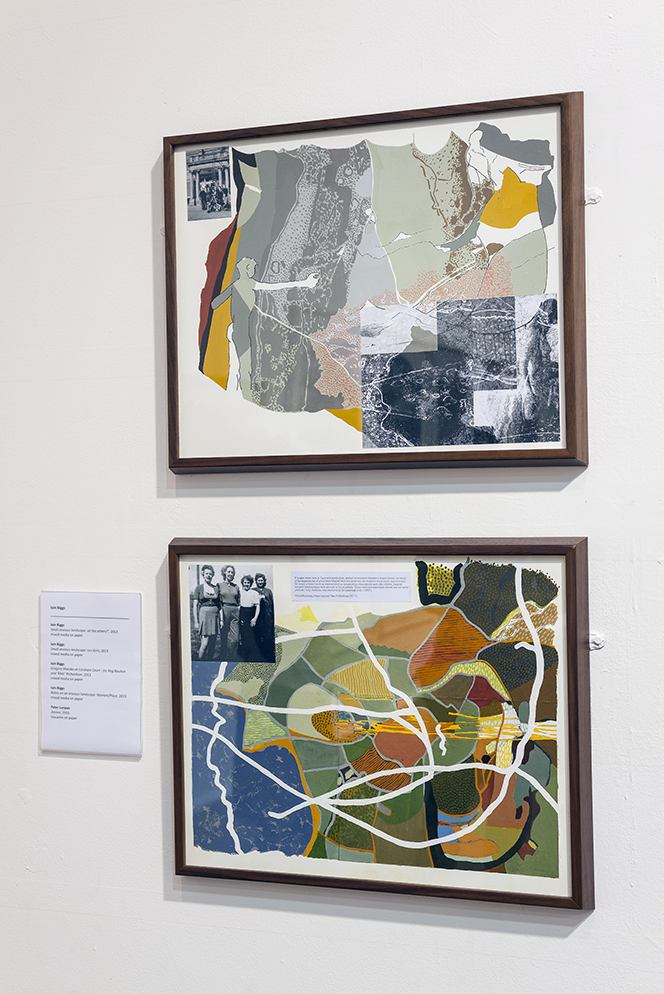
(Top) Small anxious landscape: all the others? (2013), mixed media on paper (photo Christian Shaw)

(Bottom) Small anxious landscape: Les Girls (2013), mixed media on paper (photo Christian Shaw)

Like the other two ‘Small anxious landscape’ images, Small anxious landscape: all the others? reflects on the social context within which the post-war art world was located at the time my parents-in-law were students. Also to the emphasis on ’social reconstruction’ (of traditional norms as much as of social infrastructure) after a war that, despite everything, many young people clearly found a liberating experience. The sub-title references all those from that period who, unlike Keith Vaughan and Peter Lanyon, were not able to have a career as professional artists, with the various freedoms that licenced.

The photograph used in Small anxious landscape Les Girls was taken by my father-in-law, Reg Boulton, and includes his future wife ‘Rikki” Richardson (on the far right of the image). I was very taken by the different stances and expressions of these four young women that, with aspects of Reg and Rikki’s family history, provided a starting-point for Small anxious landscape: Les Girls. Also in my mind was the very public recent exposure of the sexual abuse over many years of music students by their teachers, a situation that raised questions about Peter Lanyon’s affairs with two of his students, seen by art historians as of the greatest importance to his experience of place.     

Iain's 4

(Clockwise from top left – photo Christian shaw))

 Song / Place / Singer: first and last thoughts (2013) acrylic on paper on board

Night thoughts (after Zennor) (2013), acrylic on board

Song / Place / Singer: Peter Lanyon and Keith Vaughan (2013), acrylic on papers and board 

Landscape + Sexual Encounter = Place? (after Peter Lanyon) (2013), acrylic on paper on board

Rural matters – a meditation on sinkholes

Slide1

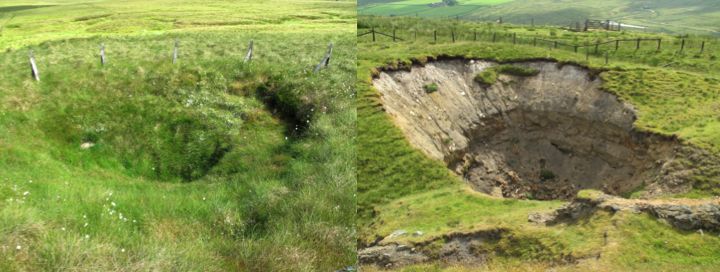
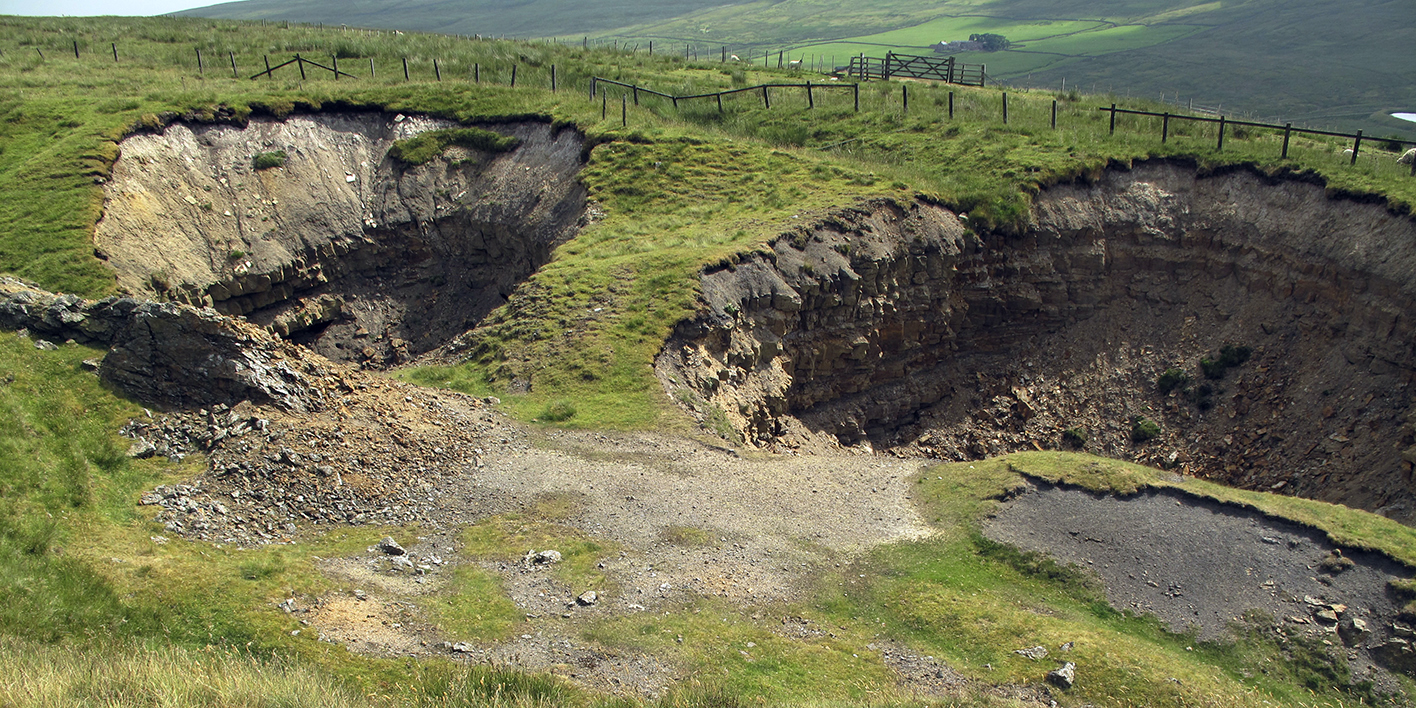
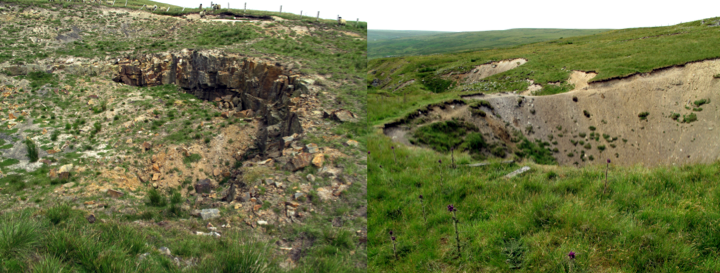
These photographs are of two sink holes in County Durham. I’ve been keeping an eye on them and their peers over a number of years.  Sink holes appear in the news every so often, usually when a portion of a city in the USA drops into one, often taking houses, vehicles and/or people with it. Their physical presence reminds me very forcibly of the instability of all aspects of the land – and not only of what’s under my feet in places such as these – and so helps me not to take it’s stability granted.

Yesterday I spoke with Margaret Ames, who teaches full time at Aberystwyth University (see http://www.aber.ac.uk/en/tfts/staff/mma/). As usually happens when we meet – sadly all too infrequently – we discussed issues relating to Welsh culture and the rural uplands farming which still just sustains the taskscape in which Margaret lives, and that has been so important to my own work. Most people have internalized an urbanist mentality that either reflects Marx’s observation about ‘the idiocies of rural life’ or tends to think nostalgically of the rural in terms of picturesque landscape and rather static, backward-looking and parochial communities on the margins of contemporary society. Such attitudes are unfortunately dominant and ignore so much – the realities of agribusiness and its negative environmental and social impact, the playing out of tensions around national identity through the politics of the ‘heritage industry’, the increasing distopia of many indigenous working rural communities, the growing crisis of Britain’s smaller farms, and so on. Some of these attitudes are perpetuated by members of rural communities themselves – particular the landowning classes and urban escapees who might be said to be located, rather than working, rurally; but many are simply a reflection of ignorance and media stereotyping.

IMG_9892

Margaret’s and my conversation was focused by a number of general issues that it seems worth articulating here. The first relates to what I take to be the most pressing educational issue of our time which, as anyone who reads these notes regularly will know, is the need to facilitate the shift from a disciplinary-based to an ecosophical conception of education; namely one that aims to provide a basis for ecosophical praxis. While the resistance to any such a shift – which requires a radical change in the realpolitik of Higher Education and the professions – is naturally massive, it is none the less a vital part of creating a genuinely sustainable future. Perhaps ironically, and this brings me to my second issue, working rural communities in countries like Wales – which still have a tradition of poetics – are far more likely to offer us initial models of what is necessary for ecosophical praxis to emerge in practice that any number of academic tomes on Guattari.

In Margaret’s home village, as in communities like that on the Isle of Mull, most people must exercise a wide range of different skills and understandings, both in order to earn a living and to sustain any kind of living culture. Community in such places is always fragile, cannot be taken as a given, and requires a good deal of effort by individuals and groups to sustain and constantly recreate it. To survive, let alone to thrive, an uplands farming community requires an engagement in the intermeshing of environmental, social and personal ecologies that, while very far from Guattari’s ecosophy in some respects, in others offers an important lived embodiment of the tensions and connectivities any genuine ecosophical praxis must engage with. While the urban academic theorist can take for granted that her monthly salary enables her to gather her basic physical and cultural sustenance on her way between home and work – whether from a supermarket or a multiplex or arts center – in rural communities these things usually require planning, a thoughtful allocation of resources and, very often, the necessity of social co-operation. In short they require skills that, as the unsustainability of our current consumerist culture starts to bite, will be increasingly necessary to us all.

Slide1

A third related issue has to do with dwindling fossil fuel resources for long-distant transportation of basic necessities, land use, and the production of food. At present upland farming is increasingly threatened by a combination of factors – many of them related to a blending of economic and social policies that – in the name of a popularist pseudo-democracy – enables Government to believe itself entitled to ignore the needs of ‘marginal’ rural communities. However, as climate change continues to lead to rises in sea level, our whole approach to land use will need to change because there will simply be less and less of it – whether to live on or produce food. (Ironically, it is possible that global warming may allow grain to be grown on a small scale at higher altitudes than at present, as it did in the late Iron Age and Roman period in upland Britain). If, as seems inevitable, the UK will need to become both far more self-sufficient in terms of food production and, with many of its major city at close to sea level, need to relocate very substantive percentages of it population to higher ground, working rural communities in general and upland rural communities in particular, are likely become a contested but vital basis for the creation of a genuinely sustainable society. At present both the dominant social order and our increasingly embattled rural communities – facing such issues as the loss of post-offices, in many places a cornerstone of rural communities – lack the necessary envisioning necessary to catalyze the kind of ecosophical praxis necessary to address these issues. While artists – in the broadest sense – are beginning to undertake just such an envisioning they can only do so much on their own.

And it is at this point that an ecosophical approach to the arts and education as they apply to these issues is urgently needed.

Creating convivial places – towards another politics?

IMG_0962

In these increasingly uncertain times I am more and more impressed by the way in which people I meet are managing to continue to make ‘convivial places’ that serve to grow or support forms of community and mutual support – ‘places’ that exist solely through the coming together in good faith of people engaged in creative action. This form of ‘making’ seems to me one basis for what we might call another kind of politics and some of the most valuable creative work we can do. Indeed, if some theorists are to be believed, it perhaps lies at the heart of the creative conversations that we undertake when we engage in the work (verb) of art.

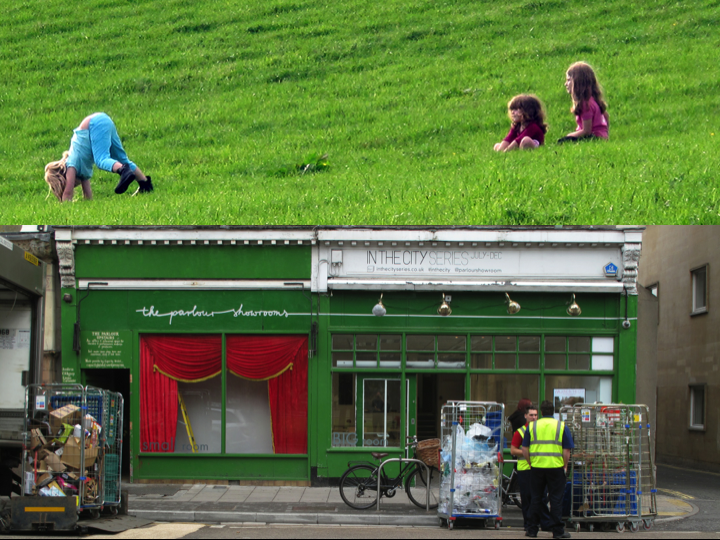
Recently the most obvious example of this kind of work for me has been The Showroom Projects with whom Mel Shearsmith and I (representing PLaCE) worked on the Walking in the City project. (http://www.inthecityseries.co.uk – see my last post and Walking In The City). The three main people involved are Alice Tatton-Brown, Hannah Sullivan and Martha King, who describe themselves as ‘creative practitioners and producers’. Something of the spirit of this enterprise is suggested by the description of Alice Tatton-Brown’s role: “Alice is currently looking after finance and development at TPS, though like Martha and Hannah, she too can also be found cleaning the spaces, emptying bins and filling holes in the walls” (http://www.parlourshowrooms.co.uk/thetea/). Not to mention, at least in Martha’s case, taking on other low-paid work so as to help keep body and soul together). Alice is also soon to perform Ariel – part audio walk, part installation, and part performance – an intimate story told and retold in Exeter Central Library (19-26th October).

It might be argued that what I admire in these three women is simply indicative – a working in the kind of hybrid, ‘in-between’ psychosocial space that is occupied, willingly or unwillingly, undertaken by innumerable artists who have both to subsist and sustain their practice by multi-tasking, creatively and economically. While that may be true, it risks missing the particular outward-looking, enthusiastically engaged and intellectually curious quality of the ‘convivial place’ these three have managed to create at the Parlour Show Rooms. It is this creative conviviality, perhaps more than anything else, that we now need as a society and that Bristol City Council risks disabling when it dispossesses The Showrooms Projects later this year.

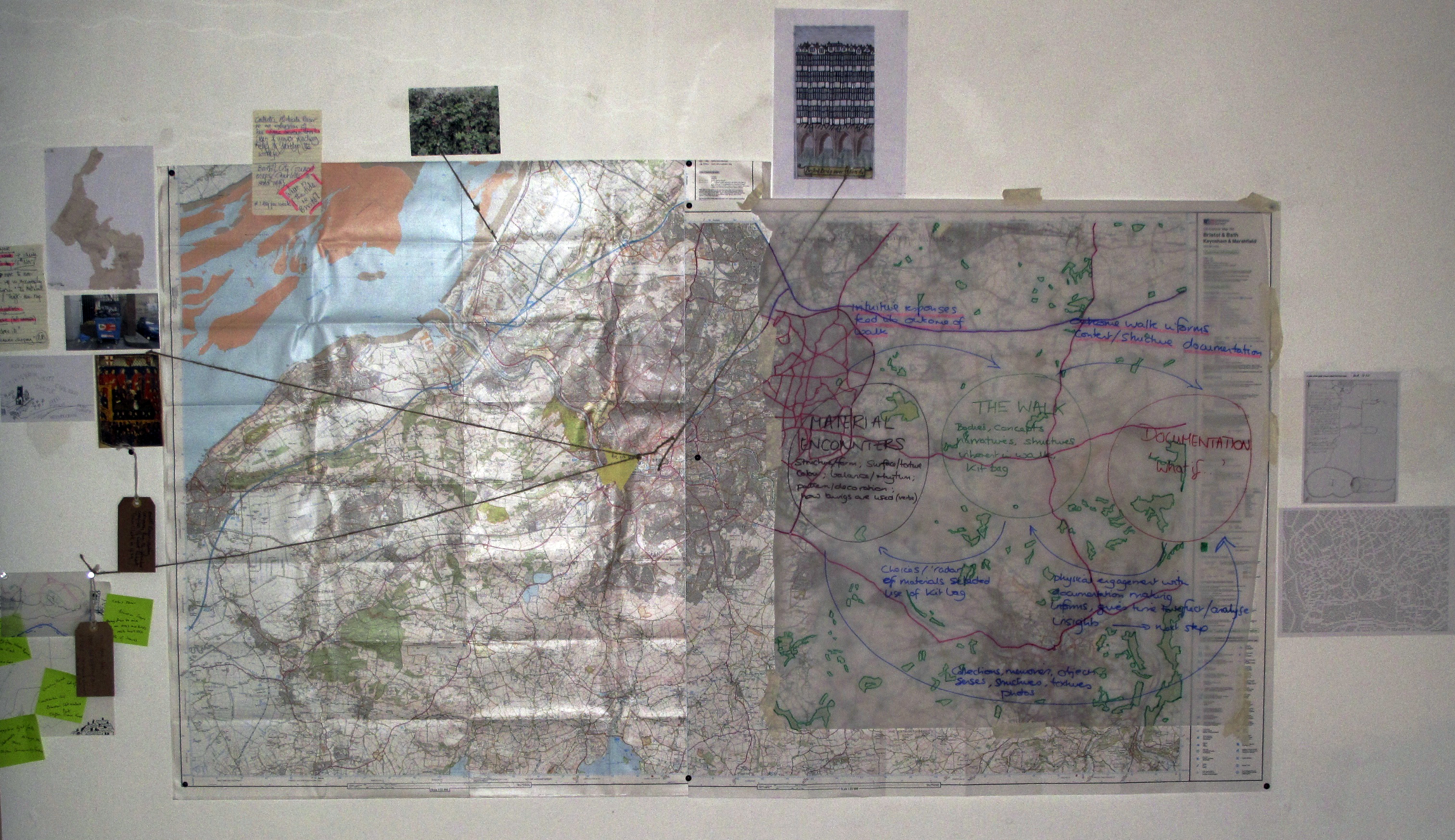
Notes towards a deep mapping of Bristol

IMG_1041

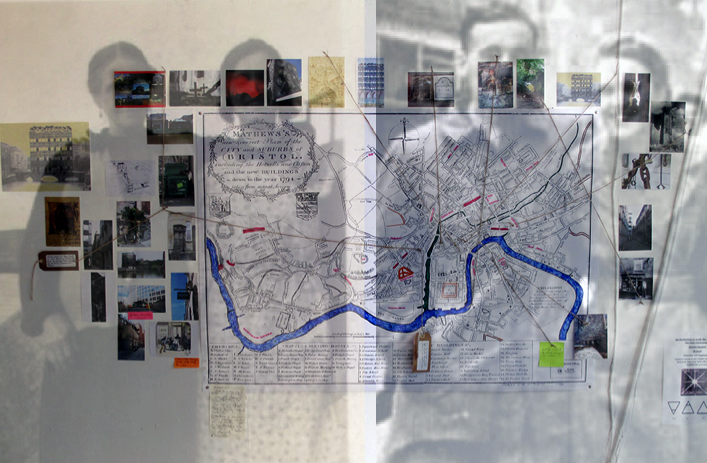
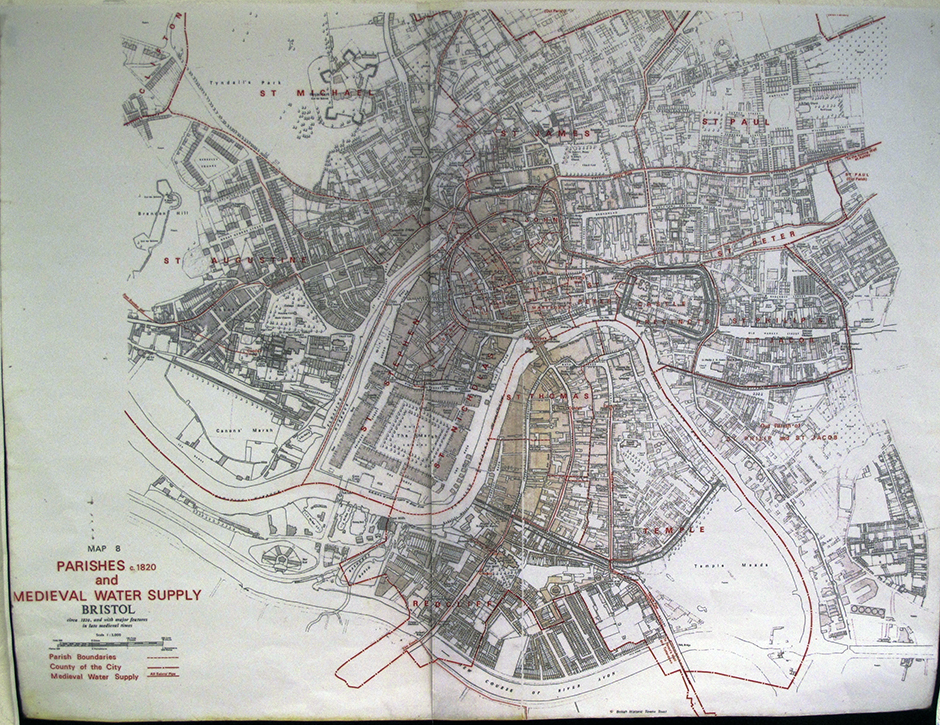
PLaCE has just engaged with the wonderful Parlour Showrooms on the Walking in the City programme – something very much driven by Mel Shearsmith’s engagement and enthusiasm. As part of the four day event Sue Maude (above) and Sarah Rhys (with myself providing some backup and support) spent some time working on preliminary notes for a deep mapping of Bristol, using the old city and issues of waterways as two key focal points. The public response was wonderful and between us we had a great many interesting conversations with the public. (That Bristol City Council has failed to extend the Showrooms’ tenancy of the building on College Green beyond December shows, in the light of reports like Jocelyn Cunningham’s ‘Knitting Together Arts and Social Change” (RSA), just how unbelievably insular, short-sightened and reductive local government officials can become. I do wonder who made that decision, on what kind of ‘informed’ basis, and how those involved in the council’s arts policy where involved, given the massive level of support for the Showrooms work. That we will never get open answers to those questions tells us a great deal about how cities are run).

IMG_0895

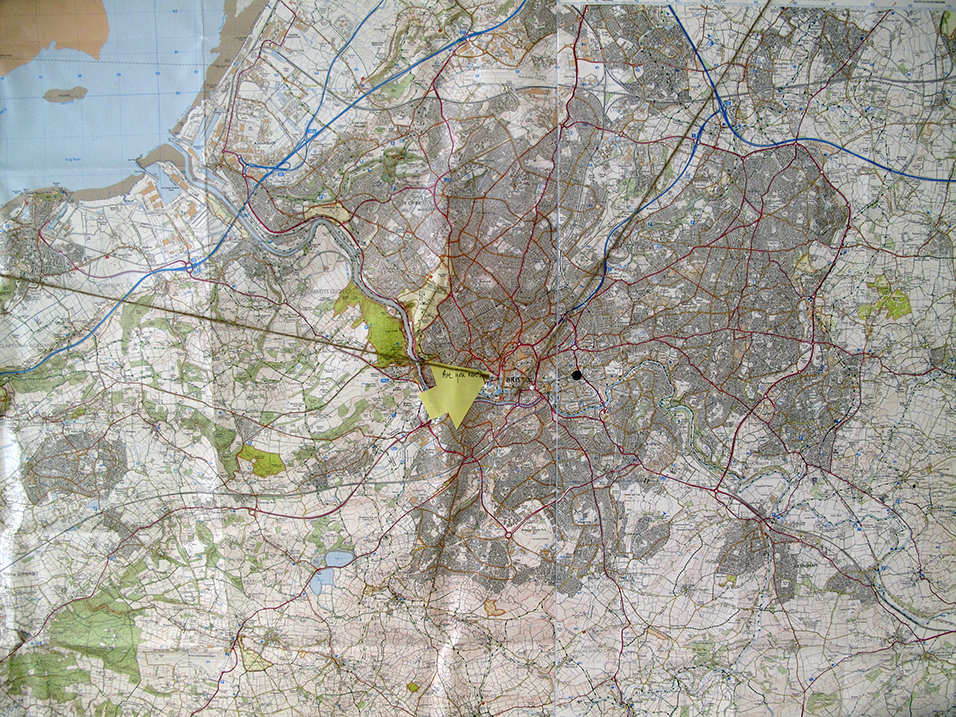
For me our mapping process started with a simple reversal – from the usual ‘You are here’ to the question: ‘Are you here”? we have begun to identify some of the historical and contemporary resonances and tensions that help to “make up” Bristol (see my comments re Bristol City Council above).

IMG_0912

Are you here?

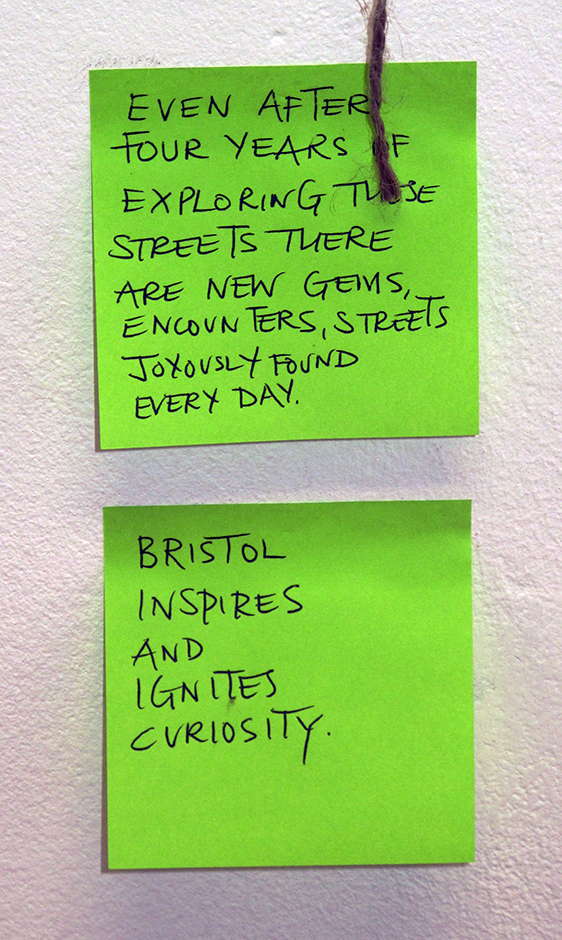
Perhaps the most enjoyable aspect of this work has been the engagement by members of the public – a mix of young and old, of local people, new arrivals, and tourists. Their responses have ranged from that of a New Zealand archaeologist who lectured me on the inequalities by which the arts “get all the funding”, and then “rip off” archaeology, which is condemned for “just” being about”heritage” through to the woman who wrote the following for our mapping:

IMG_1026

More on this as I digest the rich brain and heart food that the last four days have provided, but one of the pleasures has been the way in which working simply and as a team in the context of the Showrooms, which enabled us to appropriate very interesting related material.

IMG_1044