Locating the Gothic – text for the paper ‘Mapping Spectral Traces’

IMG_1564

NB – For a review of the conference at which this paper was presented see Locating the Gothic Conference and Festival: a South African Review (17 Nov 2014) by Miss Esthie Hugo.

I have just attended Locating the Gothic http://locatingthegothic.weebly.com, a very rich and wonderful interweaving of a two day academic conference and a wide range of related Gothic events, all taking place in the city of Limerick. This was organised with great flair, warmth, and efficiency by Maria Beville (Mary Immaculate College, UL) and Tracy Fahey (Limerick School of Art and Design, LIT) and allowed me to hear, meet, and talk with, a fascinating variety of very friendly and well-informed ‘Gothically-minded’ people from all over the world. I particularly enjoyed Tabish Khair’s thoughtful and compassionate paper The Significance of the Scream: Otherness in Post-Colonial and Gothic Fiction, my various conversations with Aurora Pineiro (who teaches at the National University of Mexico), and with others far too numerous to mention. 

As a result it’s now only too clear to me that the field of the Gothic is much broader, more nuanced, and more deeply engaged in present and everyday issues than, in my ignorance, I had assumed. Before I went to Limerick it would never have crossed my mind that I would learn, for example, about the ways in which the trade in human organs – an increasing part of the economics of the new, post-aparteid South Africa – finds a queasy resonance in a knowing punk video for the ‘Gothic’ rap rave crew ‘Die Antwoord’. (This via Esthie Hugo’s informative and rather wonderfully titled paper ‘Hide and Sick: Gothic Pop Culture in the Contemporary South African Moment’).

I was particularly pleased to be able to chair a panel on Psychogeography and Visual Culture, which consisted of three very interesting talks on their own projects by Irish artist/educators Paul Tarpey,  Martina Cleary, and Marilyn Lennon. This also gave me a chance to meet and talk with them about their work. I was at the conference to gave a plenary presentation and I’ve posted the text of this in italic below. It’s pretty much ‘as delivered’ (that’s to say without images, many references, etc.).

Anyone interested in the reasoning that fed into this presentation, or in search of a bibliography that at least in part relates to it, should look at the post Acting Elsewhere and Otherwise.

Mapping Spectral Traces: notes from, and on, a Debatable Land; Or: (Re)Locating the Gothic?

I’d like to begin by thanking Maria and Tracy for inviting me to give this presentation. The Gothic is not my field, so I’m particularly honoured to be speaking here.

Much of my work revolves around ‘deep mapping’, which uses a variety of creative practices to reimagine what might be called ‘the cartographic impulse’ from a perspective not unlike that of Lawrence Sterne’s Tristram Shandy. My concern with the Gothic is via an interest in spectral traces, particularly as these relate to the re-emergence of animism. Deep mapping has to attend to the spectral element in place. In a paper called Spectral traces: photography, futurity and landscape, the Scottish artist Gina Wall draws on Derrida to note that in the particular, often uncanny, places she photographs (I quote) : “there is a strong sense of overlay of time”, so that the living present is “‘secretly unhinged’ from itself, “allowing other temporalities to leak through”. She reminds us that this challenge to exclusive notions of the present relates to Derrida’s concern with our responsibility towards ghosts. She adds that photographs – and by implication other images – can be both “spectral and futural”. They can, she argues, become “revenant” – “begin by coming back”. Hence my interest in the Gothic.

I see the Gothic as the trace of a psychosocial fault-line – the manifestation of a particular historical episode in the plate tectonics of our culture. Such manifestations inevitably slowly fade when the epicentre of psychosocial tension moves elsewhere. So there’s an implicit question behind this presentation: ‘Have the tensions that brought the Gothic into being now shifted elsewhere’? Or, put this question rather differently: “How does the Gothic relate to the Dark Mountain Project http://dark-mountain.net ; to the US military employing Max Brooks – author of the zombie novel  World War Z – to script disaster simulations for military training purposes; or to prints by the Japanese artists Toshio Saeki and Yamamoto Takato? While the Gothic is clearly a major element in contemporary culture, should we understand this as an aftershock? Is the energy that originally animated the Gothic now working elsewhere – perhaps driving the appearance of neo-animism and the lifeworld as polyverse? Or is the Gothic now both spectral and futural?

I’m going to focus on two of the Gothic’s edgelands – one pre-Gothic and one contemporary. The first is vernacular, liminal and part of the material from which the Gothic emerged. I’ve explored it via a deep mapping project called Debatable Lands that drew on micro-histories and ethnographies related to an archaic vernacular, quasi-animistic, Scottish mentality. I came to the second edgeland through contingency and genetic happenstance. I’ll describe these two edgelands later.

What’s useful about the Debateable Lands project in this present context is that it moved back and forth across a fault-line identified by Isabelle Stengers in her 2012 article Reclaiming Animism http://www.e-flux.com/journal/reclaiming-animism/. This, as I understand it,  is the divide between the progressive rationality of a modernity rooted in the secularized monotheism of the Enlightenment and, over against that, all it regarded as other. Not just Christian metaphysics but all those lived realities that make polytheism a “distinct mode of thought and of universal organisation”. Seen from Stengers’ perspective, the Gothic appears to me as a Debatable Land. (Historically the Debatable Land was a disputed territory straddling the English/Scottish Border north east of Carlisle. It included an Elizabethan earthwork – Scot’s Dyke – and for some 300 years it was perhaps the most dangerous place in Britain).

The first of my two edgelands is the quasi-pagan Scottish vernacular mentality that left traces in testimony from witch trails and in the old ‘supernatural’ Border ballads so important to James Hogg and Walter Scott. Drawing on authors like Carlo Ginzburg and Emma Wilby, I understand this mentality as inhabiting a polyverse that carried traces of an earlier, Pan-European animism. What’s significant about this mentality is that it acknowledges a messier, darker, less rationalized lifeworld than either late medieval Christianity or modernity. I’m interested in it because I think it evokes and addresses the same messy ambiguities that we find in the best Gothic art, albeit on somewhat different terms.

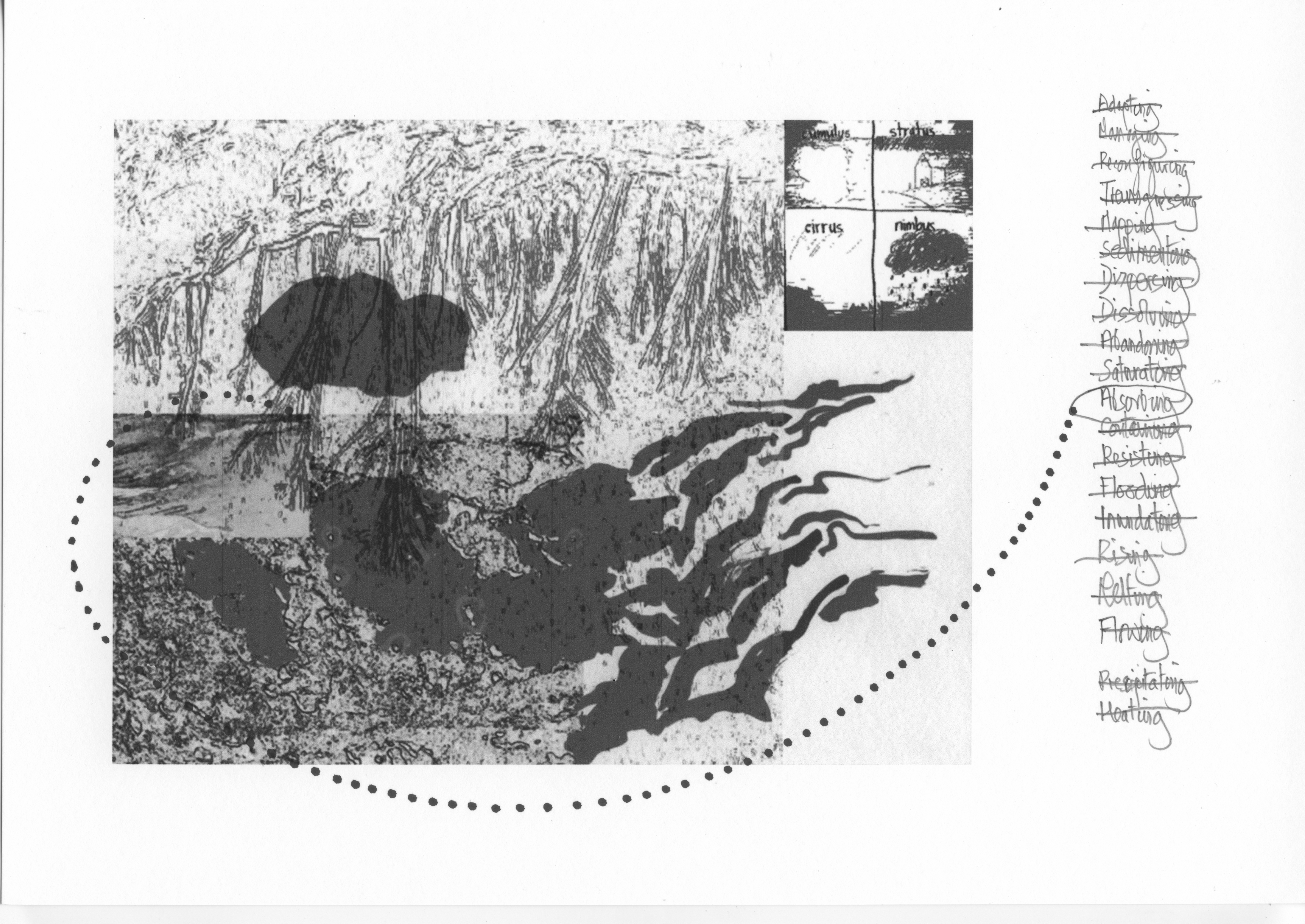
I have explored spectral traces of this mentality – this and the next slide indicate something of the processes involved – so as to stage a haunting.

I want to haunt the contemporary neo-animist theory of Felix Guattari and the anthropologist Tim Ingold. Like a revenant returning to warn loved ones in an old Border ballad, I want to remind neo-animist theory that loss and pain are central to human identity. So this haunting is intended as a prophylactic against what Barbara Ehrenrich calls our ‘Smile or Die’ culture and draws on my experience of a second edgeland. This is a limbo or non-space created by powerful authority figures who terrorize a vulnerable, marginalized group of people – a situation that I’m going to suggest is a literal enactment of Gothic terror. The people in this group suffer from chronic Myalgic Encephalomyelitis – ME for short.

This presentation is in four stages. I’ll begin with some background. I’ll then focus on my second edgeland, its relationship to the Gothic, and its relevance here. Following that I’ll locate and describe my first, neo-pagan, edgeland – in part to explain my linking Stengers’ thoughts on animism to my sense of the Gothic as a fault-line. Finally, I’ll turn to the question of whether a re-mapping of the Gothic would now be beneficial. What I’m going to say – and the images of my own work I’ll show – flow in large part from my Debateable Lands project. This started as an exploration of the supernatural Borders ballad Tam Lin and of specific locations on the English/Scottish Borders I associate with it. Later it expanded into an examination of site-specific memory, liminality and metamorphosis. I’ll show you some material from this project, but won’t say much about individual works since these are not my focus here.

I’ll also show you images by the painter Paula Rego. These I take to be located firmly on one side of Isabelle Stengers’ divide. As a child in Portugal Paula sat under her parents’ kitchen table and absorbed peasant proverbs and folk tales, material with the same ancestry as my Borders edgeland. Refracted through memory and imagination, this material still pervade her work. Unlike Paula I’ve no direct, visceral, access to that ancient vernacular mentality. Instead I came to it by researching Tam Lin and the micro-histories and psycho-geographies that flow through and from it. That in turn took me to studies of Scottish witch trial testimony. But despite differences between Paula Rego’s approach and my own, I see them as complementary, not as opposed.

One issue here is whether it’s possible to learn from the mentality underpinning Tam Lin – its tenacity, dark humour, plain speaking, and canny attention to an uncanny world. And, if so, whether attending to that mentality can help us ground and re-orient contemporary neo-animist theory so as to better understand and live with the uncertainties of our own more-than-human polyverse? Can it help engender the qualities necessary to living with a life-world that is both the object of scientific study and what the phenomenologist and magician David Abram calls (I quote): “a spontaneous, playful, and dangerous mystery in which we participate”.

So my haunting aims to be a reminding of the kind enacted by the three revenant sons in the ballad The Wife Of Usher’s Well. Haunting is the appropriate term here because neo-animist theory moves too quickly over issues of human pain and loss, its forgetfulness a symptom of what Stengers sees as tradition of analytical theorizing that’s contaminated by “a poisoned milieu”. One that, to use her own analogy, assumes it “knows better” than both the witch and the witch hunter, so that its adherents become heir to the particular authority assumed by the witch hunter. The production, consumption, and use of this hyper-analytical discourse remains framed by the now naturalized presuppositions on which that particular authority depends. As such it’s blind to the lifeworld as polyverse.

I see our dilemma as follows. We need neo-animist theory to help deconstruct mono-ideational belief systems – scientism, economic fundamentalism, analytical reductivism, or theological fundamentalisms claiming to be derived from the Religions of the Book. But, as Stengers indicates, such theory is itself ultimately the product of practices and traditions situated on the colonialist’s side of the divide. The side that characterized ‘others’ as animists and is itself characterized by obedience to the moral imperative: ‘thou shalt not regress’. So we remain in thrall to a discursive realpolitik predicated on possessive individualism, on unsustainable notions of techno-economic progress, and on the ancient, pervasive fear of cognitive dissonances inevitable in a lifeworld experienced as polyverse. Historically, Christianity’s ability to displace paganism lay in large part in managing that fear, converting it to an engine of salvation. But as Christianity as an explanatory system started to loose its authority, that fear had to be reframed – an historical process that first initiated the Gothic and may now have run its course, or so Marina Warner suggests.

As I’ve said, I’m interested in the imaginal world of Paula Rego’s work because much of it is located on the ‘wrong’ side of Stengers’ divide. Like any imaginal artist, she is perfectly happy to regress. She understands that ongoing metamorphosis is inseparable from imaginal work. My own approach is embedded in creative in-disciplinary research and is inflected by the assumption that borders, divides, boundaries both separate and join distinct territories. The Debatable Lands project deliberately crosses and re-crosses boundaries as an act of translation or bridging. It moves back and forth, happily schizophrenic – sometimes involving ‘regressive’ imaginal making and sometimes observantly participating in contemporary research and theorizing – all in the hope of translating between – bridging – the two sides of Stengers’ divide.That’s why I see Paula Rego’s approach and my own as complementary – not opposed.

I hope something of the spirit of that bridging activity is evoked by these images.I also hope it’s clear why the project needed a psychosocial framework not aligned to a ‘progressive’, colonizing, scientism – not bent on reducing everything that exists to objective, rational knowledge. That alternative framework is a post-Jungian, ‘polytheistic’ social psychology. An observation by James Hillman from 1992 should indicate the relevance of that approach. 

“We do not die alone. We join ancestors, and all the little people, the multiple souls who inhabit our nightworld of dreams, the complexes we speak with, the invisible guests who pass through our lives, bringing the gifts of urges and terrors, tender sighs, sudden ideas – they are with us all along, those angels, those demons”. (“Recovery” (1992 p. 127).

This statement may appear deeply alien in a culture of hyper-individualism but, like this group portrait of five generations of the More family, is entirely consistent with Gina Wall’s reading of Derrida’s “unhinged” and revenant present.

If I think Marina Warner may be right in suggesting that the conditions that gave rise to the Gothic no longer apply, why am I concerned to reconsider the spaces of the Gothic? The simple answer is that my desire to haunt neo-animist theory is therapeutic –animated by questions about how we best inhabit our life-world as polyverse. And my only real justification for speaking here is that I experience the same therapeutic desire in certain contemporary ‘Gothic’ works. I find it in Toni Morrison’s Beloved, Diane Settlefield’s The Thirteenth Tale,Margo Lanagan’s Singing My Sister Down; in audio-visual work by Catherine Sullivan; in Davina Kirkpatrick’s collaborative, site-specific, mourning performances; in Cecelia Mandrile’s reworking of the ‘Trouble Dolls’ of her South American childhood; and in songs by Lal Waterson, The Handsome Family, Emily Portman, Alasdair Roberts, and other singer/musicians who draw on the supernatural Borders ballads tradition. It seems to me that, along with specifically Gothic elements, these works vividly acknowledge that our lifeworld is multi-stranded and conflicted; that it always both exceeds and falls short of any categorical mapping predicated on a mono-ideational explanatory system. And that it’s not enough to smile, or to see everything we can’t smile about as an opportunity to build up the resilience of our personal egos. Given the terrible eco-social and intra-psychic damage inflicted by mono-ideational systems, I hope my suggestion that we now need to think of our lifeworlds as polyverses won’t appear too outlandish.

Before I describe my second edgeland I need to ask how you understand Angela Carter’s claim that: “we live in Gothic times”.

I ask this because my second edgeland is, at least to my mind, the product of a literal enactment of the Gothic. It’s a zone marked by the terror imposed by people in authority onto others already rendered helpless by chronic illness. This is the Gothic zone inhabited by people suffering with ME, and by their families and carers. A zone created by the medical and psychiatric Establishments that neglects and abuses them and that is contested by the same therapeutic impulse that I find in aspects of the Gothic.

I think the award-winning film Voices from the Shadows http://voicesfromtheshadowsfilm.co.uk is animated by that same impulse. By the need to give a face to – and so to face – a situation that is almost unbelievably painful or terrifying. In the case of ME this is abuse – by authority figures whose actions exhibit the exact antithesis of the qualities they publically claim to embody – of chronically sick individuals without power. In extreme cases these authority figures threaten patients with forcible hospitalization or with being sectioned and placed in psychiatric units. They threaten this because patients, or their carers, refuse treatments that they know will exacerbate an already chronic illness. And of course individuals have died or taken their own lives when these threats are carried out.

The Gothic nature of the terror here lies in part in a grotesque but deeply institutionalized assumption. Namely that nothing ME sufferers say about their illness can be trusted. Their experience, self-understanding, their entire identity, is regularly dismissed out of hand by those professionally empowered to determine their treatment. Any articulation of their own reality that is at odds with the official view of their illness is, all too often, taken as evidence of a pathological desire to deceive, a willful attempt to ‘stay sick’.

So I want to argue that ME sufferers live not only in Gothic times but also in a Gothic zone. They are trapped in this liminal zone and, as a consequence, constantly threated with ‘zombification’ in the sense of being condemned to a kind of  living death. Threatened not simply by the chronic nature of the illness itself – as if that were not bad enough – but also by doctors, social services employees, psychologists, the realpolitik of academic research, and the fiscal policies of politicians. ME sufferers are subject to what is paraphrasing Robert Miles on the Gothic – a process of violent deracination. They’re dispossessed in their identities, bodies and homes. Many are suspended, perhaps permanently, in a deeply frightening condition of violent personal and social rupture and dislocation – one that’s always, horribly, threatening to get worse.

My contention then is that ME sufferers – and of course innumerable others who suffer similar socially sanctioned abuse and neglect – literally live out, on a daily basis,the horror epitomized by a strand within the Gothic. This strand embodies an element of institutionalised sadism within our social system. Sadism animated by fear of cognitive dissonances that cannot be resolved or controlled by the professional authority of those who enact it. And behind this fear is the refusal to acknowledge a failure to progress, a failure to master disease. Ultimately this is a deeper fear – of regression, of the lifeworld as polyverse and, by implication, that Stengers’ divide is wrongly located, that the line between ‘progress’ and ‘regression’ has been wrongly drawn. So there’s a question here. Does all this need to be remapped, both in the context of polytheism as a distinct mode of thought and universal organisation, and of the presence of spectral and futural in the present as evoked by Derrida.

I want to suggest that paying closer attention to the two edgelands I’ve referred to might assist us to re-negotiate or translate across Stengers’ divide. It might strengthen our impulse to use image, the performative and text – both professionally and in day-to-day life – to move more freely back and forth across that divide. Why? So as to give a face to – to help us face – aspects of human suffering denied articulation and authenticity by our mono-ideational, single-minded concept of social evolution – of absurdities like ‘sustainable development’ – and the all-too-often sadistic psychosocial impulses these produces.

Notwithstanding claims from the progressive side of that divide, our world is still saturated with acute and terrible suffering – suffering that’s often denied articulation, subject to social repression, forgetting, marginalization or denial. Perhaps this suffering – and the cognitive dissonances that it produces – can only be faced, only find a face, in the ambiguous, messy space between fact and fiction, image and data, regression and progression. The liminal fictive worlds that emerge from that space often appear ‘unnatural’. In the case of Toni Morrison’s Beloved this ‘unnaturalness’ includes horrific violence, infanticide, bestiality, and haunting by a being part poltergeist, part revenant, part succubus; yet also and always still, somehow, Beloved. The practical issue here is, then, how to articulate all this through forms of telling or showing that gives horror a knowable form without explaining it away – and as such both allows and requires us to face that horror.

It’s just this need to ‘face’ horror that Nigel Clark calls for in his book Inhuman Nature: Sociable Life on a Dynamic Planet. Suggestively, in the context of my first edgeland, Clarke proposes that: “what goes by the name of ‘traditional ecological knowledge’ may be as much about coping with loss and suffering as it is about transmitting practical advice”. Acknowledging the reality of that horror is central both to our ability to cope and to the space I’m trying to evoke here – a space that borders both the Gothic and the polyverse of Felix Guattari’s Three Ecologies – a space that is, psychosocially speaking, the other to our ‘smile or die’ culture.  

In Fantastic Metamorphoses, Other Worlds (2001)  Marina Warner identified a major shift in contemporary fiction, claiming that: “the Christian supernatural, with its terror of pagan concepts of metamorphosis, no longer obtains”. Instead, she suggests, we are offered: “… the growing fallout from such concepts as the subliminal self, with its connections to spirit voyaging, to revenants, and teleporting souls, to animism and metempsychosis, to a vision of personal survival through dispersed memory, in life and in death, rather than Freud’s unconscious, and its hopes for potential individual integration”. I see this shift as anticipated by the understanding evident in my early quotation from James Hillman. From my perspective what she is identifying is a shift away from the historical tension between the monotheistic presuppositions of the Christian supernatural and all that’s Other to it – the tension that located the Gothic as a Debatable Land. And it seems to me that this shift might require those engaged with the Gothic to reformulate its territory.

I happen to think that Warner’s observation is belated. The new relationships between terror and identity central to our emerging psychosocial situation were already apparent in the 1970s, in Hillman’s work and in novels like Ursula Le Guin’s 1974 double award-winning The Dispossessed. I’ll now suggest a historical context for Warner’s argument, one that relates to my first edgeland.

Pieter Bruegal the Elder’s painting Netherlandish Proverbs is an early example of visual art as proto-ethnography. Itdocuments some one hundred idioms and aphorisms of Flemish peasant life and is sometimes seen as a critical comment on human stupidity and foolishness. If that’s the case, it’s a contribution to the sixteenth century’s systematic creation of intellectual distance between itself and the old vernacular culture that informed my first edgeland – the same process by which Scottish Calvinism violently differentiated itself from an older, quasi-pagan, vernacular culture.

But Bruegal’s late works – including The Corn Harvest of 1565– suggest that he was more ambivalent than such a reading suggests. So it may not be entirely fortuitous that, 435 years after this work was painted, the anthropologist Tim Ingold used it to help him articulate the neo-animist concept of taskscape, a stepping-stone to a mycelial thinking that parallels that of Deleuze and Guattari. Ingold’s neo-animism is implicit in his understanding that physical locations are a complex meshscape: “a polyrhythmic composition of processes whose pulse varies from the erratic flutter of leaves to the measured drift and clash of tectonic plates”; with the result that we are co-constituted by “a tangle of interlaced trails, continually ravelling here and unravelling there”.

His casual use of the word unravelling is, for me, indicative of the forgetfulness of neo-animist theory. Forgetfulness of the human price paid for inhabiting a polyverse – all those messy paradoxes, cognitive dissonances, and painful ‘unravellings’ that inevitably flow from the politics of our eco-social situation – not to mention our mortality. In short, it forgets the lived, existential reality of that word ‘unravelling’ – the reality acknowledged by a character in Ursula Le Guin’s The Dispossessed when he insists that human solidarity “begins in shared pain”. But I’m running ahead of myself.

In 1662 Isobel Gowdie – who lived in the Scottish hamlet of Lochloy some twenty miles east of Inverness – was accused of witchcraft, arrested, and rigorously interrogated. Her extraordinarily detailed testimony provides the basis for Emma Wilby’s book The Visions of Isobel Gowdie: Magic, Witchcraft and Dark Shamanism in Seventeenth Century Scotland. Of all attempts to understand such testimony, this book gives perhaps the most comprehensive sense of the lifeworld of the accused as a polyverse, the same vernacular polyverse that left its trace in the supernatural Border ballads. It seems almost certain that Isobel experienced her lifeworld as perpetually dogged by cognitive dissonances, by inexplicable levels of human violence, by the chronic uncertainties of the natural world and, perhaps most difficult for her to comprehend, by the all-pervasive social fallout of recent and radical metaphysical regime change.

By the 1660s the Scottish land-owning classes had largely internalised a strictly dualistic Calvinism. By and large Isobel and her peasant neighbours had not. Their lifeworld continued to be shaped by a multitude of forces, all interwoven and some antagonistic. This polyverse was tensioned between individual lives and the natural rhythms of the land, the authority of both human and divine law, the power of human desire categorized as demonic temptation; the inexplicable patterning of fate governed by the planets and stars; and the various powers inherent in their local, vernacular, emotional geography. These included wise women and their familiars, revenants, wizards, collective dreaming, sites associated with popular Catholic belief, and of course ‘the good neighbours’ – the elves or fairies ruled over by The Dame of the Fine Green Kirtle or Queen of Elphame. In consequence Isobel’s lifeworld as polyverse was radically at odds with the strictly monotheistic universe of Calvin.

So I want to suggest that, in certain respects, her lifeworld was actually closer to the dense webs of complex interdependences that determine our current ecological, economic, and psycho-cultural conditions than to Calvinism – if only in its structural complexity and the radical uncertainty regarding the exact relationship between particular causes and effects.

Hypothetically of course the Calvinist God sat spider-like right in the centre of Isobel’s polyverse, governing all its aspects. But in practice she and most of her neighbours lived uneasily, and often fearfully, at the convergence of a constellation of fluctuating cultural, natural, and supernatural forces ambiguously related to that God – if related at all. Unsurprisingly then, it took the full dogmatic violence of the Puritan revolution in Scotland to suppress that polyverse and the old ballads that tacitly perpetuated its values. It declared them both illegal and damnable. Yet despite that violent reframing, the supernatural ballads and their offspring – Gothic or otherwise – still haunt us. And I think we need them to do so if we are to find forms of understanding, and of creative praxis, to help us face our emergent polyverse and so our uncertain future.

Isobel’s way of inhabiting her profoundly uncertain polyverse offered her the support of powerful psychosocial beliefs and rituals, strange as these now seem to us. These helped her face and cope with a world that constantly and terrifyingly threatened to unravel before her eyes. My hope is that aspects of the Gothic at its best can still do something similar for neo-animist theorizing, helping it become a thick description of our polyverse by enabling our traveling back and forth across Isabelle Stengers’ divide.

This is why I think we need to revisit the parallels between Isabel Gowdie’s polyverse and our own. Between, for example, the suppression of her vernacular culture and the sadistic terror imposed on powerless contemporary social groups by those who act in the name of a supposedly benign science or of civil society. But we also need to explore less obvious matters. Why, for example, do the animal transformations in Tam Lin still evoke a certain psychic latency that resists the single-minded conceptions of the status quo? Does this relate to the wonder that Jane Bennett identifies with a child’s sense of itself as emerging out of an over-rich field of protean forces and materials, only some of which are tapped by its current, human, form? A sensing she links to Deleuze and Guattari’s interest in the childhood game of becoming-animal, becoming-otherwise. And what human need is served when children, animists, and the imaginally engaged access a polyverse constantly in play? But again I’m digressing.

My concern here is not with Bennett’s celebration of neo-pagan enchantment – however important that may be. It’s with our culture’s growing inability to face, and give value to, unravellings – those painful elements in human life that our ‘Smile or Die’ culture actively distorts or denies. Painful elements that, I want to suggest, may require a re-mapping of the Gothic, one that can support coping strategies that enable us to face, rather than belittle, deny, privatize or otherwise exploit the human pain and suffering that grounds our commonality. This would be in line with James Hillman and David Abram’s insistence that we must address the ‘anesthetized numbness’ basic to our culture – which of course is where Bennett’s neo-pagan enchantment comes in. Perhaps only then can we realistically face powers that exceed all our attempts to control them – along with the grief and suffering they inevitably bring us.

Any such remapping of the Gothic would relate to David Abram’s claim that a new environmental ethics will appear: “not primarily through the logical elucidation of new philosophical principles and legislative strictures, but through a renewed attentiveness”. Attentiveness, that is, to the “perceptual dimension that underlies all our logics, through a rejuvenation of our carnal, sensorial empathy with the living land that sustains us”. I think the Gothic is central here because that carnal, sensorial empathy tends to be experienced in a temporal present that, as Gina Wall reminds us, needs to include traces of spectral “unravelings” – both of the consequences of the wild destructiveness of earthquakes, volcanoes, storm surges, floods, and tsunamis, and of the chronic abuses that cause man-made terror and disaster.

In drawing this presentation to an end I’ll take my cue from Marina Warner and suggest – despite being a trespasser here – that the re-emergence of the lifeworld as polyverse may have implications for how you articulate or map what’s vital in the Gothic, given that its mass-market version is now a ubiquitous aspect of the global culture industry.

So I want to ask whether the psychosocial value of the Gothic has been diluted, even perverted, in the service of mass entertainment? While films like George Romero’s 1978 Dawn of the Dead could once be seen as a biting criticism of consumer culture, is the figure of the zombie now co-opted to feed the pathology of murderous personal entitlement that Elias Canetti so succinctly identified in his discussion of the ‘survivor’ in Crowds and Power?

I would argue that Paula Rego’s response to the failure of the abortion referendum in Portugal enacted in these images evokes an empathy once central to aspects of the Gothic. They refer us to current enactments of a literally Gothic horror in our own backyard. So I want to suggest it’s not enough to note, as Marina Warner has done, that the figure of the zombie thrives today because: “work turns people into zombies; other people turn people into zombies; life does it (so do committees)”.

I’ve tried to suggest ways in which the Gothic may continue to be relevant to our need to find, and continually renew, ways to facing, of coping with, suffering, horror, cruelty, loss, grief and death. Facing these means just that – finding ways to give them a face familiar enough to identify them for what they are without trivializing the fact that they remain on the border of the unspeakable. Of course this doesn’t mean simply accepting the horror that Beloved or Voices from the Shadows show us. What it does mean is that we will need to acknowledge an ethical baseline grounded in “shared pain” if we are to engage fully with our emergent polyverse. Shared pain leads to shared coping strategies – to the sense of common concern denied by Canetti’s survivor on the basis of a pathological, indeed ultimately murderous, sense of personal entitlement.

Speaking personally,I have to accept that I can do relatively little to facilitate a cure for my daughter’s ME, or even to seriously mitigate the difficulties she will inevitably face when my wife and I – her carers – die. While I was putting together this presentation we were getting reports of a young German woman with ME slowly dying as a result of being sectioned. This situation is the direct result of the arrogance and ignorance of the medical establishment and judiciary and of her father’s vindictiveness towards her mother. So I value any image or narrative that helps me cope with the suffering caused by my relative helplessness, my sense of disempowerment, loss and grief. Again, how we determine the balance between coping and the outrage that led our family to make Voices from the Shadows is obviously critical, but not something I can address here.

As experts on the Gothic you’re best placed to say whether it needs re-mapping. I can only suggest why that might be useful. What is clear to me is that neo-animist theory can’t generate the ecosophy Guattari rightly calls for while it forgets that re-thinking our situation is not enough. We also need a heartfelt reframing of human expectations. That reframing must enable us to see that human sufferingis not a ‘problem’ to be ‘solved’. It’s integral to the human sociability that Canetti’s pathological ‘survivor’ refuses to acknowledge. We can cope with suffering through endurance, tenderness, common courage, and kindness, but we can’t abolish it. It’s this hard fact that opens us to what Emanuel Levinas calls ‘being as vulnerability’, and it’s in this context that I ask if the Gothic needs re-mapping.

The ‘survivor mentality’ increasingly pervades our society. Those adopting it act in the belief that their lifestyle is an exclusive right – despite the misery, or indeed the extinction, of vast numbers of human and non-human beings this causes. Even given the heading that goes with this image, it may well seem unreasonable to identify the mass adoption of this mentality as the most disturbing current manifestation of Gothic horror. But consider some recent research undertaken at a prestigious US University. Using MRI scans of students’ brain activity, this shows that many students, particularly the wealthiest, react to photographs of the homeless and drug addicts as if they have stumbled on a pile of trash. In the UK we are now familiar with this mentality from the present Government’s policies on the long-term sick and very poor.

Are these groups the kind of ‘human trash’ that elements within the popular culture industry now visualize as a ‘zombie plague’ to be eliminated? I’m not qualified to answer that question. But I’ll end by suggesting that it’s just such questions that any re-mapping of the Gothic would need to address.

I’d  like to acknowledge the coaching on the Gothic I received from my daughter Anna, whose breadth of reading and liveliness of mind were a great asset in helping me put this presentation together.   
 

Coping strategies and the art of social translation.

IMG_0363

(photo – Gwenda van der Vaart)

The text below is from a presentation given as part of a recent workshop organised by researchers in the Faculty of Spatial Sciences at the the University of Groningen. This was called “Resilience: Just do it?!”. (See previous posts for details).

The practical examples are by individuals who, for the most part, have web sites that show the work referred to here. I would strongly advise readers who are interested to find these web sites and study that work. Many of them can be found on my ‘friends’ page.

Yesterday I was reminded that it may take a couple of years for academics from different disciplines to understand each other’s language. And here I am, trying to explain work out on the edge of current art practice that many people in my own discipline don’t really grasp to people in a radically different discipline. As George Steiner says of trying to translate one language into another, this is perhaps impossible. But as he also goes on to say, it must be attempted. Otherwise we are left in “arrogant parishes bordered by silence”.

Luci Gorell Barnes’ The Atlas of Human Kindness is a growing collection of maps made by individuals and groups in Bristol, including refugee groups and children with learning difficulties. It shows where and when they experienced kindness from people concerned about their rights, feelings, and welfare. It invites debate about how stories, memories and imaginings make and re-make place, and how fragmented personal landscapes can become less fragmented. It invites people to think about values and connections, and about what networks and community means. Like Luci I often use mapping to translate between lifeworlds – between those of artists and scientists, academic researchers and rural communities, and so between theory and the mess and unpredictability of everyday life. But this work has an ambiguous relationship to resilience.

Terms like ‘resilience’, ‘social capital’, ‘community identity’, ‘place attachment’, ‘community cohesion’ and ‘community participation’ are all-to-often concepts imposed “from outside” onto supposedly vulnerable communities, usually without much reference to their ideas or lived experience. We don’t discuss former Bullingdon Club members – who include the British Prime Minister, the Mayor of London, and Chancellor of the Exchequer – in these terms. Yet they represent the most resilient section of society. They’re experts in using networks, social participation, and a sense of belonging to enhance their resilience to the social consequences of increasing environmental disaster. They have what Elias Canetti calls a ‘survivor mentality’. Everything they do is ultimately aimed at protecting their lifestyle, which they assume to be their exclusive right. This mentality is increasingly pervasive, in no small part because of the media and advertising. Recently researchers at a prestigious US University, using MRI scans of students’ brain activity, have shown that many students, particularly the wealthiest, react to photographs of the homeless and drug addicts as if (I quote): “they had stumbled on a pile of trash”. I don’t know about the Netherlands, but in Britain this same mentality now drives official Government attitudes towards the long-term sick and very poor.

Traditionally religion has been central to what is now termed resilience – both the resilience of elites and of radical spiritual traditions concerned with social justice and compassion. At a time when religious dogma is increasingly co-opted by fundamentalism, creative ritual as a form of grassroots spiritual resilience is also growing. Largely invisible to the art world and academia, this offers a small but significant counterpoint to the dominant ideology of possessive individualism. This type of creative ritual is often focused by a need – particularly in rural contexts – to address the erosion of traditional social activities that helped sustain the resilience of rural communities but also bound them to psychosocial frameworks that, today, leave them increasingly marginalized and vulnerable.

Human beings have the ability to take risks with who they are. They can choose to risk entering unknown situations that might change them. In a very small way that’s what these people are doing by exchanging stories of joy and pain in their city with total strangers.I’m only here today because, at a certain point, I chose to risk changing a core characteristic of my identity – the idea of ‘being an artist’. The ability of the human psychic ecology to risk change differentiates it from natural systems. In ecological science, ‘resilience’ refers to an eco-system’s ability to fend off or manage threats that would undermine its core characteristics. We, however, can chose to change them. So rather than use the conservative term ‘resilience’, I prefer the active notion of ‘coping strategies’ – a phrase used by the landscape architects Maggie Roe and Ken Taylor.

What is the relationship between disaster and resilience?Between 1997 and 2013one thousand four hundred children were sexually abused in one English city alone. Today in Britain as a whole the most socially deprived areas are sixteen times poorer than the most affluent. These ongoing man-made disasters are made possible by the continuing resilience of a culture of possessive individualism. This does far more damage in the United Kingdom than flooding. But as Nigel Clark reminds us, other forms of resilience have always been an aspect of ‘traditional ecological knowledge’, which is as much about (I quote):‘coping with loss and suffering as it is about transmitting practical advice”. Perhaps, before we try to help others develop appropriate coping strategies – intra-psychically, socially, and environmentally – we should start by reflecting on our own?

After the recent flooding on the Somerset Levels, communities were promised a twenty-year plan based on the traditional strategy of dredging. This plan goes against the advice of flood experts and ignores a 40% Government cut in funding to the agency responsible. But in my view it’s actually the resilience of both local people and flood specialists that’s the biggest hindrance to developing an effective alternative policy.

A deeply resilient cultural ‘framing’ locks us into the mindset of possessive individualism. We are taught that we should each have a separate, exclusive identity and that expressing this is the most important thing we can do. This exclusive notion of identity needs exclusive, mono-ideational explanatory systems to support it. We may choose a professional discipline, or eco-scientism, a regional tradition, the economic bottom line, or even fundamentalist religion. But in actuality our lifeworlds – like the causes of flooding – are complicated and multi-layered, a shifting, unstable weave of causes and effects; a poly-verse rather than a mono-verse. Mono-ideational explanatory systems are comforting because they support the idea of exclusive identities and reduce cognitive dissonance. They also blind us to the complexity, paradoxes and contradictions of life in a polyverse. A polyverse is the world envisaged by Felix Guattari’s ‘ecosophy’, a world where the “thinking together” of self, society and environment – taken as both discrete and linked dynamic fields – allows us to open to change and risk in relation to a future we can never accurately predict.

Eco-scientism treats Guattari’s three ecologies as identical rather than both related and distinct. Practices like ‘deep mapping’, on the other hand, try to evoke the ways in which those three ecologies are interwoven. Evans and Reid analyze the social consequences of the reductivism of eco-scientism in their Resilient Life: The Art of Living Dangerously. But in a sense they miss the point. As I’ve said, our most fundamental problem is one of psychosocial framing. We have internalized what Barbara Ehrenrich calls the ‘smile or die’ culture of ‘positive thinking’ that helps sustain possessive individualism. Increasingly, our institutions require us to be positive and proactive at all times. So valid criticism becomes ‘personal negativity’, oftenpreventing us from attending to the ideas and experience of others who, through no fault of their own, are caught in negative and disabling circumstances.

So what should we do? We certainly need to understand the realpolitik behind mono-ideational explanatory systems – including exclusive, disciplinary thinking. But more fundamentally we need to ask on what authority we speak about others’ resilience– particularly, in my case, in rural taskscapes. Researchon Swiss farmers supports my own view that authority in such taskscapes flows from, and is largely validated by, degrees of embodied, collectively valued skill. This differentiates it from the authority of professional discourses. Unless we understand this difference we add to the kinds of distrust that Nick van der Voort and Frank Vanclay identify in relation to mitigation measures around gas extraction in Groningen.

The projects I’m going to introduce are based on experiencing the world as polyverse. They work with both professional and lay understandings, different types of authority, skills, perspectives, and affective narratives. Their approach is similar to Sarah Whatmore and Catharina Landstrum’s work around ‘knowledge controversies’, ‘competency groups’, and ‘pre-figured categories’. This includes ‘slowing down’ expert reasoning and so creating opportunities to generate new knowledge opportunities and gather new publics. This helps build mutual understanding and greater trust by translating across very different, sometimesantagonistic, lifeworlds.

People in rural taskscapes develop coping strategies out ofembodied, place-specific, collective practices learned ‘on the job’ – on a smallholding, a hill farm, in a kitchen, on a fishing boat, at a quarry, a guest house, a small-scale industrial unit, a village shop, a timber yard, and so on – places where discursive, disciplinary authority usually appears largely irrelevant.But rapid socio-environmental change means that there’s an increasing need for trust and exchange between those who inhabit rural taskscapes and those with professional knowledge. This needs both groups to start to re-fashion the framing narratives that underpin their identity and sense of authority. Otherwise, as socio-environmental and governance disputes increase, they will simply continue to retreat into what Paul Ricoeur calls: “incommunicability through protective withdrawal”.

Creative translators, people who can work across the similarities and differences between lifeworlds, can facilitate this process. They may be trained as ‘artists’, but the ability to translate across lifeworlds relates primarily to their conscious awareness of lifeworlds as polyverses rather than to the business of ‘making art’.

Ffion Jones’ doctoral project included performing in a sheep byre on her parents’ farm in a remote Mid Wales valley. Her project aims (I quote): “to use ‘insider’ knowledge (lay discourse) as a way of exploring and extrapolating experiences of place within a rural farming family that confirms, contradicts and combines with academic discourses about our farming lives. As a researcher/farmer, I bridge two lifeworlds; my work seeks to look at a farming family’s attachment and experiences of place from the inside-out”. Ffion’s work bridges lifeworlds usually assumed to be distinct ‘worlds-unto-themselves’. She acknowledges and works both with what’s valuable in her given regional lifeworld but also with external ideas and possibilities, creating conditions that facilitate the possibility of new strategies for coping emerging from inside the community into which she was born.

Ffion’s work flows from the skills and understanding of a performer, daughter of farming parents, scholar, musician, tenant farmer, mother of a young child, and so on. Through staging their interplay she opens up new ways to relate to place as a ‘simultaneity of stories-so-far’ in Doreen Massey’s sense. Her work doesn’t reinforce a given identity or set of skills, a given understanding of community, or a fixed notion of self. Instead it invites us to take up the unending task of negotiating and re-negotiating between positions that are usually assumed to be fixed or given. This, in turn, lays the groundwork for developing new collective coping strategies.

Pauline O’Connell’s work questions normative assumptions about identity and land ownership in rural Ireland. Since 2012 she’s completed two projects based on a historical Tug O’ War competition. These are part of a larger project using vernacular history and trace memories to publically explore the changing conditions of community and social identity through the medium of a community-owned field. The geo-social position of this field enables her to engage local people in debates where community isn’t simply assumed to be something given, a norm and the guarantor of an established ‘position’. Instead it can appear as an ongoing experiment by individuals coming together – however temporarily – to cope with the shifting psychosocial and environmental dynamic of a place.

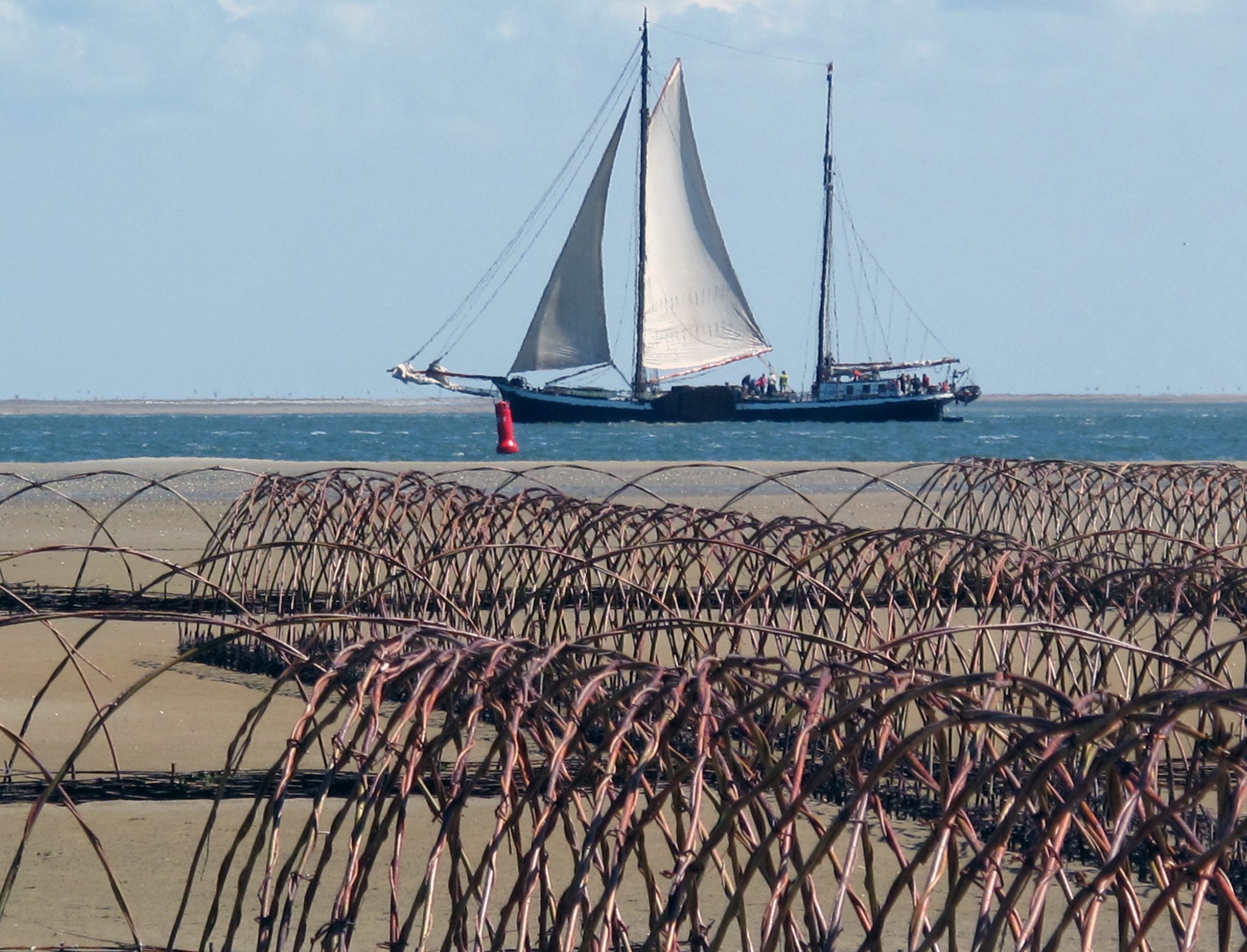
Simon Read,who lives with his partner on a barge on the River Deben, works as an artist, teacher, environmental designer, community mediator, and ecological activist. He’s been involved with local people and official bodies on saltmarsh restoration projects since 1997. His large map drawings relate to, and frequently inform, management strategies for fluid environments by delineating specific locations in terms of projections of their probable future condition. He retrieves, cross-references, and synthesizes large amounts of data from different official sources so as to equip himself to facilitate debate around environmental planning and management. Simon’s concern about the erosion of the Falkenham Saltmarsh led to him design and build barriers to manage tidal flow and encourage the controlled deposition of silt. This provides a material context in which environmental and other officials, the local community, and inmates at the local prison all play a part. Simon’s intervention responds to environmental change by creating a working local context that acknowledges and addresses the practical and cultural implications of changes in our understandings of land, ownership, responsibility and belonging. It does this in a rapidly eroding physical environment that tends to polarize farmers and those responsible for implementing environmental governance. To address this polarization he is currently exploring how farmers could be encouraged to support carbon-absorbing salt marsh – also a vital protection against coastal erosion – through a carbon credit system that compensates them and benefits the environment.

Cathy Fitzgeraldtrained as a biologist and now works as a forester, artist filmmaker, blogger, green political activist, and writer. She lives in a small wood in County Wicklow, Ireland, which is also the focus for all her activities. Cathy is facilitating the transformation of a Sitka spruce plantation into a sustainably managed mixed species wood. She works in the space between official policy – which neglects, for example, the roll of trees in flood management – and grass roots interest in broadleaf native trees. This interweaves the normally distinct lifeworlds of silvicultural specialists, local communities, timber users, artists, and environmental enthusiasts. Her aim is to realign eco-cultural, scientific, economic and green policy concerns locality, across Ireland, and even internationally. Her work is simultaneously ecological, creative, political, and educational, with her own public self-education as a forester providing the context for dialogue between innovative forestry practice, new conceptions of the nature/culture relationship, and a rethinking of community and environment.

Antony Lyons trained as an environmental and geo-scientist, sculptor, and landscape designer and engages with tidal, estuary, catchment, and other water environments.The Lovely Weather project in Donegal used a multi-constituency approach to challenge normal conceptions of inter-disciplinarity by involved scientific specialists, a local postman, and teachers, parents and pupils from the locality on an equal footing. This created non-hierarchical interactions between scientific weather measurements (rainfall, humidity, temperature, pressure, wind speed, wind direction), the local weather lore held by the village postman, and personal weather-related material from Antony and members of a small volunteer observation team. Local peat bogs and their role as carbon sinks were central here, raising questions about the complexity of climate and its changes in a local context. These questions now feed into debates about the Irish Government’s interpretation of European environmental legislation.

Deirdre O’Mahony was born in the rural west of Ireland, left to develop a career, and later returned to work there. She often works by recognizing and using the transformative potential of anomalies in conventional situations and narratives. The situations she then generates loosen up habitual narratives and positions, helping to change protective withdrawal into outgoing social action. The X-PO project is typical of this process. The anomaly here was the life of a man called Mattie Ryan – that’s his portrait on the right. I don’t have time to go into detail here but it’s all on the web site. The project inspired a local research group who then challenged an authoritative anthropological account of rural life in the West of Ireland in the 1930s, written by two Harvard scholars. This challenge highlights the unequal power relations embedded in traditional academic fieldwork, and so raises questions about the inequality of other, more immediate, power relations. X-PO also provides the basis for SPUD, a many-stranded, ongoing international collaboration brings together the traditional Irish agricultural knowledge of local farmers,and individuals and cultural institutions internationally. Its purpose is to value local knowledge, facilitate ability to cope with threats to food security, and raise levels of self-sufficiency.

In different ways and in different contexts, each of these projects works to facilitate new coping strategies by making space for the empathetic imagination necessary to shared ethical action – including political action. They do so by translating across lifeworlds normally assumed to be insular ’worlds-unto-themselves’, by listening out for then anomalies that might allow people to re-narrate those insular worlds in other, more open and empathetic ways. They invite exchange between global knowledge and local understanding, between professional practice and lay skills, between all the multiple elements of lifeworlds as polyverses. If they facilitate resilience, it is a shared social resilience that collectively chooses to face, rather than resist, radical change.

Evoking a polyverse: the problem of academic writing.

IMG_1492

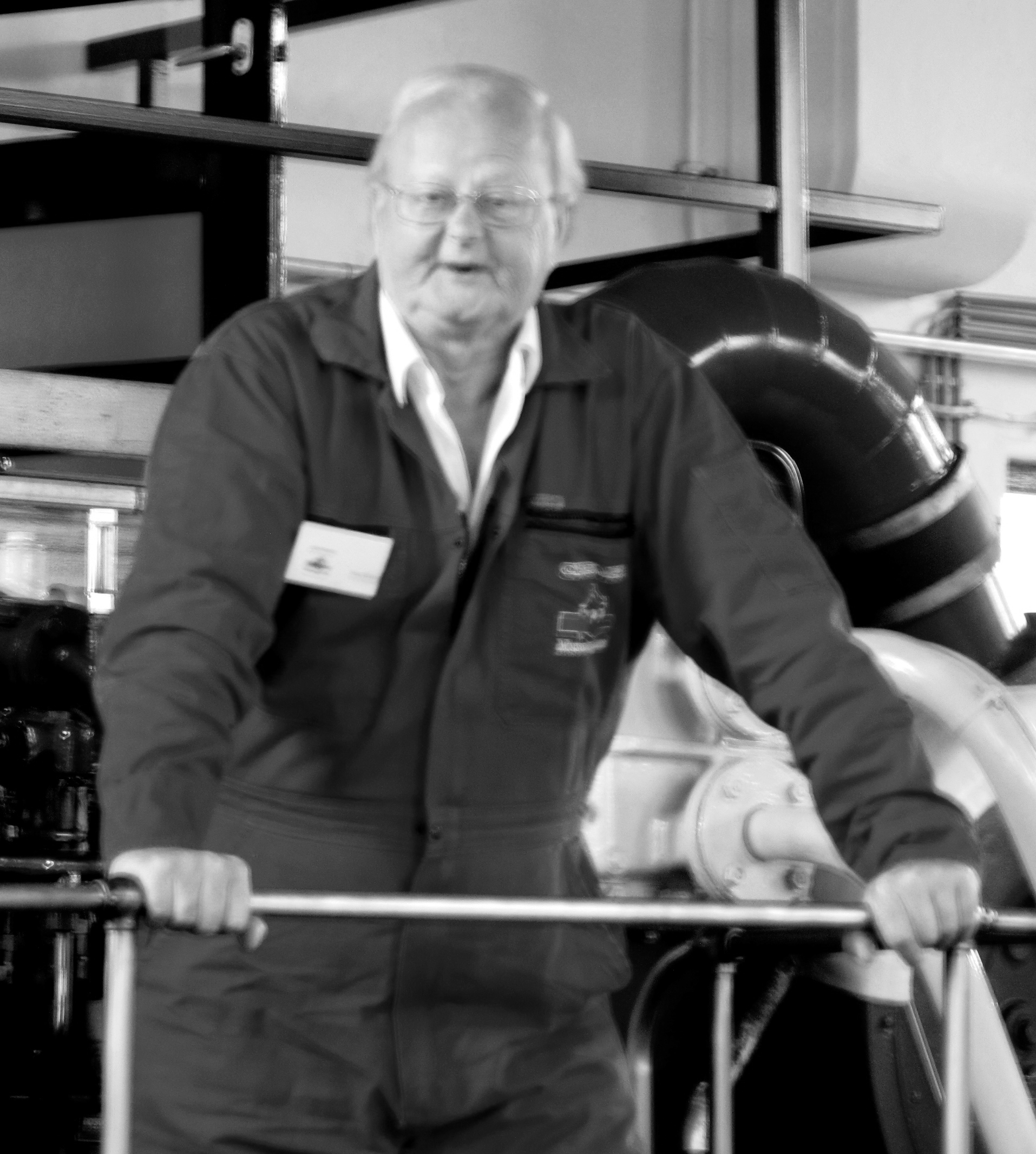
A great deal of academic writing is inaccessible in two senses. Firstly, it is written in a specialist language that is exclusive in the sense of being difficult for the average lay reader to follow. This is to some degree inevitable, and actually applies equally to exchanges between the gentlemen in the image above and his co-enthusiasts. (That’s to say it’s hard to follow unless you’re a Dutch pumping station enthusiast). But at least the enthusiasm that animates such conversations, together with external points of reference and relevance, mean they can be accessed by anyone who really wants to learn more. That’s simply not the case with academic writing. Most of this is published in specialist journals which cannot be accessed from outside the library systems of academic institutions – unless, of course,  you are prepared to pay very large sums of money to do so. (This notwithstanding that it is public money in various forms that pays for the production of this writing).

It’s in this context that my thoughts below appear.

Three recent events have prompted me to think yet again about what, for me, is another central problem of academic writing/publishing. (A email exchange with Elen-Maarja Trell, one of the organisers of a recent resilience workshop at Groningen University, questions from Antony Lyons following a talk on deep mapping given at UWE, Bristol, on Monday 15th October, and down-loading the  Intellect Journals house style pdf – all 16 pages of it). The problem is that, at least for the most part, such writing/publishing requires the writer to adopt a highly artificial and exclusive ‘voice’ that is usually shorn of all the enthusiasm and wider reference that allows us to find ways into the conversations of enthusiasts. A voice heavily constrained by the increasingly repressive realpolitik of exclusive disciplinary and managerial protocols and the instrumentalism inherent in the management policies that drive current knowledge production.

I downloaded Intellect’s style guide because I have almost finished an article, the result of a Visiting Fellowship at NUI, Galway, that relates to my subsequent talks – particularly at Groningen – and so needs to go out into the world. Fine, but if I submit it to a journal I must:

  • ‘Tidy it up’ so that editors are happy with in terms of house style and ‘academic probity’. (I’ve been both an editor for Wild Conversations Press and for an academic  journal, so I entirely understand the numerous ‘technical’ issues involved in producing text for a book or journal, but that doesn’t diminish my concern with the whole system);
  • Wait for up to two years before my article appears, by which time it’s relevance to the work of the people who might find it most useful will almost certainly be severely reduced;
  • Finally, and most significantly, either I (or if not the reviewers’ requirements  and editorial interventions) will have largely smoothed away all the traces of other, non-academic, ‘voices’ that were present in the presentation and related conversations from which the article derives. As a result, the published article would reinforce our sense of academia as a ‘world-unto-itself’, a world structured around disciplinary ‘single-mindedness’, rather than reminding us that we work in a  polyvocal polyverse.

Its this last point that vexes me at present, since I’ve been doing all I can to draw attention to our need to move on from a thinking based on disciplinary ‘worlds-unto-themselves’. To suggest that we need to refuse the rhetoric of ‘inter-disciplinarity’ that all too often masks the intellectual Neo-colonialism of ‘serious’ (scientific) disciplines that are predicated on what Peter Marris (in his wonderful book Loss and Change, 1986) identifies as an “aggressive conservatism” (p. 130). Disciplines for which the arts and humanities are all too often little more than a source of subaltern labour to be exploited at will. Any outward-facing creative research in a democratic country that’s worth the name needs to be multi-contituency research; to be predicated on working towards seeing the world more as a mycelial polyverse, and less as the hierarchical mono-verse co-produced by the dominant elite and our current epistemology.

So, I’ll no longer try and find a journal to publish my article – Acting elsewhere and otherwise? Imaginative action between the institutional worlds of art, education, and politics. Instead as soon as it is completed I will simply add it to this web site and let it find its own way out into the world by word of mouth. At least in doing so I will give it the dignity of standing or falling on its own merits.


Deep Mapping – a partial view

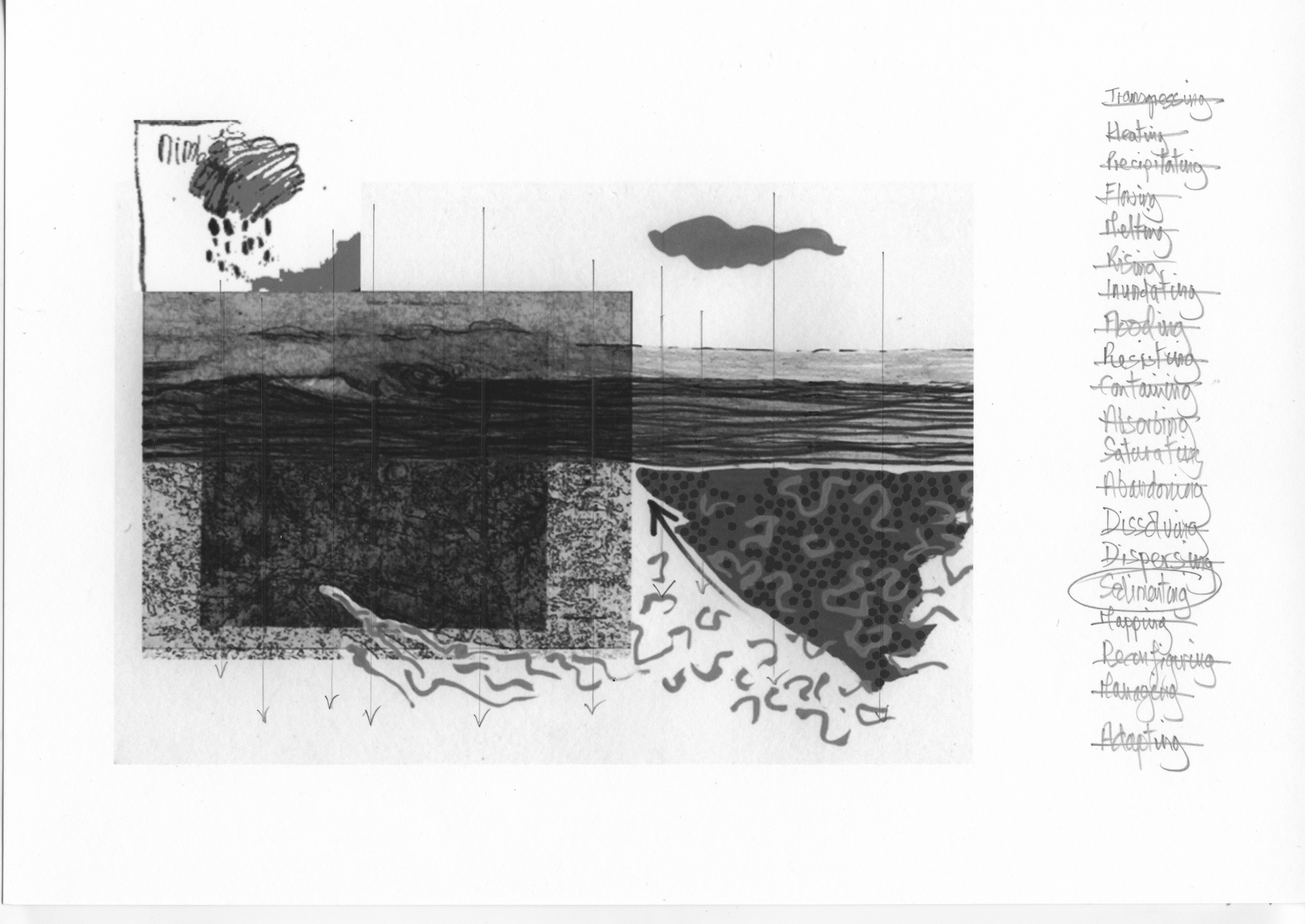
Transgression 19Transgression 19

This post is the text of a presentation made at UWE for the Hydro-citizenship research network. Related material can be found elsewhere on this web site. An online broadcast of the talk and following question & answer session can be found at :
http://uwe.hosted.panopto.com/Panopto/Pages/Viewer.aspx?id=27652064-70b3-4384-920f-0ed5752aa53d

There’s no single definition of deep mapping. It’s a trajectory, a constellation of shifting impulses – in many ways ultimately educational – rather than a unified set of technical approaches or a creative methodology. However, historically it’s possible to identify two strands within this trajectory as reasonably distinct. So I’ll start with some history, then look at some specific projects, and end by suggesting where I think deep mapping is heading today. I should add that, perhaps because of my background in the visual arts, my approach is partisan rather than academic – hence my title.

Part One – two traditions

Broadly speaking one strand of deep mapping is text-based and the other performative and visual. The first is sometimes seen as a Regionalist genre of place-oriented writing, sometimes called ‘vertical travel writing’, and Americans insist it started in 1955 with Wallace Stegner’sWolf Willow: A History, a Story, and a Memory of the Last Plains Frontier. But in reality this text-based trajectory goes back much further and also includes books by Tim Robinson, W G Sebald, and psycho-geographers like Iain Sinclair and Peter Ackroyd that don’t fit the US model. The second trajectory is predominantly European and uses various combinations of performance, site-specific multi-media work, and visual arts practice. Of course some individuals, myself included, happily borrow from both trajectories. So ‘deep mapping’ names a hybrid cluster of creative practices that draw on the humanities and/or the social and environmental sciences. It also regularly interbreeds with ‘memorial cartography’, ‘geo-poetics’, ‘haunted archaeology’, ‘psychogeography’, ‘theatre archaeology’, ‘experimental geography’, ‘site writing’, and ‘radical cartography’.

I’m going to refer to a small number of projects, most of which intervene inthe relationship between a physical location and the social processes of remembering and forgetting to reconstruct, relocate, and modify meaning. This intervention relates to Edward S Casey’s distinction – on the slide here – between ‘position’ and ‘place’. Basically, deep mapping challenges identity – of persons and places – as ‘position’ in Casey’s sense.

Mike Pearson, Michal Shanks, and Cliff McLucas cross-referenced their own archaeological, performance, social and architectural interests with William Least Heat-Moon’s 1991 bookPrairyErth (a deep map). This offers an exhaustive exploration of Chase County, Kansas, which is the last remaining expanse of tall-grass prairie in the USA. It weaves together ecological concern, ‘participatory history’, a wonderful chorus of quotations, and archival research, all playfully integrated through homage to Laurence Sterne’s C18th novelTristram Shandy. It’s slow, unstable, polyvocal approach that evokes the approach to deep mapping I most admire.

Art world people usually link deep mapping to the Situationists and Psychogeography, but its roots are equally in ‘vernacular mappings’ of the kind taken up by Common Ground. A current example of this vernacular strand is Luci Gorell Barnes’ The Atlas of Human Kindness – a growing collection of maps made by individuals and groups in Bristol, including refugee groups and children with learning difficulties. This shows where and when individuals experienced kindness from people concerned for their rights, feelings, and welfare. It invites debate about how kindness relates to place, exploring how stories, memories and imaginings make or re-make place; and how fragmented personal landscapes can become less fragmented. As such it helps us explore questions about value, connectivity, networks, and community.

In the 1980sMike Pearson, Michael Shanks, Clifford McLucas helped form a ‘theatre/archaeology’ for the radical Welsh performance group Brith Gof. In doing so they initiated the performative and visual trajectories of deep mapping in the UK. Their pioneering performances dealt specifically with place, identity, and the politics of spectral traces as these relate to cultural resistance and community. They creatively tensioned archaeological and architectural understandings of site with a culturally specific understanding of place embedded in the Welsh language. This work relates fairly directly to that of Lucy Lippard, Edward Casey, and Doreen Massey.

Brith Gof disbanded after Cliff McLucas’ untimely death in 2001, but Mike Pearson’s work has continued to inform deep mapping. His close attention to the ghosts, failures, and double meanings that haunt the excavation and archiving of all our places remains exemplary. But of course the dynamics of the performative/visual trajectory have continued to shift in response to psycho-social and environmental needs, as suggested by Alec Findlay and Ken Cockburn’s The Road North, which remaps Scotland through the lens of Basho’s The Narrow Road to the Deep North.

Part Two: ‘Deep mapping’ in practice

At the time of his death Cliff McLucas was working on a deep mapping project on the Dutch island of Terschelling, but we know far less about this late work than we should. However his work, and particularly the manifesto Ten things I can say about these deep maps, is growing in influence thanks to artist/scholars like Rowan O’Neil at the university of Aberystwyth.

 Gini Lee’s Stony Rises deep mapping project is relevant here for two reasons. Firstly, it draws directly on McLucas’ work to develop its own intrinsic qualities – for example it’s use of physical acts of layering and incorporation. This additive approach also allows the project to echo the cumulative layering of sites as a process that has more than a purely material dimension. Just as places are constantly found, collected, disassembled and reassembled in memory, so each manifestation of this mapping writes and over-writes something of the life, events, performance, and ecologies of the Stony Rises region. Much of Gini’s recent work – she’s Professor of Landscape Architect at the University of Melbourne – addresses water-related concerns in relation to the Australian outback and its indigenous people.

Secondly,Stony Rises introduced the architectural writer, teacher and creative interventionist Jane Rendell to deep mapping. As Professor of Architecture and Art at the Bartlett School at University College, London, Jane opened up a hospitable educational space where deep mapping people could present and debate work with peers and graduate students. Genuine intellectual hospitality, vital to deep mapping as an ecosophical and educational praxis, is of course now as rare as hen’s teeth in the UK.

In the past such hospitality enabled productive dialogue between deep mapping and, for example, the urban therapeutics of Rebecca Krinke, a sculptor who teaches in the School of Landscape Studies at the University of Minnesota. We’re fortunate that researchers are now recognising the value of deep mapping and its networks elsewhere, for example at Groningen and Aalto Universities. It’s to be hoped that institutions with some genuine educational vision – for example the new undergraduate degree in Liberal Arts and Science at Groningen – will provide new intellectual spaces for the type of exchange that took place at UWE between Antony Lyons’ NOVA and the PLaCE research centre.

Of course small-scale, wholly independent deep mappings can be made and used to make highly original work – as the Scottish artist Helen Douglas has shown. The US writerand environmental activistRebecca Solnit, who worked with Helen on Unravelling the Ripple, also provides an interesting link to an early arts-led deep mapping in the USA.

Solnit’s writing on Lewis DeSoto’s Tahu-altapa Project – made between 1983 and 1988 – is particularly important in discussing an early US example of deep mapping. DeSoto’s ‘slow mapping’ project produced an installation that, chronologically and methodologically speaking, parallels the emergence of multi-media, performance-based deep mapping in Wales. The project documents and critically evokes the complex cultural and material shifts associated with ‘The Hill of the Ravens’ in the San Bernardino Valley. This later became a site for the production of marble and cement, and was renamed ‘Mount Slover’ by miners. The project traces the mountain’s material and cultural transformation over a substantial period of time and across three cultural and ethnic groups. As a multifaceted installation piece – now on permanent loan to Seattle Art Museum – it maps the destruction of this once-sacred site in ways that intersect with what Cliff McLucas would advocate in his later manifesto.

Michael Shanks suggests that deep mapping is about creating a “forced juxtaposition of evidences that have no intrinsic connection” – a process of “metamorphosis or decomposition”. This approach works against the grain of disciplinary exclusivity,re-narrating the world in ways not pre-conditioned by the realpolitik of an epistemological status quo that maintains a culture of possessive individualism. It’s for this reason that deep mapping cuts across the methods of the sciences and arts, playing with their relationship as a means to reconfigure social memory and place-identity. By activating testimonial imagination in response to the recovery of spectral traces of forgotten or untold pasts, deep mappings act educationally, critically bridging otherwise antagonistic positions and stories so as to provoke new understandings.

After fifteen years I‘ve come to see deep mapping as a way of ‘translating’ between distinct, often antagonistic, lifeworlds. It weaves together imaginative and scholarly strands of material and images precisely so as to do such bridging work. In the process it identifies and utilises gaps and frictions that allow us to see others and their place-identity and lifeworld differently. However, its focus on translation requires deep mapping to avoid identifying with any one lifeworld as a ‘world-unto-itself’, with what Casey calls a ‘position’. I refer to this avoidance as ‘disciplinary agnosticism’.

The notion of translation between lifeworlds – between collective narrative identities if you like – prompts questions about the relationship between the visible and invisible, presence and absence, love and loss. These questions are usefully raised in the chapter “Hauntings, Memory, Place” in Karen Till’s book The New Berlin: Memory, Politics, Place. She asks what it means to say that the spaces of a nation or region are haunted, or that ghosts are evoked through the process of place making? Even to ask such questions is to acknowledge an expanded sense of the present shot through with the past as social memory. Karen argues that we’re engaged in an unending process of mapping understandings of ourselves onto and through place and across time. Deep mapping uses testimonial imagination precisely in this way – to animate the possibility of collective self-understanding across different lifeworlds so as to recount and reconfigure taken-for-granted, forgotten or neglected social connections. In this respect it’s intensely political in the broader sense.

 For example,Ffion Jones’ doctoral project is grounded in a complex family ethnography that’s included performing in a sheep byre on her parents’ farm in a remote Mid Wales valley. Her project aims (I quote): “to use ‘insider’ knowledge (lay discourse) as a way of exploring and extrapolating experiences of place within a rural farming family that confirms, contradicts and combines with academic discourses about our farming lives. As a researcher/farmer, I bridge two lifeworlds; my work seeks to look at a farming family’s attachment and experiences of place from the inside-out”. The project bridges lifeworlds usually seen as ‘given worlds-unto-themselves’, acknowledging and working with what’s valuable both in regional traditions and with external ideas and possibilities, creating conditions in which new coping strategies can emerge from inside the community.

I see Ffion’s work within a trajectory that deep maps a polyverse – as flowing from skills and understanding learned as a performer, daughter of farming parents, a scholar, a musician, a tenant upland sheep farmer, mother of a young child, and so on; as a re-imagining of place asa ‘simultaneity of stories-so-far’ in Doreen Massey’s sense. Her approach doesn’t reinforce a given identity or set of skills, a given understanding of community, or a fixed notion of self. Instead it invites us to take up the unending task of negotiating between such given positions.

Another way of thinking about deep mapping as translation is to relate it to Janet Wolff’s argument for a new approach to academic writing. Wolff argues that we need to work across and between three frames of reference, each of which I equate with one of Felix Guattari’s three ecologies as follows: an autobiographical or auto-ethnographic approach that grounds the work in lived contingencies – Guattari’s ecology of self; a commitment to the concrete and particular cultural object or event seen as indicative beyond itselfGuattari’s ecology of the social;and an obligation to challenge theory’s tendency to absolutism and its neglect of sensate, bodily knowledge – a bodily knowing I would link to Guattari’s ecology of the environment. Wolff’s thinking also converges with Ruth Behar’s account of the ethnographic essay as “an act of personal witness”, one that is “at once the inscription of a self and the description of an object” – and as both open-ended and able to desegregate “the boundaries between self and other”.

I’ve tested these and related ideas in a number of different contexts. For example with a project called A Grey and Pleasant Land? An Interdisciplinary Exploration of the Connectivity of Older People in Rural Civic Society, funded by the ESRC.A small team of us worked with a farming and quarrying community in North Cornwall that increasingly dominated by urban “incomers”, many of them retired. Our task was to map the connectivity of this uneasy ‘community’ in depth.We focused on making visible the way different groupings within this community located themselves in relation to each other and to external authorities. Here some people struggle to maintain an identity embedded in a traditional taskscape, particularly when faced with the priorities of heritage tourism within the local economy. Despite excellent dialogue and support from groups like the local history society we failed to establish the web based deep map we had hoped to share, in large part because the team as a whole could not grasp that this type of work is not ‘interdisciplinary’ but ‘multi-constituency’ work, in which non-hierarchical ‘translation’ becomes central.

Another test project undertaken by two graduate students working with myself and Mel Shearsmith at the Parlour Showrooms on College Green in Bristol – part of a PLaCE collaborative project called Walking In the City. Both projects helped meto think about two interrelated aspects of deep mapping. The first, obviously, is that it enables us to translate, to intervene in the complex relationship between different social groups and between human and non-human beings – located in place and time – by facilitating the evocation of other images, telling of other stories. However if this was all it did there be little to distinguish it from many site-specific projects using relational aesthetics.

Deep mapping’s more radical function is implicit in Cliff McLucas’ insistence that it: “bring together the amateur and the professional, the artist and the scientist, the official and the unofficial, the national and the local”. Why this is necessary is implicit inBarbara Bender’s observation that [I quote]: “Landscapes refuse to be disciplined. They make a mockery of the oppositions that we create between time [History] and space [Geography], or between nature [Science] and culture [Social Anthropology]”. Both McLucas and Bender point up a growing, and ultimately political, tension between specialist knowledge based on epistemological exclusivity and a more holistic mesh of knowings and doings that recognizes a multiplicity of ways of understanding and acting in a polyverse.

To put this another way, we increasingly need to work in what the geographers Stephan Harrison, Steve Pile and Nigel Thrift call “the curious space between wonder and thought” – a space where, they insist: “there is no single Disciplinary (in an academic sense) voice”. This is one face of the space that deep mapping maps. The feminist philosopher Geraldine Finn calls this space (I quote) the: “spacebetween representation and reality, language and life, category and experience” – and it’s one that makes it possible to engage in (I quote): “the ethical encounter with others as the other and not more of the same – a space and an encounter that puts me into question, which challenges and changes me, as well as the other and the system that constrains and sustains us”. Its here, in the challenge to our given notions of mono-ideational authority, that deep mapping finds its most radical function and this encounter – unlike an ‘interdisciplinarity’ that remains safely within the control of academic thinking – changes our relationship to the world.

It does so because it puts our position in question – for example by challenging our reliance on disciplinary-based authority and membership of lifeworlds all-too-often taken to be ‘worlds-unto-themselves’. This shift can take place because the spectral traces that deep mapping works with are what Edward Casey calls “unresolved remainders” – ‘reminders’ that are the silences and gaps generated by official processes of remembering and forgetting. Exploring the personal and social resonances of those silences and gaps, and then drawing on those resonances so as to facilitate translation between antagonistic lifeworlds, is what keeps the trajectory called deep mapping vital.

Notes from the Groningen Resilience Workshop

IMG_1543

I have just attended a very thought-provoking and I hope productive two-day workshop on ‘resilience’ in Groningen, organised by Melanie Bakema, Britta Restemeyer, Elen-Maarja Trell, and Gwenda van der Vaart, who are all either teaching or undertaking doctoral work at the university there. The workshop was organized around four presentation ‘tracks’, each with its own keynote speaker; a field trip into the region that included a number of site visits and brief talks by local officials and others; and finally a brainstorming and report back session on the final afternoon. (My own contribution was to give the keynote for track two, which explored the social side of resilience and the possible role of art in that).

 IMG_1542

The contributors to this track gave us insights into a range of topics, from resilience in urban slums in India and among women in coastal communities in the Philippines to issues effecting the local communities in the north of the Netherlands, for example the Wadden area. These were all interesting, with unexpected insights coming from topics in which I might not have expected to find them. Of particular interest to me personally where presentations from Jessica de Boer, an artist/researcher who spoke about co-evolutionary behaviour in relation to integrated energy landscapes; Victoria Brown, who presented a telling paper on the impact of coastal erosion on coastal communities in north Norfolk – this coincidentally related directly to Simon Read’s work further down the coast, which I referenced in my presentation – Sebastian Becker, who talked about projects demonstrating the potential value of permaculture; Jethro Brice and Seila Fernandez-Arconada’s on socially-engaged art practice; and Gwenda van der Vaart’s on her work looking at the uses of art in building community resilience.

IMG_1546

To put the workshop in context it’s important to point out that Groningen is the main city in a region that is in decline in terms of its population and, to some extent, its economy. In both cases this is linked to the fact that both the region – and indeed now the city itself – are increasingly suffering from earthquakes as a result of decades of gas extraction by a company part-owned by the Dutch Government – a factor that gave the workshop a real sense of social and political urgency. Interestingly, there is local anger and related political activity but, it seems, in the context of a majority view (53%) that believes that ‘keeping quiet’ is probably the best option. However, as the safety of individuals is affected by property being weakened or damaged, this may change. Significantly, the Government itself siphons off the several billions of euros that constitute the annual profits from the gas extraction, while still (presumably) considering itself to be the ultimate representative of the Dutch people (or rather, perhaps, those of the people who do not live in regions effected by the earthquakes).

IMG_1486

Quite apart from the usual issues of the duplicity of Governments when working hand-in-glove with business to the disadvantage of a proportion of the electorate, the workshop and the socio-environmental circumstances informing it served as a stark and timely warning in relation to the likely consequences of fracking in the UK. Sadly, given the combination of naked greed, insularity, and chronic lack of vision that characterises the present British government in pursuing the policies it does on energy (and indeed on almost everything else), nothing that happens in the Netherlands could possibly be allowed to get in the way of its policies!

IMG_1505

Perhaps the most interesting and unusual aspect of the workshop was the final session, in which we were reorganised as new four groups, each with members drawn from different tracks. These were each tasked with creating an outline resilience strategy for Groningen on the basis of what we’d seen and heard – all in about two hours! I have to say I though initially that it would be impossible, or rather that we’d produce something too hasty and superficial to be of any real value. However, I had seriously underestimated the ability and capacity for teamwork in my own group. In addition to Jessica de Boer and myself from ‘track two’, this turned out to include some very focused and thoughtful contributors from other tracks. Having been reminded the previous day that it can take a couple of years for academics in an interdisciplinary research unit to understand each others’ language, it was both very heartening and a little surprising to see how quickly the group sorted out priorities and agreed a way of organizing and presenting our thoughts – a process that appears to have been replicated in the other three groups. Although obviously we could do little more than sketch out a proposal in the time available, I was impressed by the enthusiasm, attention to detail, and degree of mutual respect within the group and by the fact that our proposal – although sketchy in many respects – did have a workable sense of process considered, informed detail, and democratic inclusiveness, along with a genuine sense of vision that I would not have thought it possible to achieve in such a short space of time.

IMG_1492

There’s obviously a lot to think about here. Among other things the workshop demonstrated that there are plenty of good, grounded ideas about place-building the reanimation of questions of community, ‘resilience’ (a term I personally find deeply suspect – preferring the more vernacular notion of ‘coping strategies’ – a phrase proposed as an alternative by the landscape architects Maggie Roe and Ken Taylor). There was also a sense of both the issues of political pragmatics and vision and the corresponding need for practical understanding of the issues around implementation of any strategy for the area. All this suggests to me that we might need to pay more serious attention to the following.

Firstly, ensuring that younger researchers and others are enabled to have the closest possible dialogue with a wide range of ‘lay’ constituencies and that this is understood in the context of a broad-based, ‘multi-constituency enquiry’ and NOT as ‘interdisciplinary research’, a term that signals a tacit denigration of those skills and understandings that draw on experiences that are not authorized by disciplinary academic knowledge. Secondly, that flexible policies need to be in place that allow for the accessing the widest range of ideas and strategies that can be generated by mixed skill and disciplinary groups when these are given a clear focus, as happened during the workshops at Groningen. Finally, genially socially engaged institutions need to find ways to ensure that they do whatever they can to ensure both that these ideas and strategies are taken seriously by those with the leverage to do so and that they are constantly debated and reformulated by being taken back into the region for further discussion. This process needs, however, to ensure that it generates productive action, since without this it will degenerate very rapidly into the kind of rudderless talking-shop that currently seems much in evidence when it comes to thorny issues like the liability of the company responsible for the gas extraction.

IMG_1530

The response to my own presentation and the insights of others presenting in track two suggests that there is an important role for those able and willing to work imaginatively and creatively as ‘lifeworld translators’ in the sense I proposed. As I suggested at the end of my presentation, in different ways and in different contexts, projects already under way are working to facilitate new coping strategies by making space for the empathetic imagination necessary to shared ethical action – including political action. They do so by translating across lifeworlds normally assumed to be insular ’worlds-unto-themselves’, by listening out for the anomalies that might allow people to re-narrate those insular worlds in other, more open and empathetic ways. They invite exchange between global knowledge and local understanding, between professional practice and lay skills, between all the multiple elements of lifeworlds as polyverses. And if they facilitate ‘resilience’, it is a shared social resilience that collectively chooses to face, rather than resist, radical change.

OLYMPUS DIGITAL CAMERA    

(photographer of group image unknown) 

A ‘resilience’ workshop at Groningen University

I have been neglecting this blog – in part because of family issues and in part because I’ve been busy preparing a talk on deep mapping for the Hydro-citizens research network I’m involved in, a keynote paper for a conference on the Gothic (don’t ask!) and, most urgently, a presentation for an event next week called: ‘Resilience – just do it?! A workshop for PhD candidates, early career researchers and senior researchers and practitioners’, in Groningen on October 9th – 10th. The organisers have framed the event as follows:

“With regard to disaster resilience, policies are often focusing on rebuilding the economic and physical infrastructure of a community. However, resilience is a community-wide and holistic characteristic, which demands a broad conceptual underpinning if it is to be translated effectively into policy initiatives. As a result, planners and policymakers are increasingly asked to include the social side when planning for resilience. Concepts such as community identity, social capital, place attachment, community cohesion, sense of place and community participation are relevant in this context. Recent research indicates that having strong personal networks, high levels of participation in community activities and a sense of belonging in a community can contribute to residents’ resilience. Moreover, a ‘sense of place’ and community identity can enhance community resilience as they, for instance, exert substantial power to mobilize people into proactive action in recovery efforts”.

My own involvement is with one of four themed tracks, which is outlined as follows:

“This track specifically focuses on the social side of resilience, aiming to pay attention to the concepts highlighted above, and seeking to create a dialogue on how the social side of resilience could be integrated in planning for resilience. One specific focus of this track is the role that the arts can play in enhancing a community’s resilience. The arts can create a focus for community interaction and participation, in this way, fostering collective action and the development of social capital. Research suggests that the arts can be considered to have a so-called ‘survival value’, by building resilience and providing the innovation necessary for communities to cope with change”.

As it happens I actively dislike the term ‘resilience’ (which seems to me central to the new conservative eco-scientism) and am increasingly uncertain about the tacit instrumentalism implicit in the idea that “the arts can create a focus for community interaction and participation, in this way, fostering collective action and the development of social capital”. (I’m also uncomfortable with all those ‘top down’ concepts being applied to communities whose own ideas and experience rarely get a look in). So the title of my presentation is: Coping strategies and the art of social translation – with the term ‘coping strategies’ borrowed from the landscape architects Maggie Roe and Ken Taylor – taken as an active vernacular alternative to ‘resilience’.

While I’m in Groningen I’m also going to meet with Prof. Hans van Ees, Dean of the university’s newest faculty –  University College Groningen – which aims “to become an internationally recognised centre of innovative interdisciplinary education and related research on complex societal challenges”. This is happening through the good offices of Dr Bettina van Hoven, who is Associate professor Cultural Geography (Faculty of Spatial Sciences) at Groningen. ( Mary Modeen and I have recently invited Bettina to become an associate member of PLaCE International UK). In relation to this meeting my primary concern is to listen to what Prof. van Ees has to say about the potentially very valuable initiative for which he’s responsible, but I also hope to interest him in the work of PLaCE International and in approaches like deep mapping as potentially an integral part of what UCG is hoping to achieve. I have been reading the Horizons: Imagining Futures platform proposal he and a small group have recently submitted to the university, which seems to me to propose exactly the type of educational vision we now desperately need.

I will report back on this trip in due course.

“Art, Science, and Cultural Understanding” published

Scan 1 Scan 1

This book, in which I have a chapter and a co-authored chapter,  is edited by Brett Wilson, Barbara Hawkins, and Stuart Sim. The publisher’s blurb reads as follows

Art and science are often seen in contemporary Western society as almost entirely separate and polarised fields of human enterprise. In contrast, a growing number of practitioners are realising that art and science are both intimately concerned with how we conceive of the world around us; not just as individuals, but also as societies. Art and science share a common embodied imagination, cognitive creativity, and independent spirit of inquiry at their heart, and both can summon up the visionary power of revolution for our senses.

The editors and contributors to this book clearly highlight the many underlying themes that have always connected art and science throughout our history and show, through a range of essay styles and voices, how a hybrid art-science movement is now emerging. This new movement offers a broader trans-disciplinary perspective to avoid relying on narrow specialisms and short-term fixes when addressing growing global problems such as climate change, economic instability, and provision of food, water, and healthcare for a rapidly expanding world population. Practitioners, researchers, and students in the arts, sciences, and humanities will all find much in this volume to stimulate and inform new ways of thinking about their own disciplinary approaches.

Brett Wilson took early retirement from his professorial post as a university scientist to become a “scientist in residence” in an arts faculty.

Barbara Hawkins is a university-based arts educator and film maker with a special interest in practice-led arts research.

Stuart Sim is retired professor of critical theory and 18th century English literature and a widely published author. They have worked together for a number of years on previous projects and are founder members of Project Dialogue.

Everywhere – Pivots and Peripheries? (2nd part)

IMG_0710Transgression 10Transgression 10

Part Two: ‘Everywhere, pivots and peripheries’ – considering Tim Ingold’s The North Is Everywhere

In an earlier draft of the paper that forms the first part of this essay I tried to suggest that multi-constituency collaboration rarely happens because, as professional people we’re embarrassed by the self as polyverse. This is an extension of our professional discomfort with what Bakhtin calls “matters having to do with ourselves”. The majority of professional people prefer, when asked to identify themselves, to do so in terms of some autonomous cultural domain or professional discipline as an exclusive ‘world-unto-itself’.

I tried to illustrate this point by using the example of the multidimensionality of my anticipated response on coming back to the windswept northern island of Lindisfarne. I have visited it a number of times in the past, but always on family holidays. My point, obvious enough as soon as we consider it, would have been that my responses on this visit, despite my reasons for returning being ‘professional’, would not be limited by professional frames of reference – that other memories, sensations, etc. would have been peripherally present. But this example turned out to be too ponderous and long-winded and I abandoned it.

What remains from that earlier draft is a sense of the richly paradoxical, polyvocal, particular, personal, senses of the North I’d wanted to evoke – senses in which both the sensation and an cultural understanding of the north wind – derived from the extraordinary psychosocial palimpsest that is the old Supernatural ballad of Tam Lin – are always, somehow, implicit. In that ballad the north wind is the almost imperceptible hinge on which the entire narrative finally turns. This moment is described as follows:

As it fell out upon a day,

A-hunting I did ride;

There came a wind out of the north

And woe it did betide.

And drowsy, drowsy as I was,

The sleep upon me fell;

The Queen of Fairies she was there,

And took me to herself.

I have for many years had a sense of over-identification with the ‘world-unto-itself’ of hyper-professionalism, and the institutionalised forms of power we believe this to grant us, as a seductive and dangerous form of enchantment. In no small part because in my own life I’ve been constantly called to remember the price that Tam Lin would have paid for his being enchanted had Janet not woken him from it and lovingly returned him to the human lifeworld – with all the joys, trials, and tribulations that make up the lives of ordinary (lay) mortals. What I want to do here is follow the intuitive meanings that this moment in the ballad carries for me into a discussion of the issue of the North and North-ness raised during the conference.

Tim Ingold’s opening plenary – The North is everywhere – offered an imaginal, psychosocial reading of the four cardinal points as historical orientations. My notes record – and I cannot begin to do justice to the detail of his exposition – that the West is equated with modernity, with the dualistic view ‘nature versus culture’, and with ‘history of’. The East he identifies with ‘history about’ (the other), a looking-glass history of rising and falling empires. The South is identified in turn with ‘once colonized, oppressed peoples’, with non-histories or ‘people without histories, with ‘histories against’. By contrast, the North is seen as the location of ‘history from’, of ‘inhabitation’ growing from the land and with ‘lives woven into the land’, as inclusive of all beings – human and otherwise – and as ‘anti-isms’ (his examples being example Shamanism and Animism). It is to be taken as the site of circulations of vital force and revitalization, of environment as the world we inhabit grounded in a zone of interpretation where objects are illusory, merely a reification of an unfinished continuum made up of the dynamic flow of materials. In this view of the North history as a preoccupation with the ‘first time’, the novel, does not take precedence over time as repetition. But above all this north is all pervasive, indigenous, the ‘everywhere’ of inhabitation and inhabitants.

The exposition of this position was accompanied by drawings and delivered in a persuasive rhetoric that managed simultaneously to evoke the authority of philosophers and a ‘common sense’ flowing from the phenomenology of the everyday. But, as someone alerted by A. David Napier to the distinction between monotheism and polytheism as modes of thinking, and also long attuned to the ‘polytheistic’, archetypal post-Jungian thinking of James Hillman, all this troubled me.

In the question time afterwards I asked Tim Ingold whether his clear championing of the North as a position was perhaps somewhat at odds with his articulation of the world as mesh, of mycelial ravellings and unravellings, with its implication of multiple dynamic forces and perspectives. His answer suggested that, while he felt the need to acknowledge the dynamics of each of the four cardinal locations, he preferred and was committed to the North. This can be taken at face value as a personal preference, to which he is obviously entirely entitled. However, from the perspective of lifeworld as polyverse integral to the first half of this essay, it can also be taken as indicative of a problematic contradiction in Tim Ingold’s thinking – namely, that it remains, in the last analysis, animated by the same commitment to mono-ideational positions that has given rise to the modernity from which he so clearly wishes to distance himself; the same radical, secular, mono-ideational thinking that the Enlightenment inherited directly from the monotheistic theologies of the Religions of the Book.

At first I suspected that my sense of this contradiction might be as much the result of a projection of my own preoccupations as it was a possible issue inherent in Ingold’s own position. However, listening to David Martin-Jones insightful articulation of an alternative position, in which a rhizomatic South emerged as the prime location of dynamism, suggested that there might be more to my sense of an inherent contradiction than simple personal prejudice. This sense that my concerns were shared was further reinforced by a paper from Chris Dorset, with its celebration of Paul Wheatley’s 1971 work, The Pivot of the Four Quarters. I heard this as an evocation of a Dionysian, catholic (in the secular sense) South, as the counterpoint to an Apollonian, even Calvinist, North. Owain Jones’ reminder of Latour’s association of modernity with purification (a prime cause of distinction within a hierarchy of positions), and his reluctance to partly qualify the anti-modernism he shares with Tim Ingold, seemed to chime with the way in which Lisa Taylor’s informants read David Hockney. They tend to do so as confirming their own affective responses, a process that also, inadvertently, allows them to bracket out the problematic cultural and political readings that his work can also open up. (I share many of the objections to modernity articulated by both Tim and Swain but, having twice had my life saved by surgery – and so am alive only because of its technical advances – I am always mindful of it’s benefits. Additionally, and on the basis of pre-modern mortality rates and educational opportunity, my guess is that only one in ten of us would have been present at the conference had pre-modern conditions pertained). But it was a paper by Leanne Philpot – Narratives of the Transatlantic Slave trade in North West England: Museums, heritage and dockland tourism, with its insistence on the validity of blending multiple, sometimes antagonistic narratives – each a trace of a particular historical lifeworld with continuing reverberations – that was most helpful to my thinking all this into a more coherent weave.

Owain Jones had reminded us of the importance of Felix Guattari’s Three Ecologies. Each of these, as I now understand it, must be understood as the site of an interplay, of a dynamic raveling and unraveling of psychic, social and environmental energies associated with, tensioned between, and departing from, that ecology’s own, particular, cardinal points. Tim Ingold’s monolithic – as I see it – privileging of a ‘good’ North over the other cardinal points (in particular a ‘bad’ West) is, in this context, ultimately unhelpful – although, as Owain Jones’ paper made all too clear, entirely understandable given the state of the world today. What I think Tim Ingold forgot is the simple fact that all such imaginal readings are dangerously reductive when they fail to take into account that, as an analytical psychoanalyst might put it, any too close an identification with one archetypal position becomes a form of blinding enchantment, one that in turn evokes opposite and negative forces. Any call to take up a Northern perspective that neglects to attend to this risks becoming a rhetorical enchantment and, in the process, an inadvertent evocation of the mono-ideation framing that has governed the West for far too long, resulting in all the problems identified by Owain Jones and others.

Janet can only return Tim Lin to the lay world against the power of the enchantment the Dame of the Fine Green Kirtle (the Queen of Elphame), puts in place when the north wind blows by hanging on to him, sticking with him through all his multiple changes of material, category, and implicit dynamic or direction. By being the still, present, pivot around which he can swing.

So I want to suggest that, while the imaginal North may indeed be everywhere, so are each of the other imaginal cardinal points. Each, like any imaginal image, is multiple, paradoxical, and irreducible to a single perspective. To identify a ‘good’ North over against a ‘bad’ West – as I take Tim Ingold to have done – is to reify the North, and to invite the return of all those ‘bad’, ‘repressed’, elements that are also integral to its power as an orienting image.

So in the final analysis I’m not too comfortable with this way of thinking. My sense is that each cardinal point has its light and shadow and that our task is to attend at and from the pivot, the act of attending that allows us to orient ourselves by each of them as necessary and appropriate, but without identifying with any particular one. To acknowledge the unending ebb and flow of the lifeworld as polyverse in which each of us, uniquely attentive, is a pivot and, at one and the same time, utterly peripheral – just one small dynamic constellation among innumerable other constellations.

Everywhere, Pivots and Peripheries?

IMG_2704


Part One. Reframing Northern Spaces: place, creative practice, and collaboration.

This piece of writing is in two parts. The first part is a slightly revised version of a paper I’ve just given at a workshop on Holy Island or Lindisfarne, just off the Northumbrian coast, for the Northern Peripheries Network which, entirely by chance (or not) can now also serve as background context for the second part. The day workshop for which this was written took place just prior to what turned out to be a wonderful two-day conference – Further North – organized by Ysanne Holt and Angela McClanahan. The second part -to follow – is a provisional set of thoughts in response to a paper by Tim Ingold, one that also draws on points made by a number of excellent papers given during the conference – in particular David Martin-Jones’ Where is Anywhere: Ideas of North, South, East and West and Chris Dorset’s re-situating the gallery farther south. Needless to say, my reflections are partial, a personal ‘mulling over’ of the impact of what I heard over two days on my own thinking.

So, what I myself said at the workshop was roughly as follows, some of which will already be familiar to readers of this blog.   


Part One: Reframing Northern Spaces: place, creative practice, and collaboration

I’m going to talk out of my experience of working in the north, but also, of course, elsewhere – I’ve been working on my Debatable Lands project on the Borders for fifteen years – so as to present a particular view of collaboration. Some of you may feel this view is rather extreme but, having just been listening to younger artists and geographers at three sessions on geo-aesthetics at the Royal Geographical Society Conference in London last week, I can at least confirm that it’s not an entirely idiosyncratic one. What I want to say could be related in some detail to various academic arguments. To Matthew Fuller’s wild generalization that: “art … has oozed out and “become feral in combination with other forms of life”; to Sarah Whatmore and Catharina Landstrum’s work around ‘knowledge controversies’, ‘competency groups’, and ‘pre-figured categories’; or to Yuriko Saito’s argument that we need to pay more attention to the aesthetics of the everyday and less to the aesthetics of the exceptional. But my focus is ultimately practical – to help change views of collaboration and its framings. So I’ll start there, then indicate three points of resistance to dominant cultural framings, and end by introducing examples of a specific type of collaborative project.

Ffion Jones farms with her partner in the hills of mid Wales. She’s bringing up a young daughter, studying for a doctorate at Aberystwyth University, and making extraordinary multi-media performances. Simon Read teaches at Middlesex University, produces sculptural interventions in salt marshes, and makes beautifully drawn maps predicting future costal change so as to influence debates about managing the Suffolk coast. What Ffion and Simon do is normally identified as ‘art’ and I have no particular quarrel with that. But I do wonder increasingly if this does justice to their relationship to place ortheir ability to work collaboratively between radically different lifeworlds. Personally I think of them as being as much multi-skilled cultural translators working across a lifeworld as polyverse – a world made up of multiple and sometimes antagonistic normative positions that are usually seen as largely separate and distinct.

Recently I’ve come to understand that the work I’ve done over the last twenty odd years falls along a fairly broad spectrum – with genuine collaboration at one end and basic co-operation at the other. I’d argue that what animates this spectrum can be related to the two meanings of collaboration: to work together, especially in a joint intellectual effort”, and “to cooperate treasonably, as with an enemy occupying one’s country”. Grant Kester refers to these two meanings at the start of The One and the Many and, conventionally, goes on to oppose them. But I think they’re actually linked at an underlying level. I think both involve challenging given roles and identities. Genuine collaboration requires that we are willing to recognize, question, and negotiate what are often uncomfortable differences between the parties involved. That process requires a type of translation across differences that changes us, or at least has the potential to do so. But radical change in a person can all too easily be taken by others as a form of betrayal – particularly by those people who can’t or – because of vested interests – won’t think beyond the polarized categories of ‘friend’/‘enemy’, ‘specialist’/‘layperson’, ‘artist’/‘public’.

So I find myself wondering whether or not the woman in Edward Capa’s ‘Collaborator woman who had a German soldier’s child, Chartres’was in fact a genuine collaborator, not just someone who simply co-operated with France’s enemies? Might it not be that her love for the child’s father led her to question the category ‘enemy’ to the point where her own self-identity was actually transformed? Whatever the case, I would argue that genuine collaboration – by putting in question the frames of reference on which our institutionalized professional identities into question – is transformative. This clearly makes genuine collaboration a risky and transformative act in any profession where conformity to a status quo predicated on disciplinary realpolitik is a tacit requirement for any ambitious person.

Of course it also means that what academic and cultural institutions call collaboration usually isn’t – it’s actually carefully regulated co-operation based on a pre-existing consensus. Necessarily so – institutionalised authority flows from maintaining or adapting existing framings and presuppositions, not from questioning them. (A point we need to remember when we identify with that authority). It may be that distinguishing collaboration from co-operation goes some way to explain institutional and Government obsession with ‘inter-disciplinarity’. While there are obviously plenty of exceptions to what I’m about to say, I think most academic research that claims to be what’s called ‘interdisciplinarity’ is in fact little more than a slight of hand. In reality the researchers involved simply share a loose co-operative framework that allows them to do precisely what they always do – work on the basis of existing, highly institutionalised, disciplinary presuppositions. Of course such projects may sometimes produce innovative outcomes, but the problem – at least as I see it – is that this leaves the underlying framings unquestioned, not to say unchallenged. Over fifteen years ago Doreen Massey quoted Barbara Bender’s observation that (I quote): “landscapes refuse to be disciplined. They make a mockery of the oppositions that we create between time [History] and space [Geography], or between nature [Science] and culture [Social Anthropology]”. However, while research funding and academic realpolitik remain dominated by disciplinary framings, we will continue to struggle to act on new understandings of place or genuinely collaborate.

So what about framings? I’ll restrict myself to my own area of concern, which is largely with rural lifeworlds. These are now increasingly subject to Government neglect of vital infrastructure, externally imposed environmental governance, and questions around energy and food security. This situation is normatively framed in various different ways. One is dismissive, locating the rural as non-place. It’s neatly summarized by Marx and Engels’ phrase: “the idiocy of rural life” and is implicit in much arts and cultural policy. A second is more complex, involving different mixes of Romanticism, regional tradition, New Age spirituality, and Edenic environmentalism. While each mix inflects the rural differently, they all idealize it over against the urban. The third framing can be characterized as ‘instrumental’. It treats the rural as ‘standing reserve’ – a resource to be exploited with no proper regard for its particular lifeworlds and ecologies. This framing is only too obvious when the Government appoints individuals embedded in the business world to head the Environment Agency and Natural England. But it also appears in a disturbing new guise in the rise of eco-scientism as a coercive top-down rhetoric in public debates about, for example, resilience.

These three normative framings regularly lock different social constituencies into mutual incomprehension, provoking protective withdrawal and making constructive exchange, let alone collaboration, very difficult. As a result different constituencies become locked into bitter, long-running conflicts – around GM crops and alternative energy in the UK, or small-scale family turf cutting in Ireland. Working across these deeply engrained normative framings requires creative, collaborative translation based on specialist knowledge, empathetic imagination, creativity, patience, and mediation skills. Simon Read and Ffion Jones are, in my view, involved both in just such creative translation. Their work facilitates multi-constituency collaboration between antagonistic constituencies and is helping develop a new, more inclusive, aesthetic.

This kind of work is certainly not without its problems. Creative translators learn many of their skills through a professional, disciplinary training. But the people they work with in rural contexts often suspect any authority based on the framings that underpin those skills. Rural selfhoods are largely dependent on another, place-specific, performative framing – one that has little time for discursive, categorical knowledge. Instead they derive identity and authority from their qualitative, embodied co-constitution in and with a specific taskscape. Addressing this difference – a primary source of conflict between professional and lay constituencies of all kinds – is a central part of Simon Read and Ffion Jones’ work to build bridges across the differences between university-trained professionals and rural workers.

As my quotation from Barbara Bender indicates, this work requires that we don’t over-identify with disciplinary positions. Instead we have to recognize, with Geraldine Finn, that we are always both more and less than the categories that name and divide us. In reality we each live in a polyverse where our various persona – professional, lay, amateur, or domestic – require collaboration on a daily basis. However, all professional work is now increasingly framed so as to reward those who internalize the values of the institutions that validate them as discrete ‘worlds-unto-themselves’. This situation prevents genuine collaboration, ensuring that the deep-seated framings that underwrite our current environmental and psychosocial difficulties go largely unchallenged.

So how do we address the tension between skills learned in a lifeworld as polyverse and those delivered by professional ‘worlds-unto-themselves’. I’ll suggest some possible answers in two stages. First, I’ll indicate three attitudes to place that help resist disciplinary professional framings. These aren’t concerned with place in terms of an aesthetic of the exceptional that speaks primarily to the eye, but with our constantly re-placed ourselves – physically, psychosocially, and ecologically – in ways that value an aesthetic of the everyday. I’ll then very briefly introduce some collaborative projects that I take to be genuinely transformative.

The first form of resistance I want to stress is ‘slowness’ in relation to place and collaboration. Christine Baeumler, working with an ecologist and an engineer, set up this tamarack wetland restoration project on the roof of the main entrance to the Minneapolis College of Art and Design.It took years to raise funds, plan, and negotiate this demonstration that, even when transposed into an urban environment, such a fragile ecosystem could, given the right conditions, serve both as green roof infrastructure and an aesthetic micro-environment. As I understand it, Christine’s praxis has, over many years,gradually ‘gone feral’. To art students at the University of Minnesota she’s an inspiring and dedicated teacher. To her employer she’s an effective faculty member with an exemplary research and public engagement record. To local ethnic minority communities she’s a facilitator for environmental youth programmes. To her arts peers she’s a respected artist working across a multitude of media – including painting, installation, film and ecologically led landscape design. To local Dakota community activists she is a long-term practical ally in their fight for cultural recognition and proper representation. Finally, and centrally, to her neighbours Christine is somebody who has worked for eighteen years on community projects restoring the everyday environmental where she lives. It’s this slow engagement with the place in which she lives that’s catalyzed the transformation of her practice, both operationally and aesthetically. This relates directly to Whatmore and Landstrum’s discussion of the need (I quote): “to ‘slow down’ expert reasoning and so create opportunities to generate new knowledge opportunities and gather new publics”.

My second area of resistance concerns acknowledging the fragility of actually enacted community and sensing the interplay of presence & absence.Marlene Creates’ Sleeping Places, Newfoundland documents the impression left where she’s just slept – a transitory imprint from each of twenty-five nights’ brief habitation. The work plays up the relationship between bodily presence, transience, and absence. She later extended this to the fragile, temporal nature of human habitation.Places of Presence: Newfoundland kin and ancestral land, Newfoundland documents just that – familial sites where a sense of community relates as much to the dynamic of natural erasure as human inhabitation. Remembering that fragility helps us guard against institutional appeals to abstract categories like ‘the academic community’, ‘the research community’, or ‘the art community’ – appeals usually intended to evoke a spurious consensus in the interests of those with most to gain. This remembrance is vital because genuine collaboration is constructively combative – energized by differences – not the result of assumed or imposed consensus determined ‘from above’.

My third type of resistance is created by a community of active skill sharing – one that create a new, usually temporary, constellation of skills.Many of you will be familiar with Place of OriginKemnay, Aberdeenshire, Scotland (1996 – 2006). This was a many faceted ten-year ‘landscape as art’ project far too rich to detail here. I simply want to remind you that it involved many very different skills –negotiating, engineering, sculpting, landscape design, community discussion – that took as a focus the history of granite quarrying in the North East of Scotland and an understanding of place as inseparable from time and change. The project came about because Kemnay grew up as a result of its quarry but was fast becoming a commuter dormitory village for Aberdeen. In addition to creating of a temporary community of act, this project parallels, albeit in a very different register, both the need for slowness exemplified by Chris Baeumler’s work and the awareness of fragility, of the play of presence and absence, in that of Marlene Creates.

I now want to introduce some projects and approaches that are located on the cusp between art and art-based aesthetics, understood as the product of a monolithic ‘world-unto-itself’ and an unbounded creativity arising from the lifeworld as polyverses and engaged in opening up a sense of the everyday and unexceptional as potentially rich in aesthetic possibility.

Pauline O’Connell works to challenge normative attitudes to community and land ownership in rural Ireland. Building on her 2012 Drawing The Water commission, she’s been working on an open-ended project, two parts of which – Heave-Ho, An Invitation To Community and Heave-Ho, Pub Pulling League – are complete. This ongoing project raises and explores issues of community and social identity by drawing on history and trace memories – in this case relating to the 1970’s Kilkenny Tug O’ War team’s experience of getting to the All Ireland Final in 1971.Pauline’s use of a community-owned field – rare in Ireland – as a site in which to invite the performance of memory, has enabled her to intervene in the ecology of her local community. Community here is seen not as a given and permanent entity – as the guarantor of established ‘positions’ – but rather as an experimental exploration undertaken by individuals coming together – however temporarily – to re-place themselves so as to face the demands of a changing culture.

Simon Read lives on a barge on the River Deben and works as an artist, teacher, environmental designer, community activist, and ecological coastal expert. He’s been involved in saltmarsh projects since 1997 and his large map drawings relate to management strategies for fluid and shifting environments, delineating specific locations and actively meditating on change. He retrieves, cross-references, and synthesizes material from many different official sources so as to be properly equipped to contribute to complex planning and governance debates around costal environment issues. Recently Simon worked on a stabilization project for the Falkenham saltmarsh that led to him designing and building biodegradable sculptural barriers to prevent erosion by managing tidal flow and encourage the controlled deposition of silt. He has worked with official agencies, the regional community and inmates from the local prison to engage with the social dimensions of environmental issues through collaboration. This includes the planning and governance process, advocating and contributing nuanced practical solutions to problems on the ground, and addressing the cultural implications and dimensions of changing understandings of land, ownership, responsibility and belonging. His work also exemplifies a move to address the aesthetic issues Yuriko Saito raises in relation to ‘un-scenic’ saltmarsh and the need to address issues of cultural sustainability.

Cathy Fitzgeraldtrained as a biologist and now works as a forester, artist filmmaker, blogger, green political activist, writer and doctoral researcher. She lives in a small wood in County Wicklowin Ireland and her many concerns radiate out from her commitment to this one place. The immediate context for Cathy’s transforming of a Sitka spruce plantation into a sustainably managed mixed species wood is the tension between piecemeal official policy and grass roots public interest in sustainable forest and broadleaf native trees. While her commitment to this transformation is regularly assessed by the Irish Council for Forest Research and Development, Cathy is also building multiple face-to-face and virtual links between the Council, silvicultural specialists, local communities, timber users, artists, and environmental enthusiasts. Her intension is to further eco-cultural, scientific, aesthetic, economic, and green policy concerns – locality, across Ireland, and internationally. Cathy’s activities are variously ecological, creative, political, and educational in their addressing the everyday aesthetics of woodlands. They interweave personal interaction and strategic use of social media to generate professional and lay understandings shared with multiple constituencies and intended to encourage exchange between them. It is her public self-education as a forester that creatively meshes together innovative forestry practice, creative work, new conceptions of organic/mechanical relationship, and fundamental issues of community and environment.

Antony Lyons trained as an environmental geo-scientist, sculptor, and landscape designer, and is concerned with tidal, estuary, watershed and other watery environments. His Lovely Weather project in Donegal took a multi-constituency approach involving scientific specialists, a local postman and dedicated folk meteorologist, and the teachers and pupils from a local school.It created dialogue between scientific weather measurements (rainfall, humidity, temperature, pressure, wind speed, wind direction), traditional local weather lore, and personal weather-related material from Antony and members of a small volunteer observation team. Local peat bogs and their role as carbon sinks became a focus during the project and a peat stack and related artworks in the final exhibition raise questions about the complexity of climate and its changes in a local context. The project – sponsored by Leonardo and Donegal County Council – brought the concerns of a number of different regional, national and international constituencies into dialogue.

I’ll start to wind this up by pointing to same other, emergent, forms of translation. The boundary between site-specific performance and religious ritual has always been permeable. As the dogmas of the Religions of the Book are increasingly co-opted by fundamentalists, it’s perhaps inevitable that ritual as a form of collaborative spiritual resistance is taken up in the arts. Some people find that art practice constitutes a training of attention that aligns them with the dynamic psychophysical aspects of traditional rituals and want to reconfigure these in contemporary terms. This type of work is often focused by the need – particularly in rural contexts – to address the erosion of traditional cycles of ritual that, paradoxically, both helped constitute rural locations as communities but also bound them to social framings that then left them marginalized and neglected by the modern world.

Lucy Wright recently coordinated Making Traditions, an event at the People’s History Museum in Manchester. She works as an ethnomusicologist, with a folk group, as a maker and, having just gained a doctorate, as a Research Associate helping small companies with product design.Notionally ‘an exhibition’ to make the completion of her doctorate, this event was in reality a unique multimedia and multi-cultural event. It showcased costume and hats produced by Lucy in collaboration with makers from different ethnic communities, together with collections of contemporary folk objects. All these served as a backdrop for an event that brought together people engaged in different forms of vernacular performance from a wide cross-section of ages, backgrounds, and folk traditions. Lucy’s own work is focused by translation between several generic lifeworlds, exploring the vernacular North East from the inside out. As folk musician, apprentice maker, and professional ethno-musicologist she has explored the boundaries between professional and vernacular worlds so as to set up new modes of translation between them that also facilitate innovative aesthetic exchanges.

In various ways and particular places, I think each of the collaborative projects I’ve introduced challenges our given framings – not by abandoning Art and its aesthetic of the exceptional but by a way of working – but more by incorporating it into what we might call creative multi-tasking – an approach that also includes the development of a more inclusive and dynamic sense of the aesthetic of everyday place. All of which, I want to suggest, flows from engaging with the lifeworld as polyverse rather than orienting one self according to a single professional world-unto-itself.

I’m very well aware that an art historian like Clare Bishop might want simply to reincorporate these projects into the usual analytical, hyper-professionalised discourse of contemporary art history – through a set of comparative judgements about their aesthetic and relational originality. However, I don’t find that helpful and have instead tried to indicate another way we might understand them – as evidence of a shift from Art as a ‘world-unto-itself), whether badged as relational or otherwise, to a form of creative ecosophical translation. I think it’s more productive to see them as invitations in this respect, to recognise the value of collaborations that challenge normative frames and, in so doing, become transformative – allowing us to genuinely re-negotiate place in terms of multiple constituencies, framings, and possibilities. Of course those people whose work I’ve referenced have also been transformed by their collaborations. They are, viewed conventionally, somehow both more and less than artists in the usual sense and so can adopt more porous and eco-socially productive positions. Positions that, in turn, might serve as models to help re-frame debates about the places we refer to as the North.

Identity, contemporary art and ecology

IMG_1463

I gave a version of the presentation below yesterday at the 12th Waddenacademie symposium on Terscheliing in The Netherlands. Video recordings of all the talks and other information from this event can be found at: http://www.waddenacademie.nl/Programme.666.0.html?&L=1

It’s in two parts. The first thinks about relating identity, art and ecology to each other. The second presents the work of five people who, in different ways, I think enact this relationship. My underlying concern is with our urgent need to cross-reference skills learned through art with those acquired in and between other lifeworlds. This should make it possible to better translate between different existing social framings and, in consequence, to think beyond them, both essential tasks in our current eco-social situation.

Identity, contemporary art and ecology

In The Power of the Ooze, Simon Read suggests that our eco-social problems require (I quote) “a particular kind of strategy that our culture has yet to develop and promote”. I think the people I’m going to speak about – including Simon himself – embody the beginning of just such a strategy. What follows draws on their work and on Felix Guattari’s notion of ecosophy – the view that we live in three distinct, yet profoundly interdependent, ecological fields– the environment, society, and the constellation of persona we call a self. The task I’ve set myself is to identify something of the strategy Simon calls for.

The relationship between identity, art, and ecology can be understood as occupying a ‘place’ that is evoked through image and language. Whereas in Britain the language around coastal management is largely combative and military, I understand that in Holland the dyke system is classified according to “Watchers”, “Sleepers” and “Dreamers”. In this way different metaphors place their users differently in relation to the sea. As the geographer Tim Cresswell reminds us our uses of the word ‘place’ links social hierarchies, status and ownership with spatial locations and arrangements. To say that someone can be ‘put in her place’ or is supposed to ‘know his place’ shows the close connection between location and normative social positioning. The rural lifeworlds and taskscapes that particularly interest me – which are often the focus of conflict around environmental governance and legislation – are normatively positioned in a number of ways. Here are three.

The first is dismissive, typified by Marx and Engels’ phrase: “the idiocy of rural life”. This still informs much Leftist political analysis and a recent book – Austerity Ireland: the Failure of Irish Capitalism – can advocate taking Ireland’s natural resources into public ownership without bothering to make any reference to the agricultural community. The second positioning is usually conservative. Here elements of Romanticism, notions of national or regional identity, local traditions, New Age spirituality, or Edenic environmentalism – whether taken individually or in combination – are used to idealize the rural, often over against the urban. The third position is instrumental, echoing the dominant characterization of politics and policymaking as narrowly functionalist. It locates the rural as what Heidegger calls ‘standing reserve’ – whether seen in terms of food production, tourism and leisure, renewable energy sources, or as a space in which “to make room for rivers” and so avoid urban flooding.

These normative placings derive from sedimented presuppositions – old, reductive, powerfully divisive half-truths that are easily exploited by a popularist politics based on crude binaries. Theycan easily compound the neglect of the rural by policymakers and, as such, can provoke reactions and counter-reactions that lock social groups into what Paul Ricoeur calls: “incommunicability through a protective withdrawal” – a significant factor in many socio-environmental conflicts. Addressing thiswithdrawalrequires a combination of knowledge, empathetic imagination, and practical and mediation skills – most particularly those of listening and imagining. It also requires that we think differently using different metaphors and terms.

One of the things I try to do as a hybrid teacher/artist/researcher is to attempt to excavate the presuppositions of the lifeworlds I know well – two in particular. The first is that of professional specialists – people who earn a living re-organising, legislating for, and administering, the intellectual, cultural, or practical elements of other peoples’ lifeworlds. The authority and status of these professionals derives from ownership of a specific mindscape that tends to be institutionally grounded – for example in the art or academic worlds – rather than in a particular geographical region. Professional people who identify with this lifeworld tend to have internalized urban presuppositions and to either ignore the rural or view it as ‘standing-reserve’.

The second lifeworld is that of people whose livelihood and lifeworld is heavily dependent on embodied knowledge and skills. Their most valued forms of knowing are place-specific and performatively enacted. For the most part they derive their identity from their co-production of particular material taskscapes. Those who identify themselves with this rural lifeworld tend to position themselves according to one or another of the range of idealizing presuppositions I identified earlier.

Many environmental conflicts arise from failure to understand that these two generic lifeworlds presuppose radically distinct ways of being-in-the-world. An example may be useful here. A farm wife in rural north Cornwall tells a story about a local politician’s visit and the kinds of things he says. She ends her story by shrugging and saying: “But when he went, he left the farm gate open”. For her that single action speaks far louder than his words.

 Five examples

I’ll now introduce projects by five people who work across and between the two very different, often antagonistic, lifeworlds I’ve just indicated. They work with skills learned as artists, but also draw on quite other skills learned in different lifeworlds. Rather than identify themselves with a single lifeworld – the mono-verse behind the phrase “I’m an artist” – they work in and across a plurality of lifeworlds – in a poly-verse. This equips them with the range of conceptual, empathetic, and practical skills to translate and act so as to follow ecosophically productive lines of possibility. I don’t have time to say very much about each project, but I’ve given web site references if you want further information.

Cathy Fitzgerald – www.ecoartfilm.com – trained and worked as a biologist but now works as a forester, artist filmmaker, blogger, green political activist, and writer. She’s also studying for a doctorate. She lives in a small wood owned by her and her husband in County Carlow in Ireland and her larger concerns radiate out from her long-term commitment to this one place. Ireland has the lowest proportion of deciduous trees in Europe after Iceland and Malta. While ithas extensive but piecemeal forestry policy, addressing everything from water quality and archaeology through to biodiversity and the conservation of the freshwater pearl mussel, it shows little understanding of complex underlying issues like the relationship between appropriate tree cover and pluvial flood management. The immediate context for Cathy’s transforming a Sitka spruce plantation into a sustainably managed mixed species wood is the tension between this piecemeal official policy and grass roots public interest in planting sustainable forest that includes broadleaf native tree species.

However, while the wood is her focus and will be regularly assessed by the Irish Council for Forest Research and Development, Cathy is also engaged in a mesh of projects that set out to built links between silvicultural specialists, local communities, timber users, artists, and environmental enthusiasts to further eco-cultural, scientific, economic and green policy concerns locality, across Ireland, and internationally.

The orientation of Cathy’s activity is simultaneously ecological, creative, political, and educational. It’s cross-referenced through extensive personal interaction and strategic use of social media – both of which are aimed at multiple constituencies. Her intention in cross-fertilizing forestry with creative film work, writing, and political action is to encourage exchange between diverse constituencies so as to provoke ecosophical thinking. So her public self-education as a forester creatively sets out to mesh together innovative forestry practice, new conceptions of the nature/culture relationship, and fundamental issues of community and environment – thus offering new ideas and models to a variety of lay and specialist constituencies.

Antony Lyons works with a wide variety of processes, often focused by fieldwork and experimental remixing of, and translations across, archives, recordings, scientific data and contemporary narratives.His professional background is in environmental and geo-sciences, sculpture, and landscape design, and he’s increasingly using film to address the complex and multiple strands of tidal, estuary, and other watery environments. Many of his projects build on participatory and collaborative approaches to explore place and foster reconnection to natural processes and cycles. They tend to focus on deep-time geological perspectives, material associations (combinations, symbolism, etc.) and intangible cultures.

Antony’s Lovely Weather project – http://donegalpublicart.ie/dpa_lovelyweather.html – took a multi-constituency approach from the outset, actively involving scientific specialists, a local postman and a dedicated folk meteorologist, along with teachers and pupils at a local school. The project generated a dialogue between scientific weather measurements (rainfall, humidity, temperature, pressure, wind speed, wind direction), local weather lore, and personal weather-related material from Antony and members of a small volunteer observation team.

Local peat bogs and their role as carbon sinks became a focus in this project and the inclusion of a peat stack and related artworks in the final exhibition raised questions about the complexity of climate and its changes on a practical level. As with Cathy Fitzgerald’s work this project – sponsored by the Leonardo Observatory for Arts, Sciences, and Technologies and Donegal County Council – brought the concerns of a number of different regional, national and international constituencies into contact.

In the essay I quoted earlier, Simon Read writes about being excited by the potential to develop a new symbolic relationship where cultural understanding of change can feed back into the planning and management loop. A relationship that recognises that social concerns can become a driver in the development of new approaches to scientific processes. His enthusiasm and interest in symbolic relationships is also present in Kathy Fitzgerald and Antony Lyons’ work and is central to the next project I want to touch on.

The Hill of the Ravens, a sacred site in the cosmology of the Cahuilla people, wascalled Cerrito Solo or “Little Lonely Hill”by the Spanish, and is now called Mount Slover. It consists of very pure limestone and was once the tallest hill in the San Bernardino Valley. By 2009, when industrial activity ended, it was less than half its original height due to marble quarrying and cement production.Lewis DeSoto, descended from the Cahuilla people on his father’s side, is an active member of that community who works as an artist, a Professor at the San Francisco State University, and draws on both Buddhism and phenomenology in his work. He oftenengages with the spaces between ancient place-based Cahuilla stories and contemporary cartographies, encouraging viewers to reflect on the distinctive and complex relationships between place, land and culture.

DeSoto’s Tahualtapa Projectwww.lewisdesoto.net – uses the fate of the Hill of the Ravens to explore the mountain’s transformation from sacred place to standing-reserve, tracking shifting cultural and environmental relationships to the earth in the process. This major project directly influenced the thinking of the writer, curator and social activist Rebecca Solnit; specifically her critique of the morbidity and nostalgia inherent in the myth of Genesis and the Fall – two characteristics that still haunt much environmental thinking. Solnit’s reflections on DeSoto’s work help us understand how the archaeologist Tim Ingold can usefully relate traditional animist cosmologies to recent philosophical thinking – proposing in the process a view of world creation as continuous improvisation, without initial perfection or a subsequent fall.

Simon Read lives on a barge on the River Deben. He works as an artist, teaches at Middlesex University, and serves as an environmental designer, community mediator, and ecological activist – http://www.simonread.info. He’s been involved in projects on the River Debden since 1997. These images are of the Sutton Saltmarsh tidal attenuation barrier at Woodbridge, which he designed with Hawes Associates Engineers and then built with volunteers from a local Prison for the River Debden Association, a regional community organization.

Simon’s numerous large map drawings are always a response to issues relating to management strategies for fluid and shifting environments. They both delineate specific and recognizable landscapes and are active meditations on changing environmental conditions between land and water. Simon retrieves, cross-references, and synthesizes material from many different official sources so as to equip himself to join the complex environmental planning debates around the management of environments like the Debden and its salt marsh.

Recently Simon worked on the Falkenham Saltmarsh project – an examination of the conditions and potential for marsh stabilization. This eventually led to him planning and executing the building of barriers to prevent erosion of the saltmarsh by managing tidal flow and encouraging the controlled deposition of silt. These practical yet sculptural barriers are “soft engineered” from timber, brushwood, straw bales, and coir – a natural fiber extracted from the husk of coconuts. They are specifically designed to degrade back into the marsh over time. Simon responds to the challenges of environmental change by publically acknowledging our need to find the nuanced and complex solutions necessary to understanding the cultural implications and dimensions of change as these relate to a societal re-framing of our understanding of land, ownership, responsibility and belonging.

Deirdre O’Mahonyworks as an artist, art school lecturer, environmental activist and community enabler who set up the X-PO project in a former post office – http://www.x-po.ie. Rural post-offices used to be important community contact points and the Kilnaboy post office was run by a man called Mattie Rynne, a short-wave radio enthusiast and self-taught linguist, until it was permanently closed in 2002. The Mattie Rynne Archive was an installation of photographs, texts, material objects, cassette tapes, newspaper cuttings, flyers and paraphernalia left in the building when Rynne died in 2000. O’Mahony created a temporary installation that selectively re-presented Mattie’s belongings and a wall drawing from soot taken from the kitchen stove. Mattie rarely left the area around Kilnaboy but what the collection revealed was an extraordinarily rich private life, one fueled by reading, listening and continuous intellectual enquiry.

Mattie’s short-wave radio gave him access to BBC world-service language programmes, which he recorded on the cassette tapes he used to teach himself five languages. His books, journals, copybooks and correspondence courses range in subject from Advanced English and ballroom dancing to electronics, self-improvement, and spiritual healing – testament to his intellectual curiosity and desire to understand the world beyond rural Killnaboy. The re-presentation of these traces of that rich personal life gives the lie to the usual reductive presuppositions about the rural.

In conventional disciplinary terms Christine Baeumler, like the five individuals I’ve referred to, is usually identified as an artist. In reality she works across a complex polyverse. To students at the University of Minnesota she’s an inspiring and dedicated teacher. To her employer she’s an effective administrator with an exemplary public engagement record. Her colleagues see her as working between ecology and art and ranging across media from painting and film to complex collaborative installations like the piece on the left here. Her neighbours know her as having worked for 18 years on community projects restoring local natural and cultural landscapes. Local Dakota community activists know her as a long term practical ally. To me she’s a supportive and thoughtful friend. I could go on but I hope I’ve made my point.

I’ll end with two practical points. Firstly, our eco-social issues can only be adequately addressed by those able and willing to move between multiple lifeworlds without over-identifying with any one – including creative translators who are able to engage with multiple constituencies in developing ecosophical practices. Secondly, “incommunicability through protective withdrawal” is actually built into the realpolitik of academic disciplinarity, and so into the educational and operational presuppositions of the disciplined professions. To overcome this we need new, multi-constituency approaches rather than an interdisciplinarity that is all too often experienced – at least in the arts – as a form of intellectual neo-colonialism.

A multi-constituency approach would place greater emphasis on embodied forms of practical and place-specific knowledge and skill; on collective willingness to engage with the realpolitik of collective work – for example issues of trust and political truth-telling – through a more egalitarian approach to the planning, funding, and management of projects via “combative collaboration”. I’m aware this is a lot to ask but, if we want to build on the changing relationship between identity, art, and ecology, that’s what’s needed.

My thanks to everyone who made this trip to the Netherlands possible, particularly Owain Jones (short hair, left) and Bettina van Hoven (red case, centre), both of whom have their backs to the camera)!

IMG_1435