‘Drawing and Place’: a provocation

(This talk was given at a LAND2 symposium at Plymouth College of Art on 25.01.14. It gives a snap-shot of what I’m currently thinking, which is increasingly focused on the relationship between ‘neo-animism’ and the traces of a polytheistic world view in traditional vernacular cultural artefacts).

I want to indicate a possible notion of drawing in relation to Felix Guattari’s ‘ecosophy’ and Tim Ingold’s neo-animism, understood as “a way of being that is alive and open to a world in continuous birth”; one in which “beings do not propel themselves across a ready-made world but rather issue forth through a world-in-formation, along the lines of their relationships”.  I’ll begin by introducing three slides. I’ll then briefly discuss some ideas relating to drawing and place. I’ll then return to some images.

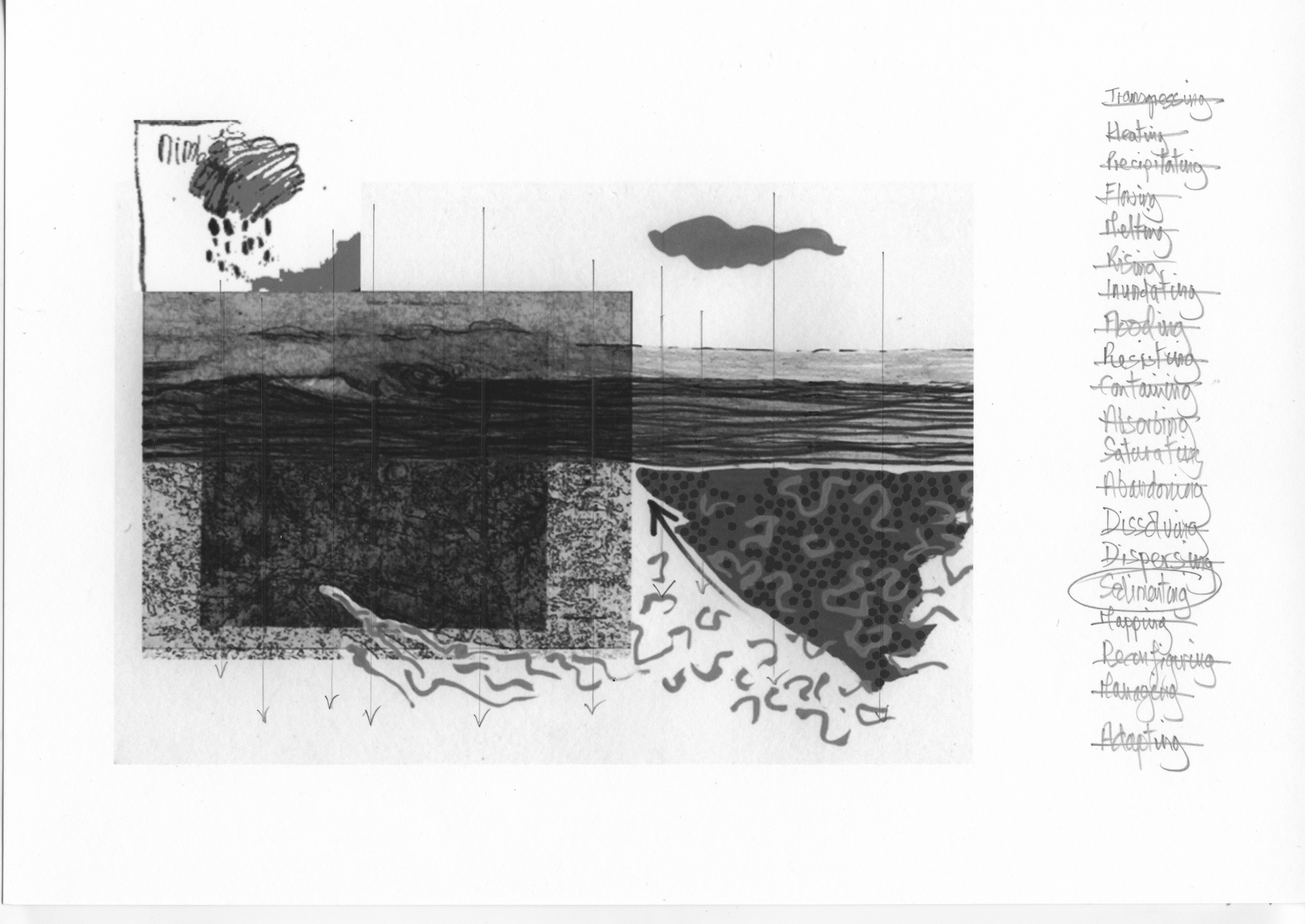
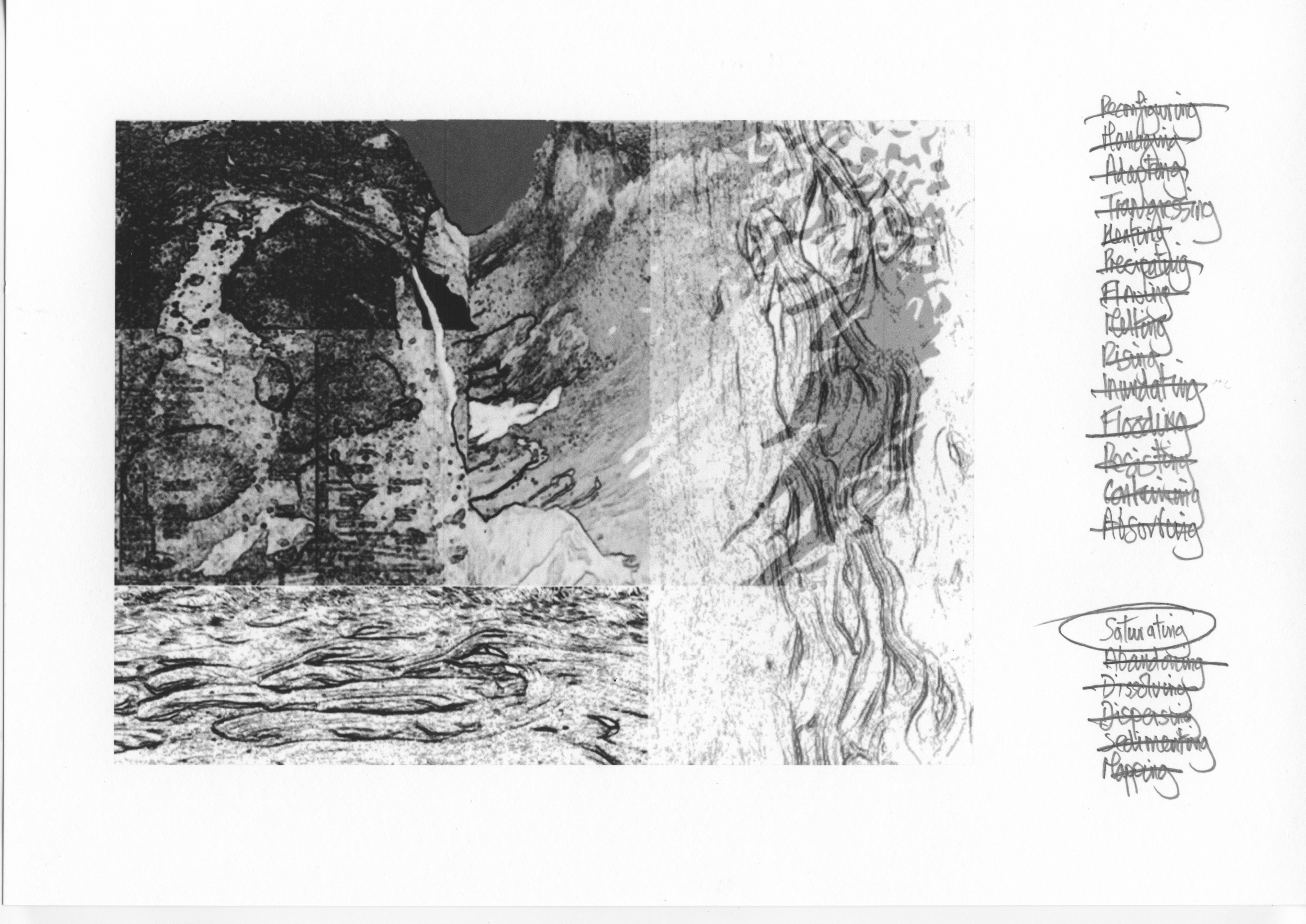
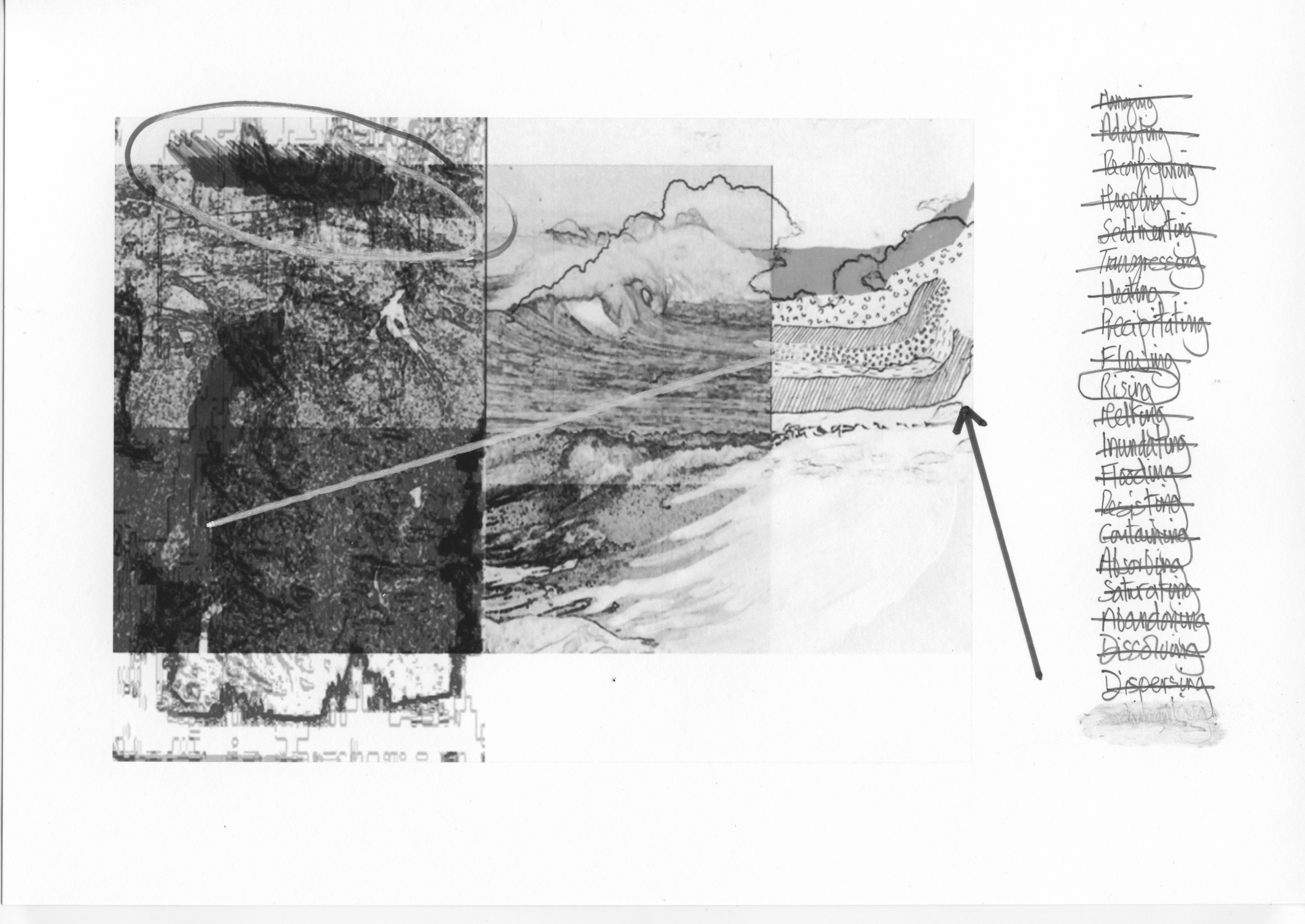
Four drawings from Transgression
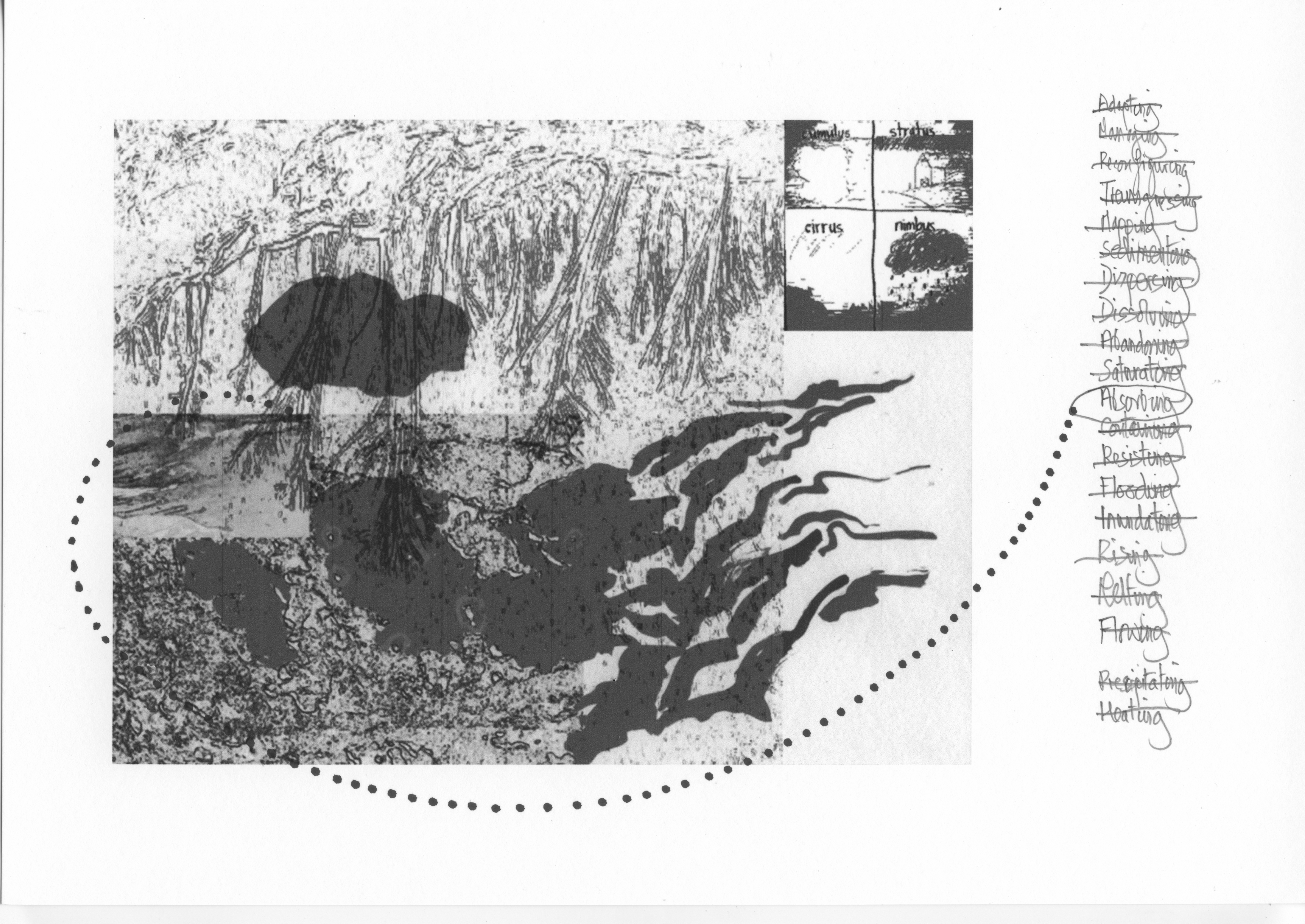
Transgression 10

Transgression 19

Transgression 9

Transgression 7

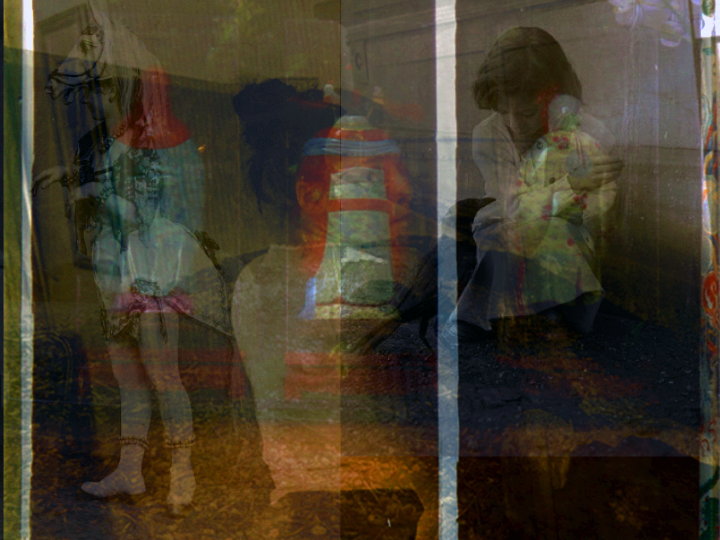
These are four digitally processed drawings from twenty made for a film by Antony Lyons and myself. It’s called Transgression: rising waters. Each drawing started with digitally scanned ‘found’ material that was then overworked autographically. The process was cumulative, with each image re-scanned and reworked to get a particular density. In some respects this mimics the geological process of transgression – that is to the way in which rises in sea level deposit sequences of sedimentary marine strata over terrestrial strata. The film deals with transgression in the context of climate change and I drew on visits to the cliffs at Aust on the Severn estuary, geological evidence of a desert that was later inundated by rising seawater.

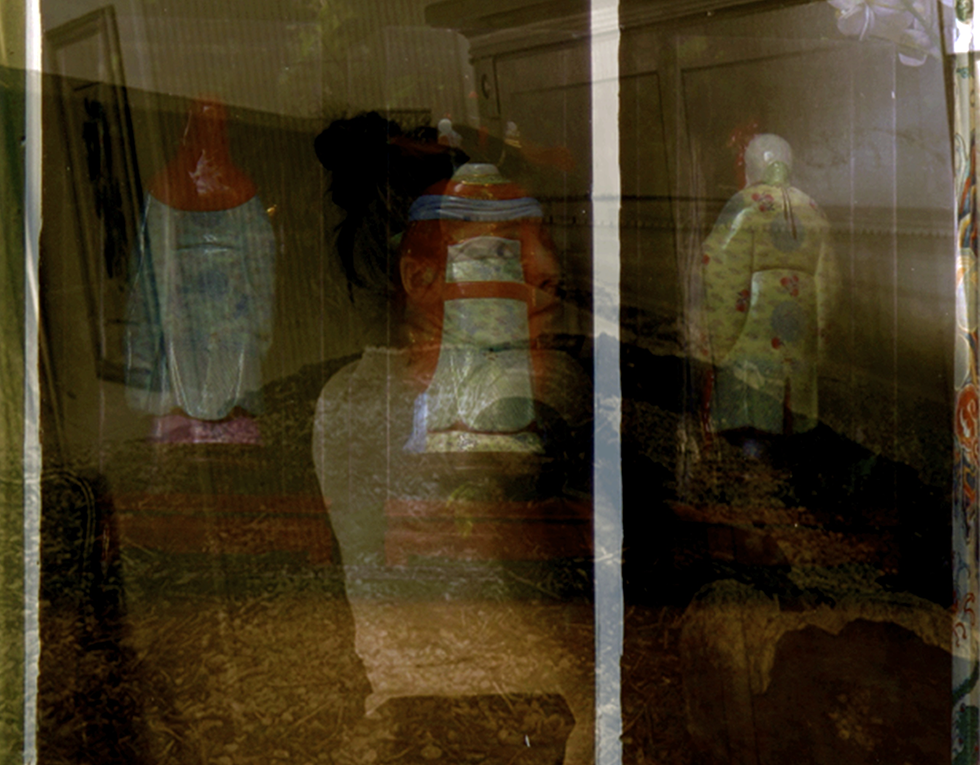
Terra Infirma: all grass is flesh (with and for Anna Biggs)
 Install shot

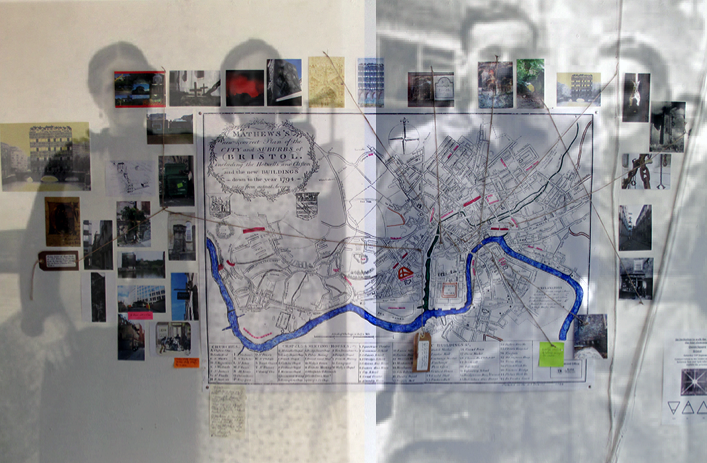
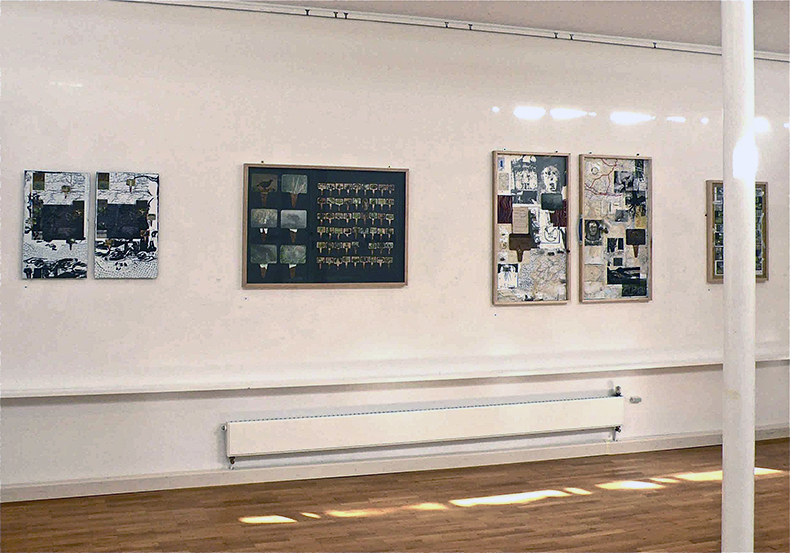
This is an installation made for an exhibition called Drawing Permanence and Place that toured in Wales, Holland and Germany. It maps my daughter’s life world and was made with her help. Because she’s suffered from chronic ME for over twenty years, her physical environment is restricted to two small but intensely known places. However this physical restriction is constantly challenged by her deep curiosity about all manner of concerns. A poetic drawing together of this constellation of interests provided the starting-point for the work.

 Improvised two-hour workshop with Ron Grimes at Holy Hiatus 2010
Unknown


Go to: http://vimeo.com/20650614

This is a short extract from a video of an improvised workshop run by Ron Grimes, a professor of Ritual Studies. Ron asked us to enact a burial ritual with an absolute minimum of speech. For me this raised questions about what, if anything, distinguishes an improvised ritual that maps an emotional geography in time from, say, the later actions of Alan Kaprow.

 Sacha Kagan, drawing on both Merleau-Ponty and David Abram, insists that we need to reclaim: “the animistic and synesthetic character of human perception”. This view, which I share, challenges conventional notions of drawing. If perception is understood for an animist perspective, we need a more inclusive and dynamic understanding of what it might be, particularly in relation to place.

This understanding is implicit in Edward S Casey’s insistence that “a place, despite its frequently settled appearance is an essay in experimental living within a changing culture”. This is differently inflected by Doreen Massey’s notion of space as: “a simultaneity of stories-so-far”, in that we are then implicated, or indeed immersed, in place-making as a complex on-going process involving narrating both human and non-human processes.

The issue of strata or levels of activity in all this is indicated by Tim Ingold’s notion of land as meshscape; as a “polyrhythmic composition of processes whose pulse varies from the erratic flutter of leaves to the measured drift and clash of tectonic plates” …. “a tangle of interlaced trails, continually ravelling here and unravelling there”. This reinforces Massey’s emphasis on simultaneity and extends the dynamic complexity implicit in Casey’s statement.

This sense of dynamic, multi-dimensional patterning brings me to Felix Guattari’s notion of ecosophy – which articulates a relationship between the environment, society, and the particular constellations of persona that make up our selves. Ecosophy is poly-ideational in that it recognizes that these layers or levels need to be understood as both particular systemic entities in themselves and as interdependent elements within a larger polyverse. Ecosophy is a radical departure from the presuppositions of scientism, capitalist economics, analytic reductivism, and the monotheistic religions. That is it challenges the presumption that all change can be made accountable to a single ideation, whether it’s scientific mono-naturalism, the profit motive, hyper-rationality, or the Divine Will. It’s Guattari’s ecosophical animism that allows Matthew Fuller to discuss forms of creative praxis that are “no longer only art” in that their “methods are recapitulated” and now “ooze out and become feral in combination with other forms of life”.

All this reinforces Anselm Franke’s claim – made in his introduction to the special edition of e-flux journal on animism in 2012 – that: “a ghost is haunting modernism – the ghost of animism”. And a re-emergence of animism requires a reconsideration both of drawing as a practice and of its history since Kandinsky’s encounter with shamanism in 1889. Animism left it’s unacknowledged trace in work by Kandinsky, Picasso, Miro, Braque, O’Keefe and Beuys, and more recently by Judy Dater, Elizabeth Ogilvie, Ken Kiff, Eileen Lawrence, Andrzej Jackowski and Glen Onwin – to name only a few. So how might we reorient our sense of drawing to acknowledge what modernist art history has repressed? To answer my own question I‘ll return to my three earlier examples.

I can’t show you how these drawings function in Transgression because there’s no final edit. However, I can tell you that the camera treats them as ‘raw material’, dissolves them as discrete entities by making each permeable to the next. It moves between images and details of images so that we never see the drawings as self contained, boundaried objects, only as evocations of an estuary in which mud and water flow endlessly in various permutations, dissolves, and tidal rhythms past rocks formed in ancient deserts. In short, the film itself draws with this material so as to suggest some of the constituent forces of a watery coastal meshscape in Ingold’s sense – an evocation that is then intercut with and bled into other, different yet related, evocations. Which is simply to say that they take their place in a wider polyverse.

I see Terra Incognita as a ‘drawing’, although not in any conventional sense. The term ‘drawing’ becomes accurate, however, if to draw is taken as an inclusive verb that always awaits a further dynamic; as indicating a relational cutting across of discrete categories – as transversal, to use Guattari’s term. To engage in drawing as a verb from an animist perspective is to place oneself in a dynamic relationship: as in the ‘drawing up or down’ of material to the centre or the peripheries of space and the senses; or in the ‘drawing out’ of meanings or resonances otherwise too compressed or ephemeral to register; in the ‘drawing together’ of apparently disparate elements into a particular constellation; or as in a ‘drawing through’ or ‘drawing out’ of a thread of intuition, argument, analysis and so on.

Drawing in this expanded sense – as an act animating particular, multiple, forms of relationality – is the base-line activity of the dynamic compound entity that constellates my daughter’s life – which is unexpectedly rich despite the severe limitations imposed by her illness. Obviously in the context of relating to place and being placed, an expended sense of drawing gives us a better understanding of the complex reciprocities that, ecologically, socially, and psychically, animate and orient our lives. Reciprocities that, when properly recognized, require that we remain open to the dynamic meshes of ravelling and unravelling in which we are each particular locations and instances.

Finally, acknowledging the animist haunting of modernism restores the possibility of a more honest and open relationship between artful drawings – in, -out, -up, -down, -together, -apart, etc. – and ritual. Ron Grimes has demonstrated, through both critique and practice, that rites and rituals need not be normative, conservative, and mono-ideational. They can be understood instead as experimental essays in Casey’s sense. In Rite Out of Place: Ritual, Media and the Arts, and writing in the context of ecological crisis, he notes that: the urgent task is not in deciding which is deepest – spirituality or politics, religion or theatre – but instead learning how to nurture an attitude of interconnectedness that reconnects us to planetary life. And in the terms I’ve suggested here, this means attending to our being drawn into the matter of the world, placed by all the forces at play there; drawn out of ourselves into new meanings or as a resource in larger assemblages; drawn together into new constellations, despite and with our differences; or drawn into otherness as a result of following threads of intuition, argument, analysis, and so on. And all these events should, in turn, inform our expanded acts of drawing.
Notes on George Lakoff’s ‘Why It Matters How We Frame The Environment’

Slide1

“Reflections (polyverse)”

Well I suppose ‘happy New Year’ would be a good start, although I’m not sure it’s going to be given the present state of things.

Be that as it may, below are some notes I’ve been working on.

Introduction

Cathy Fitzgerald introduced me to the work of George Lakoff, some of whose ideas are explored below. Lakoff is an American cognitive linguist and political analyst, who has drawn together insights from disciplines including cognitive linguistics, cognitive psychology and recent neuroscience, to show how our brains develop frames in order to understand our life worlds and why, as a result, it is very difficult for most people to absorb the dramatic changes that result from our new environmental, social and psychological realities.

1. The function of ‘frames’

The significance of Lakoff’s article rests with its discussion of ‘framing’ and ‘frames’ or schemas, the “typically unconscious structures” that “include semantic roles, relations between roles, and relations to other frames”(71). These might be said to be the building-blocks that make up the mentalité of a cultural group: the collective, felt understanding that makes up the society and world in which a person lives, and determines their place within it – a worldview or outlook. Frames are what structure our thinking (and feeling) and are apparently “physically realized in neural circuits in the brain” (ibid). Words, particularly what we have referred to as ‘power words’ (‘art’, ‘society’, ‘digital’, ‘activism’, etc.) activate both their own immediate defining frame and much of the larger defining system within which that frame sits.

Lakoff insists that the fact that we “cannot avoid framing” means “there are limited possibilities for changing frames” (ibid). This is clearly a central consideration with regards to any claims to activate either ‘active citizenship’ or ‘socially engaged’ or ‘activist’ art, or indeed the supposedly radical ‘enabling’ power of the Internet. All these would need to reframe the dominant  ‘bureaucratic’ framing of the world – with its practice of “speaking as and on behalf of nobody in particular and everybody in general” (Finn 1996: 167) – which is also the framing enacted by the PR and advertising of corporations such as IBM when making claims that relate to techno-science.

Lakoff suggests that to address the problem of framing it is not enough simply to introduce “new language” – a new concept or set of terms, for example – since any innovation “must make sense in terms of the existing system of frames” and “must work emotionally”. He also adds: “negating a frame just activates the frame, as when Nixon said ‘I am not a crook’ and everyone thought of him as a crook”. This understanding of the effect of negation might have important implications for academic critique, which tends to advance arguments via processes of undermining, demolishing, or negating previous conceptual positions or understandings; an approach that, in its extreme postmodern form, becomes a framing or “state of mind marked above all by its all-deriding, all-eroding, all dissolving destructiveness” (Bauman 1992: vii-viii) – an orientation underwritten by the hermeneutics of suspicion largely predicated on the thinking of Marx, Freud and Nietzsche. (An obvious exception to this tendency would be Paul Ricoeur’s ‘critical solicitude’). This might account for the fact that academic arguments usually have very little success in countering dominant attitudes and prejudices

Additionally, the academy’s emphasis on Enlightenment or ‘scientific’ notions of reason – which Lakoff cites as being dominant in public policy, science, economics and law – are undermined by what Lakoff calls: “’Real Reason’, the way we really reason”, which is “mostly unconscious (98%); requires emotion; used the ‘logic’ of frames, metaphors, and narratives … and varies considerably, as frames vary” (ibid). It is also embodied. This clearly allows one to argue that creative practices are much more ‘Really Reasonable’ than the dominant binary art/science framing perpetuated by the traditional academic position implies.

Again, what is central to our concerns here is the conclusion Lakoff draws from this with regard to issues of public debate such as climate change. The ‘rationalist’ assumption of those remaining professionals not wholly in the thrall of political ideology – those whose positions of power and authority are underwritten by their engagement in public policy making, science, economics and the law – “may believe that if you just tell people the facts, they will reason to the right conclusion” (ibid 72-73), without any regard for the need to ensure that “the facts must make sense in terms of their system of frames, or they will be ignored” (ibid 73). At present, for example, there are both massive amount of factual information about climate change and other environmental issues available and plenty of rational arguments as to how we should respond to these facts. What is lacking, according to Lakoff, are the “environmental frames” or “the (typically unconscious) conceptual structures” that people need to have in place in order to understand and act on environmental issues. This implies that the place where the concerns of socially engaged artists and active citizens should converge is in a common understanding of the need to build, and encourage action on the basis of, new framings – which Lakoff rather reductively claims are “communicated via language and visual imagery” – that are not based simply on the negation of the previous framings. As he puts it: “what is needed is a constant effort to build up the background frames needed to understand the crisis, while building up neural circuitry to inhibit the wrong frames” (ibid 74).


2. The isssue of Hypocognition       

Lakoff’s definition of hypocognition as: “the lack of ideas we need” (ibid 76) seems to me – and not least in the light of his own argument about Real Reason (see above) – too reductive in its emphasis on ideas, a term framed for most of us in ways that privileges conscious reason over felt understanding. In my view this limits its usefulness to us in terms of our current project. I would suggest that it is more productive for us to understand hypocognition in terms of the inhibiting effects of the presuppositions that underpin the dominant framings in our culture. Why I’ll try to make clear below.

In the context of environmental concern, I would argue that we actually have, buried within our existing cultural heritage, all sorts of traces of the mentalité necessary to help us engage properly with the environmental crisis – very generally speaking this is what anthropologists refer to as ‘animism’ (I’m drawing here on Tim Ingold, Jane Bennett, etc.) and that Felix Guattari has rebranded as ‘ecosophy’. But if we wish to enable general access to this tacit animism in our existing cultural framings, we have both to foreground and ‘update’ those traces and to inhibit the outcome of the thousands of years spent constructing the framings of the Religions of the Book that served to ‘outlaw’ animist mentalités in the West and Middle East (albeit never entirely successfully). That is to say we have to understand and address the major religious/cultural mentalité and framings predicated on the presuppositions of monotheism – as a psychosocial mentalité rather than as theological dogma – a mentalité that the culture of Enlightenment science inherited in a radical secular form (Gellner 1992: 94-95).

This is why, arguably, a historical period marked by increasing concern to find new forms of understanding that can address our environmental crisis has also been marked by a rise in political fundamentalisms predicated on the framings constructed (often without any real theological justification) on the literal reading of the sacred texts of the religions of the Book – whether these take the form of a rabid Zionism; the Christian fundamentalist zealotry of the Republican Tea Party, or Islamic terrorist groups fighting for the universal imposition of Sharia Law. Within the dominant secular monotheism of our culture of possessive individualism the three most powerful framings are economic fundamentalism or capitalism – the belief that economic values are the ultimate framing – and techno-scientism and aestheticism, which as a pairing sustain themselves through a binary process of mutual antagonism that masks a mutual interdependency.

By ‘scientism’ or ‘techno-scientism’ I am referring to belief in the unlimited efficacy of techno-science. Namely, to a pervasive, largely unconscious, deeply felt belief in, relationship with, and desire for, a particular way of life predicated on unlimited and unending, technologically underpinned and enabled, consumption. A world of consumption in which techno-scientific innovation is also presented as, simultaneously, the basis for unlimited economic and personal growth; the cornerstone of both social aspiration and social cohesion and; equally simultaneously and paradoxically, the solution to environmental dis-ease resulting from over-consumption. This tangle of contradictory and logically unsustainable beliefs is now integral to our culture of possessive individualism and is endlessly promoted in the name of individual ‘choices’, ‘identities’ and ‘lifestyles’. These are in turn glossed by a culture of aestheticism mediated by techno-design that is increasingly indistinguishable from the virtual world created and sustained by the advertising industry. This conflation is facilitated by the fact that possessive individualism requires us to take as given that creativity or originality are exclusive to, and owned by, a unique individual, and is neatly illustrated by Charles Saatchi’s role in the exploitation of contemporary art to lend a ‘radical’ credibility to the culture/advertising nexus necessary to Margaret Thatcher’s ‘popular capitalism’.

The above scenario, in which scientism and aestheticism are, through the reciprocity of techno-science and the psychology that elevates the application of aesthetics to techno-design, ultimately mutually reinforcing, also helps underpin not simply our politic life and social institutions but a more fundamental “complex of assumptions about personhood, about nature and about society” (Leach 2007: 100). The role attributed to novelty and innovation in contemporary art, when mediated through conspicuous consumption and techno-design is, as already indicated, central to this scenario. Possessive individualism, which in contemporary Western culture is ultimately inseparable from aestheticism as understood here, is also the antithesis of the inclusive, ecosophical conception of care towards which we must now move in order to survive.

Like scientism, aestheticism is intrinsic to the dominant global culture, predicated as it is on the binary thinking of a now secular monotheistic mentality. Aestheticism is understood here as a belief ultimately predicated on the artist seen as “Aesthetic Adventurer”, a personage elevated above “the common run of humanity” (Morgan 1989: 16) whose ‘bohemianism’ (as it appears in the popular imagination) can be used to glamorize the pathological elements of possessive individualism. While techno-science is equated with truth and utility, with the supposedly ‘objective’ delivery of serious knowledge, and with economic prosperity (through its relationship with technology); art as its aesthetic ‘other’ is both marginalized and elevated as offering individuals “the possibility … to make visible the unseen (or deleted) dimension” of work and of a unique ‘self’ (Leach 2011:145). This possibility is, however, recuperated for the market through the processes by which techno-design, through referencing the aesthetic appearance of art and the aura of ‘uniqueness’ this is presumed to bestow, as a matter of life-style choices.

3. Ways forward?

In terms of our concerns, I would locate all the above to the view that certain aspects of contemporary art practice are becoming, to quote Matthew Fuller: “no longer only art”, given that “its methods are recapitulated” and now “ooze out and become feral in combination with other forms of life” (2011: 45). Arguably, this shift is potentially transformative in ecosophical – that is psychosocial and environmental – terms.

However, how transformative will depend on reversing current exclusions predicated on dominant framing systems, since such exclusions prevent us addressing the interwoven issues of place (physical/environmental) and placing (social/personal) in their fullest senses. These exclusions always relate to issues of social power and identity on a number of levels and, following Jane Rendell (drawing on Leplanche), may be said to work in favour of the status quo by disabling, marginalizing, rendering invisible or ‘deviant’ those social groupings whose ‘minority’ framings and expectations might otherwise provoke new cultural and creative work relevant to their own civic health and continuity (Rendell 2013: 135). This situation of exclusion is further complicated by the fact that, as Jane Rendell also reminds us: “the very act of naming an emergent practice” – for example as ‘relational’, ‘socially engaged’, etc. – “makes such a term vulnerable to the process of recuperation” (ibid: 136) by dominant intellectual, social and aesthetic orders, thus denying it of its social force, (as Anna Grear argues has already happened in the case of corporate appropriation of human rights and sustainability terminologies).[1] 

My contention in all this, perhaps obviously enough, is that we need to try to find ways of reframing, in more open and ‘animist’ or mycelial forms and contexts, those ‘deviant’ aspects of the creative arts and technological innovation that are not wholly oriented to, or underpinned by, notions of what is ‘virtuous’ according to the belief/framing systems of techno-scientism and aestheticism. The dilemma we are faced with would appear to be a variation of one identified by Geraldine Finn in relation to feminism. I take her to suggest that it is both understandable and politically indispensible that, as active citizens, we make claims against the system with regard to personal, social and environmental change “in terms the system recognizes as reasonable, rational, and possibly right”. But that, in addition, we take care not to start to believe in the framings that underpin the “articulated and authoritative categories, norms, and values” of that system, since these are never “commensurate with life”. And that we help ourselves to do this by understanding and acting on the truth that: “we are always both more and less than the categories that name and divide us” (Finn 1996: 171). This remains, however, a somewhat abstract rule of thumb in the context of the immediate issues that confront us.

So does Lakoff have anything more practical to offer us?

It may be useful to begin by noting that his claim that: “The economic and ecological meltdowns have the same cause, namely, the unregulated free market with the idea that greed is good and that the natural world is a resource for short-term private enrichment”; his identification of the psychological driver here as “short-term greed”, and his emphasis on causes being “systemic, not local” (Lakoff 2010: 77) parallel Guattari’s three ecologies – the personal, the social and the environmental. However, while useful, this must be understood alongside his point that: “frames become reified – made real – in institutions, industries, and cultural practices” and that these frames don’t disappear until the institutions, industries, and cultural practices do.

While the time-scales implicit in this observation are sobering, they do not correspond to those suggested by sociological analysis of the problem “inherent in any attempt to describe a new mode of knowledge production”; namely, that the status quo now does all it can to ensure that “nothing recognisable as knowledge … be produced outside of the socially dominant form” (Gibbons, Limoges, Nowotney, Schwartzman, Scott & Trow 1994: 1-2). These authors suggest that, while real change in intellectual framings may be delayed by a series of well-understood strategies used in the realpolitik of academic life, these become less effective once the generation(s) majorly invested in that status quo have died or no longer hold institutional authority.

This whole situation is further complicated, however, by the fact that normative criteria linked to ‘market success’ now dominate the education system, particularly at the highest level where it coincides with research. As a consequence notions of education predicated on a commitment to being-as-becoming – rather than as training for a professional ‘life as’[2] – are increasingly struggling to find opportunities to identify and facilitate alternative forms of praxis.

Lakoff’s principle argument in relation to such points is that we need to find effective ways to counter “the powerful conservative forms of resistance” (Lakoff 2010: 79) to what I want to call an ‘animist’ or ‘mycelia’ reframings that parallel Guattari’s notion of ecosophy. However, what is not clear from his paper is how this is to be done while avoiding an activation of the dominant framings by negating, repeating, or structuring an argument so as to counter the dominant framing.

But I need to explore recent writing on this issue of animism by Isabelle Stengers and Michael Taussig before I can think this through any further.


[1] Anna Grear Dahrendorf Symposium 2013: Panel Social and Legal Aspects of Climate Change http://www.youtube.com/watch?v=4iR6DIwTe4Y&list=PLVyW-1uzF8Dbvjd-6k8K9FumU9E1sNTSt

[2] The term “life-as” derives from the sociology of religion (see Heelas & Woodhead 2005), and refers to any pre-established categorical understanding in which being is predetermined by fixed conventions or presuppositions – whether religious or secular – or what Lakoff refers to as a framing. In my understanding here ‘life as’ stands over against the in-between-ness identified with transversality and the work of Geraldine Finn.


On The Road

IMG_1198

I have been out and about a good deal – ‘on the road’ in a return to how things were when I first began working as a peripatetic visiting lecturer back in the 1980s. Odd.

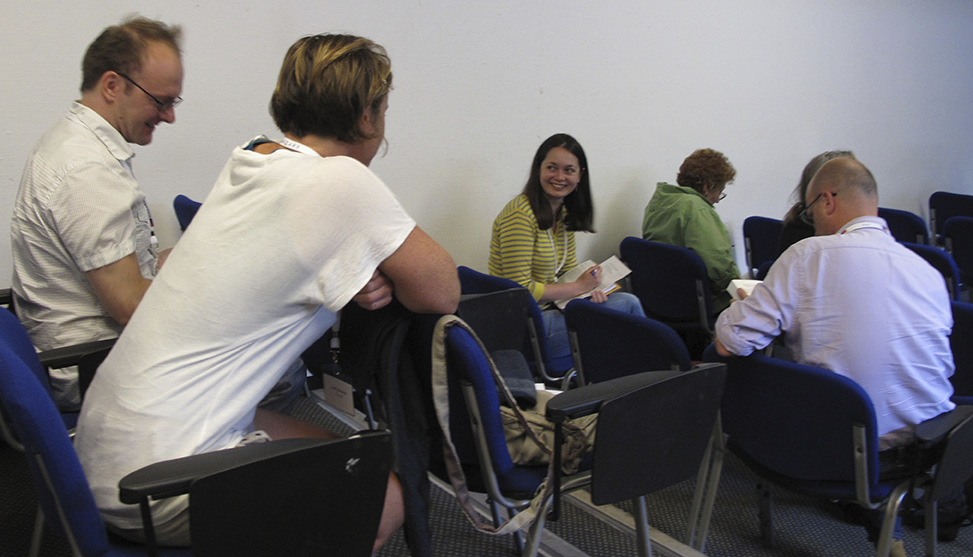
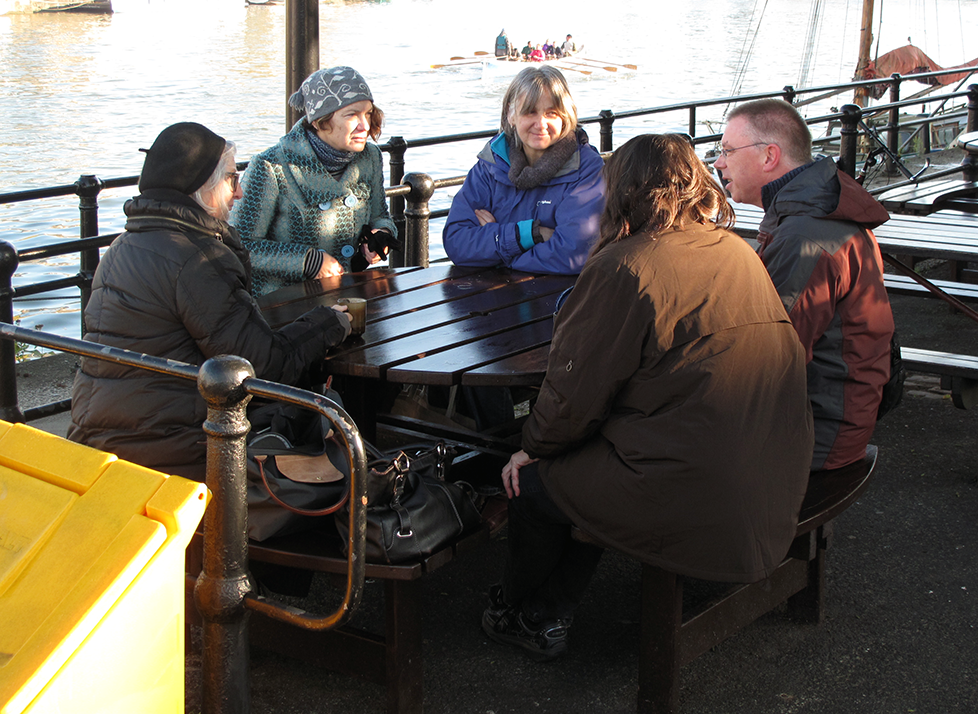
First, however, there were two very interesting days at the Transgressions conference here in Bristol, where Antony Lyons and I presented our seventeen minute film of the same name. It was very good to meet up with old friends and fellow travellers – the photo above is of (left and then clockwise) Gini Lee from Melbourne, Rebecca Krinke from Minneapolis St Paul, the film-maker and ME/CFS patient advocate Natalie Boulton (who is also my wife), David Smith from UWE here in Bristol, and Mary Modeen from Dundee – and to meet a bunch of new and interesting people. Among the material generated by those new (to me) people I was particularly impressed by Renata Tyszczuk’s presentation – The Satelite and the Fly – which offered an extraordinarily concise and effective ‘ecosophical’ insight into our current environmental situation. (You can find her research at http://www.shef.ac.uk/architecture/people/tyszczuk_r). I then flew north with Mary to spend two days working at Dundee, mostly with her Arts and Humanities MA students, before going south again with them to Leeds, where Judy Tucker had organised a two day symposium around issues of place. There I caught up again with Judy and the poet Harriet Tarlo (with whom Judy collaborates), along with other old friends who teach at the university there.

Three lectures, two seminars, a dash of studio teaching, and the usual level of participation in a symposium when you’re an ‘elder’, may seem a lot of work in under a week but, talking with Gini, Rebecca, Dave Littlefield (who was an organiser of Transgressions), Mary, Judy, Harriet and others with whom I share common cause was a great pleasure and a source of real energy.

Perhaps because of all this travelling I notice I’ve even started to learn to be more patient, knowing that it takes time to process images and ideas and for them to find their place in my imaginative processes.

Photographs I took during my previous trip to Dundee in the summer are only now beginning to surface in a creative context. Where they’ll finally come to rest I don’t know, but at present the centre of gravity for imaginal work remains the proposed third bookwork in the Debatable Lands series. This is currently looking like being a novelistic evocation of life on the Borders, a lengthy mix of image and text (currently running to almost 60,000 words) dealing with three generations across the C20th and into the C21st in which two sisters, Lizzy and Kate Oliver, play a central part. Not at all what I had intended but, like Between Carterhaugh & Tamshiel Rig where the whole Borders project started, as much a matter of ‘inner necessity’ as anything else!

I include one of Kate’s photographs for this work below, which utilises a photograph taken in Dundee. So it goes.

Kate's photo

PS re ‘different voices in education’

Having posted some thoughts on the different voices coming out of universities yesterday and subsequently finally caught up with my newspaper reading, I now see a headline in The Guardian Financial section that reads: “Economics lecturers accused of clinging to pre-crash fallacies”. Of course to those of us who know how the academy works, this kind of comment will come as no surprise. My wife Natalie Boulton, a film-maker and patient advocate, is constantly having to point up the fact that supposedly up-to-date dictionaries and medical textbooks continue to perpetuate damaging nonsense that has been disproved years ago but which continues to serve certain powerful vested interest groups whose status and ability to win lucrative research grants depends on that act of perpetuation. It now appears that this situation is equally common in economics. All of which needs to be considered in a broader context. My friend Cathy Fitzgerald has just drawn my attention to an interesting and powerfully argued piece at:  http://opinionator.blogs.nytimes.com/2013/11/10/learning-how-to-die-in-the-anthropocene/?_r=2& which includes the observation:

“The biggest problem we face is a philosophical one: understanding that this civilization is already dead. The sooner we confront this problem, and the sooner we realize there’s nothing we can do to save ourselves, the sooner we can get down to the hard work of adapting, with mortal humility, to our new reality”.

If by a civilisation we mean a certain dominant mentality and way of acting, which here I would see as the exclusive, narrow, disciplinary basis of our hyper-professionalised world predicated on possessive individualism, then this sounds to me about right. Professionals, whether they are economists, psychiatrists, senior university administrators, or whatever, will it seems always prefer to perpetuate the theories and explanations that maintain their own authority, no matter how powerfully the reality of events has demonstrated them to be entirely wrong. No wonder, as Michael Gibbons, Camille Limoges, Helga Nowotney, Simon Schwartzman, Peter Scott, and Martin Trow point out in their The New Production of Knowledge: The Dynamics of Science and Research in Contemporary Societies (1994), that it frequently require a whole generation of professionals in a discipline area to die before anything genuinely new can appear jun that discipline’s thinking!


Different ‘voices’ in Higher Education

IMG_3711

Despite my semi-retirement I retain a keen interest in what’s happening in Higher Education, not least because it’s supposed to be where the best brains of the future are being educated. (More on that in a moment). So I’m fascinated by the very different kinds of blogs that seek to reflect on the current state of HE. On the positive side there’s the blog written by Ferdinand von Prondzynski, Principal and Vice-Chancellor of Robert Gordon University, Aberdeen, Scotland, who was formally President of Dublin City University, Ireland, between July 2000 and July 2010. A lawyer by training, and with some voluntary and business interests, he is also known as a writer, public commentator and photographer. He almost always has something interesting to say and I always look forward to seeing what he’s added to http://universitydiary.wordpress.com/

Part of the fascination of von Prondzynski’s Diary is that he is quite willing to speak his mind on controversial issues. This characteristic stricks me as being fairly unusual in Vice-Chancellors – who in my rather limited experience tend to favour the safely bland and platitudinous. A good example of von Prondzynski’s critical ruminators – and the one that first caught my attention – is on the chronic failure of the disciplinary mindset to meet the obligations of society. (His thoughts on this topic and on its wider social implications can be found at the post for 2010/10/14.

In this post he makes it clear that for some time he has thought that: “attachment to the traditional disciplines is making it harder for universities to adapt to changing circumstances”. Quoting Professor Elaine Ecklund of Rice University’s Institute for Urban Research, he suggests that it may now “be necessary to abandon disciplines in order to ‘think beyond old boundaries’”. This is the case because “the problems universities are asked to help solve all tend to lie between disciplines”. Yet universities – which are still overwelmingly organised on a disciplinary basis for administrative reasons and, more fundamentally, because it is the ground of the power of the status quo in academic realpolitik – have endlessly pontificated about embracing interdisciplinary methodologies while, in practice, doing very little or nothing to move on from the disciplinary stranglehold. Von Prondzynski is under no illusions as to the tenacity of the disciplinary system – suggesting that breaking it down “would be very difficult and could meet very significant resistance”; while indicating that change is necessary if universities are to “regain society’s trust and confidence”.

While I’m wholly in agreement with Von Prondzynski, I had wondered about how one might identify the practical impact of this archaic system on the body politic. A recent TV programme answered that question in no uncertain way. In this a Swedish statistician looked at the myths that surround issues like family size and literacy in the ‘developing’ world and demonstrated that, in England, the general population who left school after secondary education are better informed about these issues that those with a university education.

At the other end of the spectrum of HE commentators there’s The Secret Administrator, a (possibly dyslexic) individual who writes about the University of the West of England which is, of course, where I used to work. His/her blog is basically a one-institution version of Laurie Taylor’s regular pieces for the THE, drawing attention to what the writer sees as the vanities and other short-comings of the university’s senior management. While it would clearly be foolish of me to comment on the detail of this blog what I can say is that, as somebody who has visited a great many different universities in the last few years, its general tenor is pretty indicative of how the ‘foot soldiers’ who deliver HE on a daily basis feel about their managers. (And, I might add, how most of the nurses I met during my cancer treatment in Bristol felt about theirs).

It’s not difficult to understand why this is the case. Put very simply, we have an increasingly harassed – some would say bullied –  ‘shop floor’ workforce which is still, to a considerable degree, motivated by a sense of a people-oriented vocation. And this group is now managed by an (ultimately parasitic) administrative / managerial class that – with honourable exceptions – appears to have wholly internalised a culture of audit based on distrust. This class appears to be very largely motivated by a mixture of self-aggrandisement and an abject conformity to the demands of the dominant political ideology. What is blindingly clear is that this situation is not good for education or for health care. What is not clear is how, given the pervasiveness of the mindset that has produced it, we can change this.


A trip to Ireland, some recent photos, and mycelial thinking …

IMG_1059

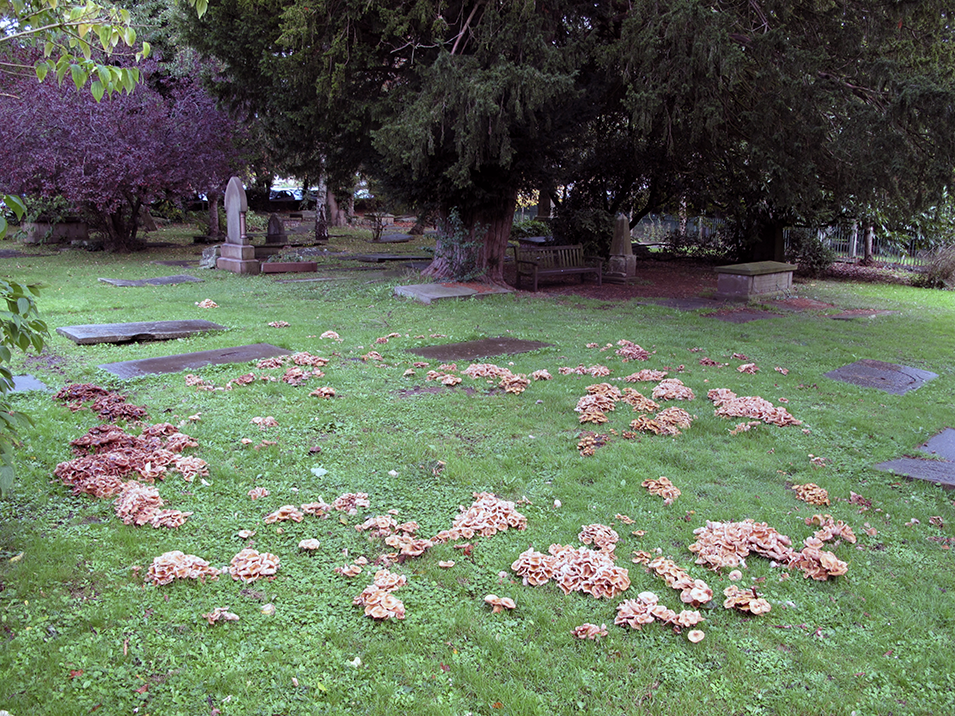
Recently we had a sudden and brief eruption of fungal growth resulting a a ragged version of a ‘fairy ring’ in the old graveyard in Clifton – new life from old. I’ve had the no doubt extensive mycelial mesh beneath these strange fruit on my mind since I took this photograph. This image has now become linked in my mind with the fact that I have just returned from three days of animated conversation and warm hospitality in Ireland, during which time I stayed with two artists with whom I’ve been working who are each part of wider mycelial networks of their own. These two were Cathy Fitzgerald (http://www.cathyfitzgerald.ie) who I stayed with at her home in the middle of Hollywood – now officially on the map, as Cathy proudly showed me – and Pauline O’Connell (http://paulineoconnell.com), along with Eamon Colman and their son Ruben in Kilkenny.

I was in Ireland for a number of different but finally linked reasons, the most fundamental of which was my continuing search to find, listen to, and establish links with creative people of all kinds who are open to working for the development of a multi-constituency thinking. A thinking that, following conversations with Antony Lyons, I’ve come to think of as ‘mycelial’ in its approach to building connectivity and the potential for active community. The trip was very productive in that I think there is an understanding of the importance of cultural engagement with rural issues in Ireland that chimes very closely with my own concerns. I sense this as part of a shifting pattern of energies that, like Eamon Colman’s paintings, brings a sense of occasional joy despite the general gloom.

Of course this can be misconstrued – I’m not interested in the rural as something ‘other’ set over against the urban – but because I think our deepening ecological problems are most visible there – sometimes starkly so. These are problems that can only be addressed ecosophically, that’s to say as at once environmental, social and personal, each level of activity shifting in response to the other. Fortunately there seem to be a growing number of people willing and able to sense and respond to the demands of these shifting forces.

IMG_1169IMG_1132

IMG_1176

IMG_1142

Before I went to Ireland I had been working with an international group who are thinking about problems of coastal flooding and all that involves. The project – a series of Between The Tides workshops – was organised by Owain Jones, Antony Lyons and Bettina van Hoven and has enabled me to start to think about possible future work in that area and to open up links with ongoing research that relates to the deep mapping project I was responsible for in Cornwall.

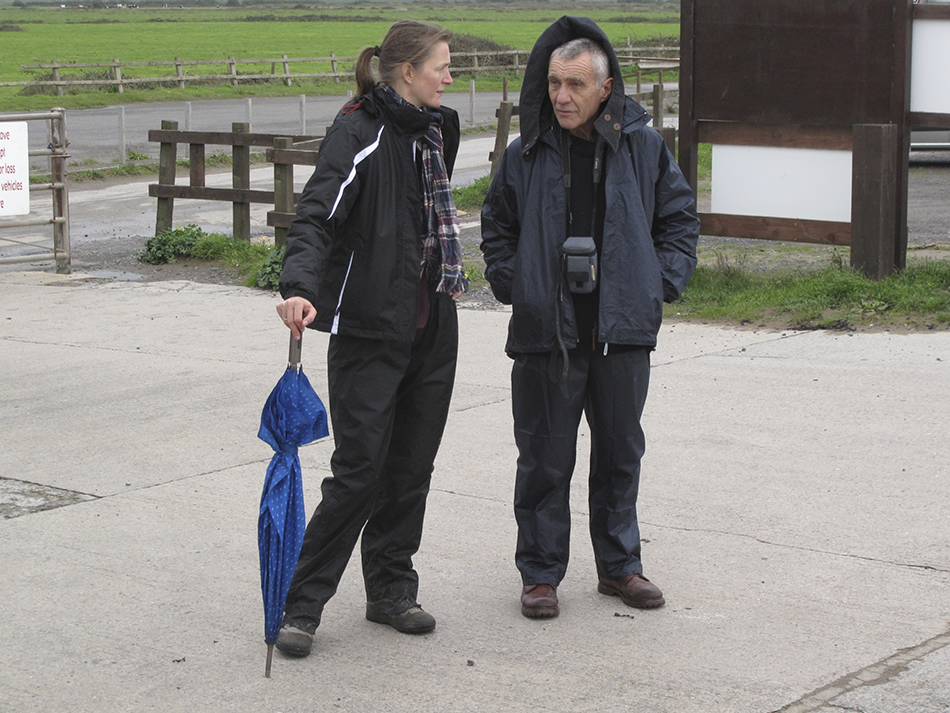
The image below is of Bettina van Hoven and my old friend Simon Read, who has been working tirelessly on environmental issues around coastal erosion and the protection of salt marsh over many years. The photograph was taken down on the levels below Brean Down.

Simon and bettina


Predictability, security, and creative mutations


Slide1

It’s often productive to read more than one text at a time because of the unexpected cross-fertilization that result. This has been the case for me with reading the International Federation of Red Cross and Red Crescent Societies’ Think differently, Humanitarian impacts of the economic crisis in Europe – see http://www.ifrc.org/en/news-and-media/features/european-economic-crisis/ – in the middle of working my way through Tom Finkelpearl’s What We Made: Conversations on Art and Social Cooperation (Duke University Press 2013). The particular cross-fertilization I want to pick up on here is between observations made by Daniel Joseph Martinez – a professor of theory, practice, and the mediation of contemporary art at the University of California, Irvine – and the opening statement of the IFRC’s report. This reads:

“Creating a sense of predictability and security has traditionally been attributed to what a society offers to its citizens.

Today, as the economic crisis has planted its roots, millions of Europeans live with insecurity, uncertain about what the future holds.

This is one of the worst psychological states of mind for human beings and we now see a quiet desperation spreading among Europeans, resulting in depression, resignation and loss of hope for their future”.

I know quite enough about living with insecurity – in my case to do with unpredictability around medical responses to my daughter’s longterm illness – not to wish unpredictability and insecurity on anybody at the level of their familial, day-to-day life. However, the assumption that the function of society has traditionally been first and foremost to create a sense of predictability and security for its citizens seems to me a little simplistic to say the least and, at least in my view, needs contextualising. There are, I suggest, some very particular modern and secular assumptions at work that don’t necessarily sit very well with what we know of European history.

It’s in this context that Martinez’s observations seem particularly pertinent.

Asked about changes in his practice in the mid-1990s he refers to the importance of mutation, of being willing to see practice as “unpredictable and uncontrollable”, and of the value of this as a basis for ideas where the emphasis is on creativity in a social context as in “perpetual motion, constant flux” (Finkelpearl 2013: 70). The contrast between this understanding of creative arts practices – and as someone much influenced by Joseph Beuys’ notion of Social Sculpture we can be reasonably certain he would extend this to creativity more generally – and the emphasis, in the IFRC’s report, on predictability and security strikes me as worth exploring. After all, in the context of creative imagination it’s fairly obvious that a degree of uncertainty about what the future holds can be a useful, indeed highly productive, state of mind.

A book that made a very marked impression on me in terms of mapping shifts and clashes in historical mentalités is Emma Wilby’s The Visions of Isobel Gowdie: Magic, Witchcraft and Dark Shamanism in Seventeenth-Century Scotland (Sussex Academic Press, 2010). It illuminates, in extraordinary detail, the point of interaction between two radically different mentalités: on the one hand that of a traditional peasant culture in which vernacular quasi-pagan beliefs co-existed both with residual elements of the Catholic faith and of the new Protestantism and, on the other hand, the new social order predicated on an essentially middle and upper class Calvinism. What is particularly significant about this clash here is that each of these mentalités, which uneasily co-existed for a while, would have understood predictability and security in very distinct ways and have valued them very differently. For example, for the vast majority of the rural poor in Calvinist Seventeenth-Century Scotland one of the very few things they know for certain was that their social status would not improve in this life and that, as born sinners who found themselves within a religious orthodoxy based on predestination, they were almost certainly condemned to the fires of Hell in the next. In terms of predictability, Wilby also makes very clear the almost unbelievable predictability, monotony and restrictions of the ordinary life or a Scottish peasant at that time.

While I have clearly chosen extreme examples, I want to make the point that neither predictability nor security need necessarily be the unalloyed or necessarily obvious ‘good’ that the report assumes them to be. What we take to be predictable – be it eternal damnation or, in the case of the mentalité of possessive individualism, the ‘sustainability of economic growth’ – may be nothing more than a delusory phantom, one on which we become so fixated that we cannot imagine an “otherwise”. Arguably it was precisely because of her creative ability to imagine an “otherwise”  through a creative synthesis of vernacular and other traditions and beliefs that Isobel Gowdie was executed. The predictabilities and securities we buy into may, then, also be the means by which we are manipulated by those who hold power in a society.

Which returns us to Martinez’s points about creativity and the unpredictability of mutability.

I don’t want to labour the point here, not least because I really do not in any way wish to imply that predictability and security are not vitally important to human society and wellbeing. My point is simply that unpredictability and insecurity, particularly as these help us see through phantasmagoric worlds such as that created by the current British government (which is actively working against both the spirit and practice of all six of the recommendations of the IFRC’s report), have their place too. Particularly where they act as a spur to a creativity that allows us to imagine the world “otherwise”.

Slide1    

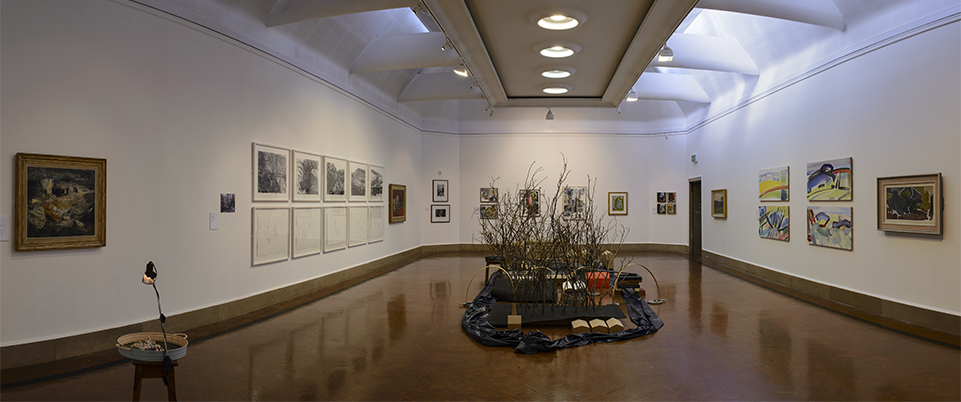
Works in Landscape, Art and Uncertainty exhibition at Southampton City Art Gallery

pano1

Installation shot of exhibition on from 7 September 2013 – 5 January 2014
Gallery 8 (photo Christian Shaw)

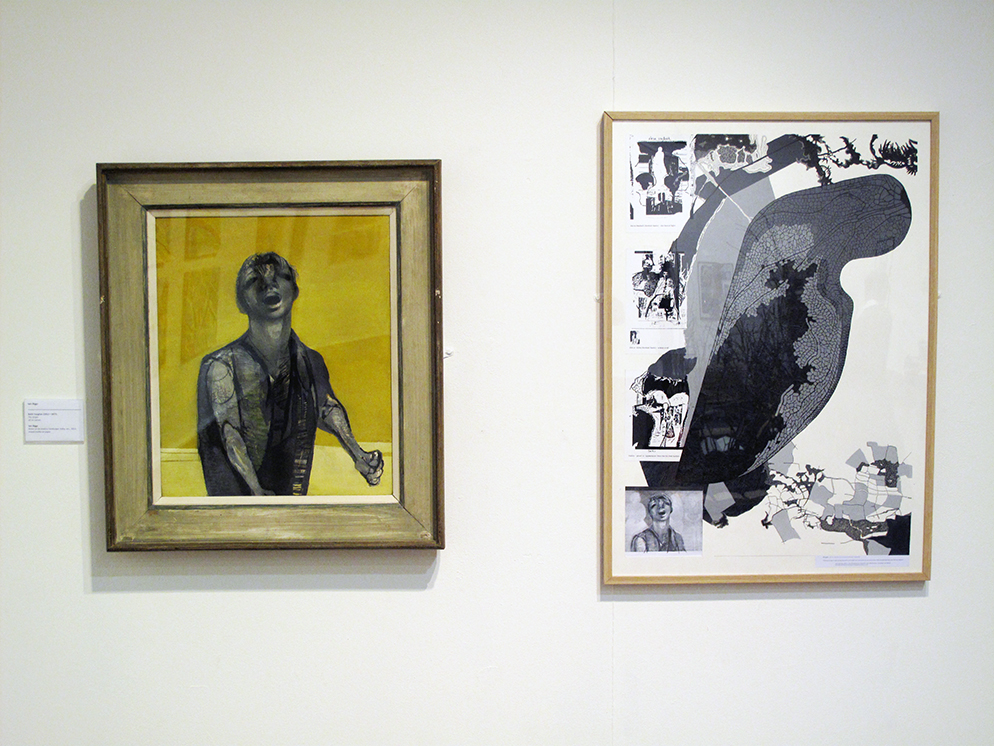
IMG_0916

(Left) Keith Vaughan The Singer (Right) Notes on an anxious landscape: Sidhe, etc. (2013), mixed media on paper

This work takes Keith Vaughan’s The Singer as its point of departure, along with scattered thoughts and visual notes on aspects of vernacular music in general and the post-war folk music revival in particular. The term sidhe (fairy) refers both to the central role of the ‘good neighbours’ in the supernatural Borders ballads central to the British vernacular song tradition and to Vaughan’s otherness as a homosexual.

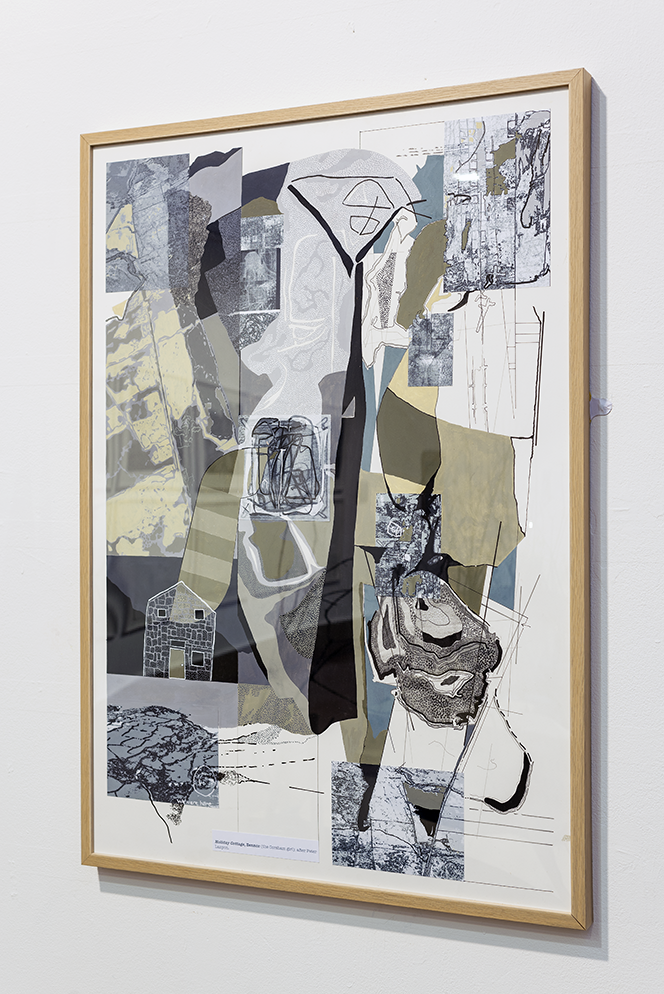
066

Notes on an anxious landscape: Women/Place (2013), mixed media on paper (photo Christian Shaw)

This work takes Peter Lanyon’s images of Zennor and other Cornish Towns as its point of departure. It is a musing on the possible interrelationship of two aspects of his work: the extra-marital relationships with various lovers said to be central to his experience of place, and the claim that he largely transformed the English landscape painting tradition by shifting its focus from landscape traditionally understood to place. The image also owes something to my long-standing interest in ‘deep mapping’.

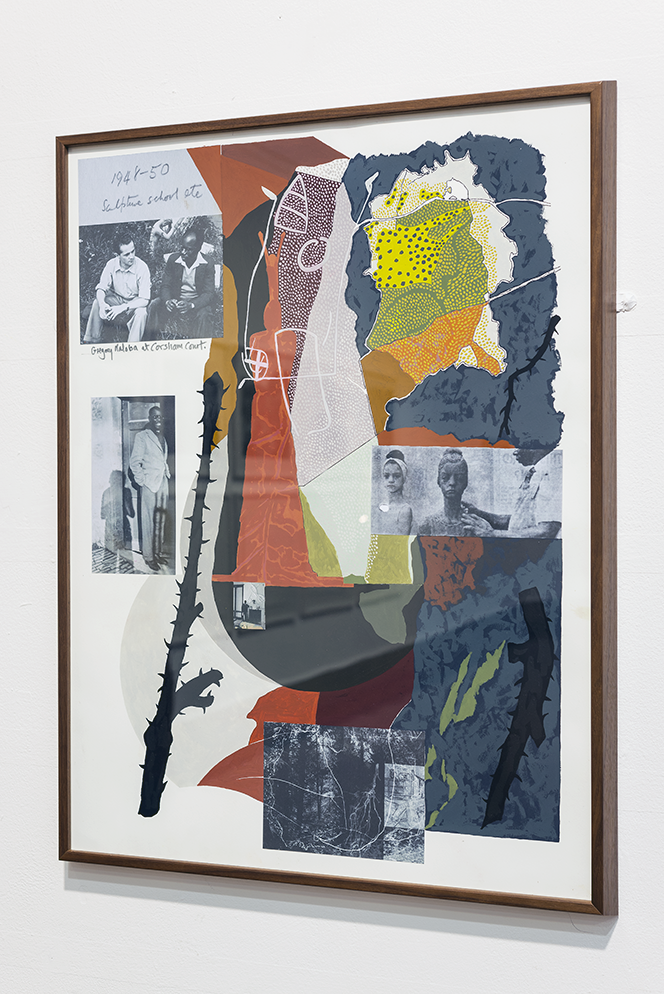
068

Gregory Maloba at Corsham Court (for Reg Boulton and ‘Rikki’ Richardson) (2013), mixed media on paper (photo Christian Shaw)

Before their marriage my parents-in-law – Reg Boulton and ‘Rikki’ Richardson as they then were – both studied art at Corsham Court (where Lanyon taught part-time). My father-in-law also attended a short painting course with Keith Vaughan, whose work he much admired. This image includes three photographs of Gregory Maloba, a Kenyan student at Corsham and friend of Rikki’s, together with material from a newspaper, as its point of departure. Other elements derive from Maloba’s vast concrete independence monument in Kampala and a map of the Corsham estate. After leaving Corsham, Maloba studied and taught art at Makerere University, where he had an incalculable impact on contemporary East African art.

069

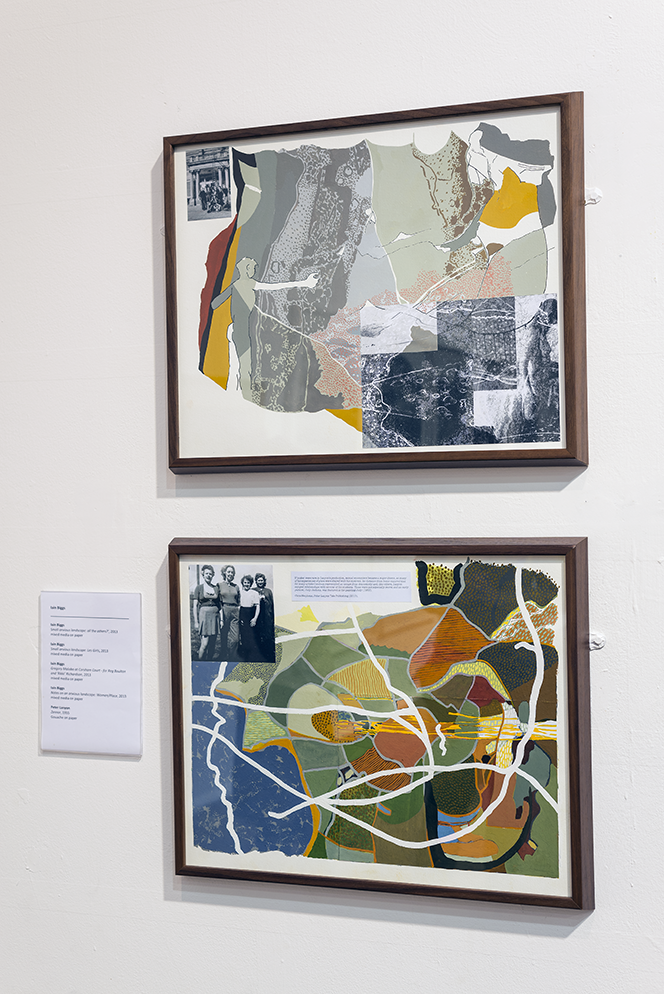
(Top) Small anxious landscape: all the others? (2013), mixed media on paper (photo Christian Shaw)

(Bottom) Small anxious landscape: Les Girls (2013), mixed media on paper (photo Christian Shaw)

Like the other two ‘Small anxious landscape’ images, Small anxious landscape: all the others? reflects on the social context within which the post-war art world was located at the time my parents-in-law were students. Also to the emphasis on ’social reconstruction’ (of traditional norms as much as of social infrastructure) after a war that, despite everything, many young people clearly found a liberating experience. The sub-title references all those from that period who, unlike Keith Vaughan and Peter Lanyon, were not able to have a career as professional artists, with the various freedoms that licenced.

The photograph used in Small anxious landscape Les Girls was taken by my father-in-law, Reg Boulton, and includes his future wife ‘Rikki” Richardson (on the far right of the image). I was very taken by the different stances and expressions of these four young women that, with aspects of Reg and Rikki’s family history, provided a starting-point for Small anxious landscape: Les Girls. Also in my mind was the very public recent exposure of the sexual abuse over many years of music students by their teachers, a situation that raised questions about Peter Lanyon’s affairs with two of his students, seen by art historians as of the greatest importance to his experience of place.     

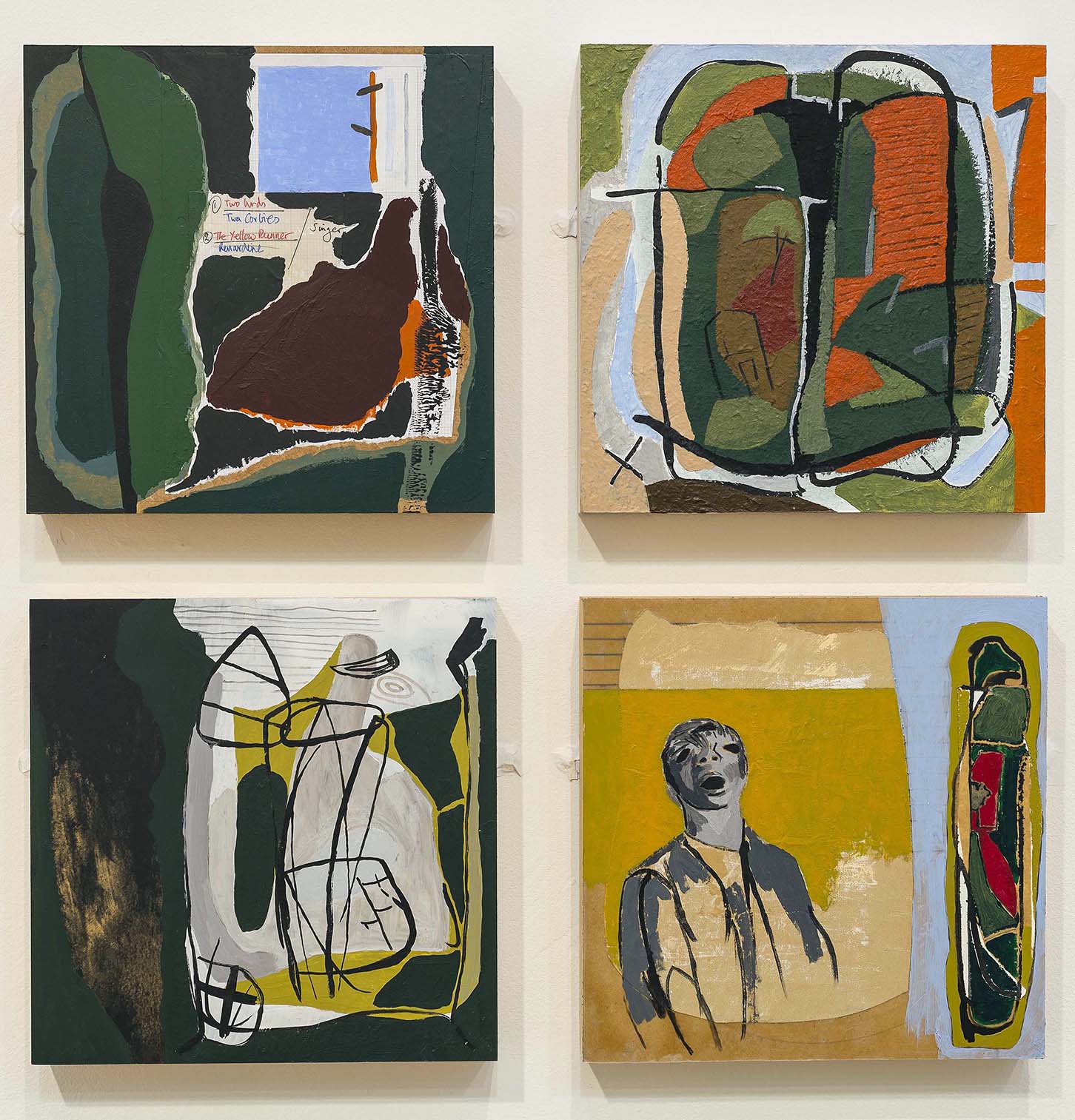
Iain's 4

(Clockwise from top left – photo Christian shaw))

 Song / Place / Singer: first and last thoughts (2013) acrylic on paper on board

Night thoughts (after Zennor) (2013), acrylic on board

Song / Place / Singer: Peter Lanyon and Keith Vaughan (2013), acrylic on papers and board 

Landscape + Sexual Encounter = Place? (after Peter Lanyon) (2013), acrylic on paper on board

Rural matters – a meditation on sinkholes

Slide1

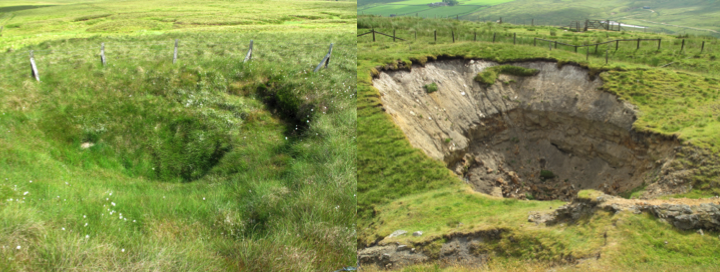
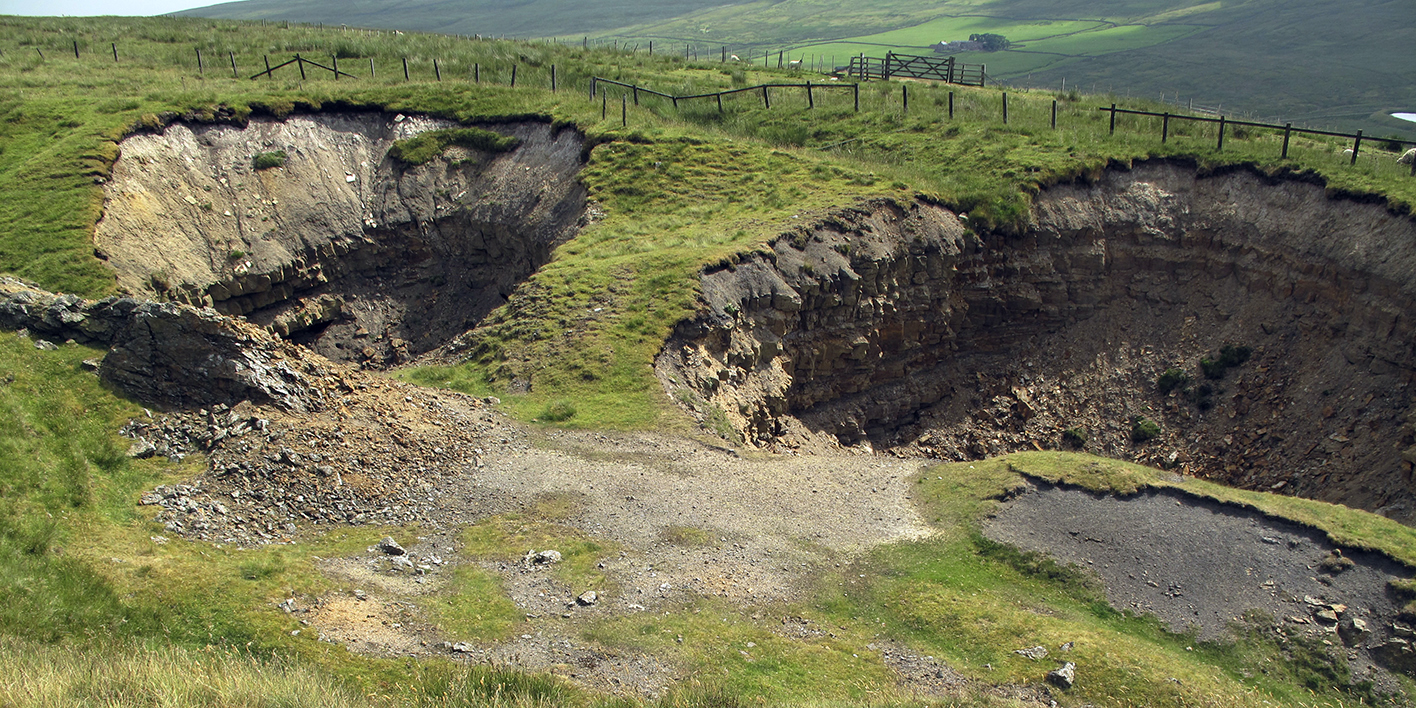
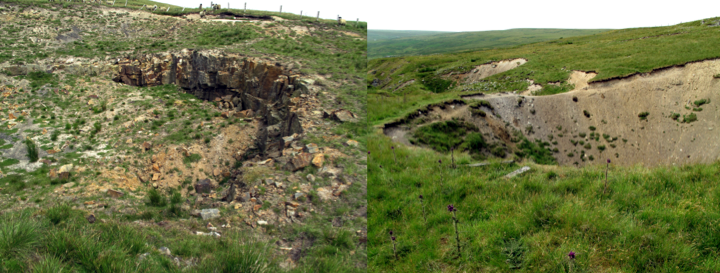
These photographs are of two sink holes in County Durham. I’ve been keeping an eye on them and their peers over a number of years.  Sink holes appear in the news every so often, usually when a portion of a city in the USA drops into one, often taking houses, vehicles and/or people with it. Their physical presence reminds me very forcibly of the instability of all aspects of the land – and not only of what’s under my feet in places such as these – and so helps me not to take it’s stability granted.

Yesterday I spoke with Margaret Ames, who teaches full time at Aberystwyth University (see http://www.aber.ac.uk/en/tfts/staff/mma/). As usually happens when we meet – sadly all too infrequently – we discussed issues relating to Welsh culture and the rural uplands farming which still just sustains the taskscape in which Margaret lives, and that has been so important to my own work. Most people have internalized an urbanist mentality that either reflects Marx’s observation about ‘the idiocies of rural life’ or tends to think nostalgically of the rural in terms of picturesque landscape and rather static, backward-looking and parochial communities on the margins of contemporary society. Such attitudes are unfortunately dominant and ignore so much – the realities of agribusiness and its negative environmental and social impact, the playing out of tensions around national identity through the politics of the ‘heritage industry’, the increasing distopia of many indigenous working rural communities, the growing crisis of Britain’s smaller farms, and so on. Some of these attitudes are perpetuated by members of rural communities themselves – particular the landowning classes and urban escapees who might be said to be located, rather than working, rurally; but many are simply a reflection of ignorance and media stereotyping.

IMG_9892

Margaret’s and my conversation was focused by a number of general issues that it seems worth articulating here. The first relates to what I take to be the most pressing educational issue of our time which, as anyone who reads these notes regularly will know, is the need to facilitate the shift from a disciplinary-based to an ecosophical conception of education; namely one that aims to provide a basis for ecosophical praxis. While the resistance to any such a shift – which requires a radical change in the realpolitik of Higher Education and the professions – is naturally massive, it is none the less a vital part of creating a genuinely sustainable future. Perhaps ironically, and this brings me to my second issue, working rural communities in countries like Wales – which still have a tradition of poetics – are far more likely to offer us initial models of what is necessary for ecosophical praxis to emerge in practice that any number of academic tomes on Guattari.

In Margaret’s home village, as in communities like that on the Isle of Mull, most people must exercise a wide range of different skills and understandings, both in order to earn a living and to sustain any kind of living culture. Community in such places is always fragile, cannot be taken as a given, and requires a good deal of effort by individuals and groups to sustain and constantly recreate it. To survive, let alone to thrive, an uplands farming community requires an engagement in the intermeshing of environmental, social and personal ecologies that, while very far from Guattari’s ecosophy in some respects, in others offers an important lived embodiment of the tensions and connectivities any genuine ecosophical praxis must engage with. While the urban academic theorist can take for granted that her monthly salary enables her to gather her basic physical and cultural sustenance on her way between home and work – whether from a supermarket or a multiplex or arts center – in rural communities these things usually require planning, a thoughtful allocation of resources and, very often, the necessity of social co-operation. In short they require skills that, as the unsustainability of our current consumerist culture starts to bite, will be increasingly necessary to us all.

Slide1

A third related issue has to do with dwindling fossil fuel resources for long-distant transportation of basic necessities, land use, and the production of food. At present upland farming is increasingly threatened by a combination of factors – many of them related to a blending of economic and social policies that – in the name of a popularist pseudo-democracy – enables Government to believe itself entitled to ignore the needs of ‘marginal’ rural communities. However, as climate change continues to lead to rises in sea level, our whole approach to land use will need to change because there will simply be less and less of it – whether to live on or produce food. (Ironically, it is possible that global warming may allow grain to be grown on a small scale at higher altitudes than at present, as it did in the late Iron Age and Roman period in upland Britain). If, as seems inevitable, the UK will need to become both far more self-sufficient in terms of food production and, with many of its major city at close to sea level, need to relocate very substantive percentages of it population to higher ground, working rural communities in general and upland rural communities in particular, are likely become a contested but vital basis for the creation of a genuinely sustainable society. At present both the dominant social order and our increasingly embattled rural communities – facing such issues as the loss of post-offices, in many places a cornerstone of rural communities – lack the necessary envisioning necessary to catalyze the kind of ecosophical praxis necessary to address these issues. While artists – in the broadest sense – are beginning to undertake just such an envisioning they can only do so much on their own.

And it is at this point that an ecosophical approach to the arts and education as they apply to these issues is urgently needed.